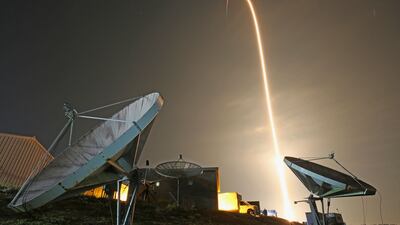
Live updates: SpaceX Crew-6 land safely on Earth
UAE astronaut Sultan Al Neyadi will take part in a special recovery programme to help his body readapt to gravity after spending six months aboard the International Space Station.
Dr Al Neyadi, 42, and his three colleagues landed back on Earth on Monday morning, with a splashdown off the coast of Florida.
Astronauts experience several side effects from the environment of space, particularly on extended missions.
Hanan Al Suwaidi, an Emirati physician who looks after Dr Al Neyadi's health, said that the astronaut will undergo the same recovery programme in Houston, Texas, that all Nasa astronauts go through after long-duration missions.
“Overall, Sultan's health has been maintained through the prescribed protocols in terms of an exercise regimen and nutritional requirements during his mission in the past six months,” Dr Al Suwaidi said during a virtual media briefing on Sunday.
“He was maintaining this very well and we had no concerns during the whole mission.
“When the crew will come back they will have known few symptoms like some nausea, some challenges in adapting to gravity, but this is usually overcome quickly in the first few hours.”
Astronauts in space are required to exercise for at least two hours a day to ensure their bones and muscles stay strong.
Their bones and muscles can grow weaker over time if they do not get the necessary amount of exercise, resulting in loss of muscle mass, which makes it difficult to readapt to gravity once back on Earth.
Salem Al Marri, director general of the Mohammed bin Rashid Space Centre, which oversees the UAE's astronaut programme, said that the recovery plan will help Dr Al Neyadi get used to gravity again.
“He'll go through physiotherapy and rehabilitation,” he said.
“They're trying to make sure that he can walk easily and get his vestibular system back into working condition so that you have all that balance.
“There's a lot of resistance training to make sure all the muscles are working well. There's a lot of stretching involved.”
Dr Al Neyadi also experienced some temporary side effects of microgravity when he was aboard the station, including a phenomenon called “Moon face”.
This is caused by a shift in body fluids, leading to facial swelling.
But astronauts who have stayed longer in space have faced more permanent side effects.
Nasa astronaut Scott Kelly spent a total of 520 days on the ISS, with a consecutive 340 days in 2015 and 2016.
His health was compared with that of his twin brother on Earth.
His heart had shrunk by 25 per cent, and after one year aboard the ISS, Nasa researchers found he had grown five centimetres and was taller than his identical twin brother Mark, who is also an astronaut.
Mr Al Marri said Dr Al Neyadi will return to the UAE soon to take part in celebrations being held in his honour.
He will then return to the US for a longer stay with more mission debriefing, including finishing the experiments he took part in while in space.
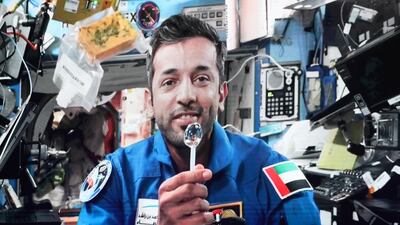
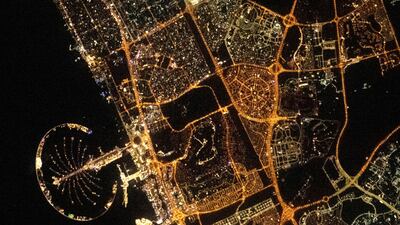
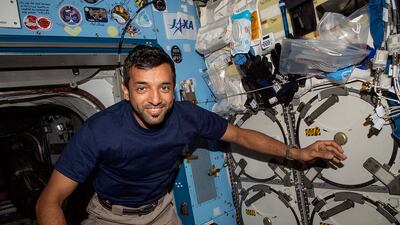
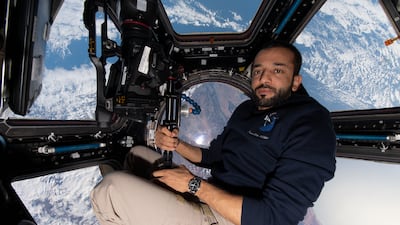
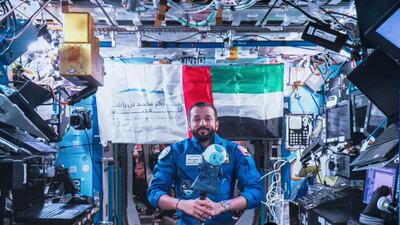
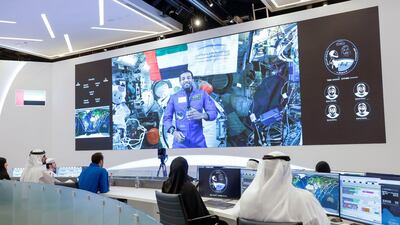
Sultan Al Neyadi in space – in pictures
Know your Camel lingo
The bairaq is a competition for the best herd of 50 camels, named for the banner its winner takes home
Namoos - a word of congratulations reserved for falconry competitions, camel races and camel pageants. It best translates as 'the pride of victory' - and for competitors, it is priceless
Asayel camels - sleek, short-haired hound-like racers
Majahim - chocolate-brown camels that can grow to weigh two tonnes. They were only valued for milk until camel pageantry took off in the 1990s
Millions Street - the thoroughfare where camels are led and where white 4x4s throng throughout the festival
Picture of Joumblatt and Hariri breaking bread sets Twitter alight
Mr Joumblatt’s pessimism regarding the Lebanese political situation didn’t stop him from enjoying a cheerful dinner on Tuesday with several politicians including Mr Hariri.
Caretaker Culture Minister Ghattas Khoury tweeted a picture of the group sitting around a table at a discrete fish restaurant in Beirut’s upscale Sodeco area.
Mr Joumblatt told The National that the fish served at Kelly’s Fish lounge had been very good.
“They really enjoyed their time”, remembers the restaurant owner. “Mr Hariri was taking selfies with everybody”.
Mr Hariri and Mr Joumblatt often have dinner together to discuss recent political developments.
Mr Joumblatt was a close ally of Mr Hariri’s assassinated father, former prime minister Rafik Hariri. The pair were leading figures in the political grouping against the 15-year Syrian occupation of Lebanon that ended after mass protests in 2005 in the wake of Rafik Hariri’s murder. After the younger Hariri took over his father’s mantle in 2004, the relationship with Mr Joumblatt endured.
However, the pair have not always been so close. In the run-up to the election last year, Messrs Hariri and Joumblatt went months without speaking over an argument regarding the new proportional electoral law to be used for the first time. Mr Joumblatt worried that a proportional system, which Mr Hariri backed, would see the influence of his small sect diminished.
With so much of Lebanese politics agreed in late-night meetings behind closed doors, the media and pundits put significant weight on how regularly, where and with who senior politicians meet.
In the picture, alongside Messrs Khoury and Hariri were Mr Joumbatt and his wife Nora, PSP politician Wael Abou Faour and Egyptian ambassador to Lebanon Nazih el Nagari.
The picture of the dinner led to a flurry of excitement on Twitter that it signified an imminent government formation. “God willing, white smoke will rise soon and Walid Beik [a nickname for Walid Joumblatt] will accept to give up the minister of industry”, one user replied to the tweet. “Blessings to you…We would like you to form a cabinet”, wrote another.
The next few days will be crucial in determining whether these wishes come true.
First Person
Richard Flanagan
Chatto & Windus
Info
What: 11th edition of the Mubadala World Tennis Championship
When: December 27-29, 2018
Confirmed: men: Novak Djokovic, Rafael Nadal, Kevin Anderson, Dominic Thiem, Hyeon Chung, Karen Khachanov; women: Venus Williams
Tickets: www.ticketmaster.ae, Virgin megastores or call 800 86 823
Our legal columnist
Name: Yousef Al Bahar
Advocate at Al Bahar & Associate Advocates and Legal Consultants, established in 1994
Marital status: Single
Education: Mr Al Bahar was born in 1979 and graduated in 2008 from the Judicial Institute. He took after his father, who was one of the first Emirati lawyers
Mercer, the investment consulting arm of US services company Marsh & McLennan, expects its wealth division to at least double its assets under management (AUM) in the Middle East as wealth in the region continues to grow despite economic headwinds, a company official said.
Mercer Wealth, which globally has $160 billion in AUM, plans to boost its AUM in the region to $2-$3bn in the next 2-3 years from the present $1bn, said Yasir AbuShaban, a Dubai-based principal with Mercer Wealth.
“Within the next two to three years, we are looking at reaching $2 to $3 billion as a conservative estimate and we do see an opportunity to do so,” said Mr AbuShaban.
Mercer does not directly make investments, but allocates clients’ money they have discretion to, to professional asset managers. They also provide advice to clients.
“We have buying power. We can negotiate on their (client’s) behalf with asset managers to provide them lower fees than they otherwise would have to get on their own,” he added.
Mercer Wealth’s clients include sovereign wealth funds, family offices, and insurance companies among others.
From its office in Dubai, Mercer also looks after Africa, India and Turkey, where they also see opportunity for growth.
Wealth creation in Middle East and Africa (MEA) grew 8.5 per cent to $8.1 trillion last year from $7.5tn in 2015, higher than last year’s global average of 6 per cent and the second-highest growth in a region after Asia-Pacific which grew 9.9 per cent, according to consultancy Boston Consulting Group (BCG). In the region, where wealth grew just 1.9 per cent in 2015 compared with 2014, a pickup in oil prices has helped in wealth generation.
BCG is forecasting MEA wealth will rise to $12tn by 2021, growing at an annual average of 8 per cent.
Drivers of wealth generation in the region will be split evenly between new wealth creation and growth of performance of existing assets, according to BCG.
Another general trend in the region is clients’ looking for a comprehensive approach to investing, according to Mr AbuShaban.
“Institutional investors or some of the families are seeing a slowdown in the available capital they have to invest and in that sense they are looking at optimizing the way they manage their portfolios and making sure they are not investing haphazardly and different parts of their investment are working together,” said Mr AbuShaban.
Some clients also have a higher appetite for risk, given the low interest-rate environment that does not provide enough yield for some institutional investors. These clients are keen to invest in illiquid assets, such as private equity and infrastructure.
“What we have seen is a desire for higher returns in what has been a low-return environment specifically in various fixed income or bonds,” he said.
“In this environment, we have seen a de facto increase in the risk that clients are taking in things like illiquid investments, private equity investments, infrastructure and private debt, those kind of investments were higher illiquidity results in incrementally higher returns.”
The Abu Dhabi Investment Authority, one of the largest sovereign wealth funds, said in its 2016 report that has gradually increased its exposure in direct private equity and private credit transactions, mainly in Asian markets and especially in China and India. The authority’s private equity department focused on structured equities owing to “their defensive characteristics.”
GAC GS8 Specs
Engine: 2.0-litre 4cyl turbo
Power: 248hp at 5,200rpm
Torque: 400Nm at 1,750-4,000rpm
Transmission: 8-speed auto
Fuel consumption: 9.1L/100km
On sale: Now
Price: From Dh149,900
More from Neighbourhood Watch:
Killing of Qassem Suleimani
Skewed figures
In the village of Mevagissey in southwest England the housing stock has doubled in the last century while the number of residents is half the historic high. The village's Neighbourhood Development Plan states that 26% of homes are holiday retreats. Prices are high, averaging around £300,000, £50,000 more than the Cornish average of £250,000. The local average wage is £15,458.
Ten tax points to be aware of in 2026
1. Domestic VAT refund amendments: request your refund within five years
If a business does not apply for the refund on time, they lose their credit.
2. E-invoicing in the UAE
Businesses should continue preparing for the implementation of e-invoicing in the UAE, with 2026 a preparation and transition period ahead of phased mandatory adoption.
3. More tax audits
Tax authorities are increasingly using data already available across multiple filings to identify audit risks.
4. More beneficial VAT and excise tax penalty regime
Tax disputes are expected to become more frequent and more structured, with clearer administrative objection and appeal processes. The UAE has adopted a new penalty regime for VAT and excise disputes, which now mirrors the penalty regime for corporate tax.
5. Greater emphasis on statutory audit
There is a greater need for the accuracy of financial statements. The International Financial Reporting Standards standards need to be strictly adhered to and, as a result, the quality of the audits will need to increase.
6. Further transfer pricing enforcement
Transfer pricing enforcement, which refers to the practice of establishing prices for internal transactions between related entities, is expected to broaden in scope. The UAE will shortly open the possibility to negotiate advance pricing agreements, or essentially rulings for transfer pricing purposes.
7. Limited time periods for audits
Recent amendments also introduce a default five-year limitation period for tax audits and assessments, subject to specific statutory exceptions. While the standard audit and assessment period is five years, this may be extended to up to 15 years in cases involving fraud or tax evasion.
8. Pillar 2 implementation
Many multinational groups will begin to feel the practical effect of the Domestic Minimum Top-Up Tax (DMTT), the UAE's implementation of the OECD’s global minimum tax under Pillar 2. While the rules apply for financial years starting on or after January 1, 2025, it is 2026 that marks the transition to an operational phase.
9. Reduced compliance obligations for imported goods and services
Businesses that apply the reverse-charge mechanism for VAT purposes in the UAE may benefit from reduced compliance obligations.
10. Substance and CbC reporting focus
Tax authorities are expected to continue strengthening the enforcement of economic substance and Country-by-Country (CbC) reporting frameworks. In the UAE, these regimes are increasingly being used as risk-assessment tools, providing tax authorities with a comprehensive view of multinational groups’ global footprints and enabling them to assess whether profits are aligned with real economic activity.
Contributed by Thomas Vanhee and Hend Rashwan, Aurifer
UAE squad
Men's draw: Victor Scvortov and Khalifa Al Hosani, (both 73 kilograms), Sergiu Toma and Mihail Marchitan (90kg), Ivan Remarenco (100kg), Ahmed Al Naqbi (60kg), Musabah Al Shamsi and Ahmed Al Hosani (66kg)
Women’s draw: Maitha Al Neyadi (57kg)
UAE currency: the story behind the money in your pockets
How to avoid crypto fraud
- Use unique usernames and passwords while enabling multi-factor authentication.
- Use an offline private key, a physical device that requires manual activation, whenever you access your wallet.
- Avoid suspicious social media ads promoting fraudulent schemes.
- Only invest in crypto projects that you fully understand.
- Critically assess whether a project’s promises or returns seem too good to be true.
- Only use reputable platforms that have a track record of strong regulatory compliance.
- Store funds in hardware wallets as opposed to online exchanges.
Tips from the expert
Dobromir Radichkov, chief data officer at dubizzle and Bayut, offers a few tips for UAE residents looking to earn some cash from pre-loved items.
- Sellers should focus on providing high-quality used goods at attractive prices to buyers.
- It’s important to use clear and appealing photos, with catchy titles and detailed descriptions to capture the attention of prospective buyers.
- Try to advertise a realistic price to attract buyers looking for good deals, especially in the current environment where consumers are significantly more price-sensitive.
- Be creative and look around your home for valuable items that you no longer need but might be useful to others.
Company%20profile
%3Cp%3E%3Cstrong%3ECompany%20name%3A%20%3C%2Fstrong%3EHakbah%0D%3Cbr%3E%3Cstrong%3EStarted%3A%20%3C%2Fstrong%3E2018%0D%3Cbr%3E%3Cstrong%3EFounder%3A%20%3C%2Fstrong%3ENaif%20AbuSaida%0D%3Cbr%3E%3Cstrong%3EBased%3A%20%3C%2Fstrong%3ESaudi%20Arabia%0D%3Cbr%3E%3Cstrong%3ESector%3A%20%3C%2Fstrong%3EFinTech%0D%3Cbr%3E%3Cstrong%3ECurrent%20number%20of%20staff%3A%20%3C%2Fstrong%3E22%20%0D%3Cbr%3E%3Cstrong%3EInitial%20investment%3A%20%3C%2Fstrong%3E%24200%2C000%0D%3Cbr%3E%3Cstrong%3EInvestment%20stage%3A%20%3C%2Fstrong%3Epre-Series%20A%0D%3Cbr%3E%3Cstrong%3EInvestors%3A%20%3C%2Fstrong%3EGlobal%20Ventures%20and%20Aditum%20Investment%20Management%0D%3Cbr%3E%3Cbr%3E%3C%2Fp%3E%0A
Key figures in the life of the fort
Sheikh Dhiyab bin Isa (ruled 1761-1793) Built Qasr Al Hosn as a watchtower to guard over the only freshwater well on Abu Dhabi island.
Sheikh Shakhbut bin Dhiyab (ruled 1793-1816) Expanded the tower into a small fort and transferred his ruling place of residence from Liwa Oasis to the fort on the island.
Sheikh Tahnoon bin Shakhbut (ruled 1818-1833) Expanded Qasr Al Hosn further as Abu Dhabi grew from a small village of palm huts to a town of more than 5,000 inhabitants.
Sheikh Khalifa bin Shakhbut (ruled 1833-1845) Repaired and fortified the fort.
Sheikh Saeed bin Tahnoon (ruled 1845-1855) Turned Qasr Al Hosn into a strong two-storied structure.
Sheikh Zayed bin Khalifa (ruled 1855-1909) Expanded Qasr Al Hosn further to reflect the emirate's increasing prominence.
Sheikh Shakhbut bin Sultan (ruled 1928-1966) Renovated and enlarged Qasr Al Hosn, adding a decorative arch and two new villas.
Sheikh Zayed bin Sultan (ruled 1966-2004) Moved the royal residence to Al Manhal palace and kept his diwan at Qasr Al Hosn.
Sources: Jayanti Maitra, www.adach.ae
RESULT
Copa del Rey, semi-final second leg
Real Madrid 0
Barcelona 3 (Suarez (50', 73' pen), Varane (69' OG)
Honeymoonish
%3Cp%3E%3Cstrong%3EDirector%3A%3C%2Fstrong%3E%20Elie%20El%20Samaan%3C%2Fp%3E%0A%3Cp%3E%3Cstrong%3EStarring%3A%20%3C%2Fstrong%3ENour%20Al%20Ghandour%2C%20Mahmoud%20Boushahri%3C%2Fp%3E%0A%3Cp%3E%3Cstrong%3ERating%3A%3C%2Fstrong%3E%203%2F5%3C%2Fp%3E%0A