

When Robin Niblett became director of Chatham House he never contemplated that his parting thoughts would be that “the wheels are coming off” the rules-based international order.
The world in 2007 had yet to experience the financial crash or Brexit or Donald Trump. But mankind is now entering a “time of great division”, the retiring think tank chief told 'The National'.
The war in Ukraine has served merely to accelerate the descent, leading the global population to a “very, very unpredictable moment”.
The real prospect of nuclear strike in addition to a pandemic, financial crisis and runaway climate change has left the internationally respected academic confounded, struggling to articulate a diagnosis for a planet gone awry.

“It feels that I'm leaving Chatham House at the moment where the wheels coming off, what we used to think was a formidable order, the rules-based international order,” he said.
“Liberal democracies have realised that they don't dominate any more, that they are not top of the hierarchy and that they have to come together. [Russian President Vladimir] Putin has absolutely accelerated that process. Everyone's stepping up now. Everyone's realised the threat is as big as it is.”
Putin’s grenade
Dr Niblett's office in central London has hosted presidents, prime ministers and a galaxy of foreign dignitaries. A large painting of the great Liberal British statesman William Gladstone looks down on his guests, alongside a mantelpiece containing a large inscribed bullet marking the end of the Colombian civil war, given to him by president Juan Manuel Santos. Books on world politics and thinkers dominate, but it feels none has yet quite explained where global politics is today or might be tomorrow.
“I suppose the big thing that's changed is that we're now trying to manage these very intense geopolitics alongside an acceleration of the big global problems,” said Dr Niblett. “For most of my 15 years here I felt that that balance could be won, or could be managed in the near term — that there was a capacity to coexist within certain boundaries.”

He pauses for a moment, glancing over to the leaves spreading across the lime trees of St James’s Square in the heart of London. “What Putin has done is that he has really driven the proverbial grenade into the middle of the table. He's exacerbated what were already rising food insecurities, he has forced China to show its hand even more than Xi Jinping had already done because they can't abandon Russia.”
After five decades of witnessing world events, writing countless books, articles and giving evidence to the UK Parliament, the only label he can find for the myriad problems created by Mr Putin’s actions is “this crazy phase”.
“For the last three or four years we’ve been trying to manage the reality of a rising China as the main geopolitical dynamic, along with climate change, pandemics and global financial instability. What Vladimir Putin has done now is weaponise that moment to his own advantage when the West is weakened.”
Nuclear contagion
Mr Putin might not have used nuclear weapons but he has unleashed a new existential terror previously uncontemplated. Days after his invasion, the Russian president was direct: if Nato attempted to intervene transparently in Ukraine he threatened nuclear weapons. It worked. America and the rest were rattled enough not to directly oppose it.
“People look at the way Russia has used the nuclear threat to give itself room for conventional military action. That lesson has now been sent to many other people that your real security potentially comes from owning a nuclear weapon.”
With Iran on the threshold of nuclear bomb viability, Mr Putin’s actions may well “provide the excuse for other countries” to seek a nuclear arsenal to prevent conventional attack, he said, listing Turkey, Japan, South Korea and Saudi Arabia as potential nuclear powers.
“What Putin has done is remind us it's a dog-eat-dog world, that we can't trust anyone any more. You could be in a position in two or three years’ time where there's a bunch of other countries have done a nuclear test. No one is stopping Putin from attacking because he's got nuclear weapons.”
Three alliances
Dr Niblett said it was likely that there would now be three global camps: the West, Russia and China, then the rest.
“We end up with this very strange world where you've now got a kind of a very large, non-aligned community. You've the G7 plus Australia and South Korea, then Russia and China, not in an alliance but sufficiently back-to-back, each wanting to support the other even if they mistrust each other. Then the rest of the world, who don't want to be with either and they will triangulate.”
Areas such as the Gulf region, could “play it both ways”, continuing their economic relationship with China while remaining on good terms with the West.
There was also doubt over the future of the G20, which will hold a summit in Indonesia this November. “The G20 was meant to be the proof that the world could come together,” he said. “But I just don't even know if it's going to meet properly in Indonesia. If Putin is there I don't see Biden or Johnson or Macron present.” The summit could turn into a “G20 minus six or seven”.
-
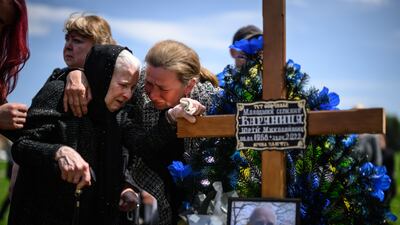
Family members mourn at the graveside of soldier Yuri Varyanytsia during the burial of three soldiers in the Field of Mars at Lychakiv cemetery in Lviv, Ukraine. Getty Images -

A pedestrian takes a picture as she walks past the wreckage of a Russian armoured vehicle outside the National Museum of Military History of Ukraine in Kyiv. AFP -
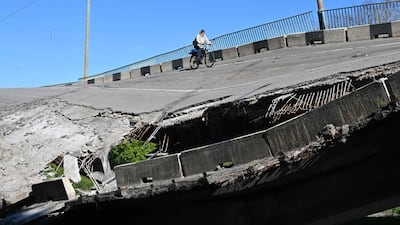
A man rides his bicycle over a heavily damaged bridge near Pechenegi village in the Kharkiv region, amid the Russian invasion of Ukraine. AFP -
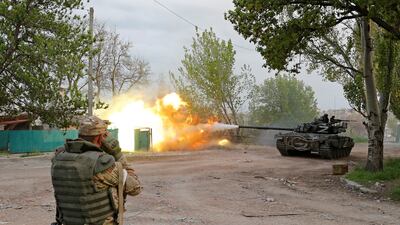
Pro-Russian troops fire from a tank near the Azovstal steel plant in Mariupol. Reuters -
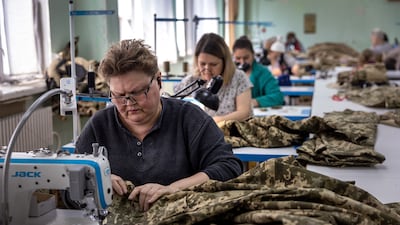
Workers sew uniforms and material for flack jackets at a military clothing factory in Kryvyi Rih, Ukraine. Getty Images -
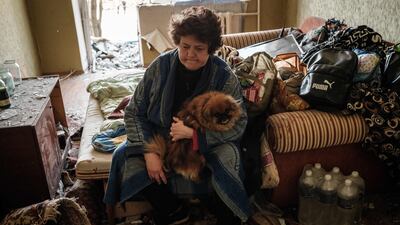
A dog provides company at a flat damaged by a missile attack in Kramatorsk, eastern Ukraine. AFP -

Patron, a dog trained by Ukrainian forces to sniff out explosives, near Kyiv. EPA -
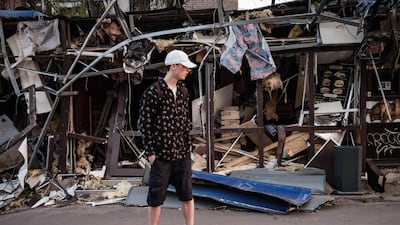
Lone skater Roman Kovalenko, 18, amid the damage at Peace Square in Kramatorsk, eastern Ukraine. All of his friends have fled. AFP -
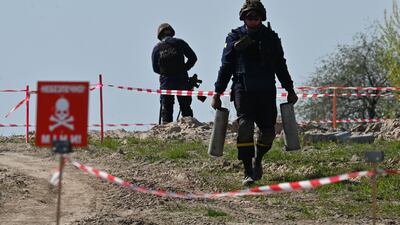
A Ukrainian sapper carries unexploded materiel during demining works at an airport in the town of Hostomel, north-west of Kyiv. AFP -
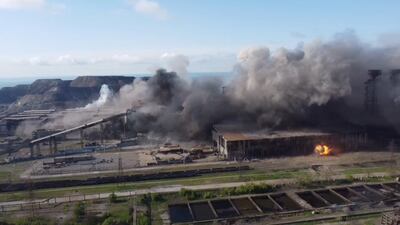
Shelling of the Azovstal steel plant complex in Mariupol. Reuters -

Violinist Irene Duval rehearses before a fundraiser to support Ukrainians arriving in the UK, at the Ukrainian Catholic Cathedral in London. PA -
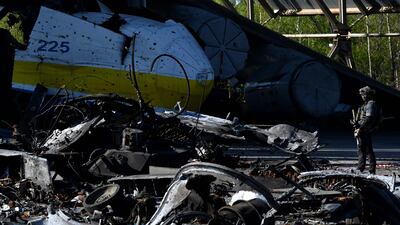
A serviceman stands guard at the destroyed Ukrainian Antonov An-225 'Mriya' cargo aircraft in Hostomel. AFP -
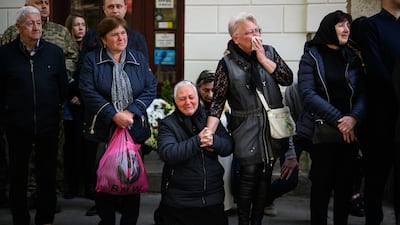
Galina Malets falls to her knees before the funeral service for her brother, fallen soldier Igor Malets, 59, in Lviv. Getty -
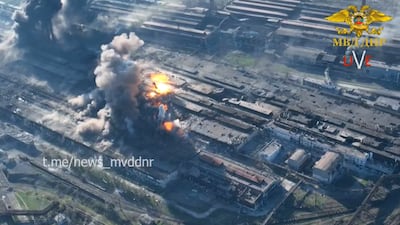
Explosions at the Azovstal steel plant in besieged Mariupol, where Ukrainian forces continue to hold out against Russian invaders. AFP -
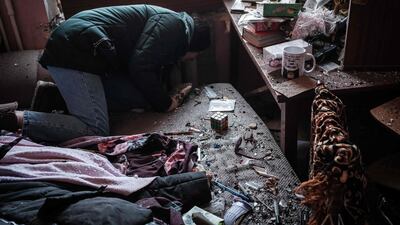
A Ukrainian woman collects her belongings after her apartment was damaged by a missile explosion in Kramatorsk, eastern Ukraine. AFP -
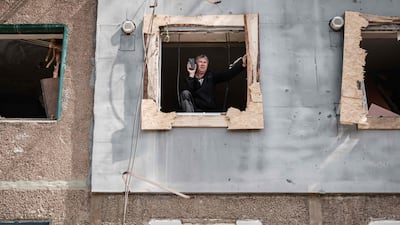
An apartment block damaged by a missile explosion in Kramatorsk, eastern Ukraine. AFP -
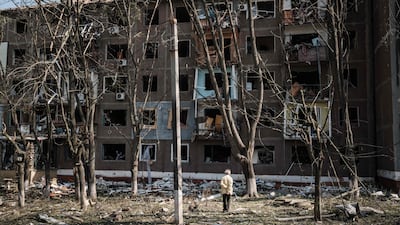
Devastation around an apartment block hit by a missile in Kramatorsk, eastern Ukraine. AFP -
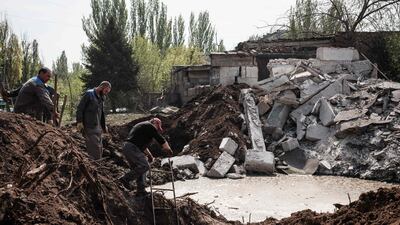
Ukrainian men at the site of a missile explosion in Kramatorsk, eastern Ukraine. AFP -
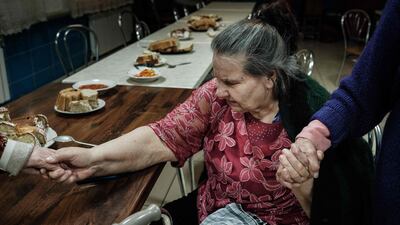
An elderly refugee from Avdiivka, eastern Ukraine, at a lunch provided by church group Awakening in Pokrovsk. AFP -
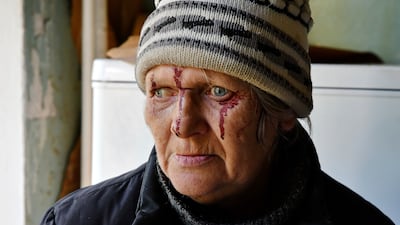
Natalia Rudneva, 59, was injured in overnight shelling in Kramatorsk, Ukraine, that put her son in hospital. AP -
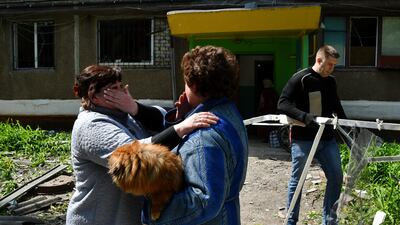
Shocked occupants of an apartment building in Kramatorsk, Donbas, that was destroyed by overnight shelling . AP -

A man outside his house in Mariupol, in territory under the government of the so-called Donetsk People's Republic, eastern Ukraine. The sign reads 'Bomb shelter, children'. AP -
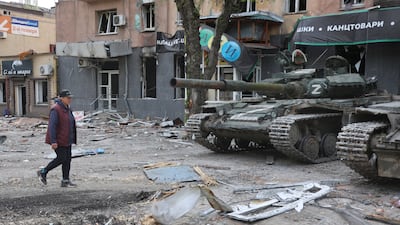
A woman passes Donetsk People's Republic militia tanks in Mariupol, eastern Ukraine. AP -
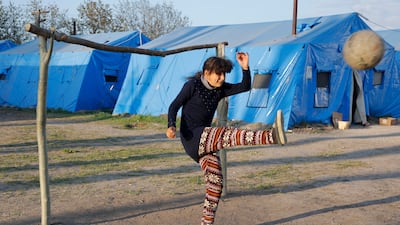
A refugee camp outside Mariupol, in territory controlled by the government of the so-called Donetsk People's Republic. AP -
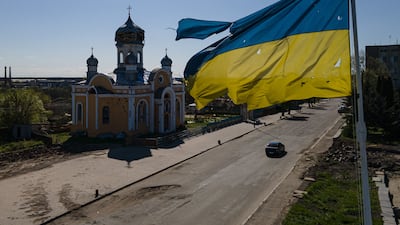
The damaged St Godmothers Cover Church next to a bullet-riddled Ukrainian flag in Malyn, Ukraine. Getty Images -
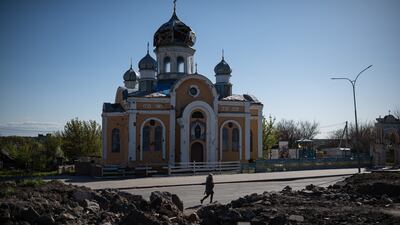
St Godmothers Cover Church, in Malyn, Ukraine. Getty Images -
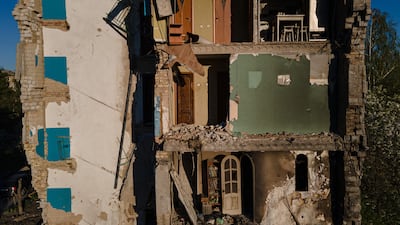
The ruins of an apartment building in Borodianka, Ukraine. Getty Images -
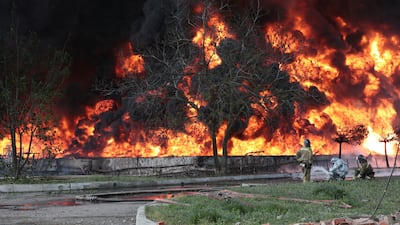
Firefighters from the self-declared Donetsk People Republic Emergency Situations Ministry battle a blaze at an oil depot after missiles struck the facility in an area controlled by Russian-backed separatist forces in Makiivka, 15 kilometres east of Donetsk, eastern Ukraine. AP -
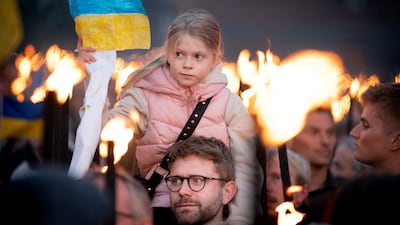
People wait for Ukrainian President Volodymyr Zelenskyy to begin a speech televised on a screen in City Hall Square in Copenhagen, Denmark. Reuters -
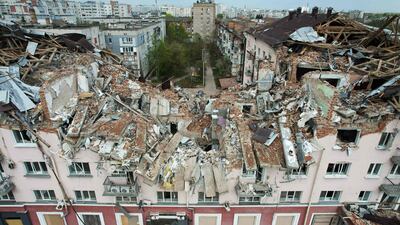
An aerial view of the destroyed Hotel Ukraine in the northern city of Chernigiv. AFP -
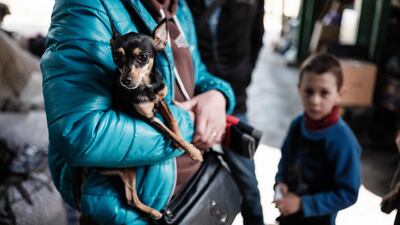
A woman who recently lost her husband arrives with her dog at a charity centre in Pokrovsk, eastern Ukraine. AFP -
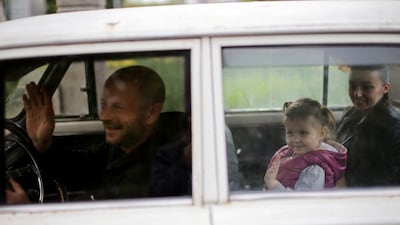
A family of Ukrainian evacuees near a donation collection point in Zaporizhzhia, Ukraine. Reuters -
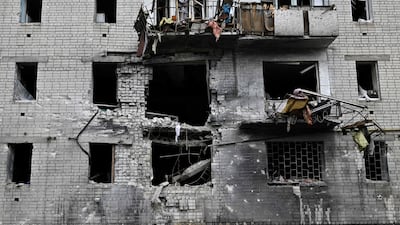
The ruins of a residential building in the northern Ukrainian city of Chernigiv, which was heavily damaged during the Russian invasion. AFP -

People pay their respects during the funeral for Ukrainian serviceman Ruslan Borovyk in St Michael's Cathedral in Kyiv. AP -
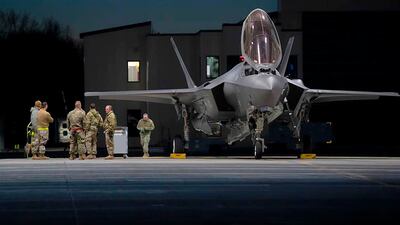
Crew chiefs and engineers with the 158th Fighter Wing meet before launching F-35A Lightning II fifth-generation aircraft at the Vermont Air National Guard Base, South Burlington, US. More than 200 Vermont air guard personnel, plus equipment and eight F-35s, are now in Europe. AP -
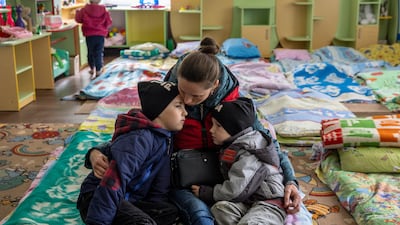
Svitlana, 36, holds her sons Artem, 7, and Kyrylo, 5, while sheltering in a kindergarten in Kryvyi Rih, Ukraine. Getty Images -
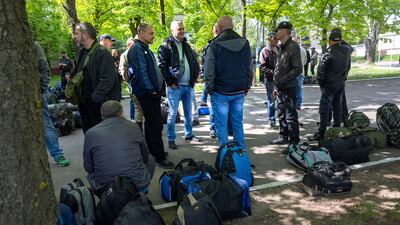
Men report to enlist in Ukrainian Territorial Defence Force units in Kryvyi Rih, Ukraine. Getty Images -
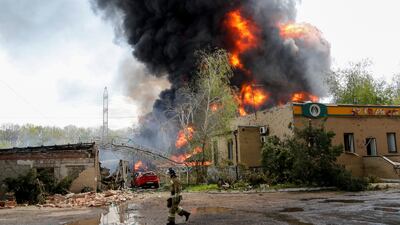
A burning oil storage unit on the outskirts of Donetsk, Ukraine. Reuters -
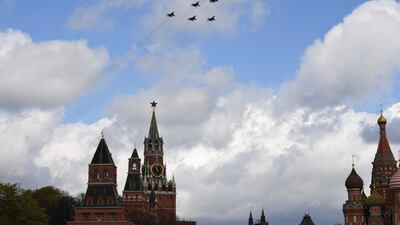
Russian MiG-29SMT jet fighters, forming the symbol Z in support of Russian military action in Ukraine, fly over Red Square in Moscow during a rehearsal for the Second World War Victory Parade on May 9, 2022. AFP -
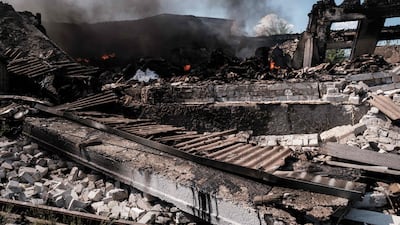
A warehouse after shelling in Severodonetsk, as fighting rages across Ukraine's east after a US warning that Moscow is preparing to formally annex eastern regions. AFP -
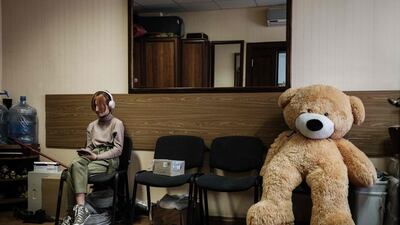
Katya, 11, waits for her mother's treatment to end at the Severodonetsk Hospital in Severodonetsk. AFP -
Antonina, 60, at a funeral home where she works and now lives with neighbours in Severodonetsk. AFP -
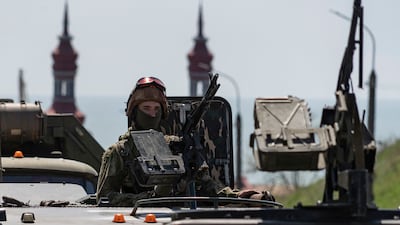
A Russian serviceman patrols a street near the sea port of Berdyansk, Ukraine. AFP -
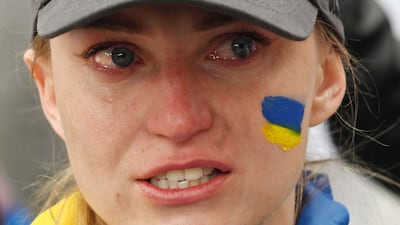
A woman during the rally in front of Ukraine President Volodymyr Zelenskyy's office in Kyiv. AFP -
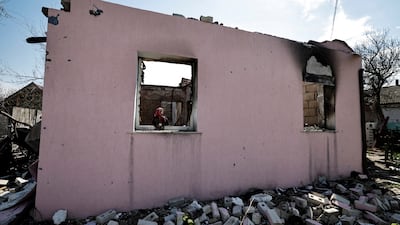
Svitlana Karpenko, 53, at what is left of her house in Sloboda, Chernihiv region, Ukraine. She said it was destroyed by shelling. Reuters -
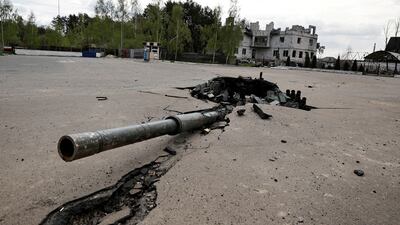
The turret from a destroyed Russian tank stuck in the ground in Zalissia, Kyiv region, Ukraine. Reuters -
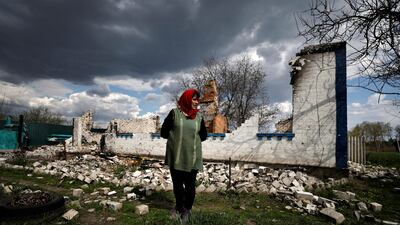
Lyubov Lenko, 61, in front of her house in Budy, Chernihiv region, Ukraine, that she says was destroyed by shelling. Reuters -
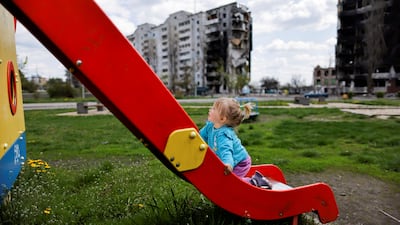
Nina Stefuryak, 2, playing in a park in front of a building destroyed by shelling in Borodianka, Kyiv region, Ukraine. Reuters -
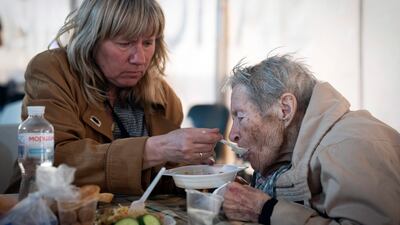
Mealtime at a centre for displaced people in Zaporizhzhia. AP -
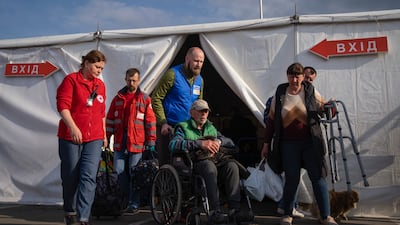
Volunteers assist a man after his arrival from Mariupol at a centre for displaced people in Zaporizhzhia. AP -
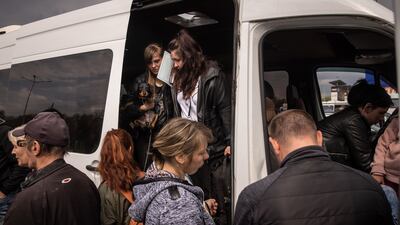
People disembark a van to be registered by police after arriving in Zaporizhzhia. Getty Images -
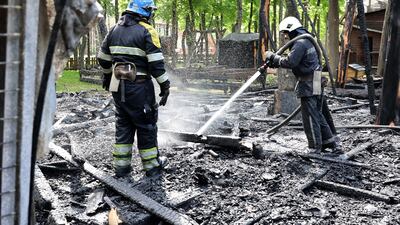
Firefighters damp down the ashes of a fire that destroyed a children's play area in Gorky Park in Kharkiv, Ukraine. EPA -

A woman touches a piano as she inspects the damage in a classroom after shelling at Kharkiv National Kotlyarevsky University of Arts. EPA -
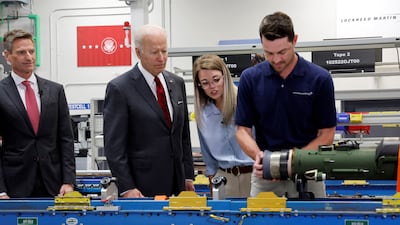
US President Joe Biden and Lockheed Martin chief executive Jim Taiclet with Javelin anti-tank missile assembly workers during a tour of a Lockheed Martin weapons factory in Troy, Alabama, US. Reuters -
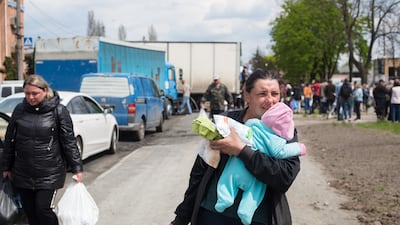
Residents collect humanitarian aid in Borodyanka, Ukraine. Getty Images


The grim outlook prompted the question of whether Dr Niblett was hopeful for the future.
“Honestly I'm struggling,” he said. “We're entering a period of division rather than competition. Never has the world been in this place before. Never has it had planetary challenges that are accelerating before our eyes.”
He gave a recent Financial Times story as an example. It reported that 20 million people in the Horn of Africa were on the edge of starvation due to rain failure.
“The climate emergency is going to keep coming,” he said. “It's unstoppable at the same time as all of this craziness on the world. The hope had been before Ukraine that you could section off areas of global cooperation.”
Rule of law
The rules-based system has largely kept the world in relative peace since the Second World War. Did it still apply?
“The global world hierarchy is now being rewritten,” he said. “We were born to the idea that it should be a world led by the rule of law, not the rule of force,” he added, quoting Lionel Curtis who helped found Chatham House in 1923.

There was also a need to “stand up for those values and not compromise on them”.
“They are beacon values that history has proven give the best and most stable forms of economic development and human empowerment possible,” he said.
“We need to stand for the side of the rule of law over the rule of force, even if that means countries having to fight for that.”
To avert disaster the global community had to “keep avenues open for dialogue wherever possible”.
Successor
Dr Niblett, 60, suggested it was “good governance” for him to move on after 15 years at the helm, although he will still contribute academic papers.
He has taken Chatham House from a respected institution to one that is now globally renowned, producing papers on key subjects including Africa, climate, cyber and health.
Its academic strength has grown from 60 to 210 personnel funded by a £20 million annual private income from individuals, foundations, governments and conferences.
What advice might he have for his successor, Bronwen Maddox, the respected former journalist and current director of the Institute of Government?
“Think tanks are going to be more in demand than ever,” he said. “Because the world is more complex than it was before. Her challenge is going to be more prioritisation and focus, not purpose.”
The need for think tanks to understand the world was fundamental in “a moment of international turmoil of the like I've not seen in my 15 years”.

Was there any hope for the world? Frowning, Dr Niblett paused for a moment. “I want to find an optimistic line. We can be optimistic about the technology because I think the technological advances we're seeing today will probably help us deal with the climate challenge. It'll help create new work.”
It is a flicker of hope before reality returns. “What technology can't do is answer that human need for identity and purpose, which is what drives Putin. He doesn't care about people being happy or better off.”

