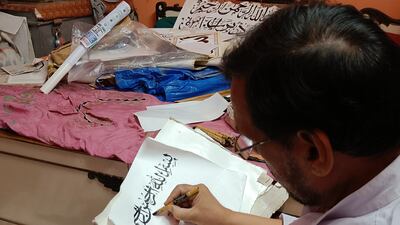
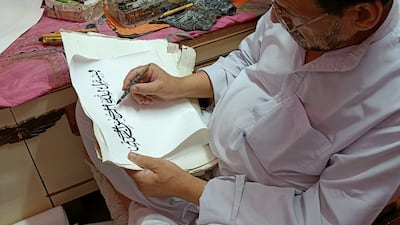
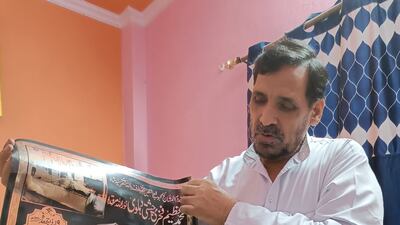
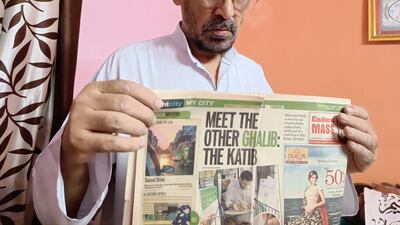
In a corner of a bookshop facing the historic Jama Masjid in bustling Old Delhi, Mohammad "Katib" Ghalib sits immersed in his work, patiently moving his hollow wooden pen, making striking curves and strokes on posters and wedding cards.
A bunch of wooden dip pens, banded together with elastic, a set of ink — black, white and red — and a small box containing other tools sit next to him.
The spectacled artist wields the pen masterfully, dipping its nib in the ink to imprint names, couplets, Quranic verses and invitations in different styles.
He might have only a handful of assignments but the work can stretch for hours.
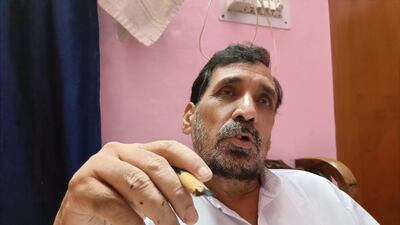
Mr Ghalib, 60, is the last known "katib", or calligrapher, in the Indian capital's old quarter, which was once a centre of the art form.
“I was born Mohammad Ghalib but 'Katib' was added to my name by people," he says.
"This has become my identity now because they say I am the last remaining calligrapher here."
The art of calligraphy, and particularly Islamic calligraphy, is said to have been introduced in the country in the 12th century during Muslim rule.
It was called the “royal art” and used for creating documents, books, posters for festivals and wedding invitations in Arabic, Persian and Urdu — a language with Persian script.
The languages were widely used in the capital even after Mughal rule ended in the 19th century.
Before the advent of computers, calligraphers like Mr Ghalib were in great demand, scripting daily newspapers for mass printing as well as magazines and books. Some jobs could take up to a year.
They were paid well for their work.
It was the art of royals … it was hugely respected because only people who could read and write could do it
Mohammad Ghalib,
calligrapher
“It was the art of royals … it was hugely respected because only people who could read and write could do it," Mr Ghalib says. "It was a work related to publishers, educated people."
But the occupation went into decline after the use of computer technology in printing became widespread in India about three decades ago.
As Urdu fonts were eventually introduced and the use of Arabic and Farsi — modern Persian — diminished in India, work started drying up for the artists of Old Delhi’s Urdu Bazar, once a vibrant centre of katibs.
Over the years, the number of calligraphers dwindled, with most passing away and the rest switching to more economically viable occupations.
But Mr Ghalib has kept the dying art alive because of his love and passion for it.
“I am continuing the craft because people still value handwritten messages but struggle to find a calligrapher," he says.
"Most have died. I feel responsible to keep this tradition alive as long as I can."
Named after Mirza Ghalib, the famous 19th-century Urdu poet, he was born in Uttar Pradesh’s Saharanpur district where he trained at an Islamic seminary as a calligrapher, also called “khushkhati”.
After mastering the art of writing over three years, he moved to Delhi about four decades ago in search of work.
Mr Ghalib's style of writing, passion and patience meant there was no lack of work.
From writing the text of election and political posters for former prime minister Rajiv Gandhi’s government and banners for Eid and Diwali festivals, to traditional wedding invitations and epitaphs, he always had work.
There were also special assignments from book publishers.
“Money might not have been good but there was so much work that we often divided it among other artists," Mr Ghalib says.
"We worked day and night ... I made enough to raise my two children and run the kitchen."
Although times have changed, his popularity has not.
As the last remaining katib, he is widely known in and around the city and people from faraway states and even countries including Japan visit him with atypical requests, such as writing couplets for wall hangings and people's names for gold pendants.
“Things have changed in the last 15 years ... I don’t get offers for book-writing or newspapers," Mr Ghalib says.
"Only those who are fond of calligraphy now come to me with requests to write wedding invitations, couplets or their names.
“But they pay handsome money because handwriting is always better than computer … it is more designer and fancy, unlike firm fonts of computer language.”
Another challenge to keeping the art alive is the unavailability of tools and pens, because the companies that made them have closed, Mr Ghalib says.
“I use the pens carefully but they have started leaking. I even use flutes as pens.”
We learnt the art as it was a means to earn bread. It gave us work, but why would youngsters learn it now?
For many years, education institutions and Delhi governments have been trying to save the art by offering special courses.
But Mr Ghalib feels the future is bleak because of the lack of economic incentives and the gradual decline of Urdu — the preferred language for the artists.
“We learnt the art as it was a means to earn bread," he says. "It gave us work, but why would youngsters learn it now?
"Even my children did not learn it. Art can thrive if only it gives job opportunities.
“Urdu language is also dying because people don’t speak it any more.
"A lot of youngsters come to me to learn [calligraphy] but how can we teach if they don’t know the language?”
ICC Intercontinental Cup
UAE squad Rohan Mustafa (captain), Chirag Suri, Shaiman Anwar, Rameez Shahzad, Mohammed Usman, Adnan Mufti, Saqlain Haider, Ahmed Raza, Mohammed Naveed, Imran Haider, Qadeer Ahmed, Mohammed Boota, Amir Hayat, Ashfaq Ahmed
Fixtures Nov 29-Dec 2
UAE v Afghanistan, Zayed Cricket Stadium, Abu Dhabi
Hong Kong v Papua New Guinea, Sharjah Cricket Stadium
Ireland v Scotland, Dubai International Stadium
Namibia v Netherlands, ICC Academy, Dubai
Results
4pm: Maiden (Dirt) Dh165,000 1,600m
Winner: Moshaher, Pat Dobbs (jockey), Doug Watson (trainer).
4.35pm: Handicap (D) Dh165,000 2,200m
Winner: Heraldic, Richard Mullen, Satish Seemar.
5.10pm: Maiden (Turf) Dh165,000 1,600m
Winner: Rua Augusta, Harry Bentley, Ahmad bin Harmash.
5.45pm: Handicap (D) Dh190,000 1,200m
Winner: Private’s Cove, Mickael Barzalona, Sandeep Jadhav.
6.20pm: Handicap (T) Dh190,000 1,600m
Winner: Azmaam, Jim Crowley, Musabah Al Muhairi.
6.55pm: Handicap (D) Dh190,000 1,400m
Winner: Bochart, Richard Mullen, Satish Seemar.
7.30pm: Handicap (T) Dh190,000 2,000m
Winner: Rio Tigre, Mickael Barzalona, Sandeep Jadhav.
About Tenderd
Started: May 2018
Founder: Arjun Mohan
Based: Dubai
Size: 23 employees
Funding: Raised $5.8m in a seed fund round in December 2018. Backers include Y Combinator, Beco Capital, Venturesouq, Paul Graham, Peter Thiel, Paul Buchheit, Justin Mateen, Matt Mickiewicz, SOMA, Dynamo and Global Founders Capital
Vidaamuyarchi
Director: Magizh Thirumeni
Stars: Ajith Kumar, Arjun Sarja, Trisha Krishnan, Regina Cassandra
Rating: 4/5
RESULT
Copa del Rey, semi-final second leg
Real Madrid 0
Barcelona 3 (Suarez (50', 73' pen), Varane (69' OG)
Desert Warrior
Starring: Anthony Mackie, Aiysha Hart, Ben Kingsley
Director: Rupert Wyatt
Rating: 3/5
Paatal Lok season two
Directors: Avinash Arun, Prosit Roy
Stars: Jaideep Ahlawat, Ishwak Singh, Lc Sekhose, Merenla Imsong
Rating: 4.5/5
Score
Third Test, Day 2
New Zealand 274
Pakistan 139-3 (61 ov)
Pakistan trail by 135 runs with 7 wickets remaining in the innings
PROFILE OF STARZPLAY
Date started: 2014
Founders: Maaz Sheikh, Danny Bates
Based: Dubai, UAE
Sector: Entertainment/Streaming Video On Demand
Number of employees: 125
Investors/Investment amount: $125 million. Major investors include Starz/Lionsgate, State Street, SEQ and Delta Partners
Planes grounded by coronavirus
British Airways: Cancels all direct flights to and from mainland China
Hong Kong-based Cathay Pacific: Cutting capacity to/from mainland China by 50 per cent from Jan. 30
Chicago-based United Airlines: Reducing flights to Beijing, Shanghai, and Hong Kong
Ai Seoul: Suspended all flights to China
Finnair: Suspending flights to Nanjing and Beijing Daxing until the end of March
Indonesia's Lion Air: Suspending all flights to China from February
South Korea's Asiana Airlines, Jeju Air and Jin Air: Suspend all flights
UAE%20athletes%20heading%20to%20Paris%202024
%3Cp%3E%3Cstrong%3EEquestrian%3C%2Fstrong%3E%3Cbr%3EAbdullah%20Humaid%20Al%20Muhairi%2C%20Abdullah%20Al%20Marri%2C%20Omar%20Al%20Marzooqi%2C%20Salem%20Al%20Suwaidi%2C%20and%20Ali%20Al%20Karbi%20(four%20to%20be%20selected).%3Cbr%3E%3Cstrong%3EJudo%3C%2Fstrong%3E%3Cbr%3EMen%3A%20Narmandakh%20Bayanmunkh%20(66kg)%2C%20Nugzari%20Tatalashvili%20(81kg)%2C%20Aram%20Grigorian%20(90kg)%2C%20Dzhafar%20Kostoev%20(100kg)%2C%20Magomedomar%20Magomedomarov%20(%2B100kg)%3B%20women's%20Khorloodoi%20Bishrelt%20(52kg).%3Cbr%3E%3Cbr%3E%3Cstrong%3ECycling%3C%2Fstrong%3E%3Cbr%3ESafia%20Al%20Sayegh%20(women's%20road%20race).%3Cbr%3E%3Cbr%3E%3Cstrong%3ESwimming%3C%2Fstrong%3E%3Cbr%3EMen%3A%20Yousef%20Rashid%20Al%20Matroushi%20(100m%20freestyle)%3B%20women%3A%20Maha%20Abdullah%20Al%20Shehi%20(200m%20freestyle).%3Cbr%3E%3Cbr%3E%3Cstrong%3EAthletics%3C%2Fstrong%3E%3Cbr%3EMaryam%20Mohammed%20Al%20Farsi%20(women's%20100%20metres).%3C%2Fp%3E%0A
What are NFTs?
Are non-fungible tokens a currency, asset, or a licensing instrument? Arnab Das, global market strategist EMEA at Invesco, says they are mix of all of three.
You can buy, hold and use NFTs just like US dollars and Bitcoins. “They can appreciate in value and even produce cash flows.”
However, while money is fungible, NFTs are not. “One Bitcoin, dollar, euro or dirham is largely indistinguishable from the next. Nothing ties a dollar bill to a particular owner, for example. Nor does it tie you to to any goods, services or assets you bought with that currency. In contrast, NFTs confer specific ownership,” Mr Das says.
This makes NFTs closer to a piece of intellectual property such as a work of art or licence, as you can claim royalties or profit by exchanging it at a higher value later, Mr Das says. “They could provide a sustainable income stream.”
This income will depend on future demand and use, which makes NFTs difficult to value. “However, there is a credible use case for many forms of intellectual property, notably art, songs, videos,” Mr Das says.
RESULT
Chelsea 2
Willian 13'
Ross Barkley 64'
Liverpool 0
EXPATS
%3Cp%3E%3Cstrong%3EDirector%3A%3C%2Fstrong%3E%20Lulu%20Wang%26nbsp%3B%3C%2Fp%3E%0A%3Cp%3E%3Cstrong%3EStars%3A%3C%2Fstrong%3E%20Nicole%20Kidman%2C%20Sarayu%20Blue%2C%20Ji-young%20Yoo%2C%20Brian%20Tee%2C%20Jack%20Huston%3C%2Fp%3E%0A%3Cp%3E%3Cstrong%3ERating%3A%3C%2Fstrong%3E%204%2F5%3C%2Fp%3E%0A
'Gehraiyaan'
Director:Shakun Batra
Stars:Deepika Padukone, Siddhant Chaturvedi, Ananya Panday, Dhairya Karwa
Rating: 4/5
Real estate tokenisation project
Dubai launched the pilot phase of its real estate tokenisation project last month.
The initiative focuses on converting real estate assets into digital tokens recorded on blockchain technology and helps in streamlining the process of buying, selling and investing, the Dubai Land Department said.
Dubai’s real estate tokenisation market is projected to reach Dh60 billion ($16.33 billion) by 2033, representing 7 per cent of the emirate’s total property transactions, according to the DLD.
'How To Build A Boat'
Jonathan Gornall, Simon & Schuster
THE SPECS
Engine: 1.5-litre
Transmission: 6-speed automatic
Power: 110 horsepower
Torque: 147Nm
Price: From Dh59,700
On sale: now
Seven tips from Emirates NBD
1. Never respond to e-mails, calls or messages asking for account, card or internet banking details
2. Never store a card PIN (personal identification number) in your mobile or in your wallet
3. Ensure online shopping websites are secure and verified before providing card details
4. Change passwords periodically as a precautionary measure
5. Never share authentication data such as passwords, card PINs and OTPs (one-time passwords) with third parties
6. Track bank notifications regarding transaction discrepancies
7. Report lost or stolen debit and credit cards immediately
MATCH INFO
Manchester United 1 (Fernandes pen 2') Tottenham Hotspur 6 (Ndombele 4', Son 7' & 37' Kane (30' & pen 79, Aurier 51')
Man of the match Son Heung-min (Tottenham)
The specs: 2019 Lincoln MKC
Price, base / as tested: Dh169,995 / Dh192,045
Engine: Turbocharged, 2.0-litre, in-line four-cylinder
Transmission: Six-speed automatic
Power: 253hp @ 5,500rpm
Torque: 389Nm @ 2,500rpm
Fuel economy, combined: 10.7L / 100km
RESULTS
%3Cp%3E%0D%3Cstrong%3E1.45pm%3A%3C%2Fstrong%3E%20Green%20Oasis%20Trading%20%E2%80%93%20Maiden%20(PA)%20Dh50%2C000%20(Dirt)%201%2C400m%0D%3Cbr%3E%3Cstrong%3EWinner%3A%3C%2Fstrong%3E%20Meeqat%2C%20Saif%20Al%20Balushi%20(jockey)%2C%20Khalifa%20Al%20Neyadi%20(trainer)%0D%3Cbr%3E%3Cstrong%3E2.15pm%3A%20%3C%2Fstrong%3EAl%20Shafar%20Investment%20%E2%80%93%20Maiden%20(TB)%20Dh60%2C000%20(D)%201%2C400m%0D%3Cbr%3E%3Cstrong%3EWinner%3A%3C%2Fstrong%3E%20Flying%20Hunter%2C%20Ray%20Dawson%2C%20Ahmad%20bin%20Harmash%0D%3Cbr%3E%3Cstrong%3E2.45pm%3A%20%3C%2Fstrong%3EThe%20Union%2051%20Cup%20%E2%80%93%20Handicap%20(TB)%20Dh84%2C000%20(D)%201%2C400m%0D%3Cbr%3E%3Cstrong%3EWinner%3A%3C%2Fstrong%3E%20Ibra%20Attack%2C%20Adrie%20de%20Vries%2C%20Ahmed%20Al%20Shemaili%0D%3Cbr%3E%3Cstrong%3E3.15pm%3A%3C%2Fstrong%3E%20ASCANA%20Thakaful%20%E2%80%93%20Maiden%20(TB)%20Dh60%2C000%20(D)%201%2C200m%0D%3Cbr%3E%3Cstrong%3EWinner%3A%3C%2Fstrong%3E%20Onda%20Ruggente%2C%20Royston%20Ffrench%2C%20Salem%20bin%20Ghadayer%0D%3Cbr%3E%3Cstrong%3E3.45pm%3A%20%3C%2Fstrong%3ECommercial%20Bank%20of%20Dubai%20%E2%80%93%20Handicap%20(TB)%20Dh76%2C000%20(D)%201%2C200m%0D%3Cbr%3EWinner%3A%20Dignity%20Joy%2C%20Antonio%20Fresu%2C%20Musabah%20Al%20Muhairi%0D%3Cbr%3E%3Cstrong%3E4.15pm%3A%20%3C%2Fstrong%3EDubai%20Real%20Estate%20Centre%20%E2%80%93%20Handicap%20(TB)%20Dh76%2C000%20(D)%201%2C600m%0D%3Cbr%3E%3Cstrong%3EWinner%3A%3C%2Fstrong%3E%20Tolmount%2C%20Xavier%20Ziani%2C%20Salem%20bin%20Ghadayer%0D%3Cbr%3E%3Cstrong%3E4.45pm%3A%20%3C%2Fstrong%3EJebel%20Ali%20Racecourse%20%E2%80%93%20Handicap%20(TB)%20Dh84%2C000%20(D)%201%2C950m%0D%3Cbr%3E%3Cstrong%3EWinner%3A%20%3C%2Fstrong%3ERakeez%2C%20Tadhg%20O%E2%80%99Shea%2C%20Bhupat%20Seemar%3C%2Fp%3E%0A
Traces%20of%20Enayat
%3Cp%3E%3Cstrong%3EAuthor%3A%3C%2Fstrong%3E%20Iman%20Mersal%3Cbr%3E%3Cstrong%3EPublisher%3A%3C%2Fstrong%3E%20And%20Other%20Stories%3Cbr%3E%3Cstrong%3EPages%3A%3C%2Fstrong%3E%20240%3C%2Fp%3E%0A
War
Director: Siddharth Anand
Cast: Hrithik Roshan, Tiger Shroff, Ashutosh Rana, Vaani Kapoor
Rating: Two out of five stars
ELIO
Starring: Yonas Kibreab, Zoe Saldana, Brad Garrett
Directors: Madeline Sharafian, Domee Shi, Adrian Molina
Rating: 4/5
Walls
Louis Tomlinson
3 out of 5 stars
(Syco Music/Arista Records)