The lifeguard station in the French resort of Le Lavandou in early August. The sign, updated daily in summer, gives air, sea and wind information. The sea temperature at the time was 28°C. Colin Randall for The National
The lifeguard station in the French resort of Le Lavandou in early August. The sign, updated daily in summer, gives air, sea and wind information. The sea temperature at the time was 28°C. Colin Randa

In hot water: why we should be worried about a warming Mediterranean


Colin Randall
  • English
  • Arabic

The notice on the wall of the lifeguard station in Le Lavandou, a popular resort on France’s Cote d’Azur, indicated that the sea temperature was 28.5ºC.

At the height of the holiday season, even that reading was an understatement of the abnormally rising temperature of the Mediterranean.

Off the eastern coast of Corsica, between the island and Italy, one of the special buoys used by the French meteorological service France Meteo recorded a level of 30.7ºC.

A heatwave on land has caused gardeners, industry and agriculture to bemoan the lack of rain for much of the summer of 2022. When the weather did break around the Mediterranean basin, it came in torrents, sometimes accompanied by fierce hailstorms and inflicting destruction.

Each period of canicule ― extreme heat ― sets up devastating downpours causing huge damage and often loss of life.

On the French Riviera, residents recall that very high sea temperatures tend to be followed by severe flooding, weeks or months later. This month, television news footage of desperately dry, cratered river beds and farmland has given way to scenes of inundation.

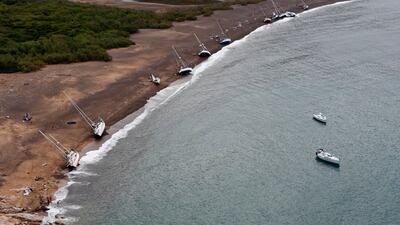
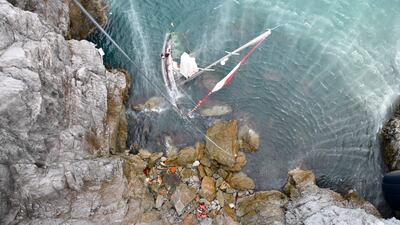
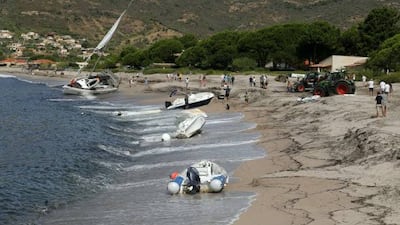
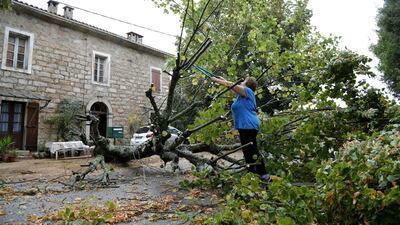
There has been flooding and storm damage with rare but heavy rainfall battering towns and villages, flattening trees and engulfing properties in parts of the French Riviera and, more seriously, Corsica.

The storm that hit Corsica has been likened to a “derecho”, uncommon in the region but pursuing a violent, 1,500-kilometre path from Majorca to the Czech Republic.

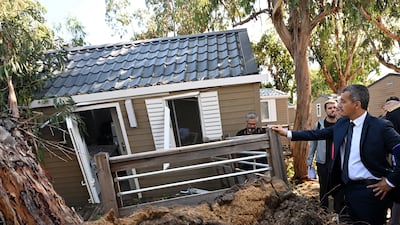
A damaged house after storms in Saint-Martin-Vesubie in 2020. AFP

Even worse, in October 2020, in the valleys around Saint-Martin-Vesubie, a picture-postcard town north of Nice, Storm Alex caused at least 10 deaths ― eight other people are still listed as missing ― and destroyed hundreds of houses, 50 bridges and stretches of roads and ramblers’ footpaths.

It was described as a “meteorological bomb”, although the link with warming seas is said to be indirect.

“High sea temperatures are not actually something that provokes flooding,” Gaetan Heymes, a senior France Meteo forecaster, told The National.

“The actual cause is atmospheric disturbance. But those higher temperatures intensify the storms and can therefore aggravate storm damage.”

Mr Heymes rules out any connection between sea warming and the forest fires that have also ravaged some coastal areas “even if both are enhanced by atmospheric heatwaves”.

Most fires are not caused naturally but by arsonists or negligence, such as reckless barbecues or discarded cigarette butts. But shocking images of overworked firefighters battling the flames, and the damage inflicted on nature, add to popular impressions of a climate out of control.

Grande Parade Maritime 2022 off Marseille, south-east France on July 3, 2022 takes place in unusually hot temperatures. AFP

The World Wildlife Fund said that some aspects of climate change, notably the transformation of the Mediterranean’s most important marine ecosystems, were irreversible. Its 2021 report The Climate Change Effect in the Mediterranean: Stories from an overheating sea claimed increasingly severe weather is causing significant damage to vulnerable coral beds, presenting an unseen menace to coastlines and the towns located there.

.
.

Average seasonal summer sea temperatures can go as low as 20ºC off the French and Italian rivieras, peaking in late August at 25ºC off the Cote d’Azur, 26ºC off Corsica. Le Lavandou's little blackboard reading demonstrates that higher sea temperatures in the Mediterranean are part of a changing reality.

As temperatures reach tropical levels, an estimated 1,000 types of alien fish have migrated to the warmer Mediterranean, sometimes replacing endemic species.

People flock to the Mediterranean on holiday, sunshine more or less guaranteed, but now find themselves sweltering in abnormal heat. Without air conditioning, nights can be sleepless, sweaty ordeals.

Even the relief of a dip in the sea is marred by the heat-related profusion of jellyfish. Having to rub sand into the skin to alleviate painful stings, or seek antibiotic treatment, is not what tourists bargain for.

The WWF report discussed the serious consequences for fisheries, tourism and the nature of human fish consumption. It admits now that little has changed.

Storms in Corsica - in pictures

“The Mediterranean of today is not the same as it used to be,” said Guiseppe Di Carlo, director of the WWF’s Mediterranean Marine Initiative.

“Its tropicalisation is well under way. Climate change is not in the future, it is a reality of today that scientists, fishers, divers, coastal communities and tourists are already experiencing.

“There is a lot at stake for the economy and the benefits that the Mediterranean provides. If we want to reverse the current trend, we must reduce human pressure and build resilience. Healthy ecosystems and thriving biodiversity are our best natural defences.”

For the WWF, climate change is the “biggest single threat to the human species”. The only feasible solution, it argues, is for governments to translate fine words into urgent action to reduce greenhouse gas emissions. WWF studies show that the Mediterranean is becoming the “fastest-warming and the saltiest sea on our planet”.

In the Mediterranean as a whole, key fish species have mutated with harsh local economic consequences.

The report warns of a “dangerous relationship between climate-driven impact and existing human pressures on marine life, such as overfishing, pollution, coastal development and shipping that have already dramatically reduced the ecological resilience of our sea”.

Stocks of native molluscs in Israeli waters have declined by almost 90 per cent and invasive species such as rabbitfish now account for 80 per cent of catches by Turkish fishermen.

A man catches a jellyfish in waters off a beach on the French Mediterranean island of Corsica. AFP

But the changes in habitats and fish populations are occurring across the whole Mediterranean.

Typically southern species, including barracudas and dusky groupers, are commonly found off the Italian region of Liguria, especially north of Genoa towards to the border with France east of Monaco.

On one slightly positive note, coastal communities are learning to adapt to “the new reality”, catching rabbitfish, jellyfish and other alien species as new seafood delicacies.

But the WWF report highlights the spread of non-indigenous species in Mediterranean waters warm enough to support them, spreading north and west every year.

“Other native species are shifting their ranges north as they track cooler waters, while some endemic species have been left on the verge of extinction,” it says.

“At the same time, jellyfish plague fishermen and tourists alike … these are not future projections, they’re things that are happening right now in the Mediterranean, all caused or accelerated by climate change.”

The deep-sea bottom is affected, too. The WWF says endemic Posidonia oceanica meadows, gorgonian corals and Pinna nobilis, or fan mussel, are in decline and sometimes extinct. The threat to Posidonia is particularly worrying because it provides essential oxygen to the seabed.

“Losing these species would have dramatic impacts on the whole marine ecosystem as they provide vital habitats for many species, for the climate as some of them function as natural carbon sinks, and also for our economy as they often attract divers and tourists,” the report said.

This year there have already been three marine heatwaves in the Mediterranean, according to Samuel Somot, a researcher and climatology team leader with France’s National Centre for Meteorological Research (CNRM).

A diver swims over 'Posidonia oceanica' meadows in the Mediterranean Sea near Cannes, southern France. AFP

He told the French newspaper Les Echos that while there have always been peaks, incidents of global warming are increasing in number, size and duration.

The effect on biodiversity is striking. Among the alien species now found in the Mediterranean, rabbitfish devours underwater flora and lionfish eat fish larvae, enough to "create a big shock for the ecosystems", Mr Somot said.

Nearly three weeks after his first conversation with The National, France Meteo’s Gaetan Heymes said there had been little significant change, with sea surfaces still abnormally warm.

“It is a complex global issue,” he said. “There is no easy solution.”

Company profile

Name: Tratok Portal

Founded: 2017

Based: UAE

Sector: Travel & tourism

Size: 36 employees

Funding: Privately funded

Gifts exchanged
  • King Charles - replica of President Eisenhower Sword
  • Queen Camilla -  Tiffany & Co vintage 18-carat gold, diamond and ruby flower brooch
  • Donald Trump - hand-bound leather book with Declaration of Independence
  • Melania Trump - personalised Anya Hindmarch handbag
House-hunting

Top 10 locations for inquiries from US house hunters, according to Rightmove

  1. Edinburgh, Scotland 
  2. Westminster, London 
  3. Camden, London 
  4. Glasgow, Scotland 
  5. Islington, London 
  6. Kensington and Chelsea, London 
  7. Highlands, Scotland 
  8. Argyll and Bute, Scotland 
  9. Fife, Scotland 
  10. Tower Hamlets, London 


Timeline

2012-2015

The company offers payments/bribes to win key contracts in the Middle East

May 2017

The UK SFO officially opens investigation into Petrofac’s use of agents, corruption, and potential bribery to secure contracts

September 2021

Petrofac pleads guilty to seven counts of failing to prevent bribery under the UK Bribery Act

October 2021

Court fines Petrofac £77 million for bribery. Former executive receives a two-year suspended sentence 

December 2024

Petrofac enters into comprehensive restructuring to strengthen the financial position of the group

May 2025

The High Court of England and Wales approves the company’s restructuring plan

July 2025

The Court of Appeal issues a judgment challenging parts of the restructuring plan

August 2025

Petrofac issues a business update to execute the restructuring and confirms it will appeal the Court of Appeal decision

October 2025

Petrofac loses a major TenneT offshore wind contract worth €13 billion. Holding company files for administration in the UK. Petrofac delisted from the London Stock Exchange

November 2025

180 Petrofac employees laid off in the UAE

Jetour T1 specs

Engine: 2-litre turbocharged

Power: 254hp

Torque: 390Nm

Price: From Dh126,000

Available: Now

%3Cp%3E%3Cstrong%3EEngine%3A%20%3C%2Fstrong%3E4-litre%20twin-turbo%20V8%0D%3Cbr%3E%3Cstrong%3ETransmission%3A%3C%2Fstrong%3E%208-speed%20auto%0D%3Cbr%3E%3Cstrong%3EPower%3A%20%3C%2Fstrong%3E470hp%2C%20338kW%0D%3Cbr%3E%3Cstrong%3ETorque%3A%3C%2Fstrong%3E%20620Nm%0D%3Cbr%3E%3Cstrong%3EPrice%3A%3C%2Fstrong%3E%20From%20Dh491%2C500%20(estimate)%0D%3Cbr%3E%3Cstrong%3EOn%20sale%3A%20%3C%2Fstrong%3Enow%3C%2Fp%3E%0A
The Voice of Hind Rajab

Starring: Saja Kilani, Clara Khoury, Motaz Malhees

Director: Kaouther Ben Hania

Rating: 4/5

The Gandhi Murder
  • 71 - Years since the death of MK Gandhi, also christened India's Father of the Nation
  • 34 - Nationalities featured in the film The Gandhi Murder
  • 7 - million dollars, the film's budget 
Ms Yang's top tips for parents new to the UAE
  1. Join parent networks
  2. Look beyond school fees
  3. Keep an open mind
PREMIER LEAGUE FIXTURES

Saturday (UAE kick-off times)

Watford v Leicester City (3.30pm)

Brighton v Arsenal (6pm)

West Ham v Wolves (8.30pm)

Bournemouth v Crystal Palace (10.45pm)

Sunday

Newcastle United v Sheffield United (5pm)

Aston Villa v Chelsea (7.15pm)

Everton v Liverpool (10pm)

Monday

Manchester City v Burnley (11pm)

The burning issue

The internal combustion engine is facing a watershed moment – major manufacturer Volvo is to stop producing petroleum-powered vehicles by 2021 and countries in Europe, including the UK, have vowed to ban their sale before 2040. The National takes a look at the story of one of the most successful technologies of the last 100 years and how it has impacted life in the UAE. 

Read part four: an affection for classic cars lives on

Read part three: the age of the electric vehicle begins

Read part one: how cars came to the UAE


Nayanthara: Beyond The Fairy Tale

Starring: Nayanthara, Vignesh Shivan, Radhika Sarathkumar, Nagarjuna Akkineni

Director: Amith Krishnan

Rating: 3.5/5

South Africa World Cup squad

South Africa: Faf du Plessis (c), Hashim Amla, Quinton de Kock (w), JP Duminy, Imran Tahir, Aiden Markram, David Miller, Lungi Ngidi, Anrich Nortje, Andile Phehlukwayo, Dwaine Pretorius, Kagiso Rabada, Tabraiz Shamsi, Dale Steyn, Rassie van der Dussen.

The specs: 2018 Mercedes-Benz E 300 Cabriolet

Price, base / as tested: Dh275,250 / Dh328,465

Engine: 2.0-litre four-cylinder

Power: 245hp @ 5,500rpm

Torque: 370Nm @ 1,300rpm

Transmission: Nine-speed automatic

Fuel consumption, combined: 7.0L / 100km

What are the main cyber security threats?

Cyber crime - This includes fraud, impersonation, scams and deepfake technology, tactics that are increasingly targeting infrastructure and exploiting human vulnerabilities.
Cyber terrorism - Social media platforms are used to spread radical ideologies, misinformation and disinformation, often with the aim of disrupting critical infrastructure such as power grids.
Cyber warfare - Shaped by geopolitical tension, hostile actors seek to infiltrate and compromise national infrastructure, using one country’s systems as a springboard to launch attacks on others.

Tamkeen's offering
  • Option 1: 70% in year 1, 50% in year 2, 30% in year 3
  • Option 2: 50% across three years
  • Option 3: 30% across five years 

Mercer, the investment consulting arm of US services company Marsh & McLennan, expects its wealth division to at least double its assets under management (AUM) in the Middle East as wealth in the region continues to grow despite economic headwinds, a company official said.

Mercer Wealth, which globally has $160 billion in AUM, plans to boost its AUM in the region to $2-$3bn in the next 2-3 years from the present $1bn, said Yasir AbuShaban, a Dubai-based principal with Mercer Wealth.

Within the next two to three years, we are looking at reaching $2 to $3 billion as a conservative estimate and we do see an opportunity to do so,” said Mr AbuShaban.

Mercer does not directly make investments, but allocates clients’ money they have discretion to, to professional asset managers. They also provide advice to clients.

“We have buying power. We can negotiate on their (client’s) behalf with asset managers to provide them lower fees than they otherwise would have to get on their own,” he added.

Mercer Wealth’s clients include sovereign wealth funds, family offices, and insurance companies among others.

From its office in Dubai, Mercer also looks after Africa, India and Turkey, where they also see opportunity for growth.

Wealth creation in Middle East and Africa (MEA) grew 8.5 per cent to $8.1 trillion last year from $7.5tn in 2015, higher than last year’s global average of 6 per cent and the second-highest growth in a region after Asia-Pacific which grew 9.9 per cent, according to consultancy Boston Consulting Group (BCG). In the region, where wealth grew just 1.9 per cent in 2015 compared with 2014, a pickup in oil prices has helped in wealth generation.

BCG is forecasting MEA wealth will rise to $12tn by 2021, growing at an annual average of 8 per cent.

Drivers of wealth generation in the region will be split evenly between new wealth creation and growth of performance of existing assets, according to BCG.

Another general trend in the region is clients’ looking for a comprehensive approach to investing, according to Mr AbuShaban.

“Institutional investors or some of the families are seeing a slowdown in the available capital they have to invest and in that sense they are looking at optimizing the way they manage their portfolios and making sure they are not investing haphazardly and different parts of their investment are working together,” said Mr AbuShaban.

Some clients also have a higher appetite for risk, given the low interest-rate environment that does not provide enough yield for some institutional investors. These clients are keen to invest in illiquid assets, such as private equity and infrastructure.

“What we have seen is a desire for higher returns in what has been a low-return environment specifically in various fixed income or bonds,” he said.

“In this environment, we have seen a de facto increase in the risk that clients are taking in things like illiquid investments, private equity investments, infrastructure and private debt, those kind of investments were higher illiquidity results in incrementally higher returns.”

The Abu Dhabi Investment Authority, one of the largest sovereign wealth funds, said in its 2016 report that has gradually increased its exposure in direct private equity and private credit transactions, mainly in Asian markets and especially in China and India. The authority’s private equity department focused on structured equities owing to “their defensive characteristics.”

Benefits of first-time home buyers' scheme
  • Priority access to new homes from participating developers
  • Discounts on sales price of off-plan units
  • Flexible payment plans from developers
  • Mortgages with better interest rates, faster approval times and reduced fees
  • DLD registration fee can be paid through banks or credit cards at zero interest rates
UAE currency: the story behind the money in your pockets
WHAT IS A BLACK HOLE?

1. Black holes are objects whose gravity is so strong not even light can escape their pull

2. They can be created when massive stars collapse under their own weight

3. Large black holes can also be formed when smaller ones collide and merge

4. The biggest black holes lurk at the centre of many galaxies, including our own

5. Astronomers believe that when the universe was very young, black holes affected how galaxies formed

Updated: June 08, 2023, 5:37 AM