

Egypt's population rose by one million to 104 million in just 221 days, officials announced on Saturday, underlining government warnings that the country's high birth rate is one of the most serious obstacles to progress.
On Tuesday, Housing Minister Asem El Gazzar said Egypt needs to build 600,000 homes every year to keep up with the population, after spending about 1.1 trillion Egyptian pounds (about $56 billion) on housing projects over the past 10 years.
Although the government has succeeded in reducing the birth rate from 3.5 per woman (which translates to 35 children for every 10 women) in 2014 to 2.8 in 2021, it says this is still far short of what is needed.
“The state has been facing some of its most serious challenges as it endeavours to put a cap on the population increase. When you have a country with a GDP like ours and such a large population, the state is inevitably going to struggle to develop no matter how hard it tries,” says Dr Hoda El Mallah, an economist at Egypt’s Urban Planning Authority.
While most experts agree that Egypt’s population growth is simply too high for a country of its resources and inhabitable area, some say part of the problem is a policy aimed at reducing the birth rate while neglecting to invest enough in education and job creation to boost the economy.
But President Abdel Fattah El Sisi, at a meeting of the National Family Development project earlier this year, said overpopulation was one of the main challenges the country faced in developing various sectors, particularly education, which he admitted was below par because of a lack of funds.
New school year begins in Egypt — in pictures
-

Pupils at Notre Dame School in Cairo gather for the beginning of the new Egyptian academic year. All photos: EPA -

Pupils at Notre Dame School in Cairo gather for the beginning of the new Egyptian academic year. The Ministry of Education says that a start date of October 1 applies to all except international schools. -

Girls at Notre Dame School in Cairo are back at their desks for the new academic year. -
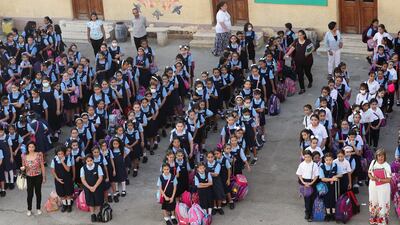
Pupils at Egyptian schools can expect a mid-year holiday at the end of January 2023, while the academic year runs until the first week of June 2023. -
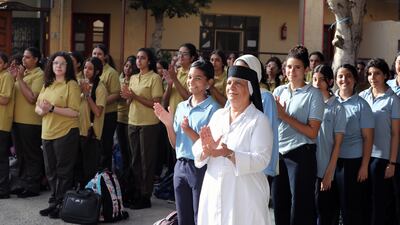
Pupils at Notre Dame School in Cairo begin their new academic year. One of newly-appointed Education Minister Reda Hegazy's decisions was to unify start dates for institutions except international schools. -
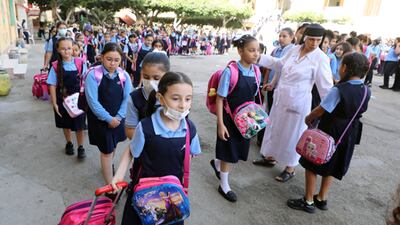
Pupils at Notre Dame School in Cairo and across Egypt are starting their academic terms later this year because, the Ministry of Education says, they will benefit from more of the summer months with their families. -

Day 1 for pupils as the new Egyptian academic year starts at Notre Dame School in Cairo. -
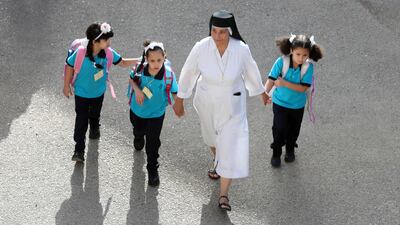
Day 1 for pupils as the new Egyptian academic year starts at Notre Dame School in Cairo.


Dr El Mallah says Egypt’s population growth, the fourth-highest in the Mena region, is driven by a number of factors that are difficult to change.
Among the main reasons are strongly held traditional beliefs and practices, particularly in rural provinces, and chief among these is the tendency to marry young, which is often encouraged by parents.
“When couples marry so young at their parents' behest, they don’t really think their marriage through and what you end up with is young couples having several children pretty quickly before they realise that they might not be able to handle the financial pressures of having a large family,” she says.
Being a patriarchal society, families in Egypt often favour having sons over daughters, which causes them to keep trying for a boy even after they’ve had one or two girls, Dr El Mallah says.
Poverty is another driver of population growth, she says.
The provinces with the highest birth rates in 2021 were Assiut, Minya, Qena and Sohag, which are also some of the poorest and most rural.
“For many Egyptian families, having many children ensures a steady stream of income into the household and as things continue to get more expensive, families often find it difficult to make ends meet, which in turn makes them have more children to share the load.”
Nana Aboelseoud, a reproductive rights researcher, says another motivation for parents to have large families is to ensure they have support when they are too old to work or to take care of themselves.
She says the government's population control programmes, such as the China-inspired "Two Is Enough" scheme launched in 2018 that offered financial incentives to couples who had only two children, often lack the cultural sensitivity needed to communicate across the country's 27 provinces, whose social dynamics are often vastly different.
reproductive rights researcher
“A lot of these programmes are devised by organisers in Cairo about areas that they don’t know much about,” she says.
“Every province comes with its own unique set of challenges. In North Sinai, for instance, women might not be responsive to population control campaigns because there are few female gynaecologists available there to educate them and they are too modest to see a male doctor. In another area, women don’t have the necessary funds to cover their transportation costs to visit a doctor and receive birth control or consultations.”
Another problem is the reliance on foreign funding. A 2021 report by the Egyptian Initiative for Personal Rights, for whom Ms Aboelseoud has written reports, concluded that Egypt does not spend any of its budget on population control initiatives and that these are funded by EU and US-based aid programmes.
Ms Aboelseoud says that the donor's agenda plays a significant role in foreign-funded programmes, so they focus on accomplishing the vision of the countries or institutions that pay for them at the expense of the benefit to Egyptians.
"What you end up with are rigid programmes that expect participants to do a certain thing or behave in a certain way and any questions or problems they may have that are unrelated to the strict agenda of the programme are ignored. This results in many not benefiting from the programme at all," she says.
And because programme implementation is often hasty, they lack proper evaluation.
"Sometimes these programmes work really well, as was the case with Port Said, for instance, which brought its birth rate down significantly in the last 10 years," Ms Aboelseoud says.
"What is missing are efforts to outline what exactly worked in Port Said so that it can be reapplied somewhere else.
"The government does not do this, which has hindered its larger efforts to control the population greatly. There is a mismanagement of the available resources that needs to be corrected."

