

Language is organic, soaking up a range of influences and adapting to the people who use it. Often, words and phrases we think of as authentic actually have complicated origins.
Arabic has a plethora of examples when it comes to this linguistic phenomena. Given Arabic's dexterity and the multi-cultural history of the region, many Arabic words have unexpected roots.
Take our Arabic word of the week, istikan, which is the name of a type of cup distinguished from other drinking vessels by a number of characteristics. There are several words that refer to cups that work across modern Arabic and across dialects.
To start off with, glass, colloquially, or a qadah in classic Arabic, is an umbrella term for any type of drinking vessel. A finjan is either a small cylinder-shaped or tea cup-shaped vessel, available with or without a handle, that is used for drinking coffee. A koub is more of a typical tea cup or mug with a saucer.
Istikan is the most distinctive of the cup family. Solely used for drinking tea, an istikan is traditionally made from glass and designed to be thin-rimmed and wider at the top, before curving inwards and opening up at the base.
This curved design makes the istikan particularly pleasing to the eye and sets are often stored so that they double as decorative objects.
An istikan can have a decorative pattern on its surface, either through glass-blowing techniques or from ornate painted designs, often in golden hues.
While an istikan stands out for its shape and decorative elements, there’s another reason why it is so fascinating. The word istikan is used mostly in Iraq, where, compared with the wider Arab region, the population has more tea drinkers than coffee drinkers.
Often mistaken as being Turkish or Farsi in origin, there is one theory that the word istikan stems from when the British colonised Iraq for 18 years, although this has been discounted by many. As big tea drinkers themselves, the British were fascinated by the little tea cups used for drinking the hot beverage and are rumoured to have referred to them as an "east tea can”. Some speculate that these three words were combined and became istikan.
Another theory is that the word's origins are Russian. Stakan in Russian refers to a cylindrical drinking vessel without a handle, made of glass and usually used for drinking water. The word istikan could have also come from the name of the city of Astrakhan in southern Russia, where small glass cups are manufactured.
The city, which has through history been influenced by the Ottoman empire as well as the Safavid Persian and Mughal Indian cultures, derives its name from the title Haji Tarkhan, which translates as "the king who has visited Mecca".
Scroll through the gallery below to see The National's pick of Arabic words of the week
-

Hob is the Arabic word for love, but can be used in many contexts -

The Arabic word helu translates, in English, to sweet -

Nashef is the Arabic word for dry, but has many connotations, depending on the context in which you use it -

The Arabic word hurriyeh translates to freedom in English -
The Arabic word tayeb can mean delicious or good, depending on the context -
The Arabic word mustaqbal is best expressed as future in English -
Waqaa, the Arabic word for fall, can signify a loss of power, stature, health or grace -
Hudood means borders in English -
The Arabic word rooh translates to spirit or soul in English -

The Arabic word ain means eye in English -
Waraq, the Arabic word of the week means paper in English -
Bahr, the Arabic for sea, has a poetic lilt -
Kareem means generous in English -
Bab means door in English -
Eid means holiday or festival -

Najm means star for the night sky and cosmos, but also has plenty of other meanings, including ambition or fame -
Alwan, the Arabic word for colours, has many shades of meaning -

Akel can refer to home-cooked meals, embezzlement, fire and rust -

Jamal is the Arabic word for beauty, be it literal or figurative -

Herfe translates to profession or craft -

Tabiaa translates to nature and can frame landscapes and portraits -

Sehha is the Arabic word for health -

Ijaza is Arabic for holiday and shines in summer but is not stress-free -

Aamal is the Arabic word for work -
Al dahr translates to time -

Qalb is a word for heart, with poetic roots -
Lugha in Arabic translates to language in English -
Insaan means human being -
Na'eeman is an idiomatic expression used when someone has had a shower or bath, a haircut or had their beard trimmed -

The Arabic word for life touches on eternity, death and accomplishment -

Qamar is the Arabic for moon -

The Arabic word for strength or power is quwwa -

Burj is Arabic for tower -

The Arabic word for sun is shams -
Sabr in English can translate to patience -
Hayba is the Arabic word for prestige -
The Arabic term al shay'e translates as 'the thing' in English -

The Arabic word for road is tareeq -
The Arabic word for read has mystical and scholarly connotations -
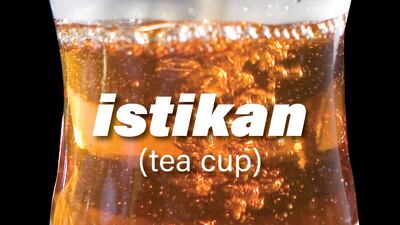
Istikan is the Arabic word for a type of tea cup -

The Arabic word hanan means affection in English -
The Arabic word atlal means ruins in English -

Kura is the Arabic word for ball, in all its forms -
Janaah in Arabic means wing in English -
The Arabic word sana translates to year in English -
Qasida is the Arabic for poem, not poetry -
Ameer, the Arabic word for prince, which influenced another English title -
Nakhla translates to palm tree in English -
Al samt is the Arabic for silence -

Kalimaat translates to words in English -

Markaz is Arabic for centre -
Beshara is the Arabic word for good news -
Bayt is the Arabic for house or home -

Fann is the Arabic word for art, and can be either a verb or an adjective -
Isim, which means name, is made up of three letters, alif, seen and meem -
Dunya is the Arabic word for world -

Nazaafah translates to cleanliness in English -
Many traditions revolve around drinking coffee, including weddings, funerals and business meetings -
Fajr is the Arabic word for dawn -
Maghrib is the Arabic word for sunset -

The Arabic language is filled with idioms, quotes and colloquial quips involving the mirror -

Raei is the Arabic word for opinion -

Wa'ed is a multifaceted word for 'promise', as well as a female name -
Qussa is the Arabic word for story -
Sadaaka is the Arabic word for friendship -
Akhbaar is the Arabic word for news -
Rasem is made up of the three Arabic letters Rah, Seen and Meem. While it can simply mean a drawing or a sketch it’s also a malleable word whose definition can change depending on context and dialect – particularly between colloquial and classical Arabic. -

As well as finishing a task, khatem denotes a deeper sense of finality -
Commonly translated to blessed, mubarak is used as a popular greeting on auspicious days -
The Arabic word for lighthouse is also a term that has become closely associated with Islam -
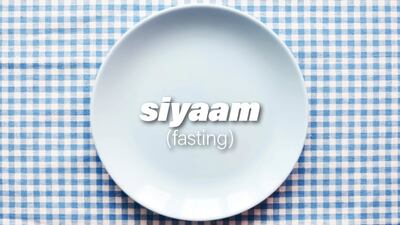
Siyaam, the Arabic word for fasting is also connected to silence -

Tawbah, the Arabic word for repentance, is also connected to Ramadan -

Safar, the Arabic Word for travel can also refer to sunny days, a brighter-blazing fire or exile. The National



