
Teamwork, as they say, makes the dream work. The adage also appears to hold for investors such as Antony G, a Dubai resident who owns a portion of several multifamily apartment complexes in the US.
The British citizen, who asked that only his first name be used for privacy reasons, takes the syndicated approach to property investment.
Real estate syndication – pooling money with others for mutual returns – allows buyers to gain access to large properties that may be out of their reach, using smaller investments than if they were to buy outright.
With sums starting at $50,000, these projects offer a lower-risk route to passive income without the burden of day-to-day maintenance.
Antony owns houses across the Midwest, but being part of a syndication lets him expand his portfolio, he says.
“I already invest in other real estate. Syndication gives me bigger reach to other markets and larger apartment complexes,” he tells The National.
He is one of many regional residents seeking their own American dream – owning a piece of US real estate.
More companies are now offering these options to investors in the UAE and the Middle East.
Among them is Glenwood Equity, the property investment management company that Antony uses. It has worked with more than 500 high-net-worth individuals (HNWIs) over the past seven years to invest in property across the US, says co-founder and managing partner Rebecca Moreira.
“We help international investors, primarily Middle Eastern-based investors, access highly curated and principal-protected co-investments across a variety of commercial real estate asset classes in the US,” she says. “Investors come to us when they are looking for global diversification in hard assets in established markets.”
The company requires a minimum investment of $100,000 (Dh370,000). “However, most investors invest on average $300,000 with us on each project,” Ms Moreira says.
Glenwood Equity focuses on apartment complexes with more than 150 units, called multifamily properties in the US. As of this year, it has added land and new development options, including hotels, industrial space, healthcare complexes and data centres.
The company's syndicated properties include a short-term investment of six to nine months on a rezoning project over 92.7 hectares of waterfront land, offering return of 24 per cent per annum.
In January, it merged with US-based private wealth management company Patel Family Office to expand across the GCC and Turkey. The move caters to growing international investor demand for properties in the US, Ms Moreira says.
“The US is a leader in capital outflows from the Middle East and co-investments are a strategy that investors look for to share the risk and increase diversification during economic uncertainty,” she says.
The GCC’s strong economic growth last year resulted in “healthy levels of international investments by state-owned entities across global real estate markets [and] is expected to continue in the near term, albeit they will tread with caution”, real estate advisory JLL forecast in January.
Overall, the US attracts more than $30 billion in investment from the Middle East, the report said.
The $20 trillion US commercial real estate industry has been resilient so far this year, JP Morgan said in a May outlook report.
Multifamily properties remain strong, with the national vacancy rate at 3.9 per cent in April, compared with 4.5 per cent at the end of 2022. Retail and industrial properties are also strong, although demand for office space has declined.
Syndicated investments, like outright property purchases, are typically illiquid investments held for the medium term.
“It is not uncommon for an asset to appreciate between 30 per cent to 40 per cent. If responsible financing has been used, equity investors have enjoyed equity multiples of two and three times over four years,” Ms Moreira says.
Besides capital appreciation, investors can also receive cash flows over the investment period, she adds.
“Cash on cash returns could be anything from 5 per cent to 9 per cent. The capital appreciation return on the sale could be between 30 per cent to 70 per cent.”
Dubai luxury property buyer trends – in pictures
-

Of all the local amenity options offered in Dubai, parks (85 per cent) were an overwhelming favourite among high-net-worth individuals. EPA -

The desire to be near a park was highest among East Asians, at 95 per cent, while Saudis considered it the most important factor. EPA -
Jumeirah Bay Island is one of three prime residential neighbourhoods in Dubai -

Dubai's prime residential neighbourhoods – the Palm Jumeirah, Emirates Hills; and Jumeirah Bay Island – dominate luxury home sales. Reuters -

More neighbourhoods in Dubai are likely to be classed as prime if they continue to achieve multimillion-dollar sales figures. AP -
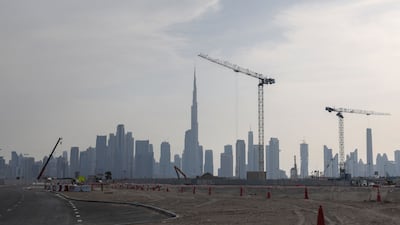
Reports finds that the super-rich would rather buy a property they can take possession of immediately than a project that will be ready some time in the future. AFP


Investors do not sacrifice their risk tolerance for these returns, she says.
“The investment analysis is made on in-place financials or pro forma numbers with a robust rationale so investors can directly evaluate potential returns [over] a particular time frame,” she says.
“This is unlike angel investing or VC [venture capital] investing, for example, where many of those investments are made with speculation and uncertainty of what or when the return will be.”
But investing in US real estate may carry other benefits for those with more cash to hand – such as a green card. The EB-5 Investor Visa Programme, the US version of a golden visa, offers permanent residency to those investing between $800,000 to $1,050,000, depending on the area, in a project that creates at least 10 new jobs.
LCP Group, a US-based private real estate investment manager that has an office in Dubai, puts together multi-investor property deals for international clients. Some projects come with an EB-5 immigration option.
“LCP has capitalised more than $500 million in debt and equity transactions, with an aggregate value of more than $5 billion, through its EB-5 investment programme,” says Denis Karasev, vice-president of the EB-5 division.
LCP has structured more than a dozen EB-5 projects that employed more than 34,000 workers and set about 1,000 foreign investors from 32 countries on the path to a US green card, Mr Karasev says.
Its clients hail from nations such as the UAE, Saudi Arabia, Yemen, India, the Philippines, France, Germany and the UK.
independent financial adviser and senior partner at Holborn Assets
LCP’s projects across the US include hotels operating under the Hilton and Marriott brands, as well as a golf course, student housing, a bus terminal and a 400-unit multifamily apartment building.
Depending on the investment, LCP’s clients can invest in projects for between $50,000 and several million dollars, Mr Karasev says.
“While the target returns to investors that invest in an LCP project may vary depending on the investment, we have historically paid approximately 15 per cent to over 25 per cent returns in recent years,” he says.
The average investment period is three to five years.
However, as with any asset class, investors must pay close attention to where they are putting their money.
In April, four apartment buildings valued at $229 million in Houston, Texas, were foreclosed after the investor, Applesway Investment Group, defaulted on its loans, the Wall Street Journal reported.
Investors must thoroughly examine any potential deal, says Keren Bobker, an independent financial adviser and senior partner at Holborn Assets in Dubai.
Consider the quality of the property, the general area and the availability of tenants. For new builds, add due diligence on the developer and its track record, and seek completion guarantees.
“When buying via a syndicate, it is really important to understand your obligations and restrictions as an investor. Can you sell easily? What if other investors want to get out? Are the management licensed and experienced? There should be a watertight contract and that needs to be read in detail and understood,” Ms Bobker says.
“Specific rules apply to real estate syndicates in the US that are set up as investment vehicles. Any business that manages syndicates must be registered with the SEC for investors’ protection. If someone wants to do this privately with a group of friends or family, they should still have proper agreements drawn up by a lawyer to protect the interests of all parties.”

