When headlines hit, social media erupts into a rushing torrent of chatter; people sharing post after post of statistics, footage and opinion on whatever news of the day is of interest, until the next thing happens.
Almost 80 days into the bombardment of Gaza, however, we cannot let that happen. Even while the daily headlines continue to centre around Gaza, we cannot let ourselves become desensitised to the inhumanity of what is still happening, continuously, on the ground.
After almost 40 years of living in the Middle East, I’ve never seen more people talking about Palestine than I have now. Years ago, if I mentioned Palestine more broadly – not even Gaza – in the UK, where I’m from, I’d be greeted with blank looks. Today, everyone knows both, and while not everybody’s opinion will be in line with my own on the subject, just the fact that people are more aware than ever before is significant.
Over the past two and a half months, I’ve seen and shared countless posts about the history of the conflict, trying to raise awareness among people who may not have previously known the details.
I’ve also had difficult conversations online and in person with strangers who have a skewed understanding of what is happening, largely because they haven’t had access to objective and accurate information on the subject.
This is one of the biggest reasons why we need to keep talking. While raising general awareness is important, so too is sharing facts that reflect reality, instead of cherry-picked material that serves a political agenda. We cannot shy away from the truth that doesn’t serve our narrative and we should not fall into the trap of spreading hate speech either.
I’ve seen this too many times, whether it’s Islamophobic or anti-Semitic, racist or xenophobic in any way, there’s no need to undermine others in order to make a point, since documented history speaks for itself.
-
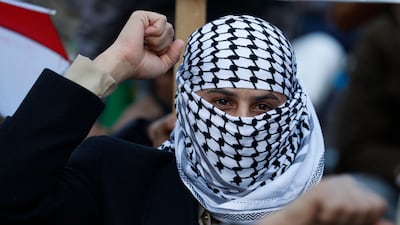
A protester in Sana'a, Yemen, covering his face with a keffiyeh. EPA -
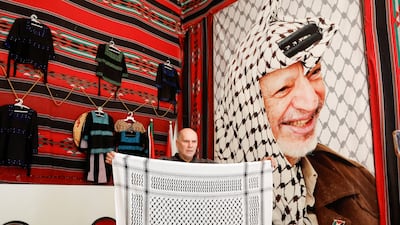
Izzat Hirbawi showing a keffiyeh at the textile factory in Hebron. Reuters -

A newly-recruited member of the Houthis' popular army covering his face with a keffiyeh during a parade in Sana'a, Yemen. EPA -
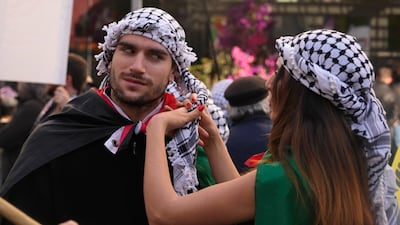
Two people wear Palestinian keffiyehs, during a Pro-Palestinian demonstration march in Madrid, Spain. AP -

A Palestinian child wearing a keffiyeh and carrying a Palestinian flag during a protest in Beirut, Lebanon. EPA -
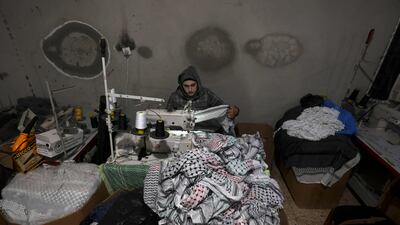
A worker sewing at the Hirbawi keffiyeh in Hebron. AFP -
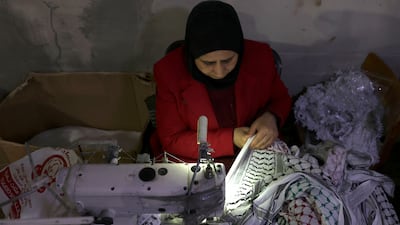
A worker sewing at the Hirbawi keffiyeh factory in Hebron. AFP -
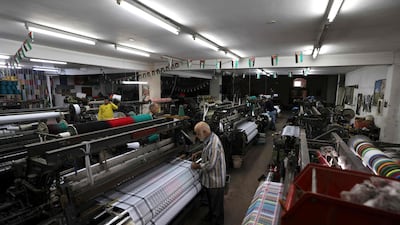
A worker stands over a loom at a textile factory producing the Palestinian Keffiyeh scarf in the occupied West Bank city of Hebron. AFP -
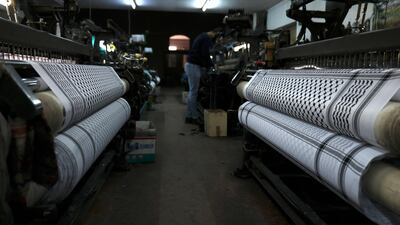
Workers producing the traditional keffiyeh in Hebron. AFP -

A worker stands over a loom at the Hirbawi textile factory producing the Palestinian Keffiyeh scarf in the occupied West Bank city of Hebron. AFP -
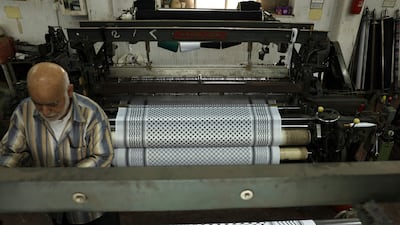
A worker stands over a loom at a textile factory producing the Palestinian Keffiyeh scarf in the occupied West Bank city of Hebron. AFP -
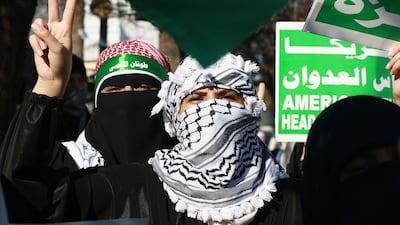
A protester flashing the V for victory sign as people march during a demonstration near the US embassy in the capital Amman in solidarity with the people of Gaza. AFP -
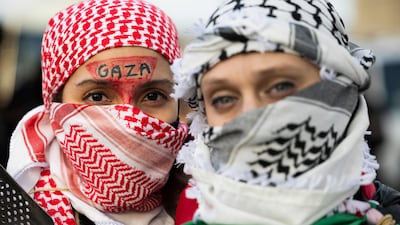
Two pro-Palestinian protestors pose outside the Hilton Hotel in Philadelphia, Pennsylvania, where US President Joe Biden was attended a fundraiser on December 11, 2023. AFP -

Pro-Palestinian protestors gathering outside of the New York Times building to protest the newspaper’s coverage of the Israel-Hamas war in New York City. Getty -

A family in Mansfield, Massachusetts taking part in a protest calling for a cease fire in the war in Gaza. AP -
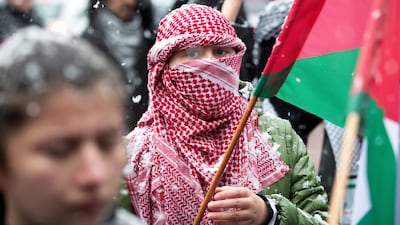
A demonstrator covering her face with a keffiyeh during a rally in support of the Palestinian people, in Sarajevo, Bosnia and Herzegovina. EPA


“Hate, it has caused a lot of problems in the world, but has not solved one yet,” said the late, great American writer and civil rights activist Maya Angelou.
Of course, we cannot simply label someone prejudiced just because they say something we don’t like, either.
Ultimately, we need to remember that what we write and post on social media, and say in real life, matters. In a flurry of emotion after seeing a devastating video or image, we might want to post the first thing that pops into our head, but it’s important to reflect and consider whether you’re about to say something discriminatory.
For example, be specific – differentiate between the Israeli government, civilians and Jews, and Hamas, Gazans and Palestinians. Don’t exacerbate stereotypes, whether that’s the good or bad of a particular ethnicity or race, since no one people can ever be described with a single, all-encompassing identifier.
Also, empathise with everyone in this conflict – there have been victims on both sides. And, perhaps most importantly, think critically about the information you’re consuming. Diversify your sources so you’re not simply living in an echo chamber created by AI-driven algorithms that risk polarising our societies further.
“The war on Palestinians has always been a war of language, a war of propaganda and PR,” wrote Palestinian author Isabella Hammad in an email exchange with Irish novelist Sally Rooney that was published by The Guardian. “Language is not small, even though in our hearts, of course, what actually matters most is this terrible, brutal waste of human life.”
She says that Israeli apartheid would not survive if the public did not continue consenting to its governments’ military support. After all, an enlightened public – or at least a majority – could not possibly agree with what has been happening for the past seven decades in Palestine.
So, the next time you post or say something about Gaza or Israel, just stop and think. Who is this statement serving? Is it an emotional release? Or could this, in some small way, help, however gradually, deepen people’s understanding of the Palestinian cause?
It is as Nelson Mandela once said: “All of us need to do more in supporting the struggle of the people of Palestine for self-determination.”