
William Skinner and Judith Ekblom Jarrold come from Savile Row houses with very different outlooks, but both are wrestling with what it means to be sustainable in a climate-challenged world.
Ekblom Jarrold runs her fingers along a haze-purple jacket made from bamboo and says how it makes a good substitute for linen. Skinner heads the venerable Dege & Skinner, established in 1865, and is in the process of complying with the climate criteria to apply for a royal warrant.
For an emblem of British excellence such as Dege & Skinner, the royal warrant is a seal of patronage that is invaluable to its holders. Savile Row, just off Piccadilly and not far from the royal palaces, is where the world's elite travel to literally dress like a king.
tailor, Scabal
For Skinner, King Charles III’s coronation last year was far from a one-day event. The application for a royal warrant has been transformed from a sheet of A4 with five years of sales figures under Queen Elizabeth II, to a questionnaire on climate-friendly procurement. As demonstrated by his central role in the opening ceremony of Cop28, King Charles is a passionate advocate for lifestyle changes to help the fight against global warming.
“We make the Yeoman of the Guard uniforms, for which we have a royal warrant that we are in the process of applying for in the king's name because it was in the queen's name,” says Skinner, whose shop doubles as his office. “Because of the king's commitment to the environment, there's an in-depth sustainability questionnaire that we have to fill out to ensure that, for example, our cloth suppliers are practising animal husbandry in a decent way."
The winds of change blow both swift and hardly at all on Savile Row, a strip of townhouses made up of shops, underground workshops populated by cutters and tailors, smartly furnished reception lounges and at least one academy for the pursuit of the tailoring arts.
Dege & Skinner shares royal warrants with fellow houses spread across the properties, which are largely owned by the Pollen Estate, a landlord that seeks to preserve the artisan and exclusive culture of the street. Near neighbour Henry Poole received its first livery warrant from Queen Victoria in 1869.

On the west side of the street is Davies & Son, which claims to have made garments for four kings and seven crown princes. It has its own speciality: the ambassadorial military-style dress uniform. Its most recent order was for the departing governor of the Falklands Islands, Alison Blake, who went away complete with a plumed swan feather hat.
Traditional stalwarts
The family scion who owns Henry Poole & Co, Simon Cundey, is a practised guide to the firm's long library of fitting cuttings, leather-bound and dating back to 1846. Poole’s meticulously exacting process spans measurements, cardboard cut-outs, multilayered coat and trouser prototypes, followed by an equally drawn-out fitting process.
There are few shortcuts when it comes to a bespoke suit, which can take eight weeks or longer to deliver.
Savile Row tailor
Henry Poole was the son of a military tailor who set up as the “Tom Ford of his day” in the first half of the 19th century, sowing the seeds for the street's speciality. “All good roads for a tailor come back to Poole,” Cundey says.
As he speaks, he points to a warrant from King Edward VII, who reigned from 1901 to 1910. “He was a man of substance who enjoyed sports and socialising around them and brought in many, many royals. That's where [our warrants] started to flood.”
Among many framed on the wall is the emblem of the Khedive of Egypt and that of a Shah of Persia. Cantering past Winston Churchill's early-1900s pinstripe, Cundey gives glancing references to clients, including the legendary US magnate William Randolph Hearst.
Closer to the present day, there is a sample to mark the 50th anniversary of Range Rover, made in collaboration with its chief designer, and a 2006 tie-up with adidas for trainers made with an in-house check.

Every tailor greets every customer with an eye as to how they could carry its house style. Cundey describes Henry Poole's as a balanced, natural-proportioned look. “We have a high waist and nice drape, which sees the cloth come over the chest and into the waist,” he says, illustratively leaning in. “We naturally want the length of the coat balanced to the body and the lapel with a high gorge [the V-shaped indent]. It elevates you.”
Henry Poole, like all the tailors, is avowedly about triaging the customer's needs, shapes and lifestyle. Another tailor, Richard Anderson, takes 18 measurements at the start of a process that can take 80 man-hours to complete. “All the time you are looking at the customer, how they stand, how they speak. Those mental notes are what we call the figuration, and that combined with measures is your starting point.”
Equally formidable is the approach at Huntsman, a few doors down, past the brass panels bearing the tailors' names. Entering is to ease into a world formed in the mid-19th century, but since populated by Coco Channel, Bruce Oldfield and Alexander McQueen.
The precise movements of head cutter Campbell Carey, who carries himself with a spartan Scottish air, are wrapped in the tight lines of his grey woollen suit. Huntsman was the inspirational backdrop of the Hollywood Kingsman blockbusters, and director Matthew Vaughan leaned on Carey's advice, delivering copies of the script to 11 Savile Row in advance.

Like almost all the tailors, Huntsman is active in the Middle East. I meet client manager Krishan Chudamasa, who is later in the day heading to the airport for a trip to spend time with a royal client from one of the Arabian Gulf's ruling families.
As the trading name might suggest, much of the tailoring Huntsman does is informed by the need to ensure that the client can sit in the saddle of a horse in perfect composure. Chudamasa sees his job as guiding Middle East clients through the English environments that still dominate high society.
master tailor, Dege & Skinner
“Our relationships can start when a father comes to the UK for Sandhurst or university and grows over time through friendship with the family,” he says. “Huntsman is very much looking after the needs of the client, but also we are constantly giving advice on the social occasions here in the UK – if it is shooting or going to Royal Ascot. Not just the right clothing but what the occasion entails, and the role of all those that make up an event. I'm here to ensure it all goes smoothly.”
Royal blue and military red
Skinner too points to Sandhurst, where the house makes the cadet uniform. Dozens of new arrivals from the Arabian Gulf get immersed in the experience every year. Skinner points at a picture of a young man in a frame. “Right there, for example, we met him at Sandhurst and that's a picture of him in wedding uniform,” he says. “We designed for him and that's now part of our heritage.”
With crowned clients and leading business magnates as well as the contract for diplomatic uniforms, Patrick Murphy at Davies & Son says word-of-mouth recommendations are key to the business. Here too every client is cut an individual pattern that is then changed through time. “The more suits you have the better, because you are always tweaking the pattern,” he says.
No fewer than eight and up to 12 weeks are needed to perfect a pattern. Murphy distains those customers who want to shortcut the process, recalling one who told him to pick any cloth “as long as it was blue”. “Honestly, I didn't want to make it for him,” he says. “If he was not showing any enthusiasm in the cloth, where was my get-up-and-go to make the suit?”
director, Maurice Sedwell and Savile Row Academy
With as many as three in four Davies suits made for American clients, Murphy and other cutters are frequently out of town on so-called “trunk trips”. Davies staff travel to America at least four times a year, as well as to the Middle East and parts of Asia.
All requests for extras are entertained. From hidden gun pockets, which were popular for travellers to Russia after the fall of the Soviet Union, to mobile phone snugs today. Davies even fitted the secret pockets of a New York illusionist. Last year, a Central African rapper asked for a replica of the braid military jacket the house previously made for Michael Jackson.
Innovators and mavericks
As Anderson walks among his tailors in the basement workshop, he says the US business is so important because there is no tradition of the artisan skills on display. The business offers ready-to-wear suits that walk-in customers can take home. Also available is made-to-measure, allowing customers to choose the fit and fabric of a factory-made outfit. And the high end on Savile Row is handmade, bespoke design.
In the spirit of innovation, Anderson even offers a bespoke range of jeans, made from a robust Japanese-sourced denim. Others are bringing the customer experience to life through technology. Alex McKie of Norton & Sons shows me the iPad experience of choosing elements such as the length and touches such as patch pockets, all done from the comfort of the airy showroom's leather-bound sofa.

Even more daring in his offer to customers is Rav Matharu, founder of clothsurgeon, who makes tracksuits from Loro Piana fabrics or suits from “technical nylons”, as he tries to cater for whatever the client imagines. “This is made from Nike sweatpants into a suit jacket,” he says, showing a canvas fitting of a new commission. “We have done canvas on the exterior to show all the work that's gone into the jacket in a design-led piece.”
On one rail awaiting collection is a piece made from a single Louis Vuitton scarf. “That was tight in terms of cutting,” he says. “The guy's a 44-inch chest and six-foot three.”

Italian-born Fedro Gaudenzi describes his work as between couture and the rigidities of the traditional Savile Row, as well as a nod to his apprenticeship in his homeland.
“The design appointment really allows me to create anything you want,” he says “The way couture works is every six months you present a collection and make a piece on the client. So I think that's the wrong term for me. But I do think there is something missing in the market right now, which is a more contemporary, bespoke consumer.”

He talks of the cutting work that went into a wedding gown for a client from Saudi Arabia, and other contemporary works that go through Savile Row techniques. “Our coatmakers are the same as others on the Row; some we have trained for four years to make a hoodie the same as they are making a jacket.”
Gaudenzi observes that female clients who visit Savile Row need more than “a man's suit put on woman”.
“We don't work in that way, we work with the proportions of a woman,” he says.
Diversity leaders
Ekblom Jarrold not only works with bamboo and other innovative fabric, but also sees her role as standard bearer for the work of Andrew Ramroop, owner of Maurice Sedwell, who is a pioneering black tailor on the Row. Sedwell's houses the Savile Row Academy, where apprentice cutters and tailors are learning the skills needed in the bespoke trade.
“The kinds of issues I run into are similar to the kinds of issues Andrew ran into,” she says and points to the importance of the academy in nurturing a new generation of the Savile Row workforce. “The academy is not just for us, but it's very important for the future of the business. It's very important that we continue to train people. There was a huge gap a number of years ago and there were not enough young people coming through.”
Jared Godden, 23, a coatmaker apprentice at the academy, has his eyes on being a master tailor and sees the trade more relevant in an environmentally conscious era. “Not a lot of people understand there's a new side to this,” he says. “There's a higher level of quality and a different craftsmanship than even the high-fashion shops.”

Those who were once rebels eventually become the establishment on Savile Row. Nina Penlington, the head cutter at Edward Sexton, is carrying the tradition of a house that made its name dressing Andy Warhol, Bianca Jagger and John Lennon in the 1970s. Founder Sexton teamed up with a colleague, Tommy Nutter, to create a signature look of a wide lapel and a long, lean body. The pair were known as the subversive tailors.
Both are now deceased, but their legacy lives on. “If it's a handmade product, it's got our DNA in it,” Penlington says. “Our workshop understands intrinsically what a Sexton suit is and how it should feel on the body.
“It allows us to build those shoulders for you. Even though we have a strong house style, it really is up to the customer how far we want to push that.”
Cloth and leather
At the heart of the well-dressed experience is the cloth and the shoes that will accompany the suit. Scabal makes 95 per cent of its fabrics in Huddersfield, including some of the highest weave count of fabrics, known as Super230s, produced anywhere. “We do fabrics woven with gold, with diamonds, with platinum and made from vicuna and cashmere,” says Tommy Raban, the in-house tailor for the fabric-maker. “You are wearing and buying a story.”
-
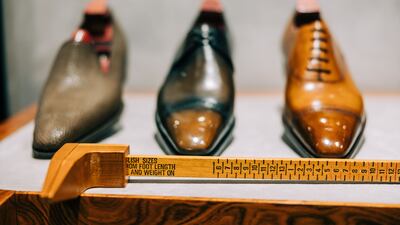
A model of the foot, known as a last, is the starting point for bespoke shoes by Gaziano & Girling on Savile Row in London. All photos: Mark Chilvers / The National -
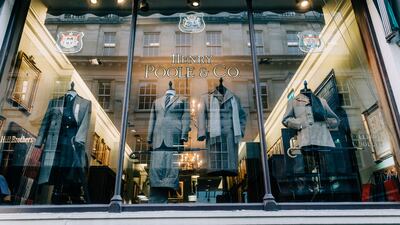
Henry Poole & Co on Savile Row, the London street world famous for its bespoke suits and tailoring -

Andrii Mytelskyi, a specialist tailor at Huntsman, works in front of thousands of customer cutouts -

Italian-born Fedro Gaudenzi describes his work as between couture and the rigidities of the traditional Savile Row -
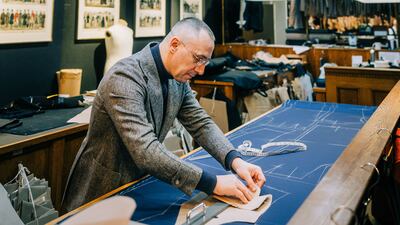
Dario Carnera, co-head cutter at Huntsman -
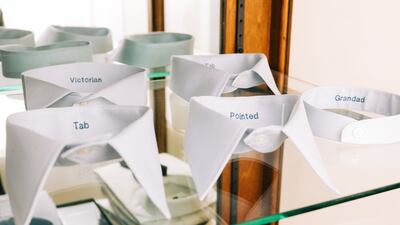
Different styles of shirt collar on display at Norton & Sons -
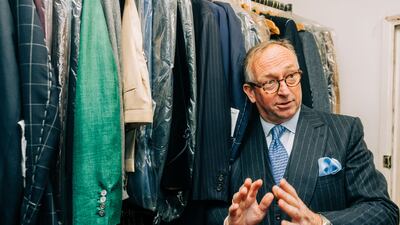
The family scion who owns Henry Poole & Co, Simon Cundey is a practised guide to the firm's long library of fitting cuttings, leather-bound and dating back to 1846 -

Savile Row is a strip of townhouses made up of shops and underground workshops populated by cutters and tailors -
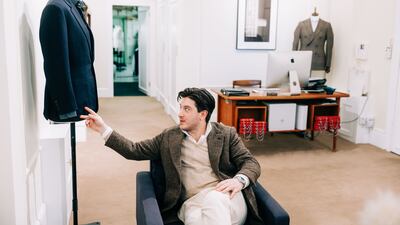
Alex McKie, store manager of Norton & Sons -

Suits on display in Fedro Gaudenzi -

Custom jackets on display at Clothsurgeon -
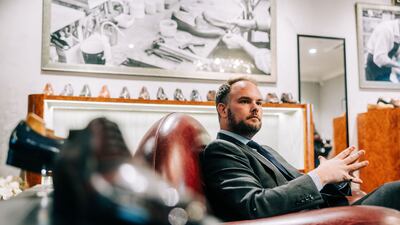
Simon Jones, store manager at Gaziano & Girling -
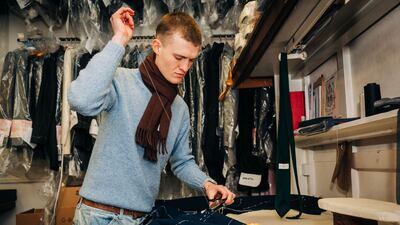
A tailor at work at Norton & Sons


The comings and goings at Gaziano & Girling, a bespoke shoemaker on the Row, suggests it's a kind of neutral ground among the tailors. Simon Jones, the store manager, also points to northern England and the traditional home of the shoe industry in Northamptonshire, where shoes fit for a king are made.
As with the pattern, the last, a model of the foot, is the starting point for the bespoke fit. Normally the lasts of King Charles III's feet reside at this plush Savile Row outfit. Not today. The monarch has ordered some new footwear and the models are at the factory.

