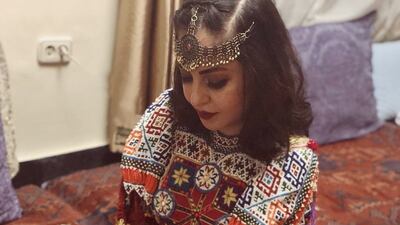
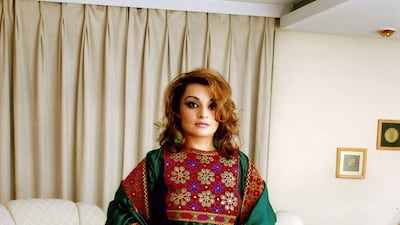
Two days before the Taliban swept into her home city of Kabul, Faiza Zeerak's mother bought her and her sister a chadari each.
The 22-year-old never expected to wear the garment, which covers her face. A lover of music, education and US TV series, the social worker falls firmly into Generation Z and feels completely at odds with the Taliban's ideology, which treats women as second-class citizens.
"When I wore it for the first time I felt so sad. It was as if I put a parcel on my head. I had to pull it down with my hands to see through that little net in the front," Ms Zeerak told The National from her home in Kabul.
It wasn't just her clothing she adjusted for her safety. On August 15, when the group took over the city, she fled her job at the charity she founded with her friends to go into hiding. The Kabul University graduate's ‘Smile for Afghan Kids’ charity caters for street children and orphans.
“I lost my job, I stopped my activities which I used to do for kids and youths. I couldn’t do anything! I am just hiding at home and I am still like prisoner,” she said.
Born in 1999 in the northern Baghlan province and then later moving with her family to the capital, she is part of a generation that differs from their elders, who experienced the 1996-2001 rule of the Taliban, brought down by a US invasion.
Back then, music was banned and women were all but erased from public life.
Everyone can see the way they deal with women, music and other basic human rights. All televisions stopped music shows and TV dramas, which are replaced with Islamic programmes.
Ms Zeerak
Afghanistan's under-25s, who make up almost two thirds of its 37 million people, have lived a very different life over the past 20 years.
“I am used to listening to music. I have a small black speaker in my room to listen to music. I listen to happy Afghan songs; I don’t like Bollywood music much but in Hollywood I only listen to the happy songs of Selena Gomez," says Ms Zeerak.
"I like watching movies, and American TV series. I had already downloaded some series such as The 100 and Humans to watch them when I am home.”
Now, her life is on a very different trajectory. The social worker has no doubt that the new freedoms that came with the US-led invasion that toppled Taliban 20 years ago are already being taken away or even lost.
She has taken the brave step of talking publicly about how her life, and that of thousands of Afghans, has changed. Seemingly without specific orders being given, people and corporations are already censoring their activities.
“Everyone can see the way they deal with women, music and other basic human rights. All televisions stopped music shows and TV dramas, which are replaced with Islamic programmes,” said Ms Zeerak, an amateur painter who loves drawing with water colours and pencil.
"Entertainment shows have completely vanished from the country. If women don’t work and are active in the society, I can’t think of a stable society only led by men."
Ms Zeerak said she knows a lot of men and women who live in fear of saying what they really think now under the Taliban.
There will be a pandemic of self-silencing, she said. She has already started doing this with her decision to wear the chadari. She fears that departing publicly from the ideology pushed by Taliban will eventually put her life in danger
Ms Zeerak thinks that the Taliban might have become more diplomatic and politically savvy in the way they want to present themselves in 2021 to the world.
But since August 15, the hardline group has been imposing strict rules and its militants have been roaming the streets to enforce the new order.
Just days after the Taliban takeover, images of women on billboards and in shops around Kabul were covered up or vandalised.
Although many women over the past four weeks returned to wearing a niqab or chadari even before the hardline group established new dress rules, others simply stopped going outside the home.
The Taliban haven't yet issued a specific dress code for all women across the country.
Then, on Sunday, Higher Education Minister Abdul Baqi Haqqani ordered gender segregation and mandatory hijabs in higher education. On the same day, a group of pro-Taliban women, reportedly mostly students, gathered at Shaheed Rabbani Education University in Kabul to express support for the country's new rulers.
My mum used to tell me about the atrocities of the Taliban from the 1990s. She bought burqas for me and my sister two days before Kabul fell into the Taliban’s hands.
Ms Zeerak
Taliban militants were also seen in social media posts using whips and sticks against a group of women protesting in Kabul last Tuesday following the announcement of a male-only government.
“We were a bit hopeful before they announced their government but after Taliban announced their cabinet, we have lost hope. They cancelled the ministry of women's affairs from their lists and that says a lot about their outlook towards women, and of course they don’t have any respect for women’s rights,” said Ms Zeerak.
The National’s calls and WhatsApp messages to Taliban spokesmen Zubiullah Mujahid and Suhail Shaheen to respond to questions for this article went unanswered.
Quick%20facts
%3Cul%3E%0A%3Cli%3EStorstockholms%20Lokaltrafik%20(SL)%20offers%20free%20guided%20tours%20of%20art%20in%20the%20metro%20and%20at%20the%20stations%3C%2Fli%3E%0A%3Cli%3EThe%20tours%20are%20free%20of%20charge%3B%20all%20you%20need%20is%20a%20valid%20SL%20ticket%2C%20for%20which%20a%20single%20journey%20(valid%20for%2075%20minutes)%20costs%2039%20Swedish%20krone%20(%243.75)%3C%2Fli%3E%0A%3Cli%3ETravel%20cards%20for%20unlimited%20journeys%20are%20priced%20at%20165%20Swedish%20krone%20for%2024%20hours%3C%2Fli%3E%0A%3Cli%3EAvoid%20rush%20hour%20%E2%80%93%20between%209.30%20am%20and%204.30%20pm%20%E2%80%93%20to%20explore%20the%20artwork%20at%20leisure%3C%2Fli%3E%0A%3C%2Ful%3E%0A
RACECARD
%3Cp%3E5pm%3A%20Al%20Shamkha%20%E2%80%93%20Maiden%20(PA)%20Dh80%2C000%20(Turf)%201%2C400m%0D%3Cbr%3E5.30pm%3A%20Khalifa%20City%20%E2%80%93%20Handicap%20(PA)%20Dh80%2C000%20(T)%201%2C400m%0D%3Cbr%3E6pm%3A%20Masdar%20City%20%E2%80%93%20Handicap%20(PA)%20Dh80%2C000%20(T)%201%2C600m%0D%3Cbr%3E6.30pm%3A%20Wathba%20Stallions%20Cup%20%E2%80%93%20Handicap%20(PA)%20Dh70%2C000%20(T)%202%2C200m%0D%3Cbr%3E7pm%3A%20Emirates%20Championship%20%E2%80%93%20Group%201%20(PA)%20Dh1%2C000%2C000%20(T)%202%2C200m%0D%3Cbr%3E7.30pm%3A%20Shakbout%20City%20%E2%80%93%20Handicap%20(TB)%20Dh80%2C000%20(T)%202%2C400m%3C%2Fp%3E%0A
Essentials
The flights
Emirates and Etihad fly direct from the UAE to Geneva from Dh2,845 return, including taxes. The flight takes 6 hours.
The package
Clinique La Prairie offers a variety of programmes. A six-night Master Detox costs from 14,900 Swiss francs (Dh57,655), including all food, accommodation and a set schedule of medical consultations and spa treatments.
The specs: 2019 Infiniti QX50
Price, base: Dh138,000 (estimate)
Engine: 2.0L, turbocharged, in-line four-cylinder
Transmission: Continuously variable transmission
Power: 268hp @ 5,600rpm
Torque: 380Nm @ 4,400rpm
Fuel economy: 6.7L / 100km (estimate)
Ferrari
%3Cp%3E%3Cstrong%3EDirector%3A%3C%2Fstrong%3E%20Michael%20Mann%26nbsp%3B%3C%2Fp%3E%0A%3Cp%3E%3Cstrong%3EStarring%3A%3C%2Fstrong%3E%20Adam%20Driver%2C%20Penelope%20Cruz%2C%20Shailene%20Woodley%2C%20Patrick%20Dempsey%3C%2Fp%3E%0A%3Cp%3E%3Cstrong%3ERating%3A%3C%2Fstrong%3E%203%2F5%3C%2Fp%3E%0A
UAE currency: the story behind the money in your pockets
Mercer, the investment consulting arm of US services company Marsh & McLennan, expects its wealth division to at least double its assets under management (AUM) in the Middle East as wealth in the region continues to grow despite economic headwinds, a company official said.
Mercer Wealth, which globally has $160 billion in AUM, plans to boost its AUM in the region to $2-$3bn in the next 2-3 years from the present $1bn, said Yasir AbuShaban, a Dubai-based principal with Mercer Wealth.
“Within the next two to three years, we are looking at reaching $2 to $3 billion as a conservative estimate and we do see an opportunity to do so,” said Mr AbuShaban.
Mercer does not directly make investments, but allocates clients’ money they have discretion to, to professional asset managers. They also provide advice to clients.
“We have buying power. We can negotiate on their (client’s) behalf with asset managers to provide them lower fees than they otherwise would have to get on their own,” he added.
Mercer Wealth’s clients include sovereign wealth funds, family offices, and insurance companies among others.
From its office in Dubai, Mercer also looks after Africa, India and Turkey, where they also see opportunity for growth.
Wealth creation in Middle East and Africa (MEA) grew 8.5 per cent to $8.1 trillion last year from $7.5tn in 2015, higher than last year’s global average of 6 per cent and the second-highest growth in a region after Asia-Pacific which grew 9.9 per cent, according to consultancy Boston Consulting Group (BCG). In the region, where wealth grew just 1.9 per cent in 2015 compared with 2014, a pickup in oil prices has helped in wealth generation.
BCG is forecasting MEA wealth will rise to $12tn by 2021, growing at an annual average of 8 per cent.
Drivers of wealth generation in the region will be split evenly between new wealth creation and growth of performance of existing assets, according to BCG.
Another general trend in the region is clients’ looking for a comprehensive approach to investing, according to Mr AbuShaban.
“Institutional investors or some of the families are seeing a slowdown in the available capital they have to invest and in that sense they are looking at optimizing the way they manage their portfolios and making sure they are not investing haphazardly and different parts of their investment are working together,” said Mr AbuShaban.
Some clients also have a higher appetite for risk, given the low interest-rate environment that does not provide enough yield for some institutional investors. These clients are keen to invest in illiquid assets, such as private equity and infrastructure.
“What we have seen is a desire for higher returns in what has been a low-return environment specifically in various fixed income or bonds,” he said.
“In this environment, we have seen a de facto increase in the risk that clients are taking in things like illiquid investments, private equity investments, infrastructure and private debt, those kind of investments were higher illiquidity results in incrementally higher returns.”
The Abu Dhabi Investment Authority, one of the largest sovereign wealth funds, said in its 2016 report that has gradually increased its exposure in direct private equity and private credit transactions, mainly in Asian markets and especially in China and India. The authority’s private equity department focused on structured equities owing to “their defensive characteristics.”
Switching%20sides
%3Cp%3EMahika%20Gaur%20is%20the%20latest%20Dubai-raised%20athlete%20to%20attain%20top%20honours%20with%20another%20country.%0D%3C%2Fp%3E%0A%3Cp%3E%3Cstrong%3EVelimir%20Stjepanovic%20(Serbia%2C%20swimming)%20%3C%2Fstrong%3E%0D%3Cbr%3EBorn%20in%20Abu%20Dhabi%20and%20raised%20in%20Dubai%2C%20he%20finished%20sixth%20in%20the%20final%20of%20the%202012%20Olympic%20Games%20in%20London%20in%20the%20200m%20butterfly%20final.%20%0D%3C%2Fp%3E%0A%3Cp%3E%3Cstrong%3EJonny%20Macdonald%20(Scotland%2C%20rugby%20union)%20%3C%2Fstrong%3E%0D%3Cbr%3EBrought%20up%20in%20Abu%20Dhabi%20and%20represented%20the%20region%20in%20international%20rugby.%20When%20the%20Arabian%20Gulf%20team%20was%20broken%20up%20into%20its%20constituent%20nations%2C%20he%20opted%20to%20play%20for%20Scotland%20instead%2C%20and%20went%20to%20the%20Hong%20Kong%20Sevens.%20%0D%3C%2Fp%3E%0A%3Cp%3E%3Cstrong%3ESophie%20Shams%20(England%2C%20rugby%20union)%20%3C%2Fstrong%3E%0D%3Cbr%3EThe%20daughter%20of%20an%20English%20mother%20and%20Emirati%20father%2C%20Shams%20excelled%20at%20rugby%20in%20Dubai%2C%20then%20after%20attending%20university%20in%20the%20UK%20played%20for%20England%20at%20sevens.%20%0D%3C%2Fp%3E%0A
Sam Smith
Where: du Arena, Abu Dhabi
When: Saturday November 24
Rating: 4/5
Quick pearls of wisdom
Focus on gratitude: And do so deeply, he says. “Think of one to three things a day that you’re grateful for. It needs to be specific, too, don’t just say ‘air.’ Really think about it. If you’re grateful for, say, what your parents have done for you, that will motivate you to do more for the world.”
Know how to fight: Shetty married his wife, Radhi, three years ago (he met her in a meditation class before he went off and became a monk). He says they’ve had to learn to respect each other’s “fighting styles” – he’s a talk it-out-immediately person, while she needs space to think. “When you’re having an argument, remember, it’s not you against each other. It’s both of you against the problem. When you win, they lose. If you’re on a team you have to win together.”
THE BIO
Bio Box
Role Model: Sheikh Zayed, God bless his soul
Favorite book: Zayed Biography of the leader
Favorite quote: To be or not to be, that is the question, from William Shakespeare's Hamlet
Favorite food: seafood
Favorite place to travel: Lebanon
Favorite movie: Braveheart
How to help
Send “thenational” to the following numbers or call the hotline on: 0502955999
2289 – Dh10
2252 – Dh 50
6025 – Dh20
6027 – Dh 100
6026 – Dh 200
Ten tax points to be aware of in 2026
1. Domestic VAT refund amendments: request your refund within five years
If a business does not apply for the refund on time, they lose their credit.
2. E-invoicing in the UAE
Businesses should continue preparing for the implementation of e-invoicing in the UAE, with 2026 a preparation and transition period ahead of phased mandatory adoption.
3. More tax audits
Tax authorities are increasingly using data already available across multiple filings to identify audit risks.
4. More beneficial VAT and excise tax penalty regime
Tax disputes are expected to become more frequent and more structured, with clearer administrative objection and appeal processes. The UAE has adopted a new penalty regime for VAT and excise disputes, which now mirrors the penalty regime for corporate tax.
5. Greater emphasis on statutory audit
There is a greater need for the accuracy of financial statements. The International Financial Reporting Standards standards need to be strictly adhered to and, as a result, the quality of the audits will need to increase.
6. Further transfer pricing enforcement
Transfer pricing enforcement, which refers to the practice of establishing prices for internal transactions between related entities, is expected to broaden in scope. The UAE will shortly open the possibility to negotiate advance pricing agreements, or essentially rulings for transfer pricing purposes.
7. Limited time periods for audits
Recent amendments also introduce a default five-year limitation period for tax audits and assessments, subject to specific statutory exceptions. While the standard audit and assessment period is five years, this may be extended to up to 15 years in cases involving fraud or tax evasion.
8. Pillar 2 implementation
Many multinational groups will begin to feel the practical effect of the Domestic Minimum Top-Up Tax (DMTT), the UAE's implementation of the OECD’s global minimum tax under Pillar 2. While the rules apply for financial years starting on or after January 1, 2025, it is 2026 that marks the transition to an operational phase.
9. Reduced compliance obligations for imported goods and services
Businesses that apply the reverse-charge mechanism for VAT purposes in the UAE may benefit from reduced compliance obligations.
10. Substance and CbC reporting focus
Tax authorities are expected to continue strengthening the enforcement of economic substance and Country-by-Country (CbC) reporting frameworks. In the UAE, these regimes are increasingly being used as risk-assessment tools, providing tax authorities with a comprehensive view of multinational groups’ global footprints and enabling them to assess whether profits are aligned with real economic activity.
Contributed by Thomas Vanhee and Hend Rashwan, Aurifer
Timeline
2012-2015
The company offers payments/bribes to win key contracts in the Middle East
May 2017
The UK SFO officially opens investigation into Petrofac’s use of agents, corruption, and potential bribery to secure contracts
September 2021
Petrofac pleads guilty to seven counts of failing to prevent bribery under the UK Bribery Act
October 2021
Court fines Petrofac £77 million for bribery. Former executive receives a two-year suspended sentence
December 2024
Petrofac enters into comprehensive restructuring to strengthen the financial position of the group
May 2025
The High Court of England and Wales approves the company’s restructuring plan
July 2025
The Court of Appeal issues a judgment challenging parts of the restructuring plan
August 2025
Petrofac issues a business update to execute the restructuring and confirms it will appeal the Court of Appeal decision
October 2025
Petrofac loses a major TenneT offshore wind contract worth €13 billion. Holding company files for administration in the UK. Petrofac delisted from the London Stock Exchange
November 2025
180 Petrofac employees laid off in the UAE
Know before you go
- Jebel Akhdar is a two-hour drive from Muscat airport or a six-hour drive from Dubai. It’s impossible to visit by car unless you have a 4x4. Phone ahead to the hotel to arrange a transfer.
- If you’re driving, make sure your insurance covers Oman.
- By air: Budget airlines Air Arabia, Flydubai and SalamAir offer direct routes to Muscat from the UAE.
- Tourists from the Emirates (UAE nationals not included) must apply for an Omani visa online before arrival at evisa.rop.gov.om. The process typically takes several days.
- Flash floods are probable due to the terrain and a lack of drainage. Always check the weather before venturing into any canyons or other remote areas and identify a plan of escape that includes high ground, shelter and parking where your car won’t be overtaken by sudden downpours.
Read more from Kareem Shaheen
David Haye record
Total fights: 32
Wins: 28
Wins by KO: 26
Losses: 4
MATCH INFO
Manchester United 2
(Martial 30', McTominay 90 6')
Manchester City 0
More from Rashmee Roshan Lall
Who's who in Yemen conflict
Houthis: Iran-backed rebels who occupy Sanaa and run unrecognised government
Yemeni government: Exiled government in Aden led by eight-member Presidential Leadership Council
Southern Transitional Council: Faction in Yemeni government that seeks autonomy for the south
Habrish 'rebels': Tribal-backed forces feuding with STC over control of oil in government territory
The specs: 2019 Haval H6
Price, base: Dh69,900
Engine: 2.0-litre turbocharged four-cylinder
Transmission: Seven-speed automatic
Power: 197hp @ 5,500rpm
Torque: 315Nm @ 2,000rpm
Fuel economy, combined: 7.0L / 100km
UAE currency: the story behind the money in your pockets
APPLE IPAD MINI (A17 PRO)
Display: 21cm Liquid Retina Display, 2266 x 1488, 326ppi, 500 nits
Chip: Apple A17 Pro, 6-core CPU, 5-core GPU, 16-core Neural Engine
Storage: 128/256/512GB
Main camera: 12MP wide, f/1.8, digital zoom up to 5x, Smart HDR 4
Front camera: 12MP ultra-wide, f/2.4, Smart HDR 4, full-HD @ 25/30/60fps
Biometrics: Touch ID, Face ID
Colours: Blue, purple, space grey, starlight
In the box: iPad mini, USB-C cable, 20W USB-C power adapter
Price: From Dh2,099
How will Gen Alpha invest?
Mark Chahwan, co-founder and chief executive of robo-advisory firm Sarwa, forecasts that Generation Alpha (born between 2010 and 2024) will start investing in their teenage years and therefore benefit from compound interest.
“Technology and education should be the main drivers to make this happen, whether it’s investing in a few clicks or their schools/parents stepping up their personal finance education skills,” he adds.
Mr Chahwan says younger generations have a higher capacity to take on risk, but for some their appetite can be more cautious because they are investing for the first time. “Schools still do not teach personal finance and stock market investing, so a lot of the learning journey can feel daunting and intimidating,” he says.
He advises millennials to not always start with an aggressive portfolio even if they can afford to take risks. “We always advise to work your way up to your risk capacity, that way you experience volatility and get used to it. Given the higher risk capacity for the younger generations, stocks are a favourite,” says Mr Chahwan.
Highlighting the role technology has played in encouraging millennials and Gen Z to invest, he says: “They were often excluded, but with lower account minimums ... a customer with $1,000 [Dh3,672] in their account has their money working for them just as hard as the portfolio of a high get-worth individual.”
Panipat
Director Ashutosh Gowariker
Produced Ashutosh Gowariker, Rohit Shelatkar, Reliance Entertainment
Cast Arjun Kapoor, Sanjay Dutt, Kriti Sanon, Mohnish Behl, Padmini Kolhapure, Zeenat Aman
Rating 3 /5 stars
Brief scores:
Kashima Antlers 0
River Plate 4
Zuculini 24', Martinez 73', 90 2', Borre 89' (pen)
Bio:
Favourite Quote: Prophet Mohammad's quotes There is reward for kindness to every living thing and A good man treats women with honour
Favourite Hobby: Serving poor people
Favourite Book: The Alchemist by Paulo Coelho
Favourite food: Fish and vegetables
Favourite place to visit: London
A little about CVRL
Founded in 1985 by Sheikh Mohammed bin Rashid, Vice President and Ruler of Dubai, the Central Veterinary Research Laboratory (CVRL) is a government diagnostic centre that provides testing and research facilities to the UAE and neighbouring countries.
One of its main goals is to provide permanent treatment solutions for veterinary related diseases.
The taxidermy centre was established 12 years ago and is headed by Dr Ulrich Wernery.
If you go
The flights
Etihad and Emirates fly direct from the UAE to Chicago from Dh5,215 return including taxes.
The hotels
Recommended hotels include the Intercontinental Chicago Magnificent Mile, located in an iconic skyscraper complete with a 1929 Olympic-size swimming pool from US$299 (Dh1,100) per night including taxes, and the Omni Chicago Hotel, an excellent value downtown address with elegant art deco furnishings and an excellent in-house restaurant. Rooms from US$239 (Dh877) per night including taxes.
The Voice of Hind Rajab
Starring: Saja Kilani, Clara Khoury, Motaz Malhees
Director: Kaouther Ben Hania
Rating: 4/5
EA Sports FC 25
Developer: EA Vancouver, EA Romania
Publisher: EA Sports
Consoles: Nintendo Switch, PlayStation 4&5, Xbox One and Xbox Series X/S
Rating: 3.5/5
Structural%20weaknesses%20facing%20Israel%20economy
%3Cp%3E1.%20Labour%20productivity%20is%20lower%20than%20the%20average%20of%20the%20developed%20economies%2C%20particularly%20in%20the%20non-tradable%20industries.%3Cbr%3E2.%20The%20low%20level%20of%20basic%20skills%20among%20workers%20and%20the%20high%20level%20of%20inequality%20between%20those%20with%20various%20skills.%3Cbr%3E3.%20Low%20employment%20rates%2C%20particularly%20among%20Arab%20women%20and%20Ultra-Othodox%20Jewish%20men.%3Cbr%3E4.%20A%20lack%20of%20basic%20knowledge%20required%20for%20integration%20into%20the%20labour%20force%2C%20due%20to%20the%20lack%20of%20core%20curriculum%20studies%20in%20schools%20for%20Ultra-Othodox%20Jews.%3Cbr%3E5.%20A%20need%20to%20upgrade%20and%20expand%20physical%20infrastructure%2C%20particularly%20mass%20transit%20infrastructure.%3Cbr%3E6.%20The%20poverty%20rate%20at%20more%20than%20double%20the%20OECD%20average.%3Cbr%3E7.%20Population%20growth%20of%20about%202%20per%20cent%20per%20year%2C%20compared%20to%200.6%20per%20cent%20OECD%20average%20posing%20challenge%20for%20fiscal%20policy%20and%20underpinning%20pressure%20on%20education%2C%20health%20care%2C%20welfare%20housing%20and%20physical%20infrastructure%2C%20which%20will%20increase%20in%20the%20coming%20years.%3C%2Fp%3E%0A
Mohammed bin Zayed Majlis
Top tips to avoid cyber fraud
Microsoft’s ‘hacker-in-chief’ David Weston, creator of the tech company’s Windows Red Team, advises simple steps to help people avoid falling victim to cyber fraud:
1. Always get the latest operating system on your smartphone or desktop, as it will have the latest innovations. An outdated OS can erode away all investments made in securing your device or system.
2. After installing the latest OS version, keep it patched; this means repairing system vulnerabilities which are discovered after the infrastructure components are released in the market. The vast majority of attacks are based on out of date components – there are missing patches.
3. Multi-factor authentication is required. Move away from passwords as fast as possible, particularly for anything financial. Cybercriminals are targeting money through compromising the users’ identity – his username and password. So, get on the next level of security using fingertips or facial recognition.
4. Move your personal as well as professional data to the cloud, which has advanced threat detection mechanisms and analytics to spot any attempt. Even if you are hit by some ransomware, the chances of restoring the stolen data are higher because everything is backed up.
5. Make the right hardware selection and always refresh it. We are in a time where a number of security improvement processes are reliant on new processors and chip sets that come with embedded security features. Buy a new personal computer with a trusted computing module that has fingerprint or biometric cameras as additional measures of protection.
Milestones on the road to union
1970
October 26: Bahrain withdraws from a proposal to create a federation of nine with the seven Trucial States and Qatar.
December: Ahmed Al Suwaidi visits New York to discuss potential UN membership.
1971
March 1: Alex Douglas Hume, Conservative foreign secretary confirms that Britain will leave the Gulf and “strongly supports” the creation of a Union of Arab Emirates.
July 12: Historic meeting at which Sheikh Zayed and Sheikh Rashid make a binding agreement to create what will become the UAE.
July 18: It is announced that the UAE will be formed from six emirates, with a proposed constitution signed. RAK is not yet part of the agreement.
August 6: The fifth anniversary of Sheikh Zayed becoming Ruler of Abu Dhabi, with official celebrations deferred until later in the year.
August 15: Bahrain becomes independent.
September 3: Qatar becomes independent.
November 23-25: Meeting with Sheikh Zayed and Sheikh Rashid and senior British officials to fix December 2 as date of creation of the UAE.
November 29: At 5.30pm Iranian forces seize the Greater and Lesser Tunbs by force.
November 30: Despite a power sharing agreement, Tehran takes full control of Abu Musa.
November 31: UK officials visit all six participating Emirates to formally end the Trucial States treaties
December 2: 11am, Dubai. New Supreme Council formally elects Sheikh Zayed as President. Treaty of Friendship signed with the UK. 11.30am. Flag raising ceremony at Union House and Al Manhal Palace in Abu Dhabi witnessed by Sheikh Khalifa, then Crown Prince of Abu Dhabi.
December 6: Arab League formally admits the UAE. The first British Ambassador presents his credentials to Sheikh Zayed.
December 9: UAE joins the United Nations.
The specs
Engine: 6.2-litre V8
Transmission: seven-speed auto
Power: 420 bhp
Torque: 624Nm
Price: from Dh293,200
On sale: now
UAE currency: the story behind the money in your pockets
Day 3, Dubai Test: At a glance
Moment of the day Lahiru Gamage, the Sri Lanka pace bowler, has had to play a lot of cricket to earn a shot at the top level. The 29-year-old debutant first played a first-class game 11 years ago. His first Test wicket was one to savour, bowling Pakistan opener Shan Masood through the gate. It set the rot in motion for Pakistan’s batting.
Stat of the day – 73 Haris Sohail took 73 balls to hit a boundary. Which is a peculiar quirk, given the aggressive intent he showed from the off. Pakistan’s batsmen were implored to attack Rangana Herath after their implosion against his left-arm spin in Abu Dhabi. Haris did his best to oblige, smacking the second ball he faced for a huge straight six.
The verdict One year ago, when Pakistan played their first day-night Test at this ground, they held a 222-run lead over West Indies on first innings. The away side still pushed their hosts relatively close on the final night. With the opposite almost exactly the case this time around, Pakistan still have to hope they can salvage a win from somewhere.
Yahya Al Ghassani's bio
Date of birth: April 18, 1998
Playing position: Winger
Clubs: 2015-2017 – Al Ahli Dubai; March-June 2018 – Paris FC; August – Al Wahda
Best Foreign Language Film nominees
Capernaum (Lebanon)
Cold War (Poland)
Never Look Away (Germany)
Roma (Mexico)
Shoplifters (Japan)