• A rocket launches from a missile system as part of a ground-based intercontinental ballistic missile test in December launched from the Plesetsk facility in northwestern Russia. AP
    A rocket launches from a missile system as part of a ground-based intercontinental ballistic missile test in December launched from the Plesetsk facility in northwestern Russia. AP
  • Russia published a revamped national security concept in January that states Moscow has lowered the threshold for using nuclear weapons to counter what it sees as a growing military threat. Reuters
    Russia published a revamped national security concept in January that states Moscow has lowered the threshold for using nuclear weapons to counter what it sees as a growing military threat. Reuters
  • Russia said on October 1 it had launched a new hypersonic cruise missile from a submarine, the latest test of emerging weapons President Vladimir Putin has dubbed 'invincible'. AFP
    Russia said on October 1 it had launched a new hypersonic cruise missile from a submarine, the latest test of emerging weapons President Vladimir Putin has dubbed 'invincible'. AFP
  • A Russian Topol-M intercontinental ballistic missile drives through Red Square in Moscow in May 2009. AFP
    A Russian Topol-M intercontinental ballistic missile drives through Red Square in Moscow in May 2009. AFP
  • A nuclear missile silo is opened for inspection by Russian rocket forces at a site 70 kilometres from Saratov on November 12, 1994.
    A nuclear missile silo is opened for inspection by Russian rocket forces at a site 70 kilometres from Saratov on November 12, 1994.
  • Master Sgt Tad Wagner looks over an inert Minuteman 3 missile in a US training launch tube at Minot Air Force Base, North Dakota. AP
    Master Sgt Tad Wagner looks over an inert Minuteman 3 missile in a US training launch tube at Minot Air Force Base, North Dakota. AP
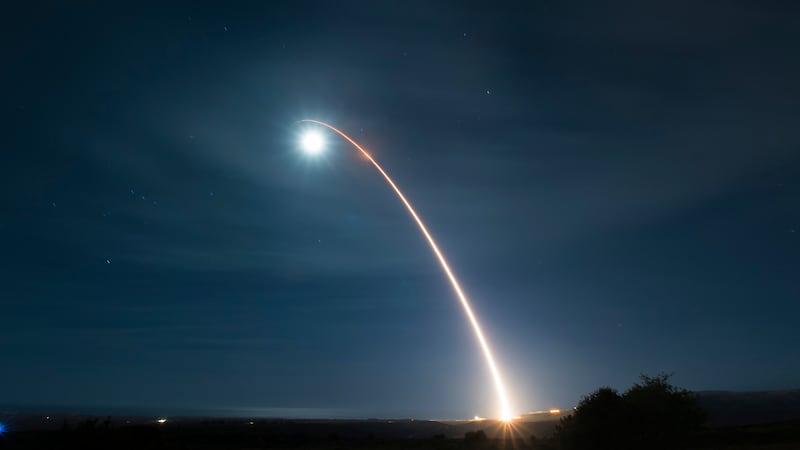
  • An unarmed Minuteman III intercontinental ballistic missile launches during a developmental test on February 5, 2020, at Vandenberg Air Force Base, California. AFP
    An unarmed Minuteman III intercontinental ballistic missile launches during a developmental test on February 5, 2020, at Vandenberg Air Force Base, California. AFP
  • A deactivated Titan II nuclear ICMB is seen in a silo at the Titan Missile Museum in Green Valley, Arizona, on May 12, 2015. AFP
    A deactivated Titan II nuclear ICMB is seen in a silo at the Titan Missile Museum in Green Valley, Arizona, on May 12, 2015. AFP
  • A Russian strategic nuclear forces officer inspects a launching tube in Drovjanaja, Siberia, in 1992. AFP
    A Russian strategic nuclear forces officer inspects a launching tube in Drovjanaja, Siberia, in 1992. AFP

Doomsday arsenal: US discloses nuclear weapon count for first time since 2017


Robert Tollast
  • English
  • Arabic

The US government has disclosed its current inventory of nuclear weapons for the first time since September 2017, saying it has an arsenal of 3,750 active and inactive nuclear missile warheads.

Of the total, 1,550 are in active service. Experts say that is enough to cause more than one billion deaths in the event of a nuclear war, although models on the severity of such a disaster vary widely.

A series of nuclear arms reduction treaties were agreed on at the height of the Cold War between the US and Communist Russia.

In 1969, the Strategic Arms Limitation Talks (Salt) and subsequent accords focused on limiting the number of nuclear weapons and methods of deployment, such as nuclear submarines and bombers.

Subsequent agreements such as Start, the Strategic Arms Reduction Treaty, were contentious for both sides and, by 1986, the combined nuclear arsenals of Russia and the US surpassed 70,000 weapons, according to the Federation of American Scientists.

But the agreements became the framework for post Cold War treaties, which sharply reduced nuclear weapon stockpiles.

Increasing the transparency of states' nuclear stockpiles is important to nonproliferation and disarmament efforts
US State Department

US President Joe Biden is reversing course on former president Donald Trump’s policy of keeping the information from public knowledge.

Mr Trump also refused to renew the New Start treaty, intended to limit and reduce nuclear weapons stockpiles in Russia and the US, and pulled out of a separate agreement, the Intermediate-Range Nuclear Forces (INF) treaty.

The new disclosure, based on stockpiles held on September 30, showed that the US had reduced its inventory by 72 nuclear warheads since September 2017.

According to a 2018 study on potential nuclear conflict, scientists at the Michigan Technological University calculated that 100 nuclear weapons could kill at least 30 million people in the “initial blasts”.

Millions more would succumb to blast injuries and the effects of radiation.

Biden and Putin's nuclear pact

In June, Mr Biden and Russian President Vladimir Putin held a summit to discuss “future arms control and risk reduction measures”, according to a statement released after the meeting.

Mr Biden pledged to “work on a mechanism that can lead to control of new and dangerous and sophisticated weapons that are coming on the scene now that reduce the times of response, that raise the prospects of accidental war”.

The recent disclosure of US nuclear arms comes at a time when Russia and the US are discussing extending the New Start weapons reduction treaty.

Mr Trump said that he would not extend the treaty, which is scheduled to expire in February.

In New Start, Russia and the US agreed to limit their nuclear arsenals to 1,550 active weapons, while both sides also dismantled non-active weapons in their stockpiles.

One of Mr Biden’s first acts in office was to propose an extension to New Start. Russia quickly agreed and earlier this month, talks began in Geneva to create a successor to the treaty, which may be expanded to include limits on non-nuclear weapons.

"Increasing the transparency of states' nuclear stockpiles is important to nonproliferation and disarmament efforts," the State Department said after Tuesday’s disclosure.

According to data released under the New Start treaty in 2018, Russia maintains 1,444 active strategic nuclear warheads. The Stockholm Institute for Peace, a non-government organisation that monitors global conflicts, believes Russia’s nuclear arsenal, including retired weapons, could total more than 6,000 warheads.

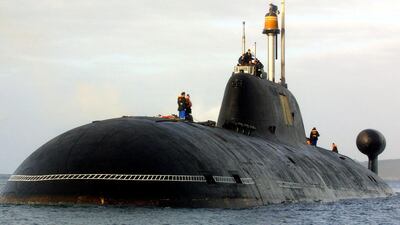
  • A file picture taken in Brest harbor, western France, on September 21, 2004, shows the Vepr Russian nuclear submarine of the Project 971 Shchuka-B type, or Akula-class (Shark) by NATO classification , the same type as the Nerpa Russian nuclear submarine. Russia has handed over the nuclear-powered attack submarine Nerpa to India at a ceremony that followed more than two years of delays, a source in the naval chief of staff told ITAR-TASS today. AFP
    A file picture taken in Brest harbor, western France, on September 21, 2004, shows the Vepr Russian nuclear submarine of the Project 971 Shchuka-B type, or Akula-class (Shark) by NATO classification , the same type as the Nerpa Russian nuclear submarine. Russia has handed over the nuclear-powered attack submarine Nerpa to India at a ceremony that followed more than two years of delays, a source in the naval chief of staff told ITAR-TASS today. AFP
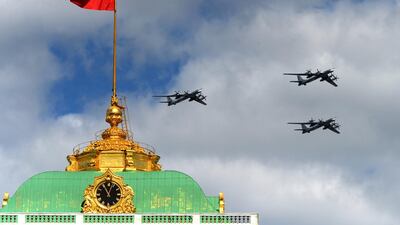
  • Russian Tupolev Tu-95 turboprop-powered strategic bombers fly above the Kremlin in Moscow, on May 5, 2015, during a rehearsal of the Victory Day parade. Russia will celebrate the 70th anniversary of the 1945 defeat of Nazi Germany on May 9. AFP
    Russian Tupolev Tu-95 turboprop-powered strategic bombers fly above the Kremlin in Moscow, on May 5, 2015, during a rehearsal of the Victory Day parade. Russia will celebrate the 70th anniversary of the 1945 defeat of Nazi Germany on May 9. AFP
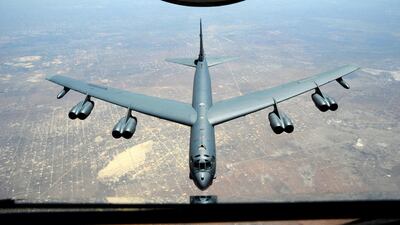
  • Handout file photo dated May 15, 2014 of A B-52 Stratofortress assigned to the 307th Bomb Wing, Barksdale Air Force Base, La., approaches the refueling boom of a KC-135 Stratotanker from the 931st Air Refueling Group, McConnell Air Force Base. The United States flew strategic bombers over the Persian Gulf on Wednesday for the second time this month, a show of force meant to deter Iran from attacking American or allied targets in the Middle East. U.S. Reuters
    Handout file photo dated May 15, 2014 of A B-52 Stratofortress assigned to the 307th Bomb Wing, Barksdale Air Force Base, La., approaches the refueling boom of a KC-135 Stratotanker from the 931st Air Refueling Group, McConnell Air Force Base. The United States flew strategic bombers over the Persian Gulf on Wednesday for the second time this month, a show of force meant to deter Iran from attacking American or allied targets in the Middle East. U.S. Reuters
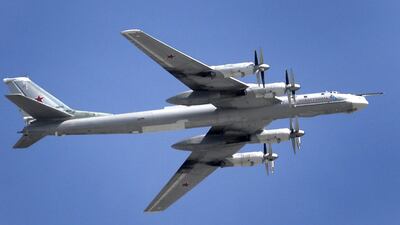
  • A Russian Tupolev Tu-95 turboprop-powered strategic bomber flies above the Kremlin in Moscow, on May 7, 2015, during a rehearsal for the Victory Day military parade. A strategic bomber with seven people on board crashed in far eastern Russia on July 14 but its crew apparently managed to parachute out and a search for them was underway, the defence ministry said. AFP
    A Russian Tupolev Tu-95 turboprop-powered strategic bomber flies above the Kremlin in Moscow, on May 7, 2015, during a rehearsal for the Victory Day military parade. A strategic bomber with seven people on board crashed in far eastern Russia on July 14 but its crew apparently managed to parachute out and a search for them was underway, the defence ministry said. AFP
  • US President Donald Trump (L) and First Lady Melania Trump (2nd L) watch a B-52 bomber flyover during the 2020 Independence Day on the South Lawn of the White House. AFP
    US President Donald Trump (L) and First Lady Melania Trump (2nd L) watch a B-52 bomber flyover during the 2020 Independence Day on the South Lawn of the White House. AFP
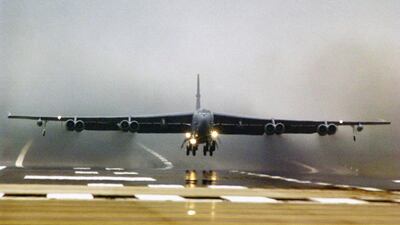
  • An American B52 bomber takes off from RAF Fairford in Gloucestershire. Although there are no details about its mission or destination, recent activity at the base suggest that the eight aircraft were heading for Iraq. Reuters
    An American B52 bomber takes off from RAF Fairford in Gloucestershire. Although there are no details about its mission or destination, recent activity at the base suggest that the eight aircraft were heading for Iraq. Reuters
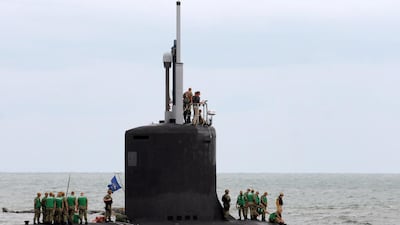
  • Crew members are seen on the USS Indiana, a nuclear powered United States Navy Virginia-class fast attack submarine, as it departs Port Canaveral in Florida on October 1, 2018, on its maiden voyage as a commissioned submarine. The nearly 380-foot-long USS Indiana was commissioned in a ceremony at Port Canaveral on September 29, 2018, and is the Navy's 16th Virginia-Class fast attack submarine. Getty Images
    Crew members are seen on the USS Indiana, a nuclear powered United States Navy Virginia-class fast attack submarine, as it departs Port Canaveral in Florida on October 1, 2018, on its maiden voyage as a commissioned submarine. The nearly 380-foot-long USS Indiana was commissioned in a ceremony at Port Canaveral on September 29, 2018, and is the Navy's 16th Virginia-Class fast attack submarine. Getty Images

But even these numbers pale in comparison with Cold War-era stockpiles. In 1967, at the peak of tensions between the US and the Soviet Union, the US arsenal numbered 31,255 warheads.

The current reduction in nuclear arms, to their lowest level on record, is hardly reassuring however.

Modelling the effects of a global nuclear conflict, the Natural Resources Defence Council calculated that a US attack on China with 789 nuclear warheads would kill 320 million people in the initial blasts, or about one quarter of China’s population, in 368 population centres.

A similar attack on the US with 124 warheads would also kill about one quarter of America’s 330 million citizens.

Anghami
Started: December 2011
Co-founders: Elie Habib, Eddy Maroun
Based: Beirut and Dubai
Sector: Entertainment
Size: 85 employees
Stage: Series C
Investors: MEVP, du, Mobily, MBC, Samena Capital

LUKA CHUPPI

Director: Laxman Utekar

Producer: Maddock Films, Jio Cinema

Cast: Kartik Aaryan, Kriti Sanon​​​​​​​, Pankaj Tripathi, Vinay Pathak, Aparshakti Khurana

Rating: 3/5

Desert Warrior

Starring: Anthony Mackie, Aiysha Hart, Ben Kingsley

Director: Rupert Wyatt

Rating: 3/5

Ticket prices
  • Golden circle - Dh995
  • Floor Standing - Dh495
  • Lower Bowl Platinum - Dh95
  • Lower Bowl premium - Dh795
  • Lower Bowl Plus - Dh695
  • Lower Bowl Standard- Dh595
  • Upper Bowl Premium - Dh395
  • Upper Bowl standard - Dh295
PRISCILLA
%3Cp%3EDirector%3A%20Sofia%20Coppola%3C%2Fp%3E%0A%3Cp%3EStarring%3A%20Cailee%20Spaeny%2C%20Jacob%20Elordi%3C%2Fp%3E%0A%3Cp%3ERating%3A%203%2F5%3C%2Fp%3E%0A
Specs

Engine: 51.5kW electric motor

Range: 400km

Power: 134bhp

Torque: 175Nm

Price: From Dh98,800

Available: Now

Asia Cup 2018 Qualifier

Sunday's results:

  • UAE beat Malaysia by eight wickets
  • Nepal beat Singapore by four wickets
  • Oman v Hong Kong, no result

Tuesday fixtures:

  • Malaysia v Singapore
  • UAE v Oman
  • Nepal v Hong Kong
Ten tax points to be aware of in 2026

1. Domestic VAT refund amendments: request your refund within five years

If a business does not apply for the refund on time, they lose their credit.

2. E-invoicing in the UAE

Businesses should continue preparing for the implementation of e-invoicing in the UAE, with 2026 a preparation and transition period ahead of phased mandatory adoption. 

3. More tax audits

Tax authorities are increasingly using data already available across multiple filings to identify audit risks. 

4. More beneficial VAT and excise tax penalty regime

Tax disputes are expected to become more frequent and more structured, with clearer administrative objection and appeal processes. The UAE has adopted a new penalty regime for VAT and excise disputes, which now mirrors the penalty regime for corporate tax.

5. Greater emphasis on statutory audit

There is a greater need for the accuracy of financial statements. The International Financial Reporting Standards standards need to be strictly adhered to and, as a result, the quality of the audits will need to increase.

6. Further transfer pricing enforcement

Transfer pricing enforcement, which refers to the practice of establishing prices for internal transactions between related entities, is expected to broaden in scope. The UAE will shortly open the possibility to negotiate advance pricing agreements, or essentially rulings for transfer pricing purposes. 

7. Limited time periods for audits

Recent amendments also introduce a default five-year limitation period for tax audits and assessments, subject to specific statutory exceptions. While the standard audit and assessment period is five years, this may be extended to up to 15 years in cases involving fraud or tax evasion. 

8. Pillar 2 implementation 

Many multinational groups will begin to feel the practical effect of the Domestic Minimum Top-Up Tax (DMTT), the UAE's implementation of the OECD’s global minimum tax under Pillar 2. While the rules apply for financial years starting on or after January 1, 2025, it is 2026 that marks the transition to an operational phase.

9. Reduced compliance obligations for imported goods and services

Businesses that apply the reverse-charge mechanism for VAT purposes in the UAE may benefit from reduced compliance obligations. 

10. Substance and CbC reporting focus

Tax authorities are expected to continue strengthening the enforcement of economic substance and Country-by-Country (CbC) reporting frameworks. In the UAE, these regimes are increasingly being used as risk-assessment tools, providing tax authorities with a comprehensive view of multinational groups’ global footprints and enabling them to assess whether profits are aligned with real economic activity. 

Contributed by Thomas Vanhee and Hend Rashwan, Aurifer


Updated: October 06, 2021, 10:53 AM