
North Korea fired at least one possible ballistic missile on Friday in its third weapons launch this month, officials in South Korea and Japan said.
The move appeared to be a reprisal for fresh sanctions imposed by the US this week over Pyongyang's earlier missile tests this month.
South Korea’s Joint Chiefs of Staff said the weapon was fired toward the east but did not say where it landed or provide other details.
Japan’s Prime Minister’s Office and the Defence Ministry also said they detected the North Korean launch on Friday and said it was possibly a ballistic missile.
The launch came hours after North Korea issued a statement reprimanding US President Joe Biden's administration for imposing new sanctions and warned of stronger and more explicit action if Washington continued its “confrontational stance”.
The Biden administration on Wednesday imposed sanctions on five North Koreans over their roles in obtaining equipment and technology for the North’s missile programmes. It also said it would seek new UN sanctions.
The US actions followed North Korea leader Kim Jong-un's call for more efforts to build up the country's “military muscle” after he observed the test of a hypersonic missile, a day after the militaries of the US, South Korea and Japan said they detected North Korea firing a suspected ballistic missile into its eastern sea.
In a statement carried by North Korea’s official Korean Central News Agency, an unidentified foreign ministry spokesperson defended the North’s recent launches of purported hypersonic missiles as a righteous exercise of self-defence.
The spokesperson said the new sanctions underscore hostile US intent aimed at “isolating and stifling” the North despite Washington’s repeated calls for Pyongyang to resume diplomacy that has stalled over disagreements about sanctions relief and nuclear disarmament steps.
The North Korean spokesperson accused the United States of maintaining a “gangster-like” stance, saying that the North’s development of the new missile is part of its efforts to modernise its military and does not target any specific country or threaten the security of its neighbours.
“Nevertheless, the US is intentionally escalating the situation even with the activation of independent sanctions, not content with referring the DPRK’s just activity to the UN Security Council,” the spokesperson said, using an abbreviation of North Korea’s formal name, the Democratic People’s Republic of Korea.
“This shows that though the present US administration is trumpeting about diplomacy and dialogue, it is still engrossed in its policy for isolating and stifling the DPRK … If the US adopts such a confrontational stance, the DPRK will be forced to take stronger and certain reaction to it,” the spokesperson said.
-
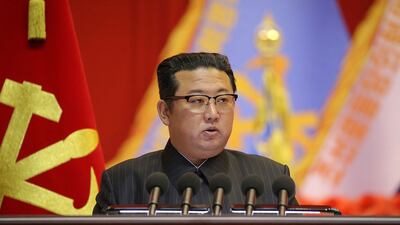
North Korean leader Kim Jong-un attends the eighth conference of military educationists of the Korean People's Army at the April 25 House of Culture in Pyongyang. Korean Central News Agency / AFP -
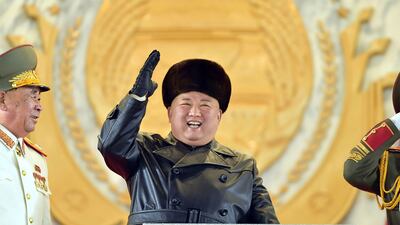
Kim Jong-un attends a military parade marking the ruling party congress at Kim Il-sung Square in Pyongyang in January 2021. KCNA / AP -
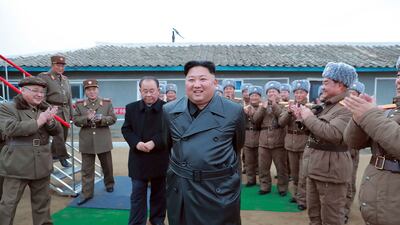
Kim Jong-un is applauded by a military unit after what North Korea claimed was a test firing of its 'super-large' multiple rocket launcher in November 2019. KCNA / AP -
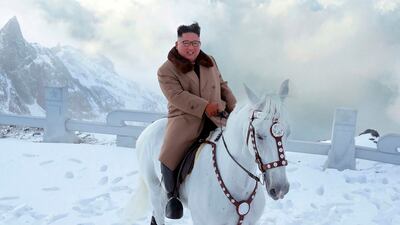
Kim Jong-un rides a horse to climb Mount Paektu in North Korea in October 2019. KCNA / AP -
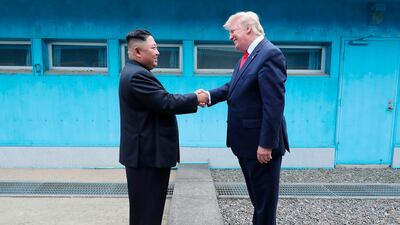
Kim Jong-un and former US president Donald Trump shake hands over the military demarcation line at the border village of Panmunjom in the demilitarised zone in June 2019. KCNA / AP -
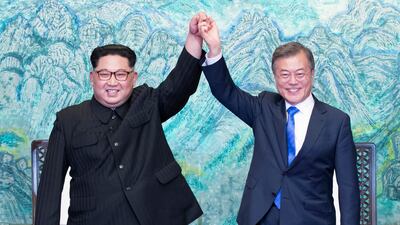
Kim Jong-un and South Korean President Moon Jae-in raise their hands after signing a joint statement in Panmunjom in April 2018. Korea Summit Press Pool / AP -
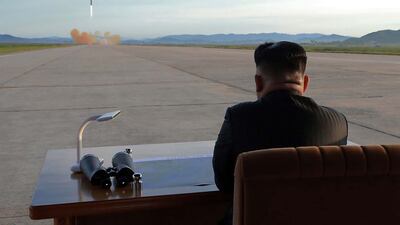
Kim Jong-un inspects a launch drill of the medium and long-range strategic ballistic rocket Hwasong-12 at an undisclosed location in September 2017. KCNA / AFP -
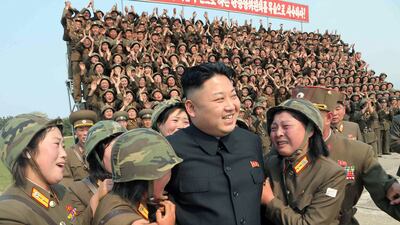
Kim Jong-un smiles with soldiers after inspecting the multiple-rocket launching drill of the women's sub-units under the Korean People's Army Unit 851 at an undisclosed location in North Korea, April 2014. KCNA / AFP -
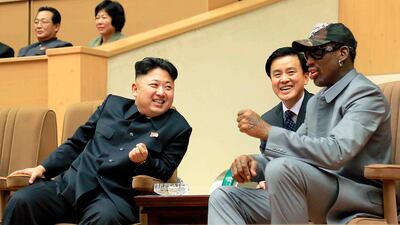
Kim Jong-un talks to former NBA star Dennis Rodman as they watch an exhibition basketball game at an indoor stadium in Pyongyang in January 2014. KCNA / AP -
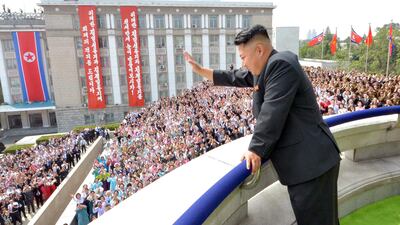
Kim Jong-un inspects a mass parade of the Worker-Peasant Red Guards at Kim Il-sung Square in Pyongyang to mark the 65th anniversary of national foundation day, September 2013. KCNA / AFP -
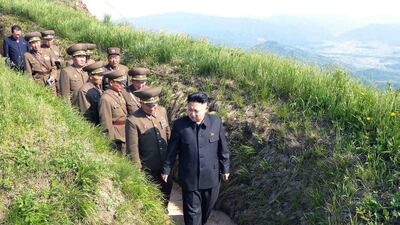
Kim Jong-un visits watch posts of KPA Unit 507 in the Kangwon province of North Korea, June 2013. KCNA / AFP -

Kim Jong-un enjoys the ride as he attends the completion ceremony of the Rungna People's Pleasure Ground in Pyongyang in July 2012. KCNA / AP -
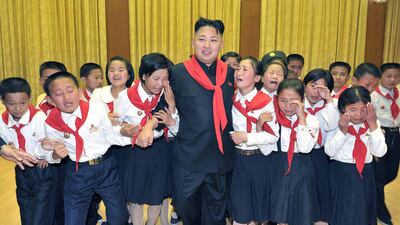
Kim Jong-un is surrounded by members of the Korean Children's Union in Pyongyang in June 2012. KCNA / AFP -
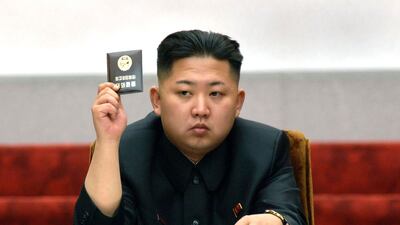
Kim Jong-un attends a meeting of the Supreme People's Assembly in Pyongyang in April 2012. KCNA / AFP -
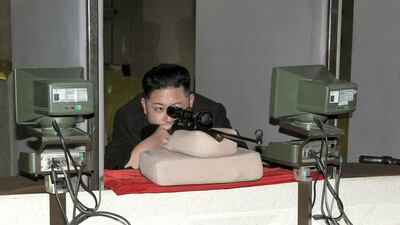
Kim Jong-un aims a gun on an inspection tour of the Sporting Bullet Factory in Pyongyang in February 2012. KCNA / AFP -
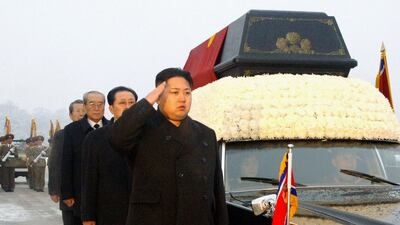
Kim Jong-un salutes besides the convoy carrying the body of his father and late leader Kim Jong-il at Kumsusan Memorial Palace in Pyongyang in December 2011. KCNA / AFP -
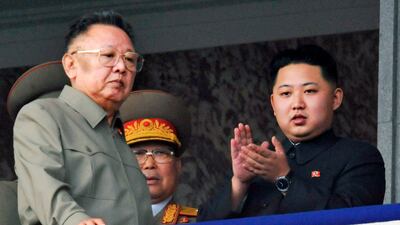
Late North Korean leader Kim Jong-il with his son Kim Jong-un on the balcony as they attend a military parade marking the 65th anniversary of the communist nation's ruling Workers' Party in Pyongyang, October 2010. Kyodo News / AP -
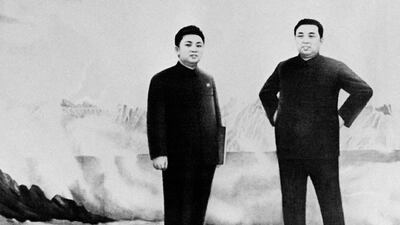
Kim Il-sung with his son and chosen successor, Kim Jong-il in November 1986. KCNA / AFP


The Biden administration, whose policies have reflected a broader shift in US focus from counterterrorism and so-called rogue states like North Korea and Iran to confronting China, has said it is willing to resume talks with North Korea at any time without preconditions.
But North Korea has so far rejected the idea of open-ended talks, saying the US must first withdraw its “hostile policy,” a term Pyongyang mainly uses to describe the sanctions and joint US-South Korea military drills.
In an interview with MSNBC, US Secretary of State Antony Blinken called the North’s latest tests “profoundly destabilising” and said the United States was deeply engaged at the UN and with key partners, including allies South Korea and Japan, on a response.
“I think some of this is North Korea trying to get attention. It’s done that in the past. It’ll probably continue to do that,” Mr Blinken said. “But we are very focused with allies and partners in making sure that they and we are properly defended and that there are repercussions, consequences for these actions by North Korea.”
The State Department said Mr Biden’s special representative for North Korea, Sung Kim, held separate calls with the nuclear envoys of South Korea and Japan to discuss trilateral co-operation following the North’s recent launches and reiterated Washington’s “ironclad” commitment to defend its allies.
A US-led diplomatic push aimed at convincing North Korea to abandon its nuclear weapons programme collapsed in 2019 after the Trump administration rejected the North’s demands for major sanctions relief in exchange for a partial surrender of its nuclear capabilities.
Mr Kim has since pledged to further expand a nuclear arsenal he clearly sees as his strongest guarantee of survival, despite the country’s economy suffering major setbacks amid pandemic-related border closures and persistent US-led sanctions.
Tuesday’s test was North Korea’s second demonstration of its purported hypersonic missile in a week. The country in recent months has been ramping up tests of new, potentially nuclear-capable missiles designed to overwhelm missile defence systems in the region, as it continues to expand its military capabilities amid a freeze in diplomacy with the United States.

