
Folding wingtips on planes could soon be a common sight for passengers peering out windows during take-off, flight and landing if an innovative technology developed by students is adopted within the industry.
The tips are attached to a hinge that operates like that on a door and could reduce how much fuel a plane needs to burn because they increase the wing span, reduce gust and manoeuvre loads, and improve an aircraft's roll performance.
Tests carried out by researchers at Bristol University in the UK show the introduction of the technology would enable a plane to use around 8 per cent less fuel than it uses with regular wings.
Their flexibility means they can be released during gusts of wind and retracted when an aircraft is grounded to meet gate limits at airports.
Aeronautical engineering students at Bristol University in the UK came up with the concept which they hope will be welcomed by an industry on a mission to become more eco-friendly.
After seven years of experiments and research, including the use of wind tunnel tests and computer modelling, the DAWS Flared Folding Wingtips are showing promising signs of being the next big thing in aviation.
The project is a collaboration between Airbus and a team at Bristol University led by Jonathan Cooper, a professor of aeronautical engineering, with input from other universities in the UK.
Prof Cooper showed a model of what students envisioned a plane with wingtips to look like at the Farnborough International Airshow in the UK on Wednesday.
Speaking at the UK Aerospace Research Consortium’s exhibition, Prof Cooper told The National he has high hopes the folding wingtips could be widely adopted within the industry as part of its bid to become more environmentally friendly.
“It was an idea. We did some initial computer modelling and that said it looks good,” he said.
“And then we did some very rudimentary wind tunnel tests to back up the numerics of how the model works.
“The fuel burn or the range of an aircraft depends on better aerodynamics which we get from having a longer wing and also from not having any extra weight.
“If it’s fixed, the wing’s got to be heavier. But if I now have this hinge when I am in flight the weight of the aerodynamics balance itself here.

“Having this floating wingtip means that you don’t have to put more extra structures [on the wing],” he added. “Extra structures equal extra weight therefore you don’t fly as far.
“The other benefit is with roll. You want to be able to move your aircraft so it’s safe in flight. The longer the wings are the slower an aircraft rolls. These folding wingtips, when you get up and roll they actually enhance the roll of the wings.”
Prof Cooper has been working closely with Airbus on the project, which has been granted funding from the aerospace giant itself, as well as the EU.
He has led six students over the course of seven years to research how the wingtips would fare on planes on short-haul and long-haul flights. So far, he said the technology looks promising and he believes it could benefit planes on shorter journeys.
The university team is now in the process of transferring the technology to Airbus.
The aviation industry is under pressure to find solutions to reduce its harmful impact on the environment and come up with innovative ways to reach a target of net zero carbon emissions by 2050.
Much of the buzz in aviation circles centres on the role sustainable aviation fuels will play in meeting the goal.
But Prof Cooper said the introduction of SAFs across the industry is not a silver bullet for the problems and said carriers will need to focus on details about plane design as well if they are to operate in a greener way.
-
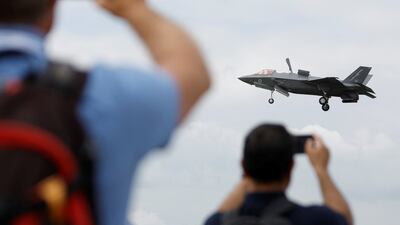
Visitors watch a RAF F-35 aircraft at the Farnborough International Airshow in Hampshire, southern England. Reuters -
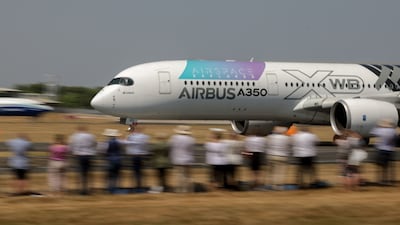
An Airbus SE A350 aircraft lands after an aerial display. Bloomberg -
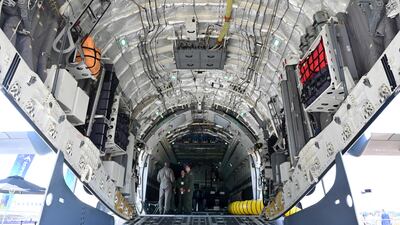
An Embraer C-390 Millennium military transport aircraft, used by Brazil's Airforce, on display. AFP -

A detailed view of a Pratt & Whitney PW123 engine. Reuters -
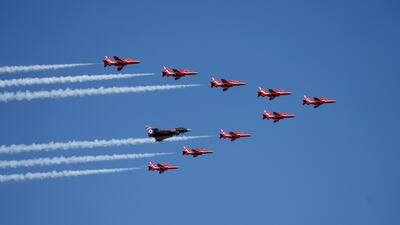
The RAF's Red Arrows aerobatics team perform. AP -
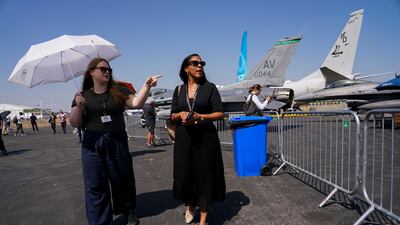
Visitors shelter from the sun as they look around the show. AP -
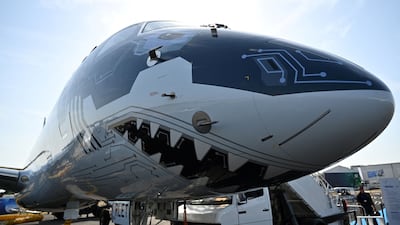
An Embraer E190-E2 aircraft. AFP -
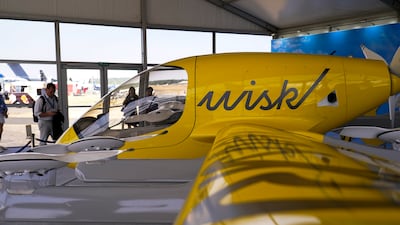
Visitors look at a model of the Wisk Aero autonomous aircraft. AP -
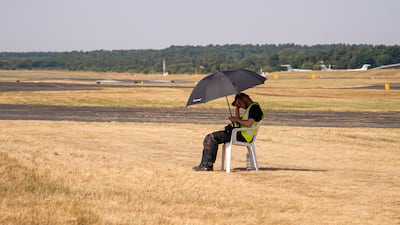
A member of staff shelters from the sun. AP -
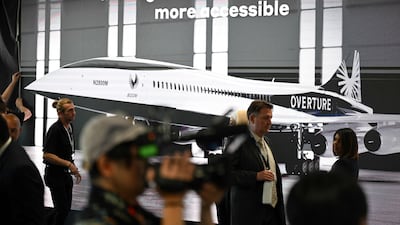
Attendees walk past a poster of a Boom Supersonic concept Overture aircraft. AFP -
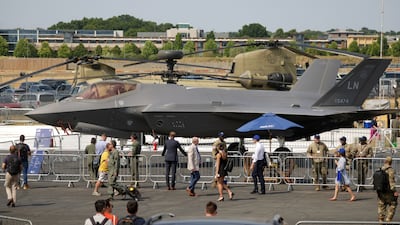
A US Air Force F-35A fighter jet on display. Bloomberg -

A model of proposed jet fighter aircraft Tempest, a joint programme by a consortium known as 'Team Tempest', which includes Britain's Ministry of Defence, BAE Systems, Rolls-Royce, Leonardo SPA, MBDA and Saab. AFP -

Visitors watch the Embraer E2 Profit Hunter plane taking off. AFP -
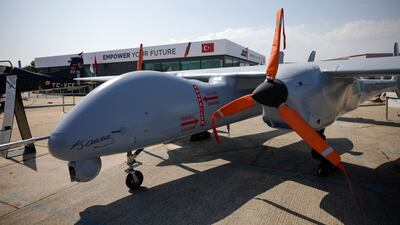
An Aksungur drone, manufactured by Turkish Aerospace Industries, on display. Bloomberg -
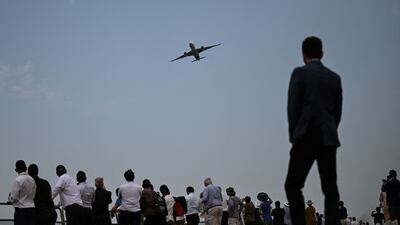
An Airbus A350 plane flying over the crowds at Farnborough. AFP -
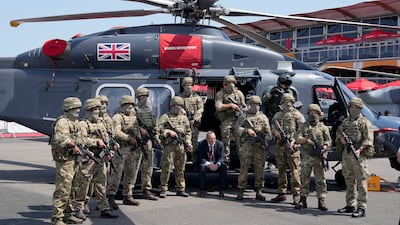
Soldiers pose beside a Leonardo helicopter. AP -
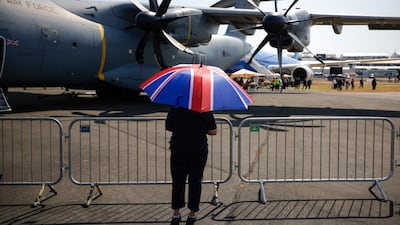
An aviation enthusiast shelters from the sun at the show. Temperatures were forecast to reach 40°C in parts of England. Bloomberg -
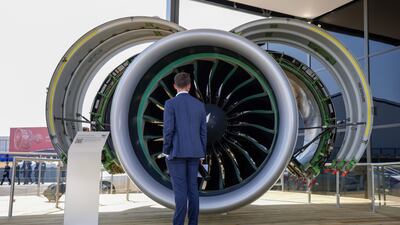
A model of a Pratt & Whitney GTF engine. This is the first Farnborough in four years, due to the pandemic. Bloomberg -
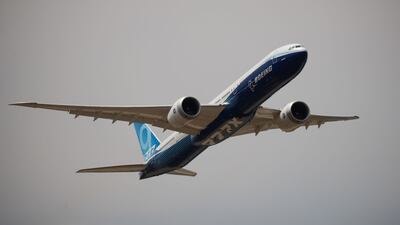
A Boeing 737-9 puts on a display at Farnborough. Bloomberg -
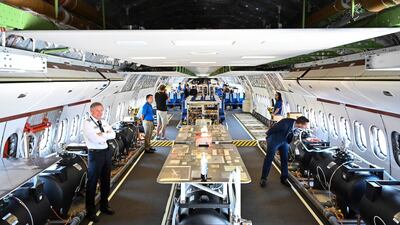
Visitors examine water barrels in a Boeing 777X, in an experiment on weight distribution. AFP -

An aviation fan uses a fan to keep cool amid soaring temperatures. Bloomberg -
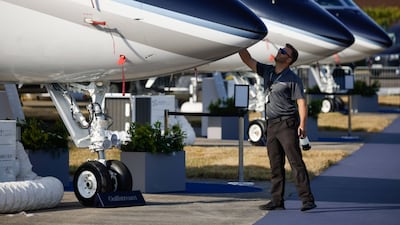
A worker keeps a GulfStream Aerospace Corp G650 business jet gleaming. Bloomberg -
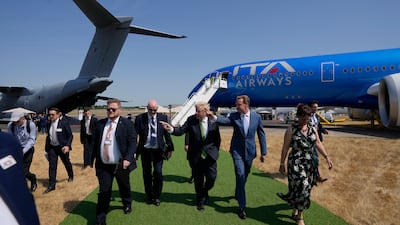
Britain's Prime Minister Boris Johnson tours Farnborough, a vital marketplace for the country's aviation industry. AP -
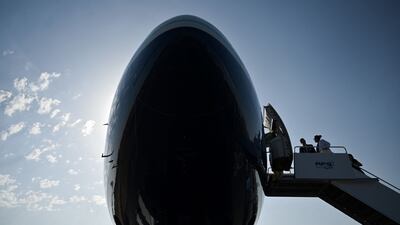
Visitors board a Boeing 777X. Deals worth £161 billion ($192bn) were agreed the last time Farnborough was held, organisers said. AFP -
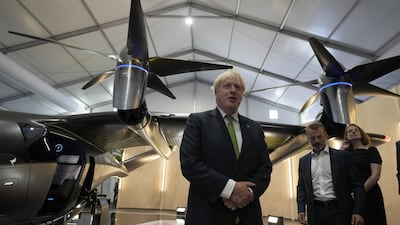
Boris Johnson views the display by SaxaVord, the UK Spaceport. PA -
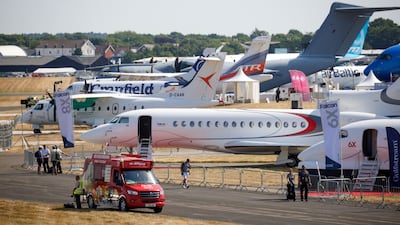
More than 80,000 visitors from 96 countries are expected to attend this week's five-day event. Bloomberg


“It’s not just a case of taking the kerosene out and putting the hydrogen in,” he said. “Hydrogen has a lot of its own problems, it’s got to be kept very cold, pressurised etc.
“But whatever the plane designs are in the next 20-30 years, they may be battery driven if they’re smaller aircraft, you want to be able to use less energy. And so this sort of device [the wingtips] will give you 7- 8 per cent reduction in fuel burn from the better aerodynamics, no increase in weight, no extra control surfaces.”
International and domestic visitors to Farnborough, in the south of England, have shown a keen interest in the folding wingtips, Prof Cooper said, adding to his hopes they could one day become the norm on planes.
“This at the minute is a very encouraging technology,” he said.
“I hope in 20 years’ time this is going to be on a real airplane. That’s the dream.”

