French President Emmanuel Macron and Israeli Prime Minister Benjamin Netanyahu in Paris on Thursday. AP

Netanyahu and Macron discuss Iran and Israeli-Palestinian tension over dinner


  • English
  • Arabic

Israeli Prime Minister Benjamin Netanyahu met French President Emmanuel Macron, business leaders and members of France’s Jewish community during a trip to Paris that has angered Palestinian supporters amid a new spasm of violence in the Middle East.

The visit began with a dinner meeting at the Elysee Palace on Thursday, where the talking points included Mr Macron's assurance of France’s “solidarity with Israel in the face of terrorism”, as well as “the need for everyone to avoid measures likely to feed the spiral of violence”, his office said.

Before departing for France, Mr Netanyahu said Iran would be “the main topic of our talk”.

Mr Macron denounced the “headlong rush” of Iran's nuclear programme after the meeting.

He criticised Tehran's lack of transparency over its nuclear activities and said its support for Russia’s war in Ukraine exposed it to further sanctions and growing isolation.

Iran's continued development of its atomic project will “inevitably have consequences”, he said.

Mr Macron also offered to help revive long-stalled dialogue between the Israelis and Palestinians.

Pro-Palestinian activists plan to hold a protest in Paris on Saturday to denounce Mr Macron’s decision to host Mr Netanyahu at such a volatile time in the conflict.

The demonstrators said they would also demonstrate against prison conditions for Palestinians held in Israel, including solitary confinement and limits on family visits.

Mr Netanyahu’s trip comes during one of the deadliest periods in the Israeli-Palestinian conflict in years, with the fighting spilling over into the Gaza Strip.

The two leaders spoke on Sunday after the fatal Palestinian shooting near a Jerusalem synagogue.

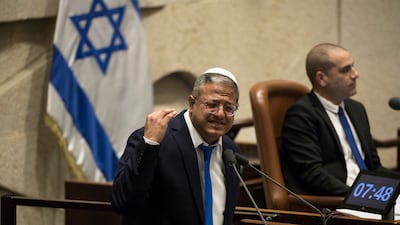
Mr Netanyahu is the head of Israel’s most right-wing government, which is buoyed by ultranationalist parties that have promised to take a hard line against Palestinians and to ramp up settlement construction in the occupied West Bank.

Israel swears in new right-wing government — in pictures

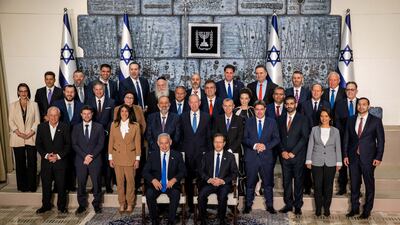
  • President Isaac Herzog and Prime Minister Benjamin Netanyahu with members of the new Israeli government. Reuters
    President Isaac Herzog and Prime Minister Benjamin Netanyahu with members of the new Israeli government. Reuters
  • Prime Minister Benjamin Netanyahu and his wife Sara attend a toast for the new speaker of Israel's parliament. Reuters
    Prime Minister Benjamin Netanyahu and his wife Sara attend a toast for the new speaker of Israel's parliament. Reuters
  • Benjamin Netanyahu after the traditional group photo with Israel's new government. EPA
    Benjamin Netanyahu after the traditional group photo with Israel's new government. EPA
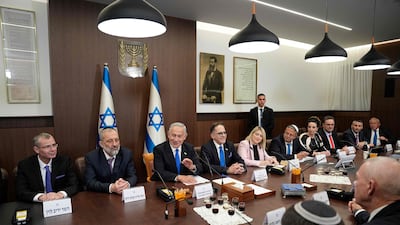
  • Benjamin Netanyahu during the first cabinet meeting of his new government in Jerusalem. AFP
    Benjamin Netanyahu during the first cabinet meeting of his new government in Jerusalem. AFP
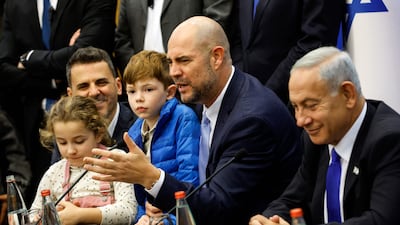
  • New Knesset speaker Amir Ohana, centre, with his partner Alon, left, their children, and Benjamin Netanyahu at the Knesset in Jerusalem. AFP
    New Knesset speaker Amir Ohana, centre, with his partner Alon, left, their children, and Benjamin Netanyahu at the Knesset in Jerusalem. AFP
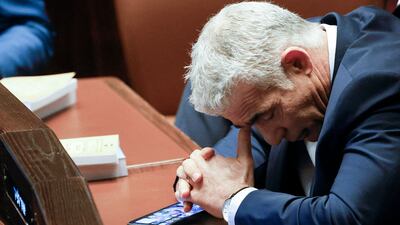
  • Outgoing Prime Minister Yair Lapid attends a special session of Israel's parliament, the Knesset, to swear in a new government. AFP
    Outgoing Prime Minister Yair Lapid attends a special session of Israel's parliament, the Knesset, to swear in a new government. AFP
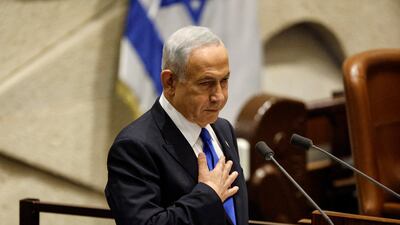
  • Israeli Prime Minister-designate Benjamin Netanyahu speaks at the special session. EPA
    Israeli Prime Minister-designate Benjamin Netanyahu speaks at the special session. EPA
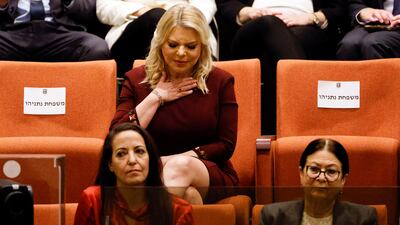
  • Sara Netanyahu, centre top, Benjamin Netanyahu's wife, Lihi Lapid, centre left, Yair Lapid's wife, and Esther Hayut, President of the Supreme Court of Israel. Reuters
    Sara Netanyahu, centre top, Benjamin Netanyahu's wife, Lihi Lapid, centre left, Yair Lapid's wife, and Esther Hayut, President of the Supreme Court of Israel. Reuters
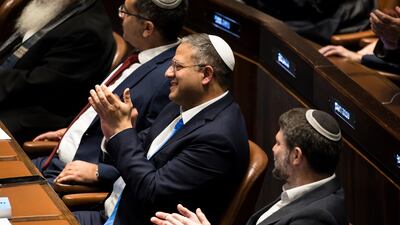
  • Designated Minister of National Security Itamar Ben Gvir, left, and designated Israeli Minister of Finance Bezalel Smotrich, right, at the session in parliament. Getty Images
    Designated Minister of National Security Itamar Ben Gvir, left, and designated Israeli Minister of Finance Bezalel Smotrich, right, at the session in parliament. Getty Images
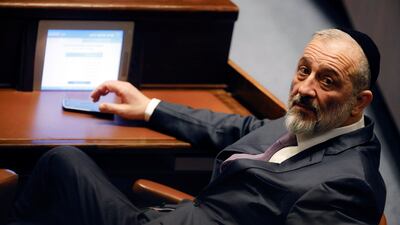
  • Member of Knesset Aryeh Deri attends a special session of the Knesset, Israel's parliament, to approve and swear in a new right-wing government, in Jerusalem. AP
    Member of Knesset Aryeh Deri attends a special session of the Knesset, Israel's parliament, to approve and swear in a new right-wing government, in Jerusalem. AP
  • Designated Minister of National Security Itamar Ben Gvir speaks at the swearing-in session. Getty Images
    Designated Minister of National Security Itamar Ben Gvir speaks at the swearing-in session. Getty Images
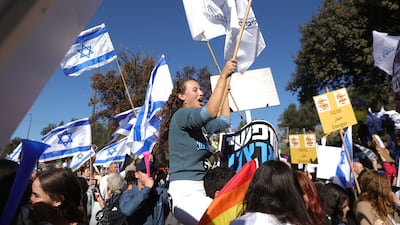
  • Protesters against the new Netanyahu government outside the Knesset, Israel's parliament, as it is sworn in. EPA
    Protesters against the new Netanyahu government outside the Knesset, Israel's parliament, as it is sworn in. EPA
  • Israelis protest against the new government. EPA
    Israelis protest against the new government. EPA

During the meeting with Mr Macron, Mr Netanyahu said he would meet French business leaders interested in investing in Israel and representatives of the Jewish community before leaving on Saturday night.

Earlier this week, the French government unveiled a plan aimed at better combating racism and anti-Semitism, including measures to deal with the proliferation of hate speech online and campaigns to raise awareness about the Holocaust.

Agencies contributed to this report.

U19 WORLD CUP, WEST INDIES

UAE group fixtures (all in St Kitts)

  • Saturday 15 January: UAE beat Canada by 49 runs 
  • Thursday 20 January: v England 
  • Saturday 22 January: v Bangladesh 

UAE squad:

Alishan Sharafu (captain), Shival Bawa, Jash Giyanani, Sailles
Jaishankar, Nilansh Keswani, Aayan Khan, Punya Mehra, Ali Naseer, Ronak Panoly,
Dhruv Parashar, Vinayak Raghavan, Soorya Sathish, Aryansh Sharma, Adithya
Shetty, Kai Smith  

TRAP

Starring: Josh Hartnett, Saleka Shyamalan, Ariel Donaghue

Director: M Night Shyamalan

Rating: 3/5

How to turn your property into a holiday home
  1. Ensure decoration and styling – and portal photography – quality is high to achieve maximum rates.
  2. Research equivalent Airbnb homes in your location to ensure competitiveness.
  3. Post on all relevant platforms to reach the widest audience; whether you let personally or via an agency know your potential guest profile – aiming for the wrong demographic may leave your property empty.
  4. Factor in costs when working out if holiday letting is beneficial. The annual DCTM fee runs from Dh370 for a one-bedroom flat to Dh1,200. Tourism tax is Dh10-15 per bedroom, per night.
  5. Check your management company has a physical office, a valid DTCM licence and is licencing your property and paying tourism taxes. For transparency, regularly view your booking calendar.
China and the UAE agree comprehensive strategic partnership

China and the UAE forged even closer links between the two countries during the landmark state visit after finalising a ten-point agreement on a range of issues, from international affairs to the economy and trade and renewable energy.

1. Politics: The two countries agreed to support each other on issues of security and to work together on regional and international challenges. The nations also confirmed that the number of high-level state visits between China and the UAE will increase.

2. Economy: The UAE offers its full support to China's Belt and Road Initiative, which will combine a land 'economic belt" and a "maritime silk road" that will link China with the Arabian Gulf as well as Southeast, South and Central China, North Africa and, eventually, Europe. 

3. Business and innovation: The two nations are committed to exploring new partnerships in sectors such as Artificial Intelligence, energy, the aviation and transport industries and have vowed to build economic co-operation through the UAE-China Business Committee.

4. Education, science and technology: The Partnership Programme between Arab countries in Science and Technology will encourage young Emirati scientists to conduct research in China, while the nations will work together on the peaceful use of nuclear energy, renewable energy and space projects. 

5. Renewable energy and water: The two countries will partner to develop renewable energy schemes and work to reduce climate change. The nations have also reiterated their support for the Abu Dhabi-based International Renewable Energy Agency.

6. Oil and gas: The UAE and China will work in partnership in the crude oil trade and the exploration and development of oil and natural gas resources.

7. Military and law enforcement and security fields: Joint training will take place between the Chinese and UAE armed forces, while the two nations will step up efforts to combat terrorism and organised crime. 

8. Culture and humanitarian issues: Joint cultural projects will be developed and partnerships will be cultivated on the preservation of heritage, contemporary art and tourism. 

9. Movement between countries: China and the UAE made clear their intent to encourage travel between the countries through a wide-ranging visa waiver agreement.

10. Implementing the strategic partnership: The Intergovernmental Co-operation Committee, established last year, will be used to ensure the objectives of the partnership are implemented.


Updated: February 03, 2023, 4:14 AM