Seventeen dust rings resembling a fingerprint created by a rare type of star and its companion. Nasa

Could moon dust be the solution to climate change?


Daniel Bardsley
  • English
  • Arabic

As the world struggles to limit greenhouse gas emissions, scientists in the US are exploring the possibility that warming could be reduced if dust were used to block some of the Sun’s rays.

Designed to stop between one and two per cent of the Sun’s radiation, the approach is most feasible with moon dust, said a study in the journal PLOS Climate.

Researchers at the Centre for Astrophysics – Harvard and Smithsonian and the University of Utah suggest that launching dust from Earth would not be the favoured approach because of the huge cost and effort.

Using moon dust would be less expensive and would still be able to shield against enough of the Sun’s rays for the technique to work.

"It is amazing to contemplate how moon dust, which took over four billion years to generate, might help slow the rise in the Earth’s temperature, a problem that took us less than 300 years to produce,” said Dr Scott Kenyon of the Centre for Astrophysics.

In carrying out their research, the scientists used techniques they usually employ to analyse how dust that forms rings around stars during planet formation intercepts and re-radiates light from the star.

Their idea is that a small amount of material in an orbit between the Earth and the Sun could, when broken up, block out a relatively large quantity of sunlight.

A simulated stream of dust launched between Earth and the Sun. Ben Bromley/University of Utah

A priority was identifying orbits that could hold the dust in position long enough for it to provide adequate shading.

"Because we know the positions and masses of the major celestial bodies in our solar system, we can simply use the laws of gravity to track the position of a simulated sunshield over time for several different orbits," said Sameer Khan, a University of Utah undergraduate and co-author of the study.

Key to this are Lagrange points, defined by Nasa as "positions in space where objects sent there tend to stay put" because gravitational forces are balanced.

The closest point between the Earth and the Sun where this is the case is the L1 Lagrange point.

A new space station platform?

One idea considered was to place a space station platform at the L1 Lagrange point and launch dust from it.

Simulations found that while the dust would provide temporary shading, it would easily be blown off course by solar winds, radiation and gravity, so dust would have to be launched every few days.

“It was rather difficult to get the shield to stay at L1 long enough to cast a meaningful shadow," Mr Khan said.

"This shouldn’t come as a surprise, though, since L1 is an unstable equilibrium point.

“Even the slightest deviation in the sunshield’s orbit can cause it to rapidly drift out of place, so our simulations had to be extremely precise.”

The researchers found that if moon dust were aimed at L1, there would be effective shielding of sunlight.

Large amounts of lunar dust would be required, but less energy would be needed to launch it, compared to sending dust from Earth.

"It is astounding that the Sun, Earth and Moon are in just the right configuration to enable this kind of climate mitigation strategy," Dr Kenyon said.

  • Sign warns of extreme heat at the Badwater Basin salt flats inside Death Valley National Park in California. AFP
    Sign warns of extreme heat at the Badwater Basin salt flats inside Death Valley National Park in California. AFP
  • Death Valley set a global record for the hottest day in September, with a temperature of 57°C. AP
    Death Valley set a global record for the hottest day in September, with a temperature of 57°C. AP
  • Death Valley National Park, California. Getty Images
    Death Valley National Park, California. Getty Images
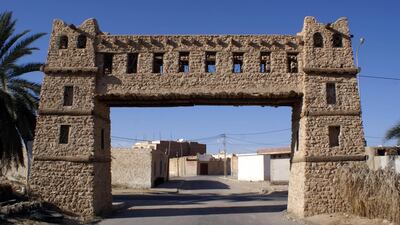
  • Kebili, Tunisia. Photo: Alamy
    Kebili, Tunisia. Photo: Alamy
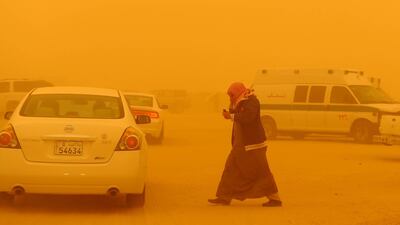
  • Mitribah, Kuwait. AP
    Mitribah, Kuwait. AP
  • Turbat, Pakistan. Photo: Wikimedia Commmons
    Turbat, Pakistan. Photo: Wikimedia Commmons
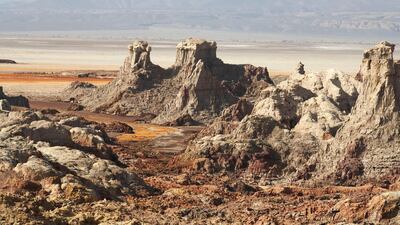
  • Dallol, Ethiopia. Reuters
    Dallol, Ethiopia. Reuters
  • Aziziyah, Libya. Photo: Wikimedia Commons
    Aziziyah, Libya. Photo: Wikimedia Commons
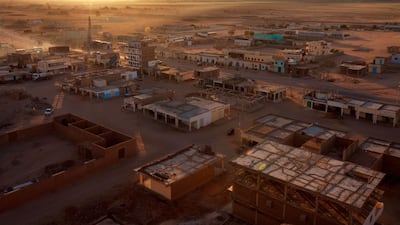
  • Wadi Halfa, Sudan. Photo: Alamy
    Wadi Halfa, Sudan. Photo: Alamy
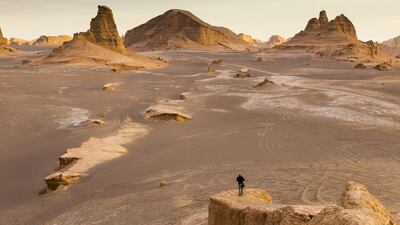
  • Dasht-e Lut Desert, Iran. Getty Images
    Dasht-e Lut Desert, Iran. Getty Images
  • Khuzestan, Iran. Photo: WallpaperFlare
    Khuzestan, Iran. Photo: WallpaperFlare
  • Ghadames, Libya. Reuters
    Ghadames, Libya. Reuters
  • Ouargla, Algeria. Photo: Unsplash
    Ouargla, Algeria. Photo: Unsplash
  • Wadi Dhayqah in Quriyat, Oman. Photo: Saleh Al Shaibany
    Wadi Dhayqah in Quriyat, Oman. Photo: Saleh Al Shaibany

Because dust particles are dispersed throughout the solar system by solar radiation, any sunshield would be temporary and dust particles would not fall to Earth, so there is no risk of our planet becoming permanently cold, the scientists say.

The researchers acknowledged that they were not specialists in climate change or in the types of rocket that might be needed to carry out the methods, but they said potentially useful approaches were worth analysing.

Bob Ward, from the Grantham Research Institute on Climate Change and the Environment, part of the London School of Economics, said solar radiation management "might be something we will have to consider".

"Particularly as it’s beginning to look increasingly unlikely we’ll limit temperature increases to below 1.5°C" above pre-industrial levels, said Mr Ward, who is not connected with the new study.

There would likely be knock-on effects from using dust, he said, including potential alterations in plant growth because less solar radiation reaches Earth.

He warned that intercepting a portion of the Sun’s rays, even if it altered temperatures, would not deal with some consequences of increased carbon dioxide levels in the atmosphere, such as ocean acidification.

But the problems of using dust may not necessarily be insurmountable, with Mr Ward saying that the approach could be considered a "Plan B" to the "more straightforward solution of stopping greenhouse gases in the first place".


FIXTURES (all times UAE)

Sunday
Brescia v Lazio (3.30pm)
SPAL v Verona (6pm)
Genoa v Sassuolo (9pm)
AS Roma v Torino (11.45pm)

Monday
Bologna v Fiorentina (3.30pm)
AC Milan v Sampdoria (6pm)
Juventus v Cagliari (6pm)
Atalanta v Parma (6pm)
Lecce v Udinese (9pm)
Napoli v Inter Milan (11.45pm)

Specs

Engine: Dual-motor all-wheel-drive electric

Range: Up to 610km

Power: 905hp

Torque: 985Nm

Price: From Dh439,000

Available: Now

Company%20profile
%3Cp%3E%3Cstrong%3ECompany%20name%3A%3C%2Fstrong%3E%20Fasset%0D%3Cbr%3E%3Cstrong%3EStarted%3A%20%3C%2Fstrong%3E2019%0D%3Cbr%3E%3Cstrong%3EFounders%3A%3C%2Fstrong%3E%20Mohammad%20Raafi%20Hossain%2C%20Daniel%20Ahmed%0D%3Cbr%3E%3Cstrong%3EBased%3A%3C%2Fstrong%3E%20Dubai%0D%3Cbr%3E%3Cstrong%3ESector%3A%20%3C%2Fstrong%3EFinTech%0D%3Cbr%3E%3Cstrong%3EInitial%20investment%3A%3C%2Fstrong%3E%20%242.45%20million%0D%3Cbr%3E%3Cstrong%3ECurrent%20number%20of%20staff%3A%3C%2Fstrong%3E%2086%0D%3Cbr%3E%3Cstrong%3EInvestment%20stage%3A%3C%2Fstrong%3E%20Pre-series%20B%0D%3Cbr%3E%3Cstrong%3EInvestors%3A%3C%2Fstrong%3E%20Investcorp%2C%20Liberty%20City%20Ventures%2C%20Fatima%20Gobi%20Ventures%2C%20Primal%20Capital%2C%20Wealthwell%20Ventures%2C%20FHS%20Capital%2C%20VN2%20Capital%2C%20local%20family%20offices%3C%2Fp%3E%0A
THE BIO

Ms Al Ameri likes the variety of her job, and the daily environmental challenges she is presented with.

Regular contact with wildlife is the most appealing part of her role at the Environment Agency Abu Dhabi.

She loves to explore new destinations and lives by her motto of being a voice in the world, and not an echo.

She is the youngest of three children, and has a brother and sister.

Her favourite book, Moby Dick by Herman Melville helped inspire her towards a career exploring  the natural world.

How to watch Ireland v Pakistan in UAE

When: The one-off Test starts on Friday, May 11
What time: Each day’s play is scheduled to start at 2pm UAE time.
TV: The match will be broadcast on OSN Sports Cricket HD. Subscribers to the channel can also stream the action live on OSN Play.

UAE currency: the story behind the money in your pockets
Match info

Liverpool 3
Hoedt (10' og), Matip (21'), Salah (45 3')

Southampton 0

HOW%20TO%20ACTIVATE%20THE%20GEMINI%20SHORTCUT%20ON%20CHROME%20CANARY
%3Cp%3E1.%20Go%20to%20%3Cstrong%3Echrome%3A%2F%2Fflags%3C%2Fstrong%3E%3C%2Fp%3E%0A%3Cp%3E2.%20Find%20and%20enable%20%3Cstrong%3EExpansion%20pack%20for%20the%20Site%20Search%20starter%20pack%3C%2Fstrong%3E%3C%2Fp%3E%0A%3Cp%3E3.%20Restart%20Chrome%20Canary%3C%2Fp%3E%0A%3Cp%3E4.%20Go%20to%20%3Cstrong%3Echrome%3A%2F%2Fsettings%2FsearchEngines%3C%2Fstrong%3E%20in%20the%20address%20bar%20and%20find%20the%20%3Cstrong%3EChat%20with%20Gemini%3C%2Fstrong%3E%20shortcut%20under%20%3Cstrong%3ESite%20Search%3C%2Fstrong%3E%3C%2Fp%3E%0A%3Cp%3E5.%20Open%20a%20new%20tab%20and%20type%20%40%20to%20see%20the%20Chat%20with%20Gemini%20shortcut%20along%20with%20other%20Omnibox%20shortcuts%20to%20search%20tabs%2C%20history%20and%20bookmarks%3C%2Fp%3E%0A
Ticket prices
  • Golden circle - Dh995
  • Floor Standing - Dh495
  • Lower Bowl Platinum - Dh95
  • Lower Bowl premium - Dh795
  • Lower Bowl Plus - Dh695
  • Lower Bowl Standard- Dh595
  • Upper Bowl Premium - Dh395
  • Upper Bowl standard - Dh295
Avatar: Fire and Ash

Director: James Cameron

Starring: Sam Worthington, Sigourney Weaver, Zoe Saldana

Rating: 4.5/5

FFP EXPLAINED

What is Financial Fair Play?
Introduced in 2011 by Uefa, European football’s governing body, it demands that clubs live within their means. Chiefly, spend within their income and not make substantial losses.

What the rules dictate? 
The second phase of its implementation limits losses to €30 million (Dh136m) over three seasons. Extra expenditure is permitted for investment in sustainable areas (youth academies, stadium development, etc). Money provided by owners is not viewed as income. Revenue from “related parties” to those owners is assessed by Uefa's “financial control body” to be sure it is a fair value, or in line with market prices.

What are the penalties? 
There are a number of punishments, including fines, a loss of prize money or having to reduce squad size for European competition – as happened to PSG in 2014. There is even the threat of a competition ban, which could in theory lead to PSG’s suspension from the Uefa Champions League.

Updated: February 08, 2023, 8:52 PM