A total solar eclipse is set to cast its shadow across some parts of the world on April 8, plunging countries into daytime darkness.
The rare celestial event occurs when the Moon perfectly aligns between the Earth and the Sun, causing it to completely block the sunlight that reaches the planet.
It would even block the Sun's disk for a few minutes, allowing observers to witness the atmosphere of the giant star.
When and where will the April solar eclipse appear?
The astronomical treat will only be visible in Mexico, through the US from Texas to Maine, and up through Canada.
"People viewing the eclipse from locations where the Moon’s shadow completely covers the Sun – known as the path of totality – will experience a total solar eclipse," Nasa said.
"The sky will become dark, as if it were dawn or dusk. Weather permitting, people along the path of totality will see the Sun’s corona, or outer atmosphere, which is usually obscured by the bright face of the Sun."

The first location that will experience totality is Mexico's Pacific coast at about 11.07am PDT (10.07pm UAE time), on April 8.
Then the path of the eclipse will continue into the US, moving into Texas first and then travelling through Oklahoma, Arkansas, Missouri, Illinois, Kentucky, Indiana, Ohio, Pennsylvania, New York, Vermont, New Hampshire and Maine.
The eclipse will enter Canada in Southern Ontario, and continue through Quebec, New Brunswick, Prince Edward Island, and Nova Scotia.
It will exit continental North America on the Atlantic coast of Newfoundland, Canada, at 5.16pm NDT (11.46pm UAE time).
The next total solar eclipse will not be visible in the contiguous US until 2044.
In the UAE, a partial solar eclipse was visible in 2022, and the next one will take place in 2027.
A partial lunar eclipse was visible in the skies in October 2023.
Safety first
Nasa said that it was important to wear solar viewing glasses to safely observe the eclipse, as it could cause severe eye damage.
"Do not look at the Sun through a camera lens, telescope, binoculars or any other optical device while wearing eclipse glasses or using a hand-held solar viewer – the concentrated solar rays will burn through the filter and cause serious eye injury," the space agency said.
"Eclipse glasses are not regular sunglasses. Regular sunglasses, no matter how dark, are not safe for viewing the Sun."
Partial solar eclipse in 2022 - in pictures
-

Tourists using a handmade protective viewing filter sheet to watch the partial solar eclipse, at the Phoenician ruins, in the southern port city of Tyre, Lebanon. AP -
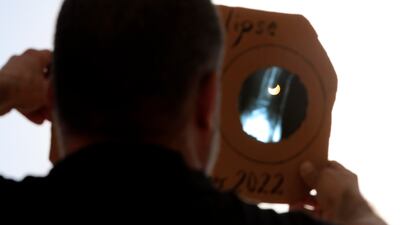
A man using handmade protective viewing to watch the eclipse in Tyre. AP -

A camel herder is silhouetted against a partial solar eclipse in Pushkar, in the western Indian state of Rajasthan. AP -

People gather at the Al Thuraya Astronomy Centre in Mushrif Park to watch the partial solar eclipse. Antonie Robertson/The National -
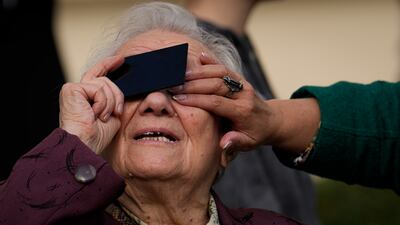
An elderly woman looks through a welding filter during a partial solar eclipse in Bucharest, Romania. AP -

People watch a partial solar eclipse in Mumbai, India. AP -
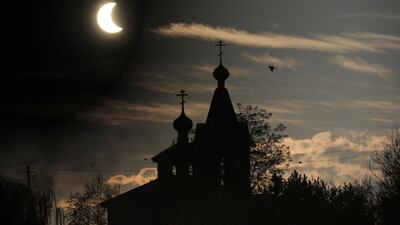
A partial solar eclipse over a Christian church in the Almaty region of Kazakhstan. Reuters -

A view of the partial solar eclipse behind the pods of a Ferris wheel at an amusement park in Dohuk in Iraq's autonomous Kurdistan region. AFP -
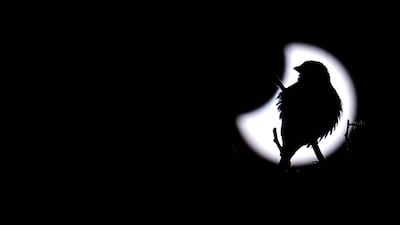
A view of the partial solar eclipse visible behind a bird on a tree in Istanbul. AFP -
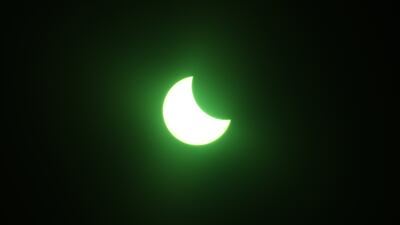
A partial solar eclipse as seen from Al Thuraya Astronomy Centre in Dubai. EPA -

The partial solar eclipse is framed by youngsters jumping on a trampoline in the outskirts of Lahore, Pakistan. AP -
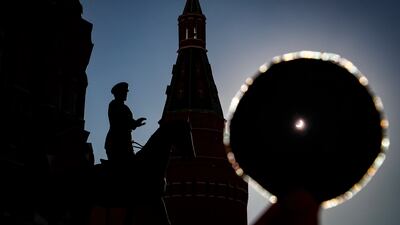
A partial solar eclipse as seen in Moscow. EPA -

People wear protective glasses to observe the celestial event in Kuwait city. EPA -

A statue of goddess Minerva is backdropped by the sun during a partial solar eclipse in Bucharest. AP -
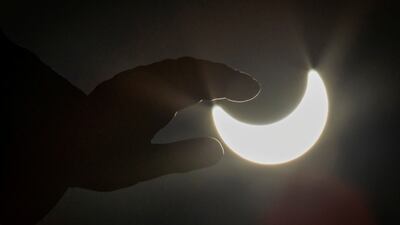
A fragment of a monument to Soviet World War Two commander Marshal Georgy Zhukov is pictured during a partial solar eclipse in central Moscow. Reuters -
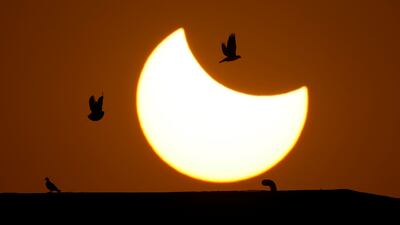
Pigeons fly past a partial solar eclipse in Ahmedabad. AP -
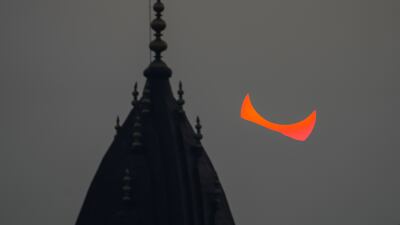
A partial solar eclipse behind the centuries-old Raghunath Hindu temple in Srinagar, Indian-controlled Kashmir. AP -
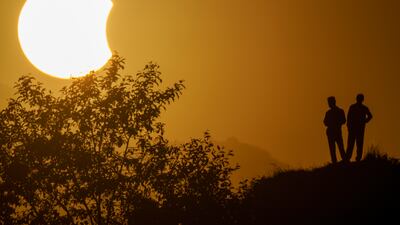
People are silhouetted against a partial solar eclipse seen from Kathmandu, Nepal. AP -
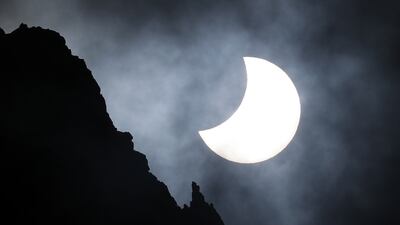
A partial solar eclipse as seen in the Tatra Mountains, southern Poland. EPA -

The celestial event in Hede-Bazouges, western France. AFP -
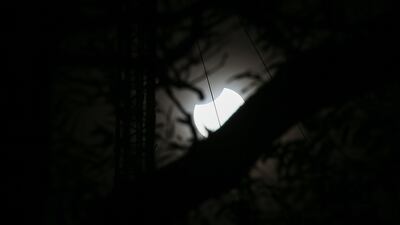
A partial solar eclipse in Huddersfield, England. EPA -
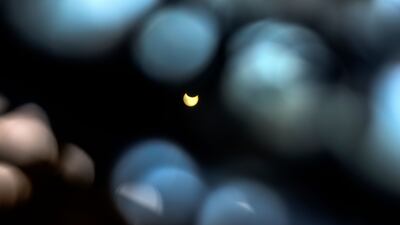
The Moon partially obscuring the Sun as seen from Gaza city. AFP -
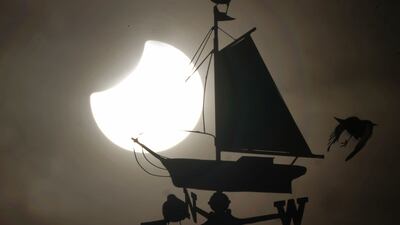
A partial solar eclipse is visible over Cullercoats Watch House in North Shields, England. AP -
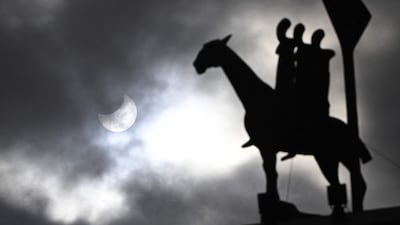
A partial solar eclipse is pictured in Malmoe, Sweden. AFP -
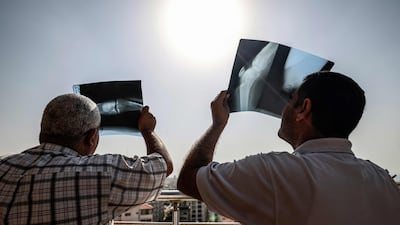
Men use X-ray images as filters to view a partial solar eclipse visible from Gaza city. AFP -

A statue on top of the Bernini's colonnade is pictured during a partial solar eclipse in St Peter's Square at the Vatican. Reuters -
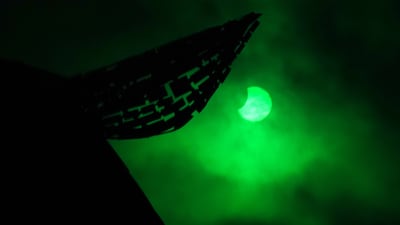
The Moon passing in front of the Sun during a partial eclipse viewed through glass from a welding visor at the Kelpies near Falkirk, Scotland. PA -
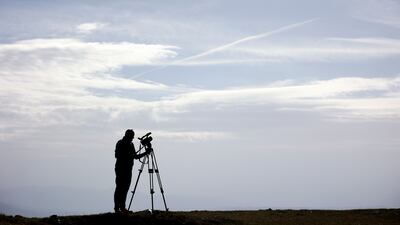
A cameraman records a partial solar eclipse near Travnik, Bosnia. AP Photo -
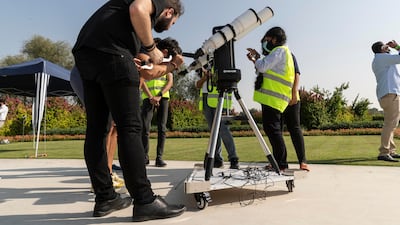
People gather at the Al Thuraya Astronomy Centre in Mushrif Park to watch the event. Antonie Robertson / The National