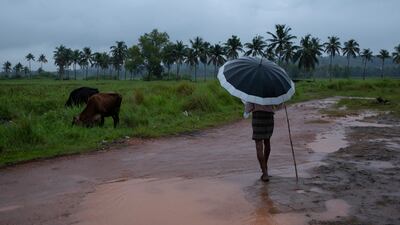
As soon as the first warning came about intense rainfall in Kerala, Rijo Rajan knew instantly it could again turn into a nightmare.
Mr Rajan, 28, and his family immediately began preparing for the impending deluge amid fears of devastating floods similar to those that struck the coastal Indian state in recent years.
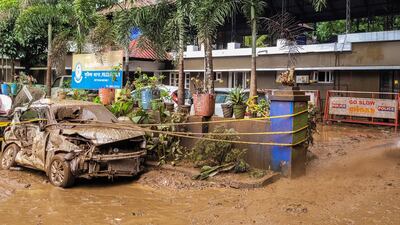
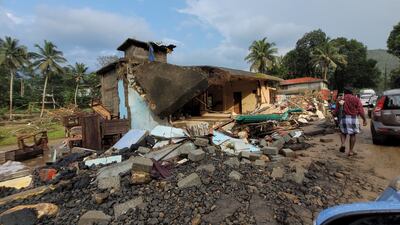
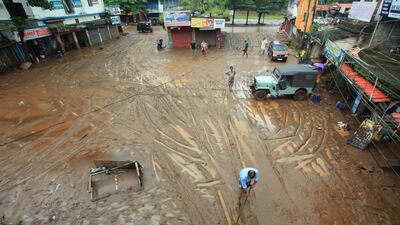
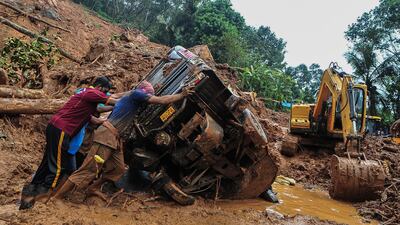
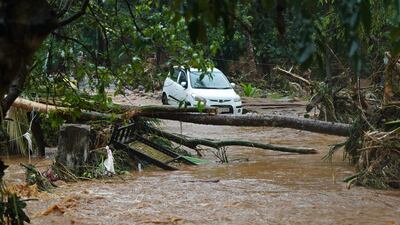
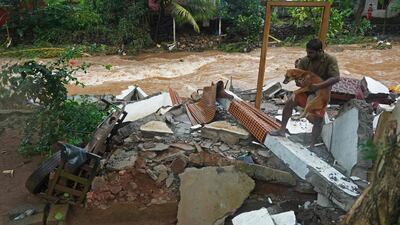
By Sunday evening, their worst fears had been realised as incessant rain caused landslides and flash floods in a disaster some experts have blamed on climate change.
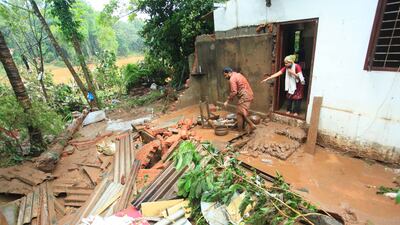
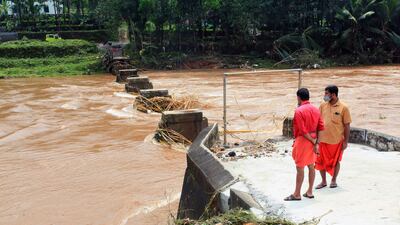
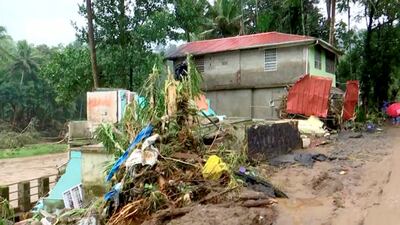
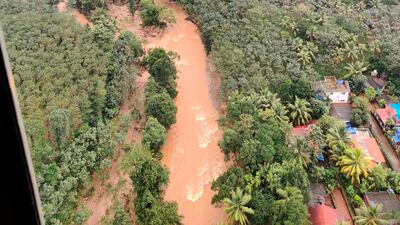
Mr Rajan’s two-storey house in Thiruvalla in Pathanamthitta district was half-marooned in brown water gushing from the overflowing Pamba and Manimala rivers.
With no electricity and fears of more rain, the family of five, including grandparents, are helplessly hoping for mercy.
Mr Rajan said his family was reliving the harrowing experience of floods in his home town last year and in 2018.
“We are just praying for the rains to stop. We are very worried for our lives,” Mr Rajan, a chef, told The National from his flooded home.
“There is no power supply and we are going through a difficult time.”
Experts say flooding is an environmental calamity, which can be blamed on climate change and “man-made disaster”.
Kerala, a state of 34 million people, witnessed the worst floods in a century in 2018 when severe rains caused flashfloods and landslides, killing nearly 500 people and leaving a million homeless.
The following year, more than 125 people were killed in flashfloods and landslides across the state. More than 50 were killed in August last year after landslides struck the hilly Munnar region.
The latest spell of torrential rains was caused by mini-cloudbursts triggered by an unusual transformation of the cloud system over the Western Ghats, Dr S Abhilash, an atmospheric scientist at the Cochin University of Science and Technology in Kerala, told The National.
“Kerala never experienced this type of classical cloudburst exceeding 100 millimetre in one hour, but considering the vulnerable landscapes, the mountain region, a rainfall of 50mm can trigger a lot of damage,” said Dr Abhilash.
“We expect mini-cloudburst events as the change in climate is supporting that because global warming is adding more water vapour to the atmosphere and it will produce a lot of heavy rain.”
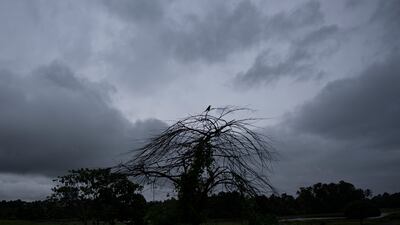
Heavy rains have hit the state since Friday and India’s weather office on Monday said the inclement weather would continue. It warned of more rains lashing the region until Thursday, further increasing Mr Rajan’s worries as authorities opened shutters at Kakki dam to release excess water.
Bodies recovered
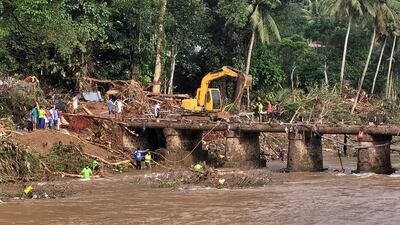
Teams of emergency workers and the army recovered 27 bodies. The majority were from Kottayam and Idukki, the two worst-affected districts that received 164.5mm and 305.5mm rain, respectively, on Saturday.
Officials said dozens were still missing as about 9,000 people had been transferred to temporary shelters across the state.
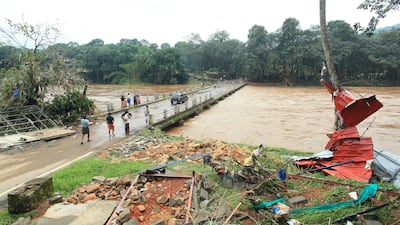
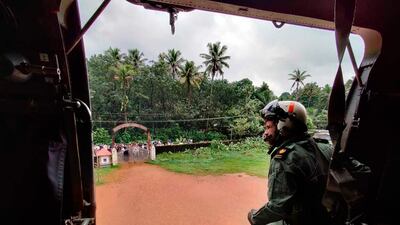
Scores of houses and roads were swept in the floods and landslides, with military helicopters being pressed to reach areas disconnected by the floods.
Though rainfall is triggering this, the man-made activities in Western Ghats are aggravating the disaster potential
Dr S Abhilash,
atmospheric scientist at the Cochin University of Science and Technology
Most parts of Kerala fall under the highly ecologically sensitive region in the Western Ghats, a mountain range extending through India’s west coast, and one the world's largest biodiversity hotspots.
In 2011, a government committee headed by ecologist Madhav Gadgil had recommended that all of the Western Ghats be declared a sensitive region and “almost all developmental activities such as mining, thermal and power plants halted in it”.
But development such as roads, buildings and rock quarries in sensitive areas of the state have helped cause natural disasters, said Dr Abhilash.
Any infrastructural activity on the hill slopes can adversely impact the region’s environment, with regular downpours causing soil erosion and landslides, he said.
“The event is a combination of man-made disaster and climate change. Though rainfall is triggering this, the man-made activities in Western Ghats are aggravating the disaster potential,” Dr Abhilash said.
The coastal state is also facing severe challenges because of rising sea levels, with a recent visualisation tool released by Nasa projecting sea levels in the state’s largest city Kochi to rise by 300mm in the next four decades.
A 2018 report by India’s National Centre for Coastal Research said several coastal regions in the state had witnessed up to a 45 per cent reduction in the shoreline because of soil erosion.
Dr Abhilash said the state could continue to be in the grip of similar natural disasters if swift corrective measures including reduced human footprints were not taken.
“The policymakers know the solution but we have to reduce the human-footprint on highly ecologically sensitive regions."
What sanctions would be reimposed?
Under ‘snapback’, measures imposed on Iran by the UN Security Council in six resolutions would be restored, including:
- An arms embargo
- A ban on uranium enrichment and reprocessing
- A ban on launches and other activities with ballistic missiles capable of delivering nuclear weapons, as well as ballistic missile technology transfer and technical assistance
- A targeted global asset freeze and travel ban on Iranian individuals and entities
- Authorisation for countries to inspect Iran Air Cargo and Islamic Republic of Iran Shipping Lines cargoes for banned goods
In-demand jobs and monthly salaries
- Technology expert in robotics and automation: Dh20,000 to Dh40,000
- Energy engineer: Dh25,000 to Dh30,000
- Production engineer: Dh30,000 to Dh40,000
- Data-driven supply chain management professional: Dh30,000 to Dh50,000
- HR leader: Dh40,000 to Dh60,000
- Engineering leader: Dh30,000 to Dh55,000
- Project manager: Dh55,000 to Dh65,000
- Senior reservoir engineer: Dh40,000 to Dh55,000
- Senior drilling engineer: Dh38,000 to Dh46,000
- Senior process engineer: Dh28,000 to Dh38,000
- Senior maintenance engineer: Dh22,000 to Dh34,000
- Field engineer: Dh6,500 to Dh7,500
- Field supervisor: Dh9,000 to Dh12,000
- Field operator: Dh5,000 to Dh7,000
DEADPOOL & WOLVERINE
Starring: Ryan Reynolds, Hugh Jackman, Emma Corrin
Director: Shawn Levy
Rating: 3/5
GIANT REVIEW
Starring: Amir El-Masry, Pierce Brosnan
Director: Athale
Rating: 4/5
Emergency phone numbers in the UAE
Estijaba – 8001717 – number to call to request coronavirus testing
Ministry of Health and Prevention – 80011111
Dubai Health Authority – 800342 – The number to book a free video or voice consultation with a doctor or connect to a local health centre
Emirates airline – 600555555
Etihad Airways – 600555666
Ambulance – 998
Knowledge and Human Development Authority – 8005432 ext. 4 for Covid-19 queries
SPECS
%3Cp%3E%3Cstrong%3EEngine%3A%3C%2Fstrong%3E%202-litre%204-cylinder%20turbo%20and%203.6-litre%20V6%0D%3Cbr%3E%3Cstrong%3ETransmission%3A%20%3C%2Fstrong%3ESeven-speed%20automatic%0D%3Cbr%3E%3Cstrong%3EPower%3A%3C%2Fstrong%3E%20235hp%20and%20310hp%0D%3Cbr%3E%3Cstrong%3ETorque%3A%20%3C%2Fstrong%3E258Nm%20and%20271Nm%0D%3Cbr%3E%3Cstrong%3EPrice%3A%3C%2Fstrong%3E%20From%20Dh185%2C100%0D%3Cbr%3E%3C%2Fp%3E%0A
Other acts on the Jazz Garden bill
Sharrie Williams
The American singer is hugely respected in blues circles due to her passionate vocals and songwriting. Born and raised in Michigan, Williams began recording and touring as a teenage gospel singer. Her career took off with the blues band The Wiseguys. Such was the acclaim of their live shows that they toured throughout Europe and in Africa. As a solo artist, Williams has also collaborated with the likes of the late Dizzy Gillespie, Van Morrison and Mavis Staples.
Lin Rountree
An accomplished smooth jazz artist who blends his chilled approach with R‘n’B. Trained at the Duke Ellington School of the Arts in Washington, DC, Rountree formed his own band in 2004. He has also recorded with the likes of Kem, Dwele and Conya Doss. He comes to Dubai on the back of his new single Pass The Groove, from his forthcoming 2018 album Stronger Still, which may follow his five previous solo albums in cracking the top 10 of the US jazz charts.
Anita Williams
Dubai-based singer Anita Williams will open the night with a set of covers and swing, jazz and blues standards that made her an in-demand singer across the emirate. The Irish singer has been performing in Dubai since 2008 at venues such as MusicHall and Voda Bar. Her Jazz Garden appearance is career highlight as she will use the event to perform the original song Big Blue Eyes, the single from her debut solo album, due for release soon.
Vikram%20Vedha
%3Cp%3E%3Cstrong%3EDirectors%3A%3C%2Fstrong%3E%20Gayatri%2C%20Pushkar%3C%2Fp%3E%0A%3Cp%3E%3Cstrong%3EStars%3A%3C%2Fstrong%3E%20Hrithik%20Roshan%2C%20Saif%20Ali%20Khan%2C%20Radhika%20Apte%3C%2Fp%3E%0A%3Cp%3E%3Cstrong%3ERating%3A%C2%A0%3C%2Fstrong%3E3.5%2F5%3C%2Fp%3E%0A
Mercer, the investment consulting arm of US services company Marsh & McLennan, expects its wealth division to at least double its assets under management (AUM) in the Middle East as wealth in the region continues to grow despite economic headwinds, a company official said.
Mercer Wealth, which globally has $160 billion in AUM, plans to boost its AUM in the region to $2-$3bn in the next 2-3 years from the present $1bn, said Yasir AbuShaban, a Dubai-based principal with Mercer Wealth.
“Within the next two to three years, we are looking at reaching $2 to $3 billion as a conservative estimate and we do see an opportunity to do so,” said Mr AbuShaban.
Mercer does not directly make investments, but allocates clients’ money they have discretion to, to professional asset managers. They also provide advice to clients.
“We have buying power. We can negotiate on their (client’s) behalf with asset managers to provide them lower fees than they otherwise would have to get on their own,” he added.
Mercer Wealth’s clients include sovereign wealth funds, family offices, and insurance companies among others.
From its office in Dubai, Mercer also looks after Africa, India and Turkey, where they also see opportunity for growth.
Wealth creation in Middle East and Africa (MEA) grew 8.5 per cent to $8.1 trillion last year from $7.5tn in 2015, higher than last year’s global average of 6 per cent and the second-highest growth in a region after Asia-Pacific which grew 9.9 per cent, according to consultancy Boston Consulting Group (BCG). In the region, where wealth grew just 1.9 per cent in 2015 compared with 2014, a pickup in oil prices has helped in wealth generation.
BCG is forecasting MEA wealth will rise to $12tn by 2021, growing at an annual average of 8 per cent.
Drivers of wealth generation in the region will be split evenly between new wealth creation and growth of performance of existing assets, according to BCG.
Another general trend in the region is clients’ looking for a comprehensive approach to investing, according to Mr AbuShaban.
“Institutional investors or some of the families are seeing a slowdown in the available capital they have to invest and in that sense they are looking at optimizing the way they manage their portfolios and making sure they are not investing haphazardly and different parts of their investment are working together,” said Mr AbuShaban.
Some clients also have a higher appetite for risk, given the low interest-rate environment that does not provide enough yield for some institutional investors. These clients are keen to invest in illiquid assets, such as private equity and infrastructure.
“What we have seen is a desire for higher returns in what has been a low-return environment specifically in various fixed income or bonds,” he said.
“In this environment, we have seen a de facto increase in the risk that clients are taking in things like illiquid investments, private equity investments, infrastructure and private debt, those kind of investments were higher illiquidity results in incrementally higher returns.”
The Abu Dhabi Investment Authority, one of the largest sovereign wealth funds, said in its 2016 report that has gradually increased its exposure in direct private equity and private credit transactions, mainly in Asian markets and especially in China and India. The authority’s private equity department focused on structured equities owing to “their defensive characteristics.”
The specs
Engine: 2.0-litre 4-cyl turbo
Power: 201hp at 5,200rpm
Torque: 320Nm at 1,750-4,000rpm
Transmission: 6-speed auto
Fuel consumption: 8.7L/100km
Price: Dh133,900
On sale: now
Lexus LX700h specs
Engine: 3.4-litre twin-turbo V6 plus supplementary electric motor
Power: 464hp at 5,200rpm
Torque: 790Nm from 2,000-3,600rpm
Transmission: 10-speed auto
Fuel consumption: 11.7L/100km
On sale: Now
Price: From Dh590,000
INDIA SQUAD
Virat Kohli (capt), Rohit Sharma, Shikhar Dhawan, KL Rahul, Vijay Shankar, MS Dhoni (wk), Kedar Jadhav, Dinesh Karthik, Yuzvendra Chahal, Kuldeep Yadav, Bhuvneshwar Kumar, Jasprit Bumrah, Hardik Pandya, Ravindra Jadeja, Mohammed Shami
Global state-owned investor ranking by size
|
1.
|
United States
|
|
2.
|
China
|
|
3.
|
UAE
|
|
4.
|
Japan
|
|
5
|
Norway
|
|
6.
|
Canada
|
|
7.
|
Singapore
|
|
8.
|
Australia
|
|
9.
|
Saudi Arabia
|
|
10.
|
South Korea
|