A nurse prepares an isolation ward for monkeypox patients at a government hospital in Hyderabad, southern India. AFP

India steps up monitoring for monkeypox as fourth case confirmed


Taniya Dutta
  • English
  • Arabic

India’s Health Ministry announced enhanced measures to track the spread of monkeypox after a fourth case was identified in the country.

The viral disease once considered endemic to parts of Africa has spread across the world in recent months, with about 16,000 people infected in more than 70 countries, most of them in Europe and North America.

The World Health Organisation declared the outbreak a public health emergency of international concern on Saturday.

Officials from India's Directorate General of Health Sciences, the National Centre for Disease Control and the Indian Council of Medical Research met on Sunday to review the situation, a day after a 34-year-old man in New Delhi was confirmed as the country's fourth case.

The patient, who the ministry said had no history of travel abroad, had reportedly returned to Delhi from a stag party in the hill resort of Manali in neighbouring Himachal Pradesh state.

He tested positive for monkeypox after going to a private hospital with fever and a rash. He was then isolated at the capital's Lok Nayak Hospital.

“The case is presently recovering,” the ministry said. “The close contacts of the case have been identified and are under quarantine.”

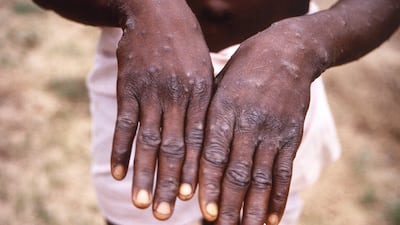
  • A man's hands are covered in a rash caused by the monkeypox virus that swept through the Democratic Republic of the Congo from 1996 to 1997. Reuters
    A man's hands are covered in a rash caused by the monkeypox virus that swept through the Democratic Republic of the Congo from 1996 to 1997. Reuters
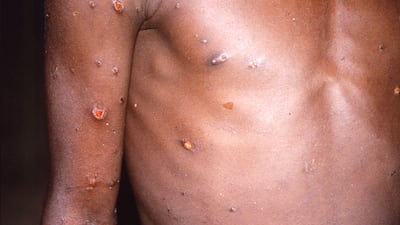
  • An image taken during an outbreak of monkeypox in the Democratic Republic of the Congo in 1996 and 1997 shows the arms and torso of a patient with skin lesions due to monkeypox. Reuters
    An image taken during an outbreak of monkeypox in the Democratic Republic of the Congo in 1996 and 1997 shows the arms and torso of a patient with skin lesions due to monkeypox. Reuters
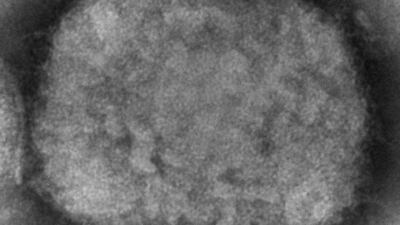
  • This 2003 electron microscope image made available by the Centres for Disease Control and Prevention shows a monkeypox virion, obtained from a sample associated with the 2003 prairie dog outbreak. AP
    This 2003 electron microscope image made available by the Centres for Disease Control and Prevention shows a monkeypox virion, obtained from a sample associated with the 2003 prairie dog outbreak. AP
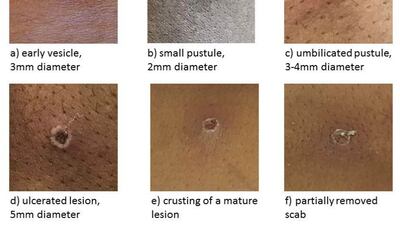
  • Images issued by the UK Health Security Agency show the stages of monkeypox. UK Health Security Agency
    Images issued by the UK Health Security Agency show the stages of monkeypox. UK Health Security Agency
  • The Massachusetts Department of Public Health confirmed a single case of monkeypox in an adult male who had recently travelled to Canada. EPA
    The Massachusetts Department of Public Health confirmed a single case of monkeypox in an adult male who had recently travelled to Canada. EPA
  • Roman Woelfel, head of the Institute of Microbiology of the German Armed Forces in Munich, gets to work after Germany detected its first case of monkeypox. Reuters
    Roman Woelfel, head of the Institute of Microbiology of the German Armed Forces in Munich, gets to work after Germany detected its first case of monkeypox. Reuters

India's first case of monkeypox was detected in Kerala on July 15, followed by two more in the southern state.

Veena George, Kerala’s Health Minister, on Monday said that all three patients were in a stable condition but remained in isolation and none of their primary contacts had tested positive so far.

Monkeypox originates in wild animals such as rodents and primates and occasionally jumps to people.

It belongs to the same virus family as smallpox, although with its clinical severity is less.

According to the WHO, it is transmitted from one person to another by close contact with lesions, body fluids, respiratory droplets.

It is a self-limited disease, with symptoms that last from two to four weeks.

While severe cases can occur, in recent times, the case fatality ratio has been between 3 per cent and 6 per cent.

ELECTION%20RESULTS
%3Cp%3EMacron%E2%80%99s%20Ensemble%20group%20won%20245%20seats.%26nbsp%3B%3C%2Fp%3E%0A%3Cp%3EThe%20second-largest%20group%20in%20parliament%20is%20Nupes%2C%20a%20leftist%20coalition%20led%20by%20Jean-Luc%20Melenchon%2C%20which%20gets%20131%20lawmakers.%26nbsp%3B%3C%2Fp%3E%0A%3Cp%3EThe%20far-right%20National%20Rally%20fared%20much%20better%20than%20expected%20with%2089%20seats.%3C%2Fp%3E%0A%3Cp%3EThe%20centre-right%20Republicans%20and%20their%20allies%20took%2061.%3C%2Fp%3E%0A
Global state-owned investor ranking by size

1.

United States

2.

China

3.

UAE

4.

Japan

5

Norway

6.

Canada

7.

Singapore

8.

Australia

9.

Saudi Arabia

10.

South Korea

How Islam's view of posthumous transplant surgery changed

Transplants from the deceased have been carried out in hospitals across the globe for decades, but in some countries in the Middle East, including the UAE, the practise was banned until relatively recently.

Opinion has been divided as to whether organ donations from a deceased person is permissible in Islam.

The body is viewed as sacred, during and after death, thus prohibiting cremation and tattoos.

One school of thought viewed the removal of organs after death as equally impermissible.

That view has largely changed, and among scholars and indeed many in society, to be seen as permissible to save another life.

COMPANY%20PROFILE
%3Cp%3ECompany%20name%3A%20Znap%3C%2Fp%3E%0A%3Cp%3EStarted%3A%202017%3C%2Fp%3E%0A%3Cp%3EFounder%3A%20Uday%20Rathod%3C%2Fp%3E%0A%3Cp%3EBased%3A%20Dubai%2C%20UAE%3C%2Fp%3E%0A%3Cp%3EIndustry%3A%20FinTech%3C%2Fp%3E%0A%3Cp%3EFunding%20size%3A%20%241m%2B%3C%2Fp%3E%0A%3Cp%3EInvestors%3A%20Family%2C%20friends%3C%2Fp%3E%0A
Biog

Age: 50

Known as the UAE’s strongest man

Favourite dish: “Everything and sea food”

Hobbies: Drawing, basketball and poetry

Favourite car: Any classic car

Favourite superhero: The Hulk original

If you go

The flights

There are direct flights from Dubai to Sofia with FlyDubai (www.flydubai.com) and Wizz Air (www.wizzair.com), from Dh1,164 and Dh822 return including taxes, respectively.

The trip

Plovdiv is 150km from Sofia, with an hourly bus service taking around 2 hours and costing $16 (Dh58). The Rhodopes can be reached from Sofia in between 2-4hours.

The trip was organised by Bulguides (www.bulguides.com), which organises guided trips throughout Bulgaria. Guiding, accommodation, food and transfers from Plovdiv to the mountains and back costs around 170 USD for a four-day, three-night trip.


Mercer, the investment consulting arm of US services company Marsh & McLennan, expects its wealth division to at least double its assets under management (AUM) in the Middle East as wealth in the region continues to grow despite economic headwinds, a company official said.

Mercer Wealth, which globally has $160 billion in AUM, plans to boost its AUM in the region to $2-$3bn in the next 2-3 years from the present $1bn, said Yasir AbuShaban, a Dubai-based principal with Mercer Wealth.

Within the next two to three years, we are looking at reaching $2 to $3 billion as a conservative estimate and we do see an opportunity to do so,” said Mr AbuShaban.

Mercer does not directly make investments, but allocates clients’ money they have discretion to, to professional asset managers. They also provide advice to clients.

“We have buying power. We can negotiate on their (client’s) behalf with asset managers to provide them lower fees than they otherwise would have to get on their own,” he added.

Mercer Wealth’s clients include sovereign wealth funds, family offices, and insurance companies among others.

From its office in Dubai, Mercer also looks after Africa, India and Turkey, where they also see opportunity for growth.

Wealth creation in Middle East and Africa (MEA) grew 8.5 per cent to $8.1 trillion last year from $7.5tn in 2015, higher than last year’s global average of 6 per cent and the second-highest growth in a region after Asia-Pacific which grew 9.9 per cent, according to consultancy Boston Consulting Group (BCG). In the region, where wealth grew just 1.9 per cent in 2015 compared with 2014, a pickup in oil prices has helped in wealth generation.

BCG is forecasting MEA wealth will rise to $12tn by 2021, growing at an annual average of 8 per cent.

Drivers of wealth generation in the region will be split evenly between new wealth creation and growth of performance of existing assets, according to BCG.

Another general trend in the region is clients’ looking for a comprehensive approach to investing, according to Mr AbuShaban.

“Institutional investors or some of the families are seeing a slowdown in the available capital they have to invest and in that sense they are looking at optimizing the way they manage their portfolios and making sure they are not investing haphazardly and different parts of their investment are working together,” said Mr AbuShaban.

Some clients also have a higher appetite for risk, given the low interest-rate environment that does not provide enough yield for some institutional investors. These clients are keen to invest in illiquid assets, such as private equity and infrastructure.

“What we have seen is a desire for higher returns in what has been a low-return environment specifically in various fixed income or bonds,” he said.

“In this environment, we have seen a de facto increase in the risk that clients are taking in things like illiquid investments, private equity investments, infrastructure and private debt, those kind of investments were higher illiquidity results in incrementally higher returns.”

The Abu Dhabi Investment Authority, one of the largest sovereign wealth funds, said in its 2016 report that has gradually increased its exposure in direct private equity and private credit transactions, mainly in Asian markets and especially in China and India. The authority’s private equity department focused on structured equities owing to “their defensive characteristics.”

Updated: July 25, 2022, 10:45 AM