A ragpicker stands in front of a mural on Covid-19 coronavirus awareness, painted on a wall along the roadside in New Delhi. AFP

Almost a quarter of Delhi has had coronavirus, study finds


  • English
  • Arabic

Almost a quarter of people in New Delhi have had the coronavirus, according to a study that cast serious doubt on the official numbers both in the city and across India.

India last week became the third country after the United States and Brazil to hit one million cases but experts have long said that with testing rates low, the true number could be much higher.

Blood tests on 21,387 randomly selected people across Delhi conducted by the National Centre for Disease Control found that 23.48 per cent of them had IgG antibodies, indicating past exposure to the virus.

  • A volunteer health worker of the NGO Bharatiya Jain Sanghatana wearing personal protective equipment (PPE) using a smart helmet equipped with a thermo-scan sensor checks the body temperature of residents in Mumbai. AFP
    A volunteer health worker of the NGO Bharatiya Jain Sanghatana wearing personal protective equipment (PPE) using a smart helmet equipped with a thermo-scan sensor checks the body temperature of residents in Mumbai. AFP
  • Staff members of a restaurant in Johannesburg demonstrate against the Covid-19 coronavirus lockdown regulations. AFP
    Staff members of a restaurant in Johannesburg demonstrate against the Covid-19 coronavirus lockdown regulations. AFP
  • Lines of ambulances used during Covid-19 emergencies stand parked on the roadside in Bangalore. AFP
    Lines of ambulances used during Covid-19 emergencies stand parked on the roadside in Bangalore. AFP
  • Funeral assistant, Bradley Georges, 26 walks to a funeral at one of Miami's largest funeral homes. AFP
    Funeral assistant, Bradley Georges, 26 walks to a funeral at one of Miami's largest funeral homes. AFP
  • Models present creations from Dior's Cruise 2021 collection during a live-streamed runway show without an audience at Piazza del Duomo, in Lecce, Italy. Reuters
    Models present creations from Dior's Cruise 2021 collection during a live-streamed runway show without an audience at Piazza del Duomo, in Lecce, Italy. Reuters
  • Ifeoma Eh, a candidate from Nigeria who has applied for US citizenship, stands with others during naturalisation ceremony in New York City. Reuters
    Ifeoma Eh, a candidate from Nigeria who has applied for US citizenship, stands with others during naturalisation ceremony in New York City. Reuters
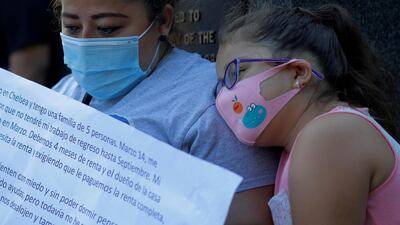
  • Sandra Cruz sits with her daughter Gabriella after telling her family’s story about losing her job because of the coronavirus outbreak in the US. Reuters
    Sandra Cruz sits with her daughter Gabriella after telling her family’s story about losing her job because of the coronavirus outbreak in the US. Reuters
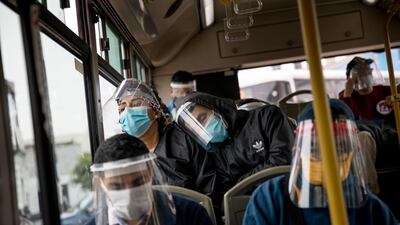
  • Commuters wearing protective face masks and face shields travel on a public bus in Lima, Peru. AP
    Commuters wearing protective face masks and face shields travel on a public bus in Lima, Peru. AP
  • People wearing face masks to protect themselves against the coronavirus visit a store on a shopping street in Beijing. AP
    People wearing face masks to protect themselves against the coronavirus visit a store on a shopping street in Beijing. AP
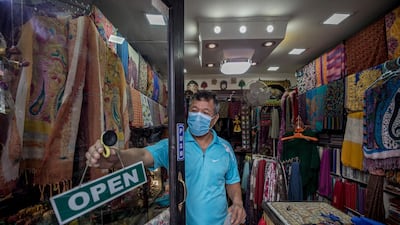
  • A man wears a mask as he opens a shop at Thamel, a major tourist hub, in Kathmandu. EPA
    A man wears a mask as he opens a shop at Thamel, a major tourist hub, in Kathmandu. EPA
  • A health worker collects blood samples from a patient recently recovered from Covid-19 in Srinagar, India. EPA
    A health worker collects blood samples from a patient recently recovered from Covid-19 in Srinagar, India. EPA

With Delhi's population of more than 20 million, the findings published Tuesday by the federal health ministry suggest that 4.7 million people have had the virus, almost 40 times the official tally of 125,000.

While praising government restrictions that have limited the spread of the virus, the ministry said the study "indicates that a large number of infected persons remain asymptomatic".

The survey was conducted between June 27 and July 10.

And more than 75 per cent are still vulnerable, including those at higher risk, Sujeet Kumar Singh, head of the National Centre for Disease Control, told a news conference.

On Wednesday, India's health ministry reported a total of 1.19 million coronavirus cases so far with almost 29,000 deaths.

States such as Maharashtra, Delhi and Tamil Nadu are among the worst affected.

Prime Minister Narendra Modi's government imposed one of the world's strictest lockdowns in late March, but it has been steadily eased in recent months to lessen the devastating economic impact.

But, independently from the federal government, states have been tightening restrictions as case numbers have soared – including in Bengaluru and other parts of Karnataka, Bihar, West Bengal and parts of Kerala and Tamil Nadu.

Daily new cases have been steadily falling in recent weeks, with fewer than 1,000 new infections recorded on Tuesday – the first time in 49 days – down from a peak of almost 4,000 in late June.

Ten tax points to be aware of in 2026

1. Domestic VAT refund amendments: request your refund within five years

If a business does not apply for the refund on time, they lose their credit.

2. E-invoicing in the UAE

Businesses should continue preparing for the implementation of e-invoicing in the UAE, with 2026 a preparation and transition period ahead of phased mandatory adoption. 

3. More tax audits

Tax authorities are increasingly using data already available across multiple filings to identify audit risks. 

4. More beneficial VAT and excise tax penalty regime

Tax disputes are expected to become more frequent and more structured, with clearer administrative objection and appeal processes. The UAE has adopted a new penalty regime for VAT and excise disputes, which now mirrors the penalty regime for corporate tax.

5. Greater emphasis on statutory audit

There is a greater need for the accuracy of financial statements. The International Financial Reporting Standards standards need to be strictly adhered to and, as a result, the quality of the audits will need to increase.

6. Further transfer pricing enforcement

Transfer pricing enforcement, which refers to the practice of establishing prices for internal transactions between related entities, is expected to broaden in scope. The UAE will shortly open the possibility to negotiate advance pricing agreements, or essentially rulings for transfer pricing purposes. 

7. Limited time periods for audits

Recent amendments also introduce a default five-year limitation period for tax audits and assessments, subject to specific statutory exceptions. While the standard audit and assessment period is five years, this may be extended to up to 15 years in cases involving fraud or tax evasion. 

8. Pillar 2 implementation 

Many multinational groups will begin to feel the practical effect of the Domestic Minimum Top-Up Tax (DMTT), the UAE's implementation of the OECD’s global minimum tax under Pillar 2. While the rules apply for financial years starting on or after January 1, 2025, it is 2026 that marks the transition to an operational phase.

9. Reduced compliance obligations for imported goods and services

Businesses that apply the reverse-charge mechanism for VAT purposes in the UAE may benefit from reduced compliance obligations. 

10. Substance and CbC reporting focus

Tax authorities are expected to continue strengthening the enforcement of economic substance and Country-by-Country (CbC) reporting frameworks. In the UAE, these regimes are increasingly being used as risk-assessment tools, providing tax authorities with a comprehensive view of multinational groups’ global footprints and enabling them to assess whether profits are aligned with real economic activity. 

Contributed by Thomas Vanhee and Hend Rashwan, Aurifer

AUSTRALIA SQUAD

Aaron Finch (captain), Ashton Agar, Alex Carey, Pat Cummins, Glenn Maxwell, Ben McDermott, Kane Richardson, Steve Smith, Billy Stanlake, Mitchell Starc, Ashton Turner, Andrew Tye, David Warner, Adam Zampa

Jetour T1 specs

Engine: 2-litre turbocharged

Power: 254hp

Torque: 390Nm

Price: From Dh126,000

Available: Now

PRISCILLA
%3Cp%3EDirector%3A%20Sofia%20Coppola%3C%2Fp%3E%0A%3Cp%3EStarring%3A%20Cailee%20Spaeny%2C%20Jacob%20Elordi%3C%2Fp%3E%0A%3Cp%3ERating%3A%203%2F5%3C%2Fp%3E%0A

1,000 Books to Read Before You Die: A Life-Changing List
James Mustich, Workman

Mercer, the investment consulting arm of US services company Marsh & McLennan, expects its wealth division to at least double its assets under management (AUM) in the Middle East as wealth in the region continues to grow despite economic headwinds, a company official said.

Mercer Wealth, which globally has $160 billion in AUM, plans to boost its AUM in the region to $2-$3bn in the next 2-3 years from the present $1bn, said Yasir AbuShaban, a Dubai-based principal with Mercer Wealth.

Within the next two to three years, we are looking at reaching $2 to $3 billion as a conservative estimate and we do see an opportunity to do so,” said Mr AbuShaban.

Mercer does not directly make investments, but allocates clients’ money they have discretion to, to professional asset managers. They also provide advice to clients.

“We have buying power. We can negotiate on their (client’s) behalf with asset managers to provide them lower fees than they otherwise would have to get on their own,” he added.

Mercer Wealth’s clients include sovereign wealth funds, family offices, and insurance companies among others.

From its office in Dubai, Mercer also looks after Africa, India and Turkey, where they also see opportunity for growth.

Wealth creation in Middle East and Africa (MEA) grew 8.5 per cent to $8.1 trillion last year from $7.5tn in 2015, higher than last year’s global average of 6 per cent and the second-highest growth in a region after Asia-Pacific which grew 9.9 per cent, according to consultancy Boston Consulting Group (BCG). In the region, where wealth grew just 1.9 per cent in 2015 compared with 2014, a pickup in oil prices has helped in wealth generation.

BCG is forecasting MEA wealth will rise to $12tn by 2021, growing at an annual average of 8 per cent.

Drivers of wealth generation in the region will be split evenly between new wealth creation and growth of performance of existing assets, according to BCG.

Another general trend in the region is clients’ looking for a comprehensive approach to investing, according to Mr AbuShaban.

“Institutional investors or some of the families are seeing a slowdown in the available capital they have to invest and in that sense they are looking at optimizing the way they manage their portfolios and making sure they are not investing haphazardly and different parts of their investment are working together,” said Mr AbuShaban.

Some clients also have a higher appetite for risk, given the low interest-rate environment that does not provide enough yield for some institutional investors. These clients are keen to invest in illiquid assets, such as private equity and infrastructure.

“What we have seen is a desire for higher returns in what has been a low-return environment specifically in various fixed income or bonds,” he said.

“In this environment, we have seen a de facto increase in the risk that clients are taking in things like illiquid investments, private equity investments, infrastructure and private debt, those kind of investments were higher illiquidity results in incrementally higher returns.”

The Abu Dhabi Investment Authority, one of the largest sovereign wealth funds, said in its 2016 report that has gradually increased its exposure in direct private equity and private credit transactions, mainly in Asian markets and especially in China and India. The authority’s private equity department focused on structured equities owing to “their defensive characteristics.”

The specs

Engine: 6.2-litre supercharged V8

Power: 712hp at 6,100rpm

Torque: 881Nm at 4,800rpm

Transmission: 8-speed auto

Fuel consumption: 19.6 l/100km

Price: Dh380,000

On sale: now 

Score

Third Test, Day 1

New Zealand 229-7 (90 ov)
Pakistan

New Zealand won the toss and elected to bat

The specs

Price, base / as tested Dh1,470,000 (est)
Engine 6.9-litre twin-turbo W12
Gearbox eight-speed automatic
Power 626bhp @ 6,000rpm
Torque: 900Nm @ 1,350rpm
Fuel economy, combined 14.0L / 100km

RESULTS

5pm: Maiden (PA) Dh80,000 1,600m
Winner: Raghida, Szczepan Mazur (jockey), Ibrahim Al Hadhrami (trainer)
5.30pm: Maiden (PA) Dh80,000 1,600m
Winner: AF Alareeq, Connor Beasley, Ahmed Al Mehairbi
6pm: Arabian Triple Crown Round-2 Group 3 (PA) Dh300,000 2,200m 
Winner: Basmah, Fabrice Veron, Eric Lemartinel
6.30pm: Liwa Oasis Group 2 (PA) Dh300,000 1,400m
Winner: AF Alwajel, Tadhg O’Shea, Ernst Oertel
7pm: Wathba Stallions Cup Handicap (PA) Dh70,000 1,600m
Winner: SS Jalmod, Richard Mullen, Satish Seemar
7.30pm: Handicap (TB) Dh100,000 1,600m
Winner: Trolius, Ryan Powell, Simon Crisford

Results

3pm: Maiden Dh165,000 (Dirt) 1,400m, Winner: Lancienegaboulevard, Adrie de Vries (jockey), Fawzi Nass (trainer).

3.35pm: Maiden Dh165,000 (Turf) 1,600m, Winner: Al Mukhtar Star, Adrie de Vries, Fawzi Nass.

4.10pm: Handicap Dh165,000 (D) 2,000m, Winner: Gundogdu, Xavier Ziani, Salem bin Ghadayer.

4.45pm: Handicap Dh185,000 (T) 1,200m, Winner: Speedy Move, Sean Kirrane, Satish Seemar.

5.20pm: Handicap Dh185,000 (D) 1,600m, Winner: Moqarrar, Dane O’Neill, Erwan Charpy.

5.55pm: Handicap Dh175,000 (T) 1,800m, Winner: Dolman, Richard Mullen, Satish Seemar.

Springsteen: Deliver Me from Nowhere

Director: Scott Cooper

Starring: Jeremy Allen White, Odessa Young, Jeremy Strong

Rating: 4/5