India's coronavirus crisis is also taking a heavy toll on its environment by generating mountains of biomedical waste.
The country has so far recorded about 7.5 million cases of Covid-19, with infections starting to mount in June after a two-month lockdown.
Hospitals, quarantine centres and households have since produced more than 18,000 tonnes of biomedical waste, according to the latest figures from the Central Pollution Control Board, India’s top environmental agency.
It said more than 5,500 tonnes of Covid-19 waste were produced in September alone and the amount will increase as case numbers rise.
The biomedical waste includes personal protective equipment such as face masks, face shields and shoe covers.
Those items are mostly made of polypropylene, which takes more than 450 years to decompose.

Human tissue, cotton swabs, syringes and bedsheets are also among the waste.
India's hospitals generated more than 100 tonnes of biomedical waste each day before the pandemic, according to the board, averaging 500 grams per bed.
This increased to between 2 kilograms and 4.5kg during the pandemic.
“We use 200 PPE kits every day for our staff and patients. It has gone up five times since the pandemic,” said Dr Vidyadhar Gaikwad, resident medical officer at Pune Cantonment Hospital, which treats Covid-19 patients.
The pollution control board set strict guidelines for the safe disposal of waste from hospitals and other medical centres that deal with Covid-19 patients at nearly 200 waste treatment plants across the country.
Coronavirus around the world
-

A supporter wearing a Trump face mask looks on as US President Donald Trump holds a campaign rally at Middle Georgia Regional Airport in Macon, Georgia, USA. Reuters -
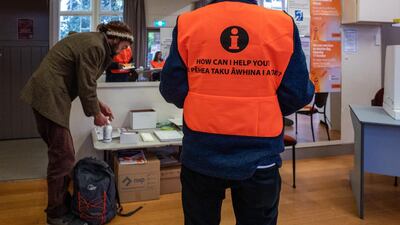
A voter applies hand sanitizer before casting his vote at the Aro Valley Community Centre polling station during the New Zealand General Election in Wellington, New Zealand. Bloomberg -
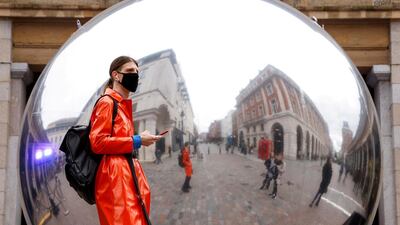
A person is reflected in an art work entitled "A=V" by Ben Cullen Williams in Covent Garden, London, Britain. Reuters -

Abraham Gajon, 31, a paramedic and patient, caresses a horse named "Linda" during equine therapy sessions for healthcare workers suffering from stress and anxiety at Miguel Hidalgo's equestrian center in Mexico City, Mexico. Reuters -
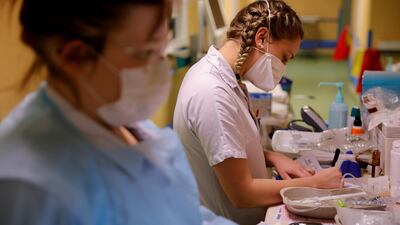
Nurses work in a Covid-19 medicine unit where patients suffering from the coronavirus disease are treated at the Bethune-Beuvry hospital in Beuvry, France. Reuters -
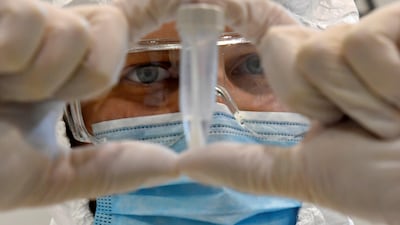
A medical employee of the Frauenhofer Institute in Dresden presents new mobile quick test that reduces waiting time for Covid-19 tests from 4 hours to 40 minutes, during a media event in Dresden, Germany. Reuters -
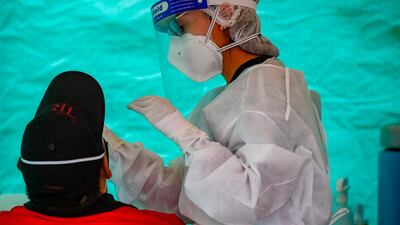
A health worker takes a sample from a man being tested for Covid-19 in Bogota, Colombia. AFP -
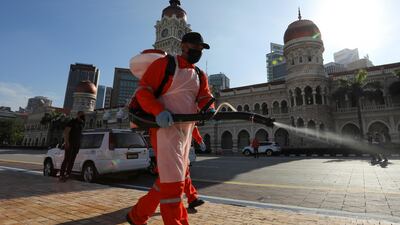
A worker sprays disinfectant at Independence Square during a disinfection operation in Kuala Lumpur, Indonesia. Reuters -

A security guard carries the Everest trophy during Everest Race Day at Royal Randwick Racecourse in Sydney, Australia. Getty Images -

Visitors and staff observe Covid-19 prevention protocols in halls of The Met Cloisters, a branch of the Metropolitan Museum of Art dedicated to medieval European art, in New York. AP Photo -
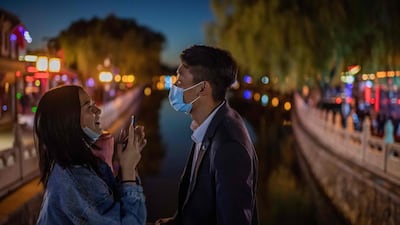
A couple share a laugh as they take pictures with a phone on a bridge at the Hu Hai lake in Beijing, China. AFP -

Waiters serve customers sitting inside a restaurant at Patriarshiye Prudy in Moscow, Russia. AP Photo -

US Democratic presidential candidate Joe Biden is seen taking off his hat, shortly after boarding his campaign plane at the Detroit Metropolitan Wayne County Airport in Romulus, Michigan, USA. Reuters


For the public, the board advised shredding or cutting up used masks and gloves and keeping them in paper bags for a minimum of 72 hours before placing them in yellow plastic bags to be collected by sanitation workers.
Most of the hospitals and private nursing homes follow the guidelines but private quarantine centres, households and people often do not, with discarded PPE ending up on the streets and in landfills.
At one of Delhi’s main landfills in Ghazipur – known as the Mount Everest of rubbish – workers deal with a deluge of surgical masks and syringes collected from the capital, home to more than 20 million people.
“Tens of thousands of masks and gloves are coming to the site every day,” said Bunty Kumar, a worker at the landfill.

The world's second most populous nation of 1.3 billion people suffered a chronic problem with waste management before the pandemic.
Improper treatment of about one billion tonnes of solid waste produced annually is causing irreversible damage to the environment.
But biomedical waste, mostly from homes, also puts millions of people at risk of contracting infections.
Since only serious Covid-19 cases are admitted to hospital, most infected people are treated at their homes.
Experts say the problem is raising awareness about the coronavirus-related waste issue that is produced and the lack of incinerators to properly dispose of it.
"The waste going from a medical centre or hospital has a chance that the process is being followed, but if it is coming from a Covid-19 patient's home it is probably going to the landfill where kids are rummaging through trash, and that is the worry," said Jai Dhar Gupta, an environmental activist in Gurgaon, near New Delhi.
The pandemic also dealt a blow to the country's fight against non-biodegradable waste, including plastic products such as single-use carrier bags, cups and cutlery.
India generates 26,000 tonnes of domestic plastic waste a day, and more than 10,000 tonnes is not collected.
Last year, the government banned the use of single-use plastics and promised to phase it out by 2022, but the pandemic slowed the campaign and created a new problem with plastic medical waste.
“Thousands of tonnes of plastic waste are going to the environment and everything related to PPE has some form of plastic in it,” Mr Gupta said.
"All of this plastic is going to show up in air, food or water in one form or another and yet there is no option as we have a question as to whether to save human lives now or in future."