• Monash University Professor Andy Tomkins, left, with Royal Melbourne Institute of Technology PhD student Alan Salek study a ureilite meteor sample at an RMIT facility in Melbourne, Australia. Photo: RMIT University
    Monash University Professor Andy Tomkins, left, with Royal Melbourne Institute of Technology PhD student Alan Salek study a ureilite meteor sample at an RMIT facility in Melbourne, Australia. Photo: RMIT University
  • Images of graphite, lonsdaleite, and diamond in ureilites. Photo: RMIT university
    Images of graphite, lonsdaleite, and diamond in ureilites. Photo: RMIT university
  • Prof Dougal McCulloch, left, Mr Salek from RMIT and Mr Tomkins from Monash, right, look at computer images of the meteor samples. Photo: RMIT University
    Prof Dougal McCulloch, left, Mr Salek from RMIT and Mr Tomkins from Monash, right, look at computer images of the meteor samples. Photo: RMIT University
  • An uncut 1,109-carat diamond named 'Lesedi La Rona' at Sotheby's auction house in London. AFP
    An uncut 1,109-carat diamond named 'Lesedi La Rona' at Sotheby's auction house in London. AFP

Mysterious diamonds found on Earth came from outer space


Sarwat Nasir
  • English
  • Arabic

Scientists have confirmed that a mysterious type of diamond found on Earth came from outer space.

New research shows that the strange diamonds, which are believed to be much harder than diamonds found on Earth, came from an ancient dwarf planet in our solar system.

Scientists studied 18 samples of ureilite meteorites – rare type of stony meteorite with a unique mineralogical composition – found in Australia and North Africa, some of which contained the diamonds.

In lonsdaleite diamonds, the atoms have a hexagonal structure, instead of a cubic structure as in regular diamonds, which is what possibly makes them harder.

The study, published in the Proceedings of National Academy of Sciences journal on Monday, was led by scientists from Monash University, Royal Melbourne Institute of Technology University (RMIT), the Australian Synchrotron and Plymouth University and the Commonwealth Scientific and Industrial Research Organisation, an Australian government agency for scientific research.

“This study proves categorically that lonsdaleite [hexagonal diamond] exists in nature,” said Dougal McCulloch, director of the RMIT microscopy and microanalysis facility.

“We have also discovered the largest lonsdaleite crystals known to date that are up to a micron in size ― much, much thinner than a human hair.”

Images of graphite, lonsdaleite, and diamond in ureilites. Photo: RMIT

The researchers believe that the diamonds may have formed shortly after the dwarf planet collided with a large asteroid about 4.5 billion years ago.

Of the 18 ureilites examined, all contained graphite, most had a diamond and a small number had lonsdaleite.

The team used advanced electron microscopy techniques to capture solid and intact slices from the meteorites.

This helped create snapshots of how lonsdaleite and regular diamonds formed.

“There’s strong evidence that there’s a newly discovered formation process for the lonsdaleite and regular diamond, which is like a supercritical chemical vapour deposition process that has taken place in these space rocks, probably in the dwarf planet shortly after a catastrophic collision,” Prof McCulloch said.

“Chemical vapour deposition is one of the ways that people make diamonds in the lab, essentially by growing them in a specialised chamber.”

It is believed that the unusual structure of lonsdaleite could help create new manufacturing techniques for ultra-hard materials in mining.

Cubic diamonds on Earth were formed more than three billion years ago deep within the Earth’s crust.

When intense heat and pressure cause carbon atoms to crystallise, diamonds form.

They are found at a depth of about 150 to 200 kilometres below the surface of Earth.

There is ongoing research on whether these diamonds may also form elsewhere in space when asteroids collide, pushing carbon inside to form these crystals.

Sotheby's unveils rare 555-carat black diamond - in pictures

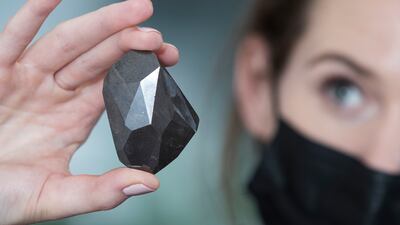
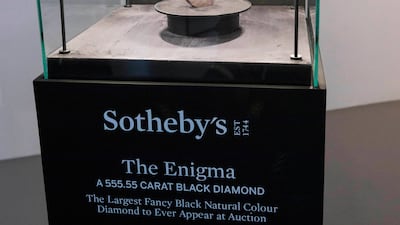
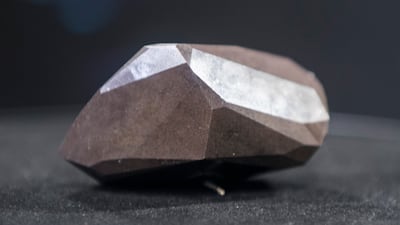
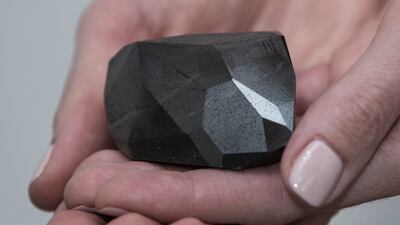
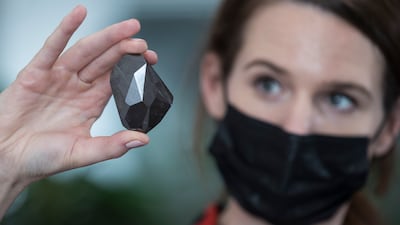
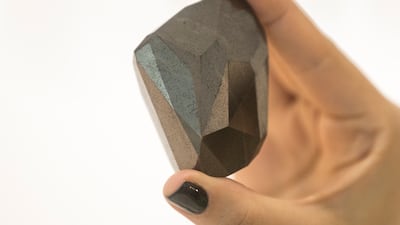
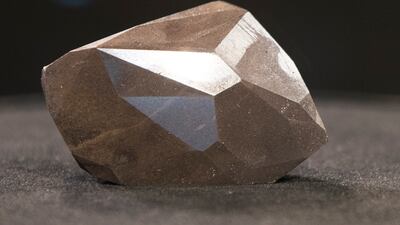
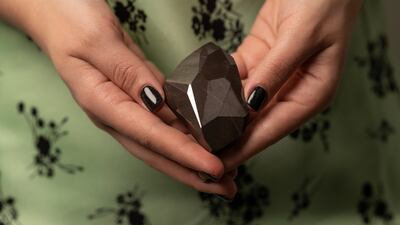
  • The Enigma is a 555.55-carat black diamond. All photos: Ruel Pableo for The National
    The Enigma is a 555.55-carat black diamond. All photos: Ruel Pableo for The National
  • It is the world’s largest Fancy Black Natural Colour diamond, as reported by Gubelin and the GIA.
    It is the world’s largest Fancy Black Natural Colour diamond, as reported by Gubelin and the GIA.
  • The stone has 55 facets and is believed to have extraterrestrial origins.
    The stone has 55 facets and is believed to have extraterrestrial origins.
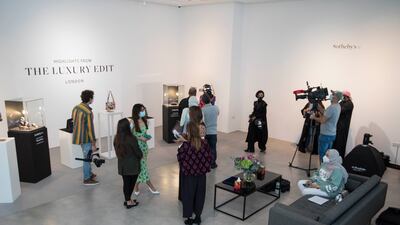
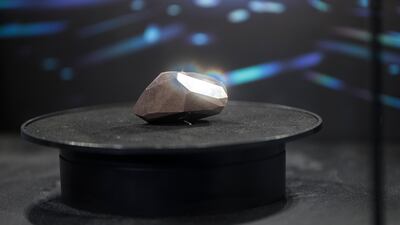
  • The gemstone is on view at the Sotheby's showroom in the DIFC.
    The gemstone is on view at the Sotheby's showroom in the DIFC.
  • The Enigma will remain in Dubai until January 20.
    The Enigma will remain in Dubai until January 20.
  • The stone will be auctioned via a single-lot online sale.
    The stone will be auctioned via a single-lot online sale.
  • Sotheby's is accepting cryptocurrency for this sale.
    Sotheby's is accepting cryptocurrency for this sale.
  • The Enigma was acquired by its current owner in the 1990s and was previously unseen on the market.
    The Enigma was acquired by its current owner in the 1990s and was previously unseen on the market.
  • Carbonado diamonds are believed to be 2.6 to 3.8 billion years old.
    Carbonado diamonds are believed to be 2.6 to 3.8 billion years old.
  • Carbonado diamonds are only found in Brazil and the Central African Republic.
    Carbonado diamonds are only found in Brazil and the Central African Republic.
  • They are believed to have been formed when a meteorite collided with the Earth billions of years ago.
    They are believed to have been formed when a meteorite collided with the Earth billions of years ago.
The Bloomberg Billionaire Index in full

1 Jeff Bezos $140 billion
2 Bill Gates $98.3 billion
3 Bernard Arnault $83.1 billion
4 Warren Buffett $83 billion
5 Amancio Ortega $67.9 billion
6 Mark Zuckerberg $67.3 billion
7 Larry Page $56.8 billion
8 Larry Ellison $56.1 billion
9 Sergey Brin $55.2 billion
10 Carlos Slim $55.2 billion

Race 3

Produced: Salman Khan Films and Tips Films
Director: Remo D’Souza
Cast: Salman Khan, Anil Kapoor, Jacqueline Fernandez, Bobby Deol, Daisy Shah, Saqib Salem
Rating: 2.5 stars

What is a robo-adviser?

Robo-advisers use an online sign-up process to gauge an investor’s risk tolerance by feeding information such as their age, income, saving goals and investment history into an algorithm, which then assigns them an investment portfolio, ranging from more conservative to higher risk ones.

These portfolios are made up of exchange traded funds (ETFs) with exposure to indices such as US and global equities, fixed-income products like bonds, though exposure to real estate, commodity ETFs or gold is also possible.

Investing in ETFs allows robo-advisers to offer fees far lower than traditional investments, such as actively managed mutual funds bought through a bank or broker. Investors can buy ETFs directly via a brokerage, but with robo-advisers they benefit from investment portfolios matched to their risk tolerance as well as being user friendly.

Many robo-advisers charge what are called wrap fees, meaning there are no additional fees such as subscription or withdrawal fees, success fees or fees for rebalancing.

Sarfira

Director: Sudha Kongara Prasad

Starring: Akshay Kumar, Radhika Madan, Paresh Rawal 

Rating: 2/5

Bridgerton%20season%20three%20-%20part%20one
%3Cp%3E%3Cstrong%3EDirectors%3A%20%3C%2Fstrong%3EVarious%3C%2Fp%3E%0A%3Cp%3E%3Cstrong%3EStarring%3A%3C%2Fstrong%3E%20Nicola%20Coughlan%2C%20Luke%20Newton%2C%20Jonathan%20Bailey%3C%2Fp%3E%0A%3Cp%3E%3Cstrong%3ERating%3A%20%3C%2Fstrong%3E3%2F5%3C%2Fp%3E%0A

Jeff Buckley: From Hallelujah To The Last Goodbye
By Dave Lory with Jim Irvin

Updated: September 14, 2022, 11:09 AM