
Boko Haram leader Abubakar Shekau killed himself after a battle with ISIS affiliated fighters, according to an audio recording AFP obtained on Sunday.
His death marks a major shift in Nigeria's 12-year insurgency. More than 40,000 people were killed and about two million were displaced by the violence in north-east Nigeria.
Boko Haram has not yet officially commented on the death of their leader, while the Nigerian army said it was investigating the claim of his death that began circulating two weeks ago.
"Shekau preferred to be humiliated in the hereafter to getting humiliated on Earth. He killed himself by detonating an explosive," said a voice resembling that of Abu Musab Al Barnawi, the leader of the self-declared Islamic State of West Africa Province (Iswap), speaking in the Kanuri language.
The recording, which was not dated, was given to AFP by a source who conveyed messages from the group.
The ISIS affiliate described how it sent fighters to Boko Haram's enclave in the Sambisa forest, that they found Shekau sitting inside his house and started a firefight.
"From there he retreated and escaped, ran and roamed the bushes for five days. However, the fighters kept searching and hunting for him before they were able to locate him," the voice said.
After finding him in the bush, ISIS urged him and his followers to repent, the voice said, but Shekau refused and killed himself.
"We are so happy," the voice said, describing Shekau as "the big troublemaker, persecutor and destructive leader of the nation".
Iswap split from Boko Haram in 2016, objecting to Shekau's targeting of Muslim civilians and use of women suicide bombers.
In the past two years, Iswap emerged as the more dominant force in the region, carrying out large-scale attacks against the Nigerian military.
As the group now looks to absorb Shekau's fighters and territory, Nigeria's army may face a more unified militant force, analysts said.
But Iswap may also struggle to control or persuade Boko Haram factions loyal to Shekau outside Sambisa, especially in border areas.
"It may not be over yet," a security source said. "Iswap will have to subdue or convince these camps to coalesce [them] into its fold to fully consolidate its control."
Infighting between militant groups may also present opportunities for Nigeria's army.
But should Iswap absorb part of Shekau's forces and weapons, it might be in a position to cut off roads to and from the Borno state capital Maiduguri, said Peccavi Consulting, a risk group specialising in Africa.
"If Iswap convinces Shekau's forces to join them, they will be controlling the majority of the enemy forces as well as having a presence in most of the ungoverned spaces in the north-east," it said.
Since 2019, Nigeria's army has pulled out of villages and smaller bases to so-called "supercamps", a strategy critics said allows militants to roam freely in rural areas.
Following its takeover of Sambisa, Iswap sent messages to locals in the Lake Chad region, telling them they were welcome to its self-declared "caliphate", said Sallau Arzika, a fisherman from Baga.
Locals were chased out of the lake islands after Iswap accused them of spying for the military.
Al Barnawi said they could now return for fishing and trading after paying tax, with the assurance they would not be harmed, Mr Arzika said.
_______________
Gallery: separatists attack Nigeria police station
-

Burnt vehicles are seen outside the Nigeria police force Imo state command headquarters after gunmen attacked and set properties ablaze in Imo State, Nigeria. Reuters -
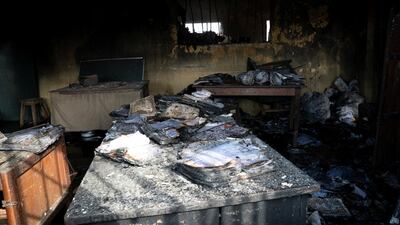
Burnt prison books are seen on the table after gunmen attacked and set the prison facility ablaze in Imo State, Nigeria. Reuters -
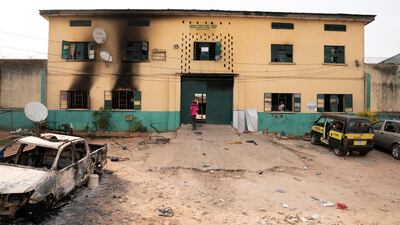
A man is seen standing in front of the main gate of the Nigerian Correctional Services facility that was attacked by gunmen, with large numbers of inmates set freed afterwards in Imo State, Nigeria. Reuters -
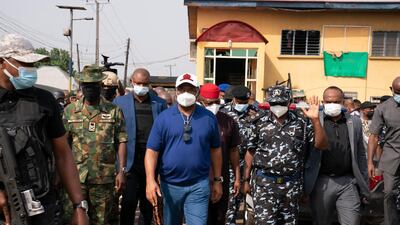
Imo state Gov. Hope Uzodinma, center, inspects the scene of an attack at the police command headquarters in Owerri. AP Photo -
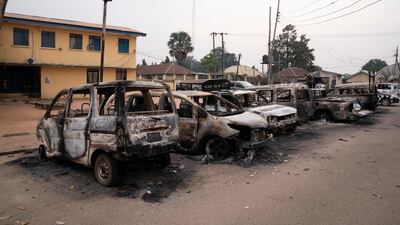
Burned vehicles are parked outside the police command headquarters in Owerri, Nigeria. Hundreds of inmates escaped from a prison in the southeastern Nigerian city after a series of coordinated attacks, according to government officials. AP Photo -
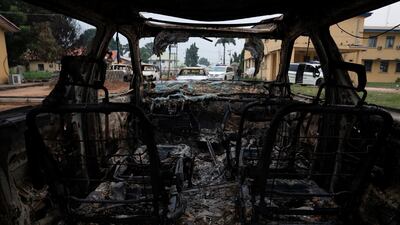
A burned vehicle is parked outside the police command headquarters in Owerri, Nigeria. Hundreds of inmates escaped from a prison in the southeastern Nigerian city after a series of coordinated attacks, according to government officials. AP Photo -

Burned documents are seen inside a correctional facility in Owerri, Nigeria. Hundreds of inmates escaped from the prison in southeastern Nigeria after a series of coordinated attacks, according to government officials. AP Photo -
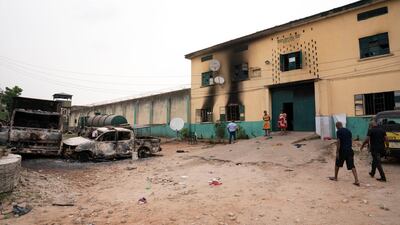
People walk past burned vehicles in front of a correctional facility in Owerri, Nigeria. Hundreds of inmates escaped from the prison in southeastern Nigeria after a series of coordinated attacks according to government officials. AP Photo



