Security officials detected increasing interest from ISIS members in the use of biological weapons during the coronavirus pandemic, they said.
The death toll caused by the virus and its crippling of the global economy have put security services on alert for bioterrorism.
The US Department of Homeland Security said extremists made “bioterrorism a popular topic among themselves”.
The UN and the Council of Europe also warned about bioterrorism attacks.
ISIS is understood to be re-examining its experiments on using bubonic plague as a weapon and there are concerns the extremist group will try to attack a level 4, high-security biosafety laboratory.
Biosecurity expert Hamish de Bretton-Gordon told The National that the group's long-standing ambitions have come back into focus.
"We do know that ISIS and Al Qaeda have experimented with bioweapons but found chemical much easier to make,” Mr de Bretton-Gordon said.
“The Covid experience will undoubtedly change this and we must now be on our guard, as it has brought the world to its knees and will take years to get out of it.”
He is a former army officer and investigated attempts by ISIS in Syria and Iraq to introduce the plague to refugee camps.
Mr de Bretton-Gordon also examined the group's research into using Ebola as a weapon.
The UK's senior defence adviser to the Middle East, Lt Gen Sir John Lorimer, said intelligence was being gathered to ensure extremist groups did not create bioweapons.
“It is important for us to continue determining what research Daesh are doing and that’s a priority," Gen Lorimer said.
"We’ve got all the right capabilities in place to deal with any chemical or biological system that they come up with, and we have got measures we can put in place to defeat them.”
He said there was no “specific information” about biological weapons but warned that security forces had to keep “absolutely alert to any option or capability used against Iraqis or coalition troops”.
“We will keep scanning and researching the intelligence to make sure we are on that," Gen Lorimer said.
The pandemic also showed that security services needed to focus on terrorist groups developing less toxic pathogens that are easily transmitted, such as Covid-19.
White supremacists in the US have also discussed in chat rooms using biological weapons.
Bioweapons also include botulinum toxin, anthrax and smallpox.
Chemical weapons can be nerve agents such as novichok, sarin and VX, or marginally less sophisticated gases such as mustard and chlorine, both of which have been used by ISIS.
Mr de Bretton-Gordon said terrorists wanted to develop the weapons because of the fear factor.
“The psychological to physical impact is 10 is to one," he said.
"It’s horrific. It’s quite difficult to get it right but it’s very easy to terrorise a lot of people with small amounts.
“I’m hugely concerned that in the light of Covid-19 they will be looking at the vulnerability of Level 4 labs around the globe.
"You can imagine what an attack or explosion at one of these labs could do, especially psychologically.”
A western military intelligence source confirmed that there were concerns over bioterrorism activity.
“ISIS are not stupid," the source said.
"We are aware that they are exploring many avenues to pursue their objectives.”
______
Gallery: Coronavirus around the world
-
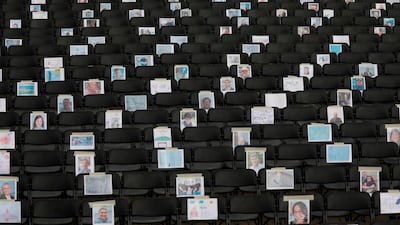
Portraits and drawings are displayed on chairs, amid the coronavirus pandemic, during a protest outside the Hamburg plant of European aircraft maker Airbus. AFP -
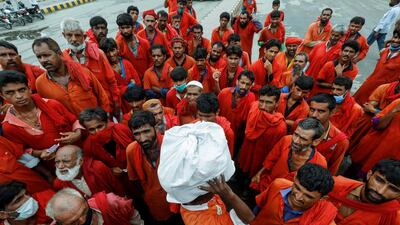
A porter, also known as a coolie, carries a sack of rations,received from a charity truck in Karachi, Pakistan. Reuters -

Fortitude, one of the pair of marble lions that sit in front of the New York Public Library's Fifth Avenue and 42nd Street branch in New York, wears a face mask to encourage New Yorkers to continue to follow safety measures in the fight against COVID-19. AFP -
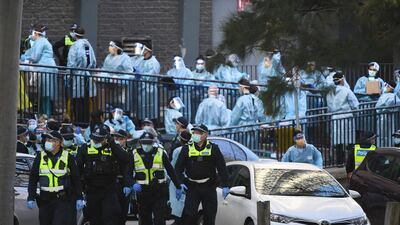
Victoria Police officers and healthcare workers congregate outside a public housing tower in North Melbourne, Australia. Nine towers in Flemington and North Melbourne were locked down on Saturday in an effort to slow the spread of coronavirus. EPA -
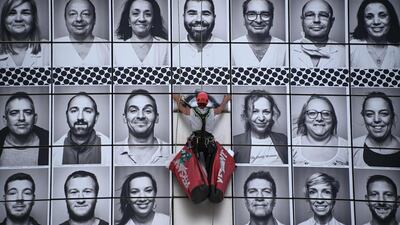
A worker pastes portraits of healthcare workers created on the facade of the Opera Bastille, at the initiative of the collective #ProtegeTonSoignant to pay tribute to caregivers in first ligne during the Covid-19 epidemic, in Paris. AFP -
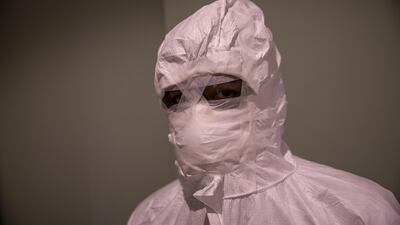
Dr John Bunge, from Venezuela, poses for a photo before entering the intensive care unit for COVID-19 cases at the private Ricardo Palma hospital in Lima, Peru. AP Photo -
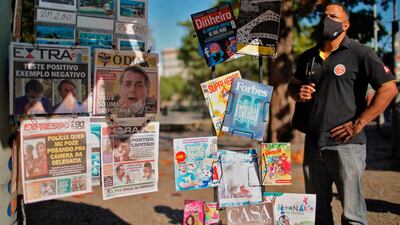
A man looks at the front pages of newspapers in Rio de Janeiro, Brazil. AFP -
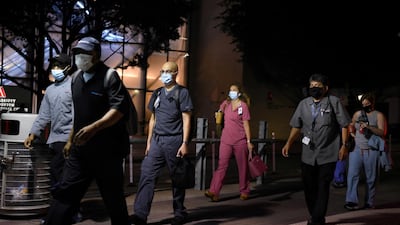
Healthcare workers walk through the Texas Medical Centre during a shift change in Houston. Reuters -

German Chancellor Angela Merkel wears a protective face mask with the logo of Germany's EU council presidency as she attends a plenary session at the European Parliament in Brussels, Belgium. Reuters -
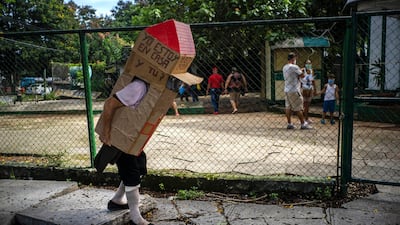
Feridia Rojas, a retired nurse, wears a cardboard box as a protective measure against the spread of the coronavirus, in Havana. AP Photo -
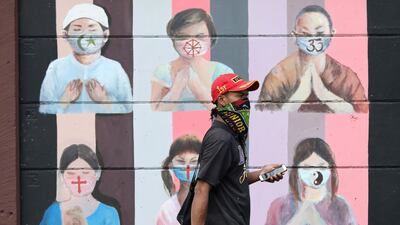
A man wearing a face mask walks past a coronavirus awareness mural in Depok, Indonesia. AP Photo -
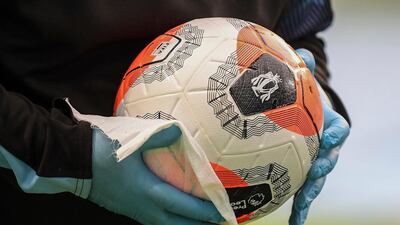
A Manchester City staffer disinfects the ball prior the English Premier League match between Manchester City and Newcastle at the Ethiad Stadium in Manchester. AP