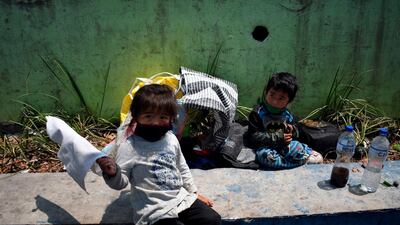
Volunteers give free food to migrant workers from Myanmar who lost their jobs following the coronavirus disease outbreak in Bangkok, Thailand. Reuters

Coronavirus: half of global workforce 'at risk of losing income'


Taylor Heyman
  • English
  • Arabic

Almost half the world’s workers could lose their income because of the coronavirus pandemic and government lockdowns, a UN report has found.

The world may see a loss of working hours equal to 305 million full-time jobs in the second quarter of the year, the International Labour Organisation said on Wednesday.

That would be the equivalent of 10.5 per cent of global employment.

But those particularly at risk are people working in informal jobs, who are self-employed and selling goods or services that have been curtailed by lockdown measures.

This includes members of the gig economy such as cleaners or food delivery couriers.

This category of worker accounts for more than 2 billion people globally, who often have poor access to health care and no income replacement in case of sickness or lockdown, the UN agency said.

“Many of them have no possibility to work remotely from home," its report said.

"Staying home means losing their jobs and without wages, they cannot eat."

  • A girl waves a white flag as a signal she needs food, along a highway in Guatemala City. AFP
    A girl waves a white flag as a signal she needs food, along a highway in Guatemala City. AFP
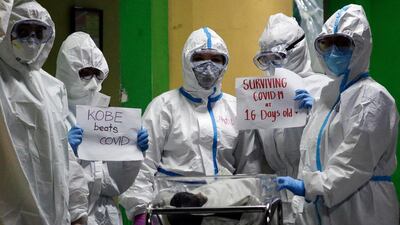
  • Health workers wearing protective suits hold signs beside a 16-day-old baby who recovered from COVID-19 in Metro Manila, Philippines. AP
    Health workers wearing protective suits hold signs beside a 16-day-old baby who recovered from COVID-19 in Metro Manila, Philippines. AP
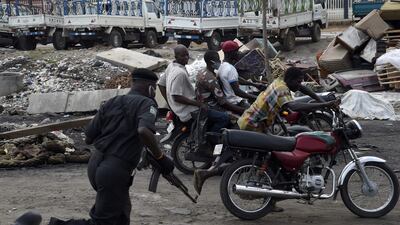
  • A police officer pursues fleeing motorcycle taxi riders who refused to stop at mounted barricades to check movement of vehicles and for failing to comply with the sit-at-home order to prevent the spread of COVID-19 coronavirus on Lagos Ibadan expressway. AFP
    A police officer pursues fleeing motorcycle taxi riders who refused to stop at mounted barricades to check movement of vehicles and for failing to comply with the sit-at-home order to prevent the spread of COVID-19 coronavirus on Lagos Ibadan expressway. AFP
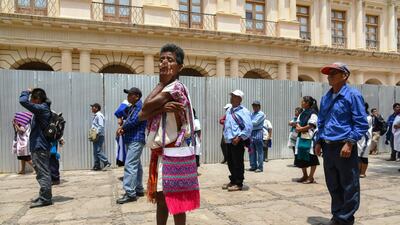
  • Indigenous people from the Altos de Chiapas queue -keeping social distancing- while waiting for an allowance from the local government in Chiapas, Mexico. AFP
    Indigenous people from the Altos de Chiapas queue -keeping social distancing- while waiting for an allowance from the local government in Chiapas, Mexico. AFP
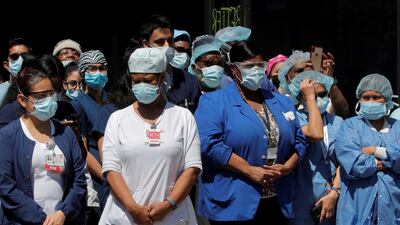
  • Healthcare workers gather for lunch purchased by members of the New York City Police Department outside the Brooklyn Hospital Centre. Reuters
    Healthcare workers gather for lunch purchased by members of the New York City Police Department outside the Brooklyn Hospital Centre. Reuters
  • An elderly lady wears a face mask to prevent the spread of the novel coronavirus in Zaragoza, Mayabeque province, Cuba. AFP
    An elderly lady wears a face mask to prevent the spread of the novel coronavirus in Zaragoza, Mayabeque province, Cuba. AFP
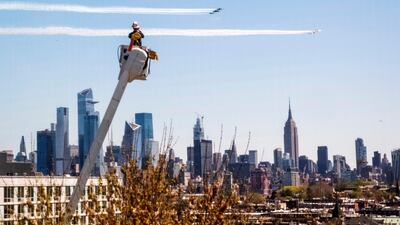
  • A utility worker watches the Navy's Blue Angels and the Air Force's Thunderbirds conduct "a collaborative salute" with a flyover of New York and New Jersey. AP
    A utility worker watches the Navy's Blue Angels and the Air Force's Thunderbirds conduct "a collaborative salute" with a flyover of New York and New Jersey. AP
  • People wear face masks and stand on special marks as a practice of social distancing in Medellin, Colombia. AFP
    People wear face masks and stand on special marks as a practice of social distancing in Medellin, Colombia. AFP
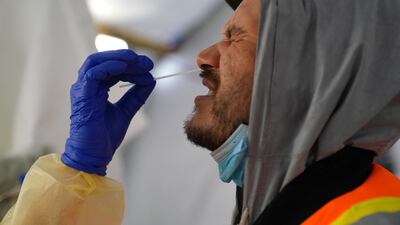
  • Provincial health workers perform coronavirus disease nasal swab tests on Raymond Robins of the remote First Nation community of Gull Bay, Ontario, Canada. Reuters
    Provincial health workers perform coronavirus disease nasal swab tests on Raymond Robins of the remote First Nation community of Gull Bay, Ontario, Canada. Reuters

Overall, the ILO estimates that 1.6 billion, just less than half of those in work, could have their livelihoods destroyed in the fallout from the pandemic.

It estimates that in the first month of the crisis, incomes of informal workers dropped by 60 per cent.

Africa and the Americas were hardest hit with a drop of 81 per cent, followed by Europe and Central Asia at 70 per cent and Asia and the Pacific at 21 per cent.

“As the pandemic and the jobs crisis evolve, the need to protect the most vulnerable becomes even more urgent,” said the agency's director general, Guy Ryder.

“For millions of workers, no income means no food, no security and no future.”

The agency estimates that 68 per cent of the world’s workforce is under some form of lockdown, down from 80 per cent on April 1.

“Millions of businesses around the world are barely breathing," Mr Ryder said.

"They have no savings or access to credit. These are the real faces of the world of work.

"If we don’t help them now, these enterprises will simply perish.”

Nations have taken measures to protect workforces, but many furlough and wage replacement schemes do not include the self-employed or newly employed.

The UN agency is calling on governments to follow a “job-rich approach” when reactivating their economies after lockdowns are eased, backed by stronger employment policies and social protection.

It also advised international co-ordination on stimulus packages and debt relief measures, and the adoption of international labour standards.

More from Armen Sarkissian
How green is the expo nursery?

Some 400,000 shrubs and 13,000 trees in the on-site nursery

An additional 450,000 shrubs and 4,000 trees to be delivered in the months leading up to the expo

Ghaf, date palm, acacia arabica, acacia tortilis, vitex or sage, techoma and the salvadora are just some heat tolerant native plants in the nursery

Approximately 340 species of shrubs and trees selected for diverse landscape

The nursery team works exclusively with organic fertilisers and pesticides

All shrubs and trees supplied by Dubai Municipality

Most sourced from farms, nurseries across the country

Plants and trees are re-potted when they arrive at nursery to give them room to grow

Some mature trees are in open areas or planted within the expo site

Green waste is recycled as compost

Treated sewage effluent supplied by Dubai Municipality is used to meet the majority of the nursery’s irrigation needs

Construction workforce peaked at 40,000 workers

About 65,000 people have signed up to volunteer

Main themes of expo is  ‘Connecting Minds, Creating the Future’ and three subthemes of opportunity, mobility and sustainability.

Expo 2020 Dubai to open in October 2020 and run for six months

UAE currency: the story behind the money in your pockets
THE SIXTH SENSE

Starring: Bruce Willis, Toni Collette, Hayley Joel Osment

Director: M. Night Shyamalan

Rating: 5/5

UPI facts

More than 2.2 million Indian tourists arrived in UAE in 2023
More than 3.5 million Indians reside in UAE
Indian tourists can make purchases in UAE using rupee accounts in India through QR-code-based UPI real-time payment systems
Indian residents in UAE can use their non-resident NRO and NRE accounts held in Indian banks linked to a UAE mobile number for UPI transactions