
The head of the UN nuclear watchdog on Wednesday said there had been "no progress" in talks with Iran to resolve disputes over the monitoring of the country's atomic programme, a day after returning from Tehran.
Rafael Grossi, director general of the International Atomic Energy Agency, told a quarterly meeting of the agency's board that his talks in Tehran were "inconclusive".
Mr Grossi had sought to tackle constraints put on the agency's inspections this year, outstanding questions over the presence of undeclared nuclear material at sites in Iran and the treatment of IAEA staff in the country.
"In terms of the substance ... we were not able to make progress," Mr Grossi told reporters, saying that the lack of agreement had come "in spite of my best efforts".
Time running out to end camera stand-off
Mr Grossi said the IAEA was running out of time to end a stand-off over reinstalling surveillance cameras at a centrifuge-parts workshop that was the victim of alleged sabotage in June.
"We are close to the point where I would not be able to guarantee continuity of knowledge," he said, referring to a long gap in access to the workshop at the Tesa Karaj complex, north-west of Tehran, where the IAEA wants to reinstall cameras removed by Iran after what it said was an attack by Israel.
In Tehran, Mr Grossi met Foreign Minister Hossein Amir-Abdollahian and Mohammad Eslami, the head of the Atomic Energy Organisation of Iran, among other officials.
The talks came before the scheduled resumption on Monday of negotiations between Tehran and world powers aimed at reviving the 2015 deal that gave Iran sanctions relief in return for curbs on its nuclear programme.
Iran began moving away from its commitments under the deal in 2019, a year after then-president Donald Trump unilaterally withdrew the United States from the accord and began reimposing tough sanctions.

One of the steps away from the deal came this year when Iran began restricting some IAEA inspection activity.
Iran and the agency have a temporary agreement, which gives the IAEA access to monitoring equipment at Iran's nuclear facilities.
However, the IAEA has given a warning that the agreement is not a durable solution and Mr Grossi said he had raised concerns while in Tehran about security checks on inspectors, which the agency described as "excessively invasive".
He said the IAEA and Iran had a legal agreement, "which is intended to protect inspectors from intimidation, from seizure of their property".
"Our Iranian colleagues have instituted a number of measures which are simply incompatible" with this, he said.
Iranian nuclear sites - in pictures
-
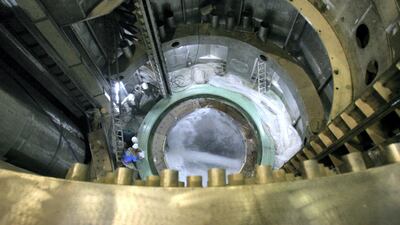
Russian contractors work at the Bushehr nuclear reactor site in 2007. The plant opened four years later. Bloomberg -
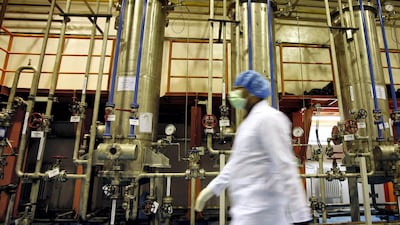
An Iranian technician at the International Atomic Energy Agency inspects the country's Isfahan plant in 2007. Tehran is no longer co-operating with the agency at nuclear sites across the country. EPA -

Workers wait to begin constructing a second reactor at the Bushehr nuclear power plant in 2019. AFP -
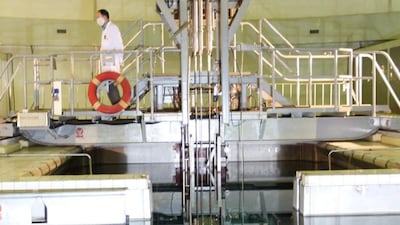
A metal-encased rod with 20 per cent enriched nuclear fuel is inserted into a reactor in Tehran in 2012. AFP -
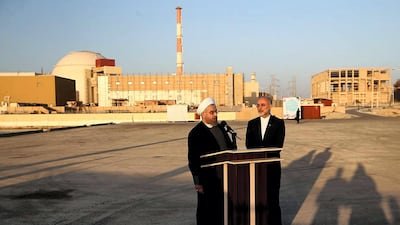
Fomer Iranian President Hassan Rouhani and the country's Atomic Energy Organisation chief Ali Akbar Salehi speak at the Bushehr nuclear site in 2015. AFP -
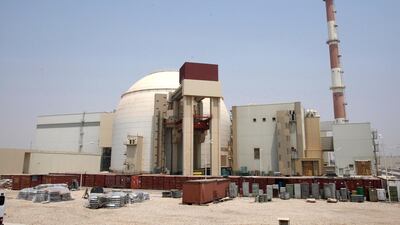
Iran's Bushehr nuclear plant has been restarted. EPA -
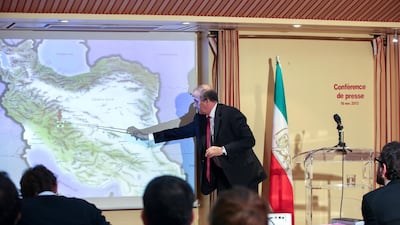
Mehdi Abrichamtchi, chairman of the Peace and Security Committee at the National Council of Resistance of Iran, shows journalists the location of a secret nuclear site in Iran in 2013. AFP -
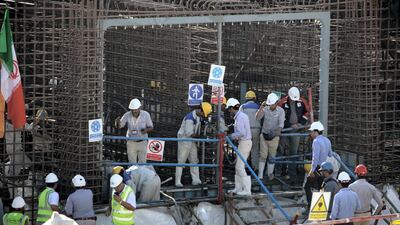
Workers prepare to begin the construction of a second reactor at the Bushehr site. AFP



