
Live updates: follow the latest news on Russia-Ukraine
Russia on Friday launched airstrikes on the southern Ukrainian city of Dnipro, a move which symbolises more than just a further territorial incursion.
Dnipro is Ukraine's fourth biggest city and boasts one of the most sprawling and renowned space manufacturing facilities in the world. Such is its international repute, its pseudonym is “Rocket City".
There are few areas in which Ukraine has been able to escape Russia's omnivorous shadow, but its space industry has seen more light than most.
During the Cold War, Ukraine played an integral role in the Soviet space programme. Much of the bloc's space infrastructure was based in the country, and many of its space engineers and scientists were of Ukrainian origin.
Following the fall of the Soviet Union in 1991, while Russia took the majority of the space spoils, Ukraine was not left completely bereft, retaining a significant number of its assets - the majority clustered around Dnipro.
Among the Rocket City nuclear arsenal was the R-36, one of the most powerful intercontinental ballistic missiles ever made.
Dnipro's legacy has, somewhat ironically, created contemporary admirers in its Cold War foe, the US.

Texas-based Firefly Aerospace opened a research and development centre in the city in 2018.
And the Tesla and SpaceX founder Elon Musk has gone on record with his admiration for the Zenit rocket, manufactured at the Dnipro-based Yuzhmash and Yuzhnoye enterprises.
Yuzhmash and Yuzhnoye are also responsible for the design and manufacture of the first stages of the Antares rocket, which propels cargo to the International Space Station, as well as the engines for Europe's Vega rockets.
Perhaps the most conspicuous hallmark of Ukraine's space legacy, however, lies in its 16,000-strong Ukrainian Space Agency, a number of employees that nearly matches Nasa.
Despite winning the heart of Elon Musk and retaining many of the trappings of its glorious heyday, Ukraine's significance on the global space stage has dwindled in recent years. Indeed, until this year it was about 11 years ago that the country last had a satellite in orbit — the Sich-2.
Ukraine's space nationalism
The decline has not gone unnoticed, and the incumbent regime, led full sail by President Volodymyr Zelenskyy, had embarked on a policy of space nationalism to assert Ukraine's power.
To this end, when SpaceX launched the observation satellite — Sich 2-30 — in January, President Zelenskyy tweeted that it heralded a new era for Ukraine as a “powerful space power".
Among Sich-2 30's aims was the collection of data for defence and security purposes. It is unknown whether the satellite is abetting Ukraine's Russian resistance, but it has been reported that the country has sought the help of other firms and space agencies to help it locate and combat the movement of enemy troops.
Russia's Rocket City strategy
Knowing Mr Zelenskyy has actively channelled Ukraine's space heritage as a means of galvanising national pride, on the surface it may appear surprising there has not yet been a concerted Russian attack on Ukraine's space cluster in and around Rocket City.
This decision is unlikely to be an oversight, according to Volodymyr Usov, former chairman of the Ukrainian Space Agency.
“I believe [Russia is] avoiding them for now because it wants to get hold of them and use them for its purposes,” Mr Usov told Space.com.
“If we win before everything is destroyed, we will keep that research and production capacity. But it can change any day. Two strikes on Youzmash and it will never recover.”

Such an outcome would pose a “huge ecological catastrophe”, not just to Ukraine but the rest of Europe too, given the hefty number of toxic chemicals stored there, Mr Usov said, echoing fears voiced after Russian strikes on the Mariupol nuclear plant.
The odds seem insuperable, but Mr Usov's future optimism for Ukraine's space industry has not been completely extinguished.
He outlined a scenario where Ukraine becomes an even bigger player in the international space sector.
“I want to open Ukraine to the world and show that it can be a trustworthy partner,” he said.
“But we need to create really good conditions and terms for other companies to co-operate with Ukraine.
“Before the war started, we were working on new legislation, which has already been signed and implemented by the President of Ukraine, to enable private companies to build space technology in Ukraine.”
Mr Usov still rankles from the 2015 dissolution of Ukraine's project with Brazil to develop the Cyclone 4M launcher which he blames on Russian political pressure.
-
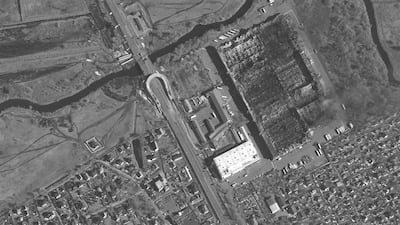
This satellite image provided by Maxar Technologies shows destroyed and burning warehouse buildings in Stoyanka, Ukraine, in the western Kyiv region, during the Russian invasion. AP -
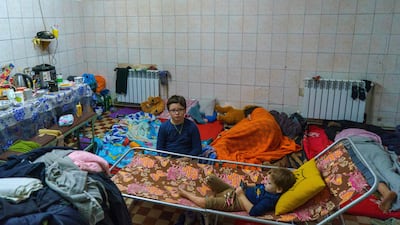
Children shelter in a metro station in Kharkiv. Moscow said on March 10, 2022, that it will open daily humanitarian corridors to allow civilians fleeing fighting in Ukraine to reach Russian territory, despite Kyiv insisting that no evacuation routes should lead to Russia. AFP -
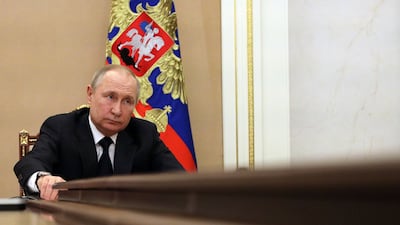
Russian President Vladimir Putin during a videoconference meeting with government members at the Kremlin in Moscow. The meeting focuses on minimising the effects of sanctions on the Russian economy. Russian troops entered Ukraine on February 24, prompting the country's president to declare martial law and triggering a series of severe economic sanctions imposed by western countries. EPA -
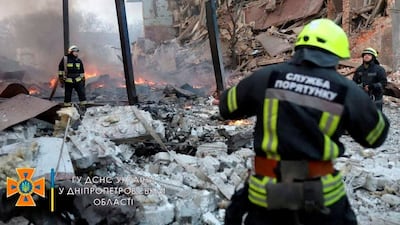
Rescuers work among remains of buildings damaged by an air strike in Dnipro, Ukraine, as Russia's attack on the country continues. Reuters -

Members of the National Guard of Ukraine, Oleksandr and Olena, listen to a priest at their wedding in Ukraine. Reuters -

People fleeing Russia's invasion of Ukraine warm up by a fire near the train station in Lviv, Ukraine. Reuters -
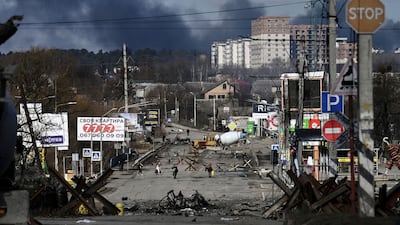
Russian forces rolled their armoured vehicles up to the northeastern edge of Kyiv, edging closer in their attempts to encircle the Ukrainian capital. AFP -
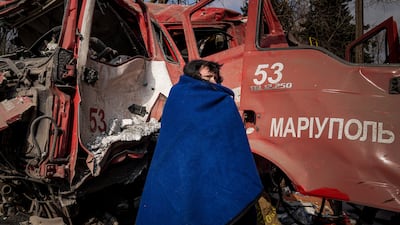
A woman covers herself with a blanket near a damaged fire truck after shelling in Mariupol, Ukraine. AP Photo -

A Ukrainian soldier hides from a helicopter air strike near Demydiv, Ukraine. Reuters -
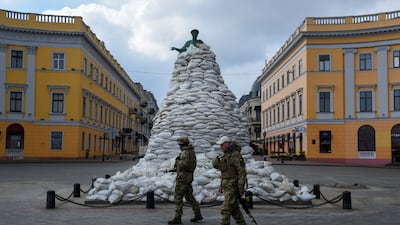
Ukrainian soldiers walk past a monument of the city founder Duke de Richelieu, covered with sand bags for protection, in Odessa, Ukraine. Reuters -
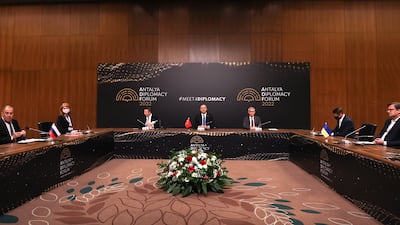
Russian Foreign Minister Sergey Lavrov, left, Turkish Foreign Minister Mevlut Cavusoglu, centre, and Ukranian Foreign Minister Dmytro Kuleba. EPA -
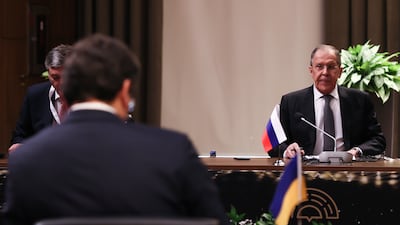
Russian Foreign Minister Sergey Lavrov in talks with Ukrainian counterpart Dmytro Kuleba during a tripartite meeting chaired by Turkish Foreign Minister Mevlut Cavusoglu, in Antalya, Turkey. AP -
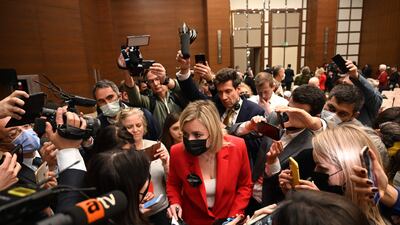
Russian Foreign Ministry spokeswoman Maria Zakharova speaks to the media as the foreign ministers of Ukraine, Russia and Turkey hold talks in Antalya, 15 days after Russia launched a military invasion on Ukraine. AFP -
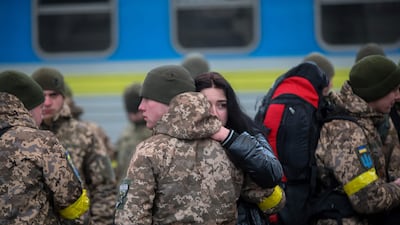
A Ukrainian serviceman says goodbye to his girlfriend before departing in the direction of Kyiv at the central train station in the western Ukrainian city of Lviv. AFP -
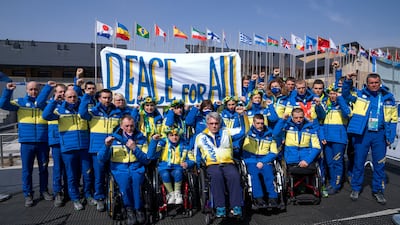
Valerii Sushkevych, president of the Ukraine National Paralympic Committee, and the Ukraine delegation raise their fists and pose with a banner at the Beijing 2022 Winter Paralympic Games. Reuters -

A member of the Ukrainian team cries during a moment of silence at the Zhangjiakou athletes village during the Beijing 2022 Winter Paralympic Games. AFP -
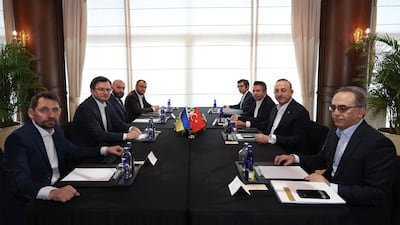
Turkish Foreign Minister Mevlut Cavusoglu, right, and Ukraine Foreign Minister Dmytro Kubela, second left, in Antalya, Turkey. AFP -
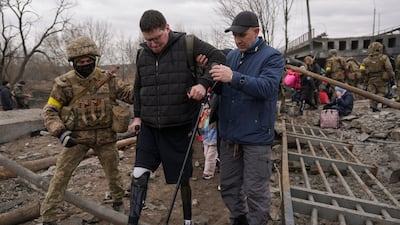
A man is supported after crossing the Irpin river while fleeing the town of Irpin, Ukraine. AP -
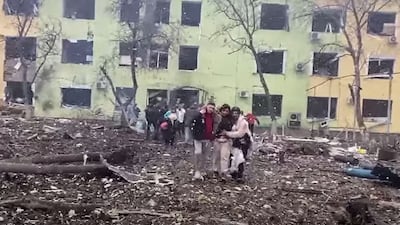
People are helped out of a damaged children's hospital following a Russian air strike in the southeastern city of Mariupol, Ukraine. AFP -

A man rides a bicycle in front of an apartment building that was damaged by shelling in Mariupol. AP -
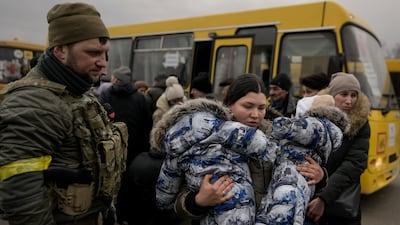
A woman carries two babies after arriving at a triage point in Kyiv, Ukraine. AP -
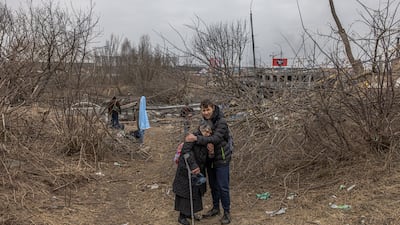
A man hugs an elderly woman after crossing a damaged bridge as they flee from the frontline town of Irpin, near the Ukrainian capital of Kyiv. EPA -
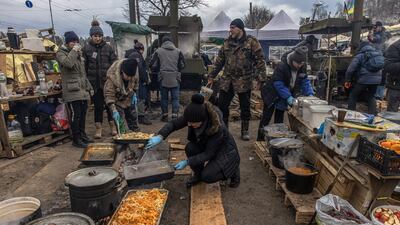
Local residents cook at a makeshift camp next to a checkpoint in Kyiv. EPA -
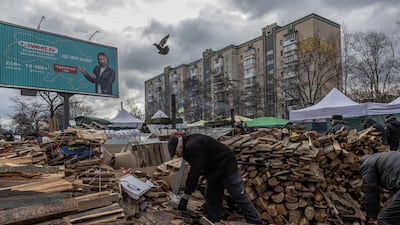
Ukrainian men chop wood at a makeshift camp next to a checkpoint in Kyiv. EPA -

A member of the Territorial Defence Forces learns how to use a Javelin missile during a training session in Kyiv. EPA -
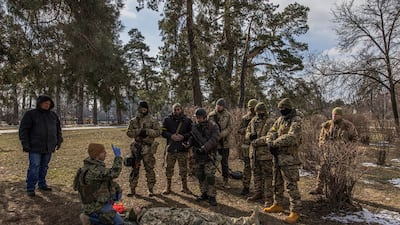
Members of the Territorial Defence Forces learn how to give first aid during the training session. EPA -
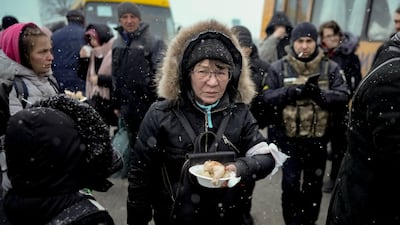
A woman rescued from the outskirts of Kyiv holds a plate of food after arriving at a triage point in the Ukrainian capital. AP -
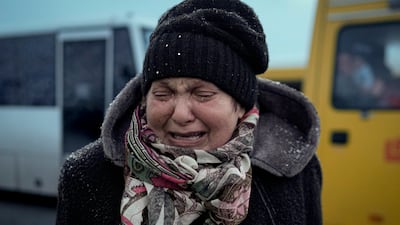
A woman cries after arriving at the triage point in Kyiv. AP -
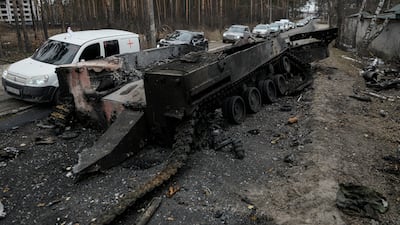
Civilian vehicles drive past a destroyed Russian tank as they leave Irpin. AP -
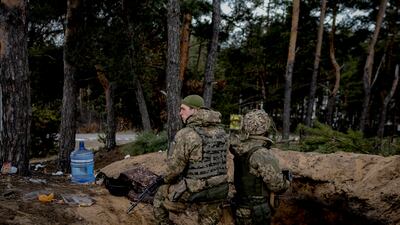
Ukrainian servicemen stand in a foxhole in Irpin. AP -
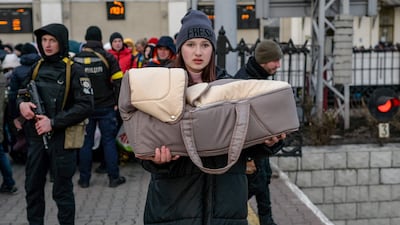
People gather on a platform to board a train leaving Odesa after the US said Russian troops are making preparations to attack the city. AFP -
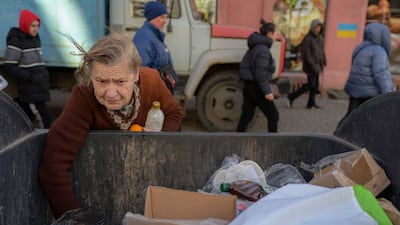
A Ukrainian woman looks for food in a bin in Odesa's city centre. AFP -
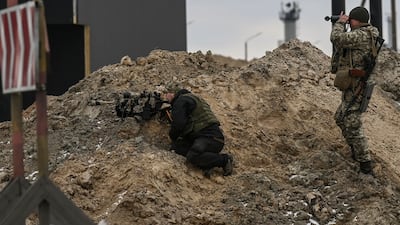
Ukrainian servicemen look towards Russian positions outside the city of Brovary, east of Kyiv. AFP -
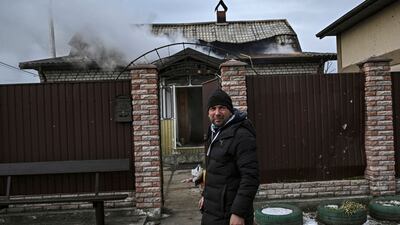
A man walks past a shelled house at the village of Velyka Dymerka, east of Kyiv. AFP -
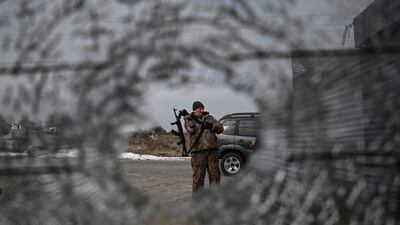
A Ukrainian serviceman stands at a check point in the vilage of Velyka Dymerka east of Kyiv. AFP -
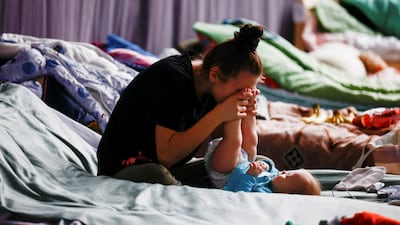
A Ukrainian woman plays with her child in a temporary refugee shelter in Przemysl, Poland. Reuters -

A woman waits outside a maternity and children's hospital damaged by shelling in Mariupol, Ukraine. AP -
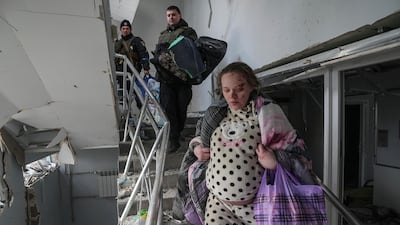
A pregnant woman leaves the hospital after she was wounded when it was bombed. AP -

A woman waits outside the damaged hospital in Mariupol. AP -

A man wounded by shelling in Mariupol. AP -
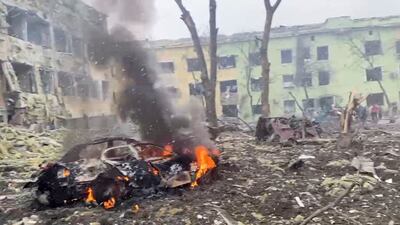
A car burns after the destruction of the children's hospital in Mariupol. Reuters -
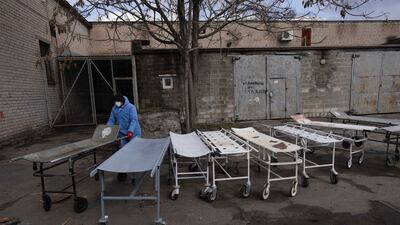
A mortuary worker wheels a stretcher used to move dead bodies before they are buried on the outskirts of Mariupol. AP


“Even after Brazil spent about $500 million on that, they closed the project because of the tension,” he said.
He sees Ukraine's space industry as far more than hardware — he sees it an allegory of Ukraine's desire to escape Russian vassalage and to westernise.
The defiance and nationalism in Mr Usov's rhetoric is the same defiance and nationalism espoused by President Zelenskyy and many of the Ukrainian people which has so inflamed Vladimir Putin.
Whether Russia or Ukraine holds the keys to Rocket City and the Ukrainian space industry in the months to come, then, will likely betoken the outcome of the wider conflict.

