

The EU is considering increasing trade tariffs and restricting visa applications for countries that refuse to take back migrants as the bloc moves towards toughening its position, diplomats told The National.
Officials declined to name the countries that could be hit with the penalties, saying it is still under discussion, but participants in a home affairs ministers meeting in Brussels last week agreed that a more hardline approach was needed.
“Efforts to bring about more returns need to be strengthened, both at national and bilateral levels, in a large number of countries,” said an EU source.
European countries are calling on the EU to make more use of Article 25A of its visa code.
Article 25A allows the European Commission to enact stricter visa requirements for citizens of countries that refuse migrant returns.
This was applied to The Gambia after a German complaint in 2019.
Eastern European countries are particularly vocal about migrant returns, as migrants increasingly try to enter Europe via the so-called Balkan Route.
Irregular border crossings at the EU's external borders rose by 73 per cent in the first 10 months of last year, according to Frontex, the European Border and Coast Guard Agency.
Yet the commission said that return rates of migrants to their home countries following the rejection of asylum claims remains low, at 20 per cent on average over the past four years.
A Slovak diplomat told The National that his country firmly believes that if a third country “fails to co-operate on returns and readmission, and all diplomatic and other options have been exhausted, the use of the options such as the one offered by Article 25A of the Visa Code may be appropriate”.
A Polish official said: “Third countries should see the coherence of action and an immediate EU response to non-co-operation.”
leader of Progressive Alliance of Socialists and Democrats group in European Parliament
Highest figures in eight years
A minority of EU countries, including Spain, Germany, Portugal and Luxembourg, have expressed caution about using retaliatory measures that may be counterproductive.
“A preventive and positive approach, based on a comprehensive and long-standing co-operation with key third countries of origin and transit, is deemed more effective than a reactive and punitive one,” said a Spanish source.
Some EU officials also believe that better co-operation with Frontex is needed. Only five countries — France, Germany, Sweden, Cyprus and Italy — make use of Frontex to support returns to third countries.
European Commission President Ursula von der Leyen revealed on Wednesday that irregular border crossings were at their highest levels since 2016.
“There are, without any doubt, increasing pressures at our external borders and it’s our duty to make sure Europe continues to be a space for protection for those who need it,” she told MEPs.
In a recent letter to EU heads of state, she made some suggestions about how to reduce migration to Europe.
Her proposals are likely to be at least in part endorsed at a meeting of EU leaders in Brussels on February 9.
Ms von der Leyen singled out Bangladesh, Pakistan, Morocco, Tunisia and Nigeria as “key partners” to “put in place specific initiatives on migration management, in particular to improve returns and readmissions”.
There are ongoing discussions with these countries about talent partnerships, said the Polish official. These partnerships provide support for citizens from third countries to study, work or train in the EU.
Ms von der Leyen also suggested that interested European countries could participate in a pilot programme in the first half of this year to apply an accelerated border procedure to cover screening, fast asylum procedures and immediate return.
Some of the points she put forward, including the pilot project, had been initially suggested by Austria’s interior minister in a letter sent to the commission in November.
Austria, which has seen a surge of migrant arrivals, has been pushing to build a wall at the Bulgaria-Turkey border, but the commission has been reluctant to fund it.
Other measures under discussion include increasing trade tariffs, said EU diplomats.
A 'fair approach'
Adjusting trade tariffs depending on a third country's willingness to welcome back its citizens that have failed the EU's asylum process would be applied in the context of the Generalised Scheme of Preferences.
The scheme is an EU programme that allows developing countries to export to the bloc with lower-than-normal tariffs.
“The idea is not new, it’s just more visible because of illegal migration,” said the Slovak diplomat.
“In the case of countries that co-operate with the return of migrants from the EU, we are open to lower export tariffs.
-
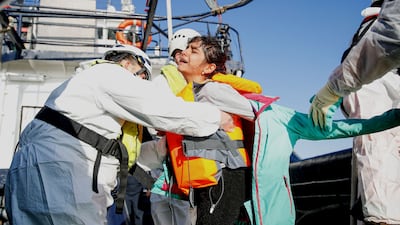
Migrants are rescued by crew members of the 'Abeille Languedoc' ship after their boat's generator broke down in French waters as they were trying to cross the Channel illegally to Britain. All photos: AFP -
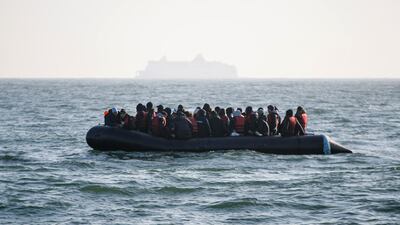
Migrants wait for help in the Channel. -
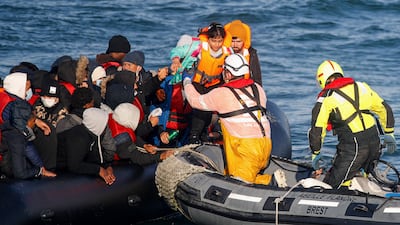
A child is rescued by crew members of the 'Abeille Languedoc'. -

The 'Abeille Languedoc' is an ocean-going tug specialising in the rescue of vessels in distress. -

Migrant children on the rescue boat. -
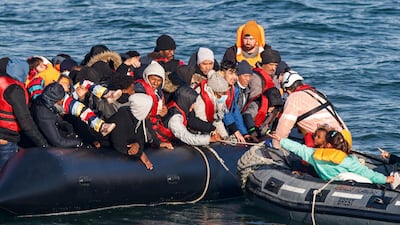
The 'Abeille Languedoc' has been moored in Cherbourg for 26 years, monitoring the Channel between the Cotentin and the Pas-de-Calais. -
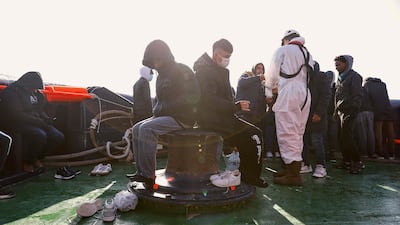
Migrants sit on board the 'Abeille Languedoc' after being rescued. -
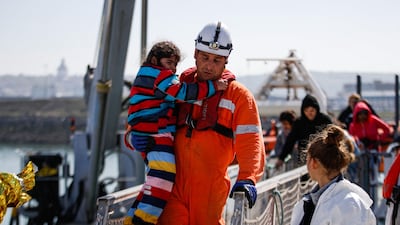
A rescuer carries a child as they disembark from the 'Abeille Languedoc'.


“In case countries are not co-operating, this system should not be applied. There should be a fair approach.”
The EU’s migration package has been under discussion for more than two years. In June, five of the EU’s rotating presidencies, including the current Swedish one, signed a joint road map aimed at finishing negotiations by February 2024 and to start implementation in April.
Some migration experts have argued that Europe should invest in raising the quality of life of would-be migrants instead of building walls.
Syrians continue to represent a large proportion of migrant arrivals in Europe despite the civil war in Syria seemingly winding down. Last year, a third of all irregular arrivals to Europe were Syrians.
Syrians are discouraged from staying in neighbouring Middle Eastern countries such as Lebanon or Turkey because of local policies designed to limit or deny their access to economic livelihoods and social rights and put them off settling permanently.
Combined, Turkey and Lebanon host over 4 million Syrians, according to UNHCR, the UN refugee agency. Local officials are increasingly blaming Syrians for domestic problems and calling on them to leave. Human rights organisations argue that Syria is not safe to return to.
A recent report published by the European Council on Foreign Relations (ECFR) argued that Europe needs to change its humanitarian-led approach to more durable solutions for Syrians living Turkey, Lebanon and Jordan, in addition to boosting support for host countries. In return, Europe should resettle more refugees than it does now.
“This new approach will help Syrian refugees live more fulfilled lives and reduce their motivation to reach European shores,” read the report, titled: “From aid to inclusion: a better way to help Syrian refugees in Turkey, Lebanon and Jordan.”
'Fortress Europe'
In the European Parliament, the weakest of the EU’s institutions, politicians are divided over migration along ideological lines.
Speaking after Ms von der Leyen’s intervention earlier this week, Manfred Weber, president of the centre-right European People’s Party, hailed Austria’s proposals, saying that “walls and fences are not a taboo” and bemoaned the little progress made by parliament on return agreements.
But his successor on the podium, Iratxe Garcia Perez, who leads the centre-left Progressive Alliance of Socialists and Democrats, said the focus must be taken away from returns.
“Criminalising NGOs and building walls, something which is supported by the right and extreme-right, cannot solve our problems,” she said.
Terry Reintke, co-president of the left-wing Greens, criticised Ms von der Leyen for her “technocratic and depoliticised language” that planned on creating a “fortress Europe”.
“Don't get me wrong,” she said, “we all want orderly border management.”
But this also applies to border guards who have carried out illegal pushbacks, said Ms Reintke, who told MEPs: “There has been no accountability, and this is unacceptable.”
Lighthouse Reports in December published footage of a Syrian man who was allegedly shot by Bulgarian police at the Turkish border, raising questions about the EU's approach to migration.
Bulgarian police have rejected the accusation that they use live ammunitions on migrants.

