Ukrainian President Volodymyr Zelenskyy dismissed a ceasefire with Russia on Thursday, saying the Kremlin would use the pause to rearm and regroup to overwhelm Kyiv’s troops.
“A pause on the Ukrainian battlefield will not mean a pause in the war,” Mr Zelenskyy said during a visit to Estonia.
“A pause would play into [Russia’s] hands. It might crush us afterward.”
Since the conflict began in February 2022, limited ceasefires have occasionally been proposed but have never taken hold.
After 22 months of fighting, both countries are rushing to replenish their weapons for what appears to be a long war ahead.
With the about 1,500km front line mostly static during winter, they both require artillery shells, missiles and drones for long-range strikes.
Mr Zelenskyy said Moscow is receiving artillery shells and missiles from North Korea and drones from Iran.
On January 4, the White House quoted US intelligence officials as saying that Russia acquired ballistic missiles from North Korea and is seeking them from Iran.
Mr Zelenskyy was in the Estonian capital of Tallinn as part of a two-day trip through Baltic countries, which have been among Ukraine’s staunchest supporters.
He met Prime Minister Kaja Kallas, who gave him a shirt with the Estonian word “Kaitsetahe” – “the will to defend” – printed on the front, which Mr Zelenskyy wore as he addressed Parliament.
“Tyranny must be defeated. Tyranny must be a loser," Mr Zelenskyy said. “Always. Always. Always.”
He said he and Ms Kallas also discussed Ukrainians who fled to Estonia when the war began, telling a news conference that any of them who are of draft age "need to help Ukraine and be in Ukraine".
Politicians in Kyiv have returned a draft law on conscription to the government for amendments, saying it might contain human rights breaches, among other concerns, officials said.
The draft law aims to impose restrictions on citizens who have evaded military duties, as Ukraine struggles with a shortage of military personnel.
Russia pounds Ukraine in biggest attack in months - in pictures
-
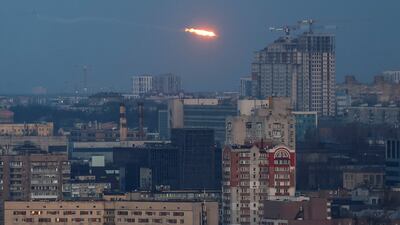
A missile explodes over Kyiv during a Russian attack involving missiles and drones. Reuters -
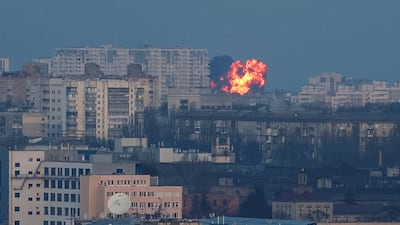
At least 10 people were killed and dozens injured in strikes across Ukraine. Reuters -
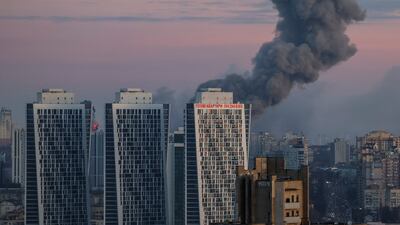
Smoke rises over Kyiv, one of several cities hit in the attack. Reuters -
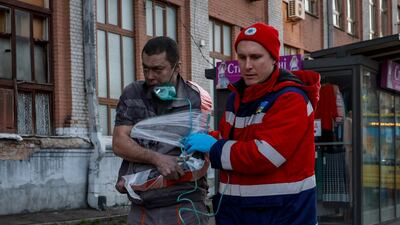
A medical worker helps a survivor of the strike in Kyiv. Reuters -
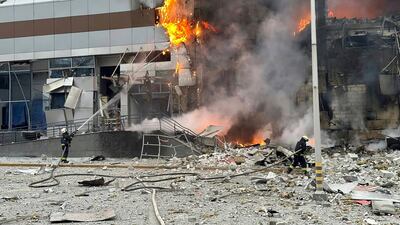
Firefighters tackle a blaze in Kyiv. AP -
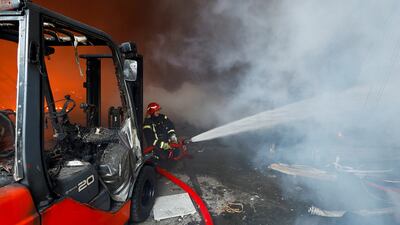
Buildings, including a maternity hospital and a shopping centre, were damaged in the strikes. Reuters -
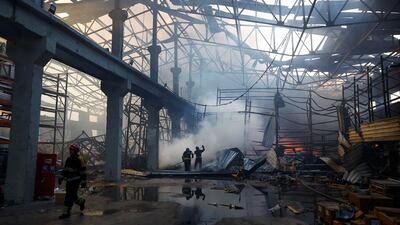
A warehouse in the Ukrainian capital was heavily damaged in the Russian attack. Reuters -
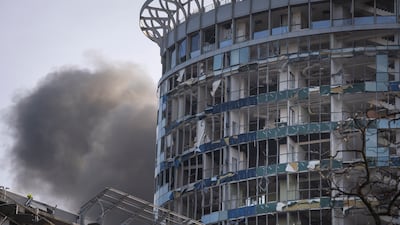
Russia launched about 110 missiles, as well as drones, Ukrainian President Volodymyr Zelenskyy said. AP -
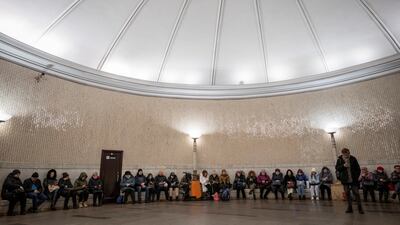
People take shelter inside a Kyiv metro station during the Russian missile and drone attack. Reuters -
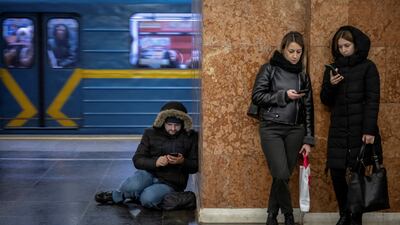
Major cities including major cities including Kyiv, Odesa and Kharkiv were targets in the attack. Reuters -

People gather in the city of Dnipro following the attack. EPA -
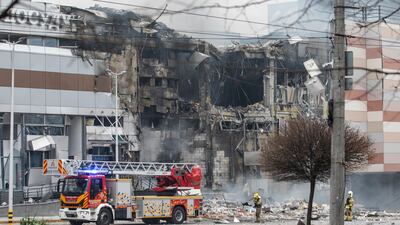
The strikes damaged a shopping mall in Dnipro. EPA


Mr Zelenskyy said last month that Ukraine's military wants up to 500,000 more troops, but he said he had asked military command to spell out the details on what is “a very sensitive matter” before deciding whether to grant their wish.
He also is pressing allies to provide Ukraine with more support on top of the billions of dollars in military aid from the West.
“Ukraine needs more, it needs better weapons," Estonian President Alar Karis said alongside Mr Zelenskyy at the Presidential Palace.
“We must boost military production capabilities so that Ukraine may get what it needs. And it’s not tomorrow, they should get it today.”
Mr Zelenskyy later went to Riga, the capital of Latvia, where President Edgars Rinkevics said his country would increase its military aid, according to Latvian public broadcaster LSM.
Latvia will supply various types of armaments and ammunition, including missiles, field guns, 155mm shells and drones that Mr Zelenskyy was asking for, LSM reported.
On Wednesday, Mr Zelenskyy won a pledge of more support from Lithuania.
EU countries have so far provided €85 billion ($93 billion) of support for Ukraine, Mr Karis said.
But the support has slowed, alarming Ukrainians who would find it hard to stand alone against their bigger neighbour.
A plan by the administration of US President Joe Biden to send $60 billion in new funding to Kyiv is being held up in Congress.
Europe’s pledge in March to provide 1 million artillery shells within 12 months has fallen short, with only about 300,000 delivered.
Mr Zelenskyy says Ukraine particularly needs air-defence systems to fend off Russian bombardments that have repeatedly hit civilian areas, although Moscow officials insist they aim only at military targets.
Recent massive Russian barrages – more than 500 drones and missiles were fired between December 29 and January 2, according to officials in Kyiv – are using up Ukraine’s air defence resources and leaving it vulnerable unless it can secure more supplies.
The small eastern European countries are among Ukraine’s staunchest political, financial and military supporters. Some in the Baltics worry they could be Moscow’s next target.