
Scientists on Britain’s Science and Technology Committee have raised hopes of finding a successful Covid-19 vaccine, saying that the coronavirus is “more similar to other viral infections than it is different”.
Leading virus academics spoke about the response to the coronavirus pandemic via videoconference on Monday afternoon.
“Coronaviruses as a class and Covid-19 in particular – they do have unique features to them but they are more similar to other viral infections than they are different,” professor Sir John Bell, regius professor of medicine at the University of Oxford, said on the call.
“And they do produce the same general types of immune response that gives you hope that a vaccine might well work in this setting.”
-
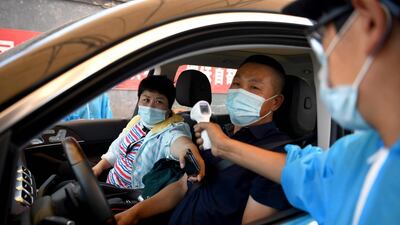
A security personnel wearing a protective suit checks the temperature of people entering the Xinfadi market in Beijing. AFP -
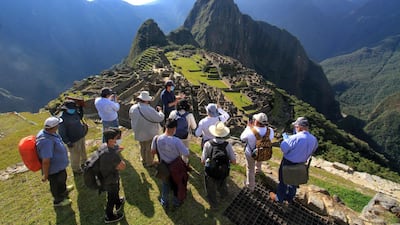
Members of a commission of authorities and experts led by the the Governor of Cusco, Jean Paul Benavente, visit the Inca citadel of Machu Picchu, assessing the new health and distancing protocols in order to reopen to the public on July 1. AFP -

A rainbow appears above the deserted streets of Kathmandu during the lockdown imposed by the government amid concerns about the spread of coronavirus disease (COVID-19), in Kathmandu, Nepal. REUTERS -
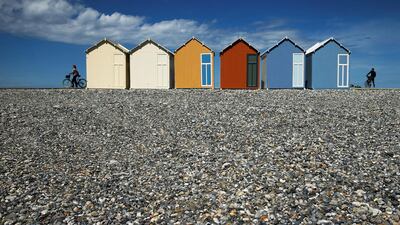
Cyclists are seen near beach huts on a pebble beach, after France reopened its beaches to the public as it softens its strict lockdown rules during the outbreak of the coronavirus disease (COVID-19), in Cayeux-sur-Mer, France. REUTERS -
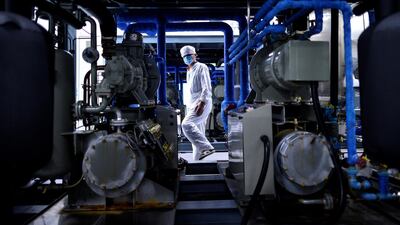
A worker wearing a protective suit walks at a lab of the Yisheng Biopharma company Yisheng Biopharma company, where researchers are trying to develop a vaccine for the COVID-19 coronavirus, in Shenyang, in China’s northeast Liaoning province. AFP -
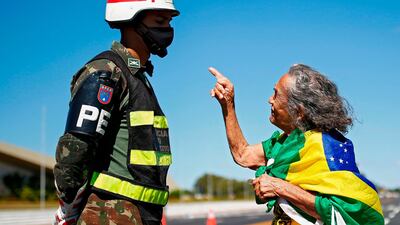
A supporter of Brazilian President Jair Bolsonaro speaks to a soldier as she takes part in a protest outside the army headquarters, against the decision of Brasilia's Governor Ibaneis Rocha to prevent crowds from attending rallies, amid the new coronavirus pandemic, in Brasilia. The number of contagions has increased in the last weeks in Brasilia. AFP -
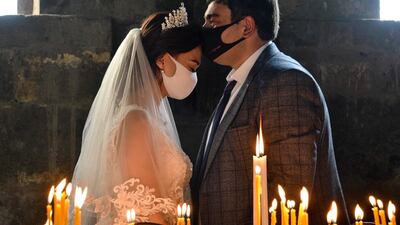
A bride and a bridegroom wearing protective face masks exchange kisses during a wedding ceremony in a church in the Saghmosavan village outside Yerevan, as the country tries to curb the spread of the COVID-19, the disease caused by the novel coronavirus. AFP -

A keeper of the Woburn Safari Park takes care of an Asian elephant, as they prepare to reopen on Monday 15th for the first time since the lockdown due to the outbreak of the coronavirus disease (COVID-19), in Woburn, Britain. REUTERS -
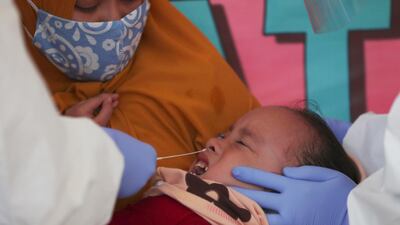
Health workers take a nasal swab sample from a girl during public testing for the new coronavirus conducted in Jakarta, Indonesia. AP Photo -
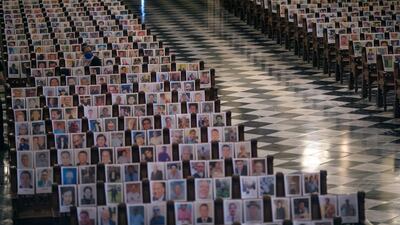
A woman sits among the more than 4 thousand portraits of people who died due to COVID-19 complications, at the Cathedral, in Lima, Peru. AP Photo


Professor Massimo Palmarini, director of the University of Glasgow’s Centre for Virus Research, echoed Mr Bell’s sentiments.
“What brings optimism for many of us is that virus behaves as an acute respiratory infection and it induces a human antibody response – T-cell [cell central to immune response] responses overall that most patients are able to overcome.
“There are many aspects that one would think would lead to the possible host immune responses to provide for the development of a vaccine,” he added.
Mr Bell said that the reason why older people are more likely to be die from the virus than young people is likely because of the state of the person’s immune system.
“Seventy per cent of people who get this disease are asymptomatic. On one end of the spectrum, it’s not a bad viral disease and on the other end it is terrible.
“Understanding those age differences I think are pretty central and I would be surprised if the human immune system wasn’t central to that.”
Professor Adrian Hayday, chair in the department of immunobiology at King's College London, said more studies were needed on the interaction between the immune system and blood-clotting, as these were factors in causing death from Covid-19.
There are more than 200 candidates for a Covid-19 vaccine. On Monday, a Chinese biotech firm announced positive early results for its prototype, claiming it induced an immune response in 90 per cent of those who were given it. The vaccine, called CoronaVac is being developed by the company Sinovac.
On Saturday, pharmaceutical company AstraZeneca agreed with Europe’s Inclusive Vaccines Alliance to supply up to 400 million doses of the experimental Covid-19 vaccine it was making in collaboration with Oxford University.
The alliance, forged by France, Germany, Italy and the Netherlands to speed up production of a vaccine, is set to take delivery of the medicine by the end of this year. The four countries agreed to pay an initial €750 million (Dh3.1 billion) for 300 million doses, Reuters reported. The countries will have an option to buy another 100 million doses.
Despite the positive results in the race for inoculation against the virus, many believe it will probably be at least another year before a safe and effective vaccine is widely available to the public.

