
The Lancet, one of the world's top medical journals, on Thursday retracted a study that claimed the use of a drug favoured by President Donald Trump as a Covid-19 treatment was dangerous, claiming there were data inconsistencies.
Only hours later, another coronavirus paper in the New England Journal of Medicine was redacted, which was not linked to hydroxychloroquine but used the same healthcare company's patient records.
The Lancet study claimed to have retrospectively analysed some 96,000 patient records at 671 hospitals worldwide.
It found that anti-malarial drugs hydroxychloroquine and chloroquine were ineffective against Covid-19 and even increased the risk of death.
Mr Trump has promoted them as a "miracle cure" for the coronavirus and this week shipped two million doses of the drug to Brazil.
The findings published in The Lancet led the World Health Organisation to temporarily suspend clinical trials into the medicine.
But the study quickly caused concern in the scientific community due to lack of information about the countries and hospitals that contributed data.
More than 100 scientists questioned the source of the data and the methods use to analyse it.
Mandeep Mehra, a professor at Harvard University who led the research, along with Frank Ruschitzka of the University Hospital Zurich and Amit Patel of the University of Utah, said in a statement they had tried to launch a third-party peer review.
But data provider Surgisphere, a little-known healthcare analytics company based in Chicago, refused to co-operate.
"We can no longer vouch for the veracity of the primary data sources," Dr Mehra of Brigham and Women's Hospital in Boston, Dr Ruschitzka of University Hospital Zurich, and Dr Patel of the University of Utah said in a statement issued by The Lancet.
“Due to this unfortunate development, the authors request that the paper be retracted.”
Although three out of four of the authors supported the paper’s retraction, Sapan Desai, a vascular surgeon and Surgisphere's chief executive, did not join and declined to comment.
The journal’s editor, Richard Horton, expressed his dismay at the developments.
"This is a shocking example of research misconduct in the middle of a global health emergency," Horton told The Guardian.
Despite the finding apparently vindicating hydroxychloroquine's safety, there is still no proof from a randomised clinical trial that the medicine works against the virus.
A trial published on Wednesday found it was not significantly better than a placebo in preventing the disease among people who had been recently exposed to Covid-19.
But scientists broadly agree that more such tests are needed, and hydroxychloroquine should not be discounted yet.
The research scandal threatens to undermine confidence in the world's leading medical journals in the middle of a pandemic.
-
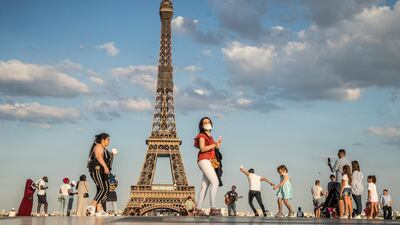
People dance to music at the Trocadero Human Rights Plaza near the Eiffel Tower in Paris, France. EPA -
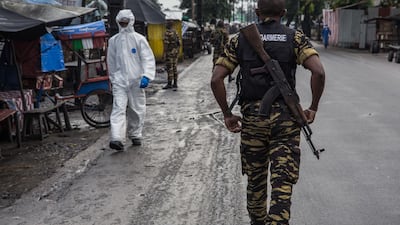
A member of the Covid-19 operational centre (CCO) is seen as soldiers form the Malagasy Gendarmerie patrol the streets of Toamasina, a port city in eastern Madagascar, where containment measures have been reinforced since June 1. AFP -

An aerial view shows the opening night of a drive-in festival in the southern Athens' suburb of Glyfada as Greece eases lockdown measures taken to curb the spread of Covid-19. AFP -
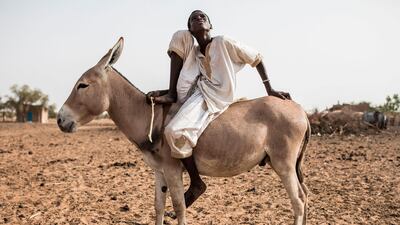
A young Fulani herder sits on his donkey in the village of Mbetiou Peulh. Pastoral families have been stuck around this village since the Covid-19 restrictions were put in place in March 2020. AFP -
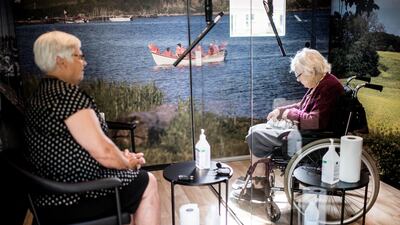
Two elderly women meet in a so-called "Heart Room" installed on the grounds of the Humlehaven nursing home in Arslev on the island of Funen, Denmark. AFP -
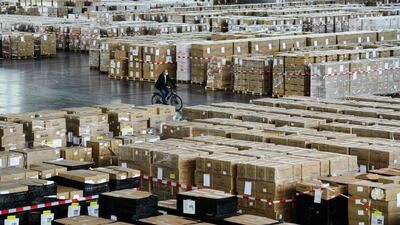
An employee drives with his bicycle at the state camp of North Rhine-Westphalia with protective equipment in Duesseldorf, western Germany amid the ongoing pandemic. AFP -
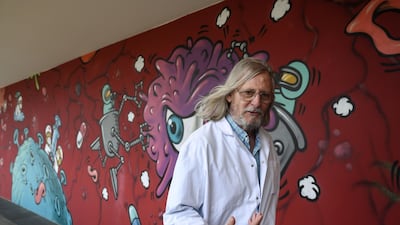
French medecine professor Didier Raoult walks along a wall painted by graffitti artist Jace at his IHU medical institute in Marseille where his works have been at the forefront of promoting hydroxychloroquine as a potential treatment for Covid-19 and has also been subject to criticisms over methodology. AFP -
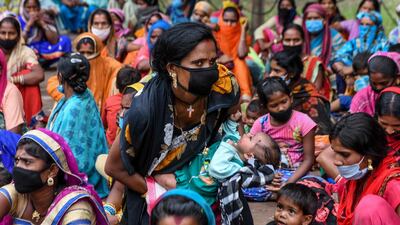
Migrant labourers and their families from Chhattisgarh sit during a protest held against the government and to demand their return to their native places outside the Deputy Commissioner's office after the government eased a nationwide lockdown, in Amritsar. AFP -
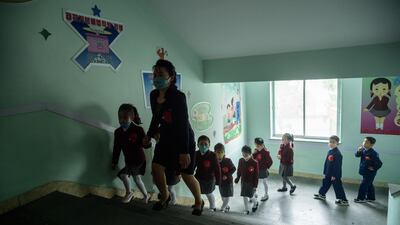
Primary school children wearing face masks as a protective measure arrive for a class at Hasin Primary School in Sosong District in Pyongyang following the re-opening of schools. AFP -

Berlin Tango ridden by David Probert goes on to win Unibet Classic Trial Stakes, as racing resumes behind closed doors at Sunbury-on-Thames, Britain. Reuters -
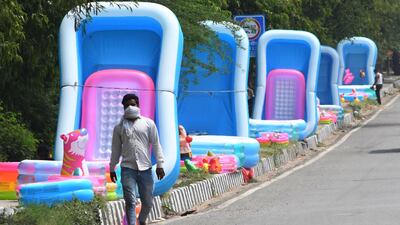
A man walks past inflatable items for sale on a roadside amid an easing of coronavirus lockdown measures, in New Delhi, India. EPA -
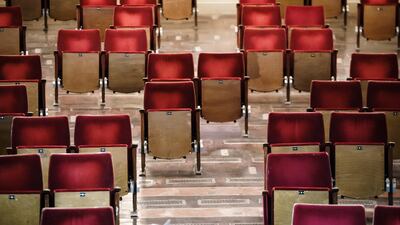
The seating area of the Berliner Ensemble theatre shows gaps of removed seats due to coronavirus measures in Berlin, Germany. EPA


Researchers began to closely scrutinise The Lancet paper shortly after its publication, highlighting red flags ranging from the huge number of patients to the unusually complete information on their demographics.
The Guardian revealed that Surgisphere had a scant online presence, with only a handful of staff listed on LinkedIn, including a science fiction author and an adult model.
The company was involved in another attention-grabbing study that found the anti-parasite drug ivermectin could be useful against Covid-19.
Although this paper had not been peer-reviewed or appeared in a journal, it caused a run on the drug in Latin America where it is widely available.
While Desai and Surgisphere have been the focus of most scrutiny, the lead author of all of these papers was Dr Mehra, who is medical director at his hospital's heart and vascular centre.
Chris Chambers, a professor of psychology at Cardiff University, said the scandal "raises serious questions about the standard of editing at The Lancet and NEJM, ostensibly two of the world's most prestigious medical journals".

