
It is six months this week since the UK went into national lockdown, at a stroke upending daily life.
It was barely imaginable that the country could close down, families be kept apart and centres of commerce run from kitchen tables. Now it's happened again.
Boris Johnson on Tuesday announced that after a summer of relatively loose guidelines, new more stringent controls were being put in place.
In the article below, The National looks for lessons drawn by ordinary Britons from the first experience of stay at home orders.
Funeral director relied on Muslim community to pull through hardest times

As Britain’s coronavirus pandemic reached its peak, Ghousia Funeral Service, the oldest Muslim mortuary in the southern English county of Bedfordshire, had to put a call out for volunteers to come and help bury the dead.
“It was just too much. It was getting hard but people stepped up,” explained Siraj Qazi, a manager at the funeral company who is the son of an imam.
After the call was put out the phone rang constantly. Volunteers came to collect caskets, drove transport to the cemeteries and went to hospital morgues.
“We had some that were brave enough to say we'll help with the ablutions as well,” Mr Qazi said referring to the ritual washing of bodies before burial in Islam.
Having to rely more on the community is just one way the Luton-based business has been upended by the pandemic. Virtually every aspect of the funeral home’s operations have been changed by the virus. First, Mr Qazi explained, was the sheer volume of the dead that had to be accommodated.
Before the outbreak, the mortuary might deal with four funerals per week. In April, they were dealing with four funerals a day.
-

Since easing its first nationwide lockdown in May, England has imposed localised lockdown rules on towns across the Midlands and North. A shopkeeper keeps a socially distanced watch on her shop from a chair on the pavement in Bolton. Getty Images -
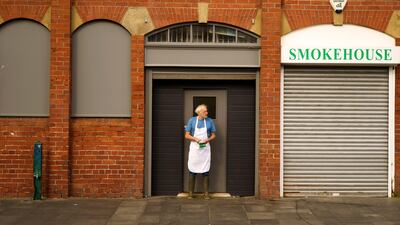
A worker takes a break in North Shields in Newcastle upon Tyne. Last weekend, almost two million people in Newcastle and surrounding areas were banned from meeting other households. Getty Images -
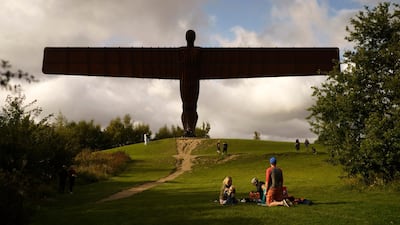
A family enjoy a picnic next to the Angel of the North in Gateshead. Getty Images -
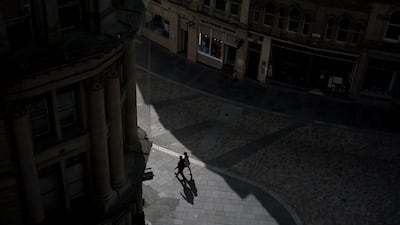
A quiet Saturday morning in the city centre in Newcastle upon Tyne. Getty Images -
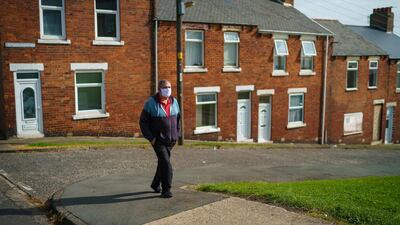
Brian Jolly of Easington Colliery Heritage Group takes his afternoon exercise in Easington Colliery. Getty Images -
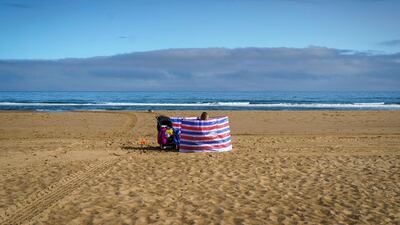
The last of the Summer sunshine falls on the beach in South Shields. Getty Images -
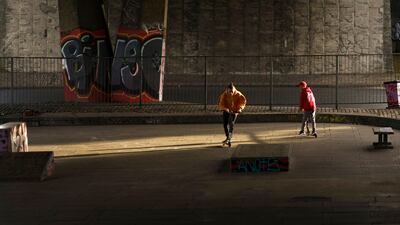
Youths play in a skatepark in Gateshead. Getty Images -
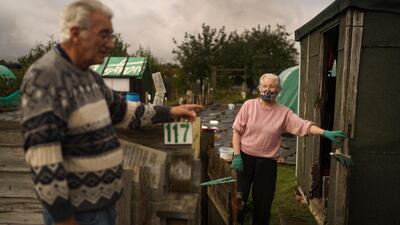
John and Florence Wilkinson tend to their allotment in Sunderland. Getty Images -

Shoppers walk past a dilapidated advertising hoarding in West Bromwich. Getty Images -
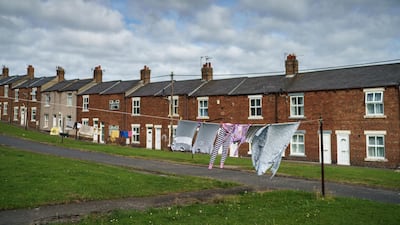
Silent streets in Easington Colliery. Getty Images


Perhaps hardest, Mr Qazi said, was having to adapt as families were forced to grieve under social distancing. Typically, a Muslim funeral in Luton could have between 300 to 3,000 attendees. These numbers had to drop dramatically and have remained far lower.
Families abroad, mostly in Pakistan or Bangladesh, have not been able travel to bury loved ones because of travel restrictions. Mr Qazi remembers watching one heartbreaking funeral broadcast on Facebook Live. The dead imam’s mourning children offered funerary prayers in the comment section.
The funeral home administrator is relatively inured to the prospect of death but he said the past six months had substantially changed how he views his father’s work.
He had always thought that the prominent local imam, Qazi Abdul Aziz Chishti was “superhuman”. But with his father, now 73, out and performing regular services he became painfully aware of the older man’s mortality.
“You got days when you thought: ‘Where does it end? Who else is this going to take from us?’” Mr Qazi said.
“We were pleading with him to back off on certain ones but people were very reliant on him,” he said.
“There were a good few, quite a few, that had spent their lives with him. And we lost them – some good people - and an imam, for certain individuals, can just console people by being present”.
Callum Paton
Lockdown bonus for Call of Duty professional gamer

Liam James entered lockdown with the ambition of trying to turn his passion for playing video games into a living. He emerged with a full-time manager and on track to earn £500,000 next year.
Liam – better known in gamer circles as Jukeyz – was the beneficiary of the cancellation of regular league football that drove fans to online eSports and the launch just two weeks before lockdown of a new game from the popular Call of Duty franchise.
The 23-year-old, from Liverpool, northwest England, was already an expert at an earlier version but his dedication to learning the new iteration of Warzone attracted fans to Twitch, a subscription streaming service, to watch him play.
At the start of lockdown after 15 months as a full-time player, he had just 24 viewers on Twitch. By the end of August this year, he had peaked at 4,600 watching him during five or more hours of mesmeric fast-paced computer action.
He has won more than $53,000 from tournaments so far in 2020, making him one of the most successful players of the new game.
He was spotted by a professional team who signed him up as an ambassador. Sponsorships, his cut from Twitch earnings and his salary from the London Ravens Call of Duty team should see him earn £250,000 next year. He hopes tournament earnings can take it to £500,000.
The earnings have had a significant impact for the family. His mother’s serious health problems and limits on contact with the wider population meant that Liam’s brother lost his warehouse job. His father was unable to work for months.
Liam’s earnings have allowed him to cover the family’s costs and set up his brother with a new business.
Liam said he picked up lots of fans among frustrated football supporters unable to follow their teams.
“Lockdown has understandably been hard for many people, but for me it has been a benefit and I hope for my family it will benefit us all in the long-run,” he said. “It’s given me the opportunity to save money and figure out I can improve as a streamer.”
Paul Peachey
Actress spun into a fitness guru for businesses

London-based Barbara Blanka hoped 2020 would be a promising year for her acting career. She was due to fly to Amsterdam to film an advert a few days before the lockdown began in the UK in March, but her flight was cancelled amid the coronavirus pandemic.
"That was the beginning of my new reality," she told The National.
“Most of the projects I was meant to be rehearsing for have stopped, some carried on for a while with unpaid rehearsals online. There wasn’t enough funding for the acting industry.”
After the theatre industry came to a standstill, she had to reconsider her plans.
“It made me realise that I won’t be doing much acting for a while and need to find something else to help me, both mentally and financially, during this difficult time.”
Barbara has always seen exercise as a good way to take care of her mental health, being a dancer as well as an actor.
“It has always helped me with anxiety, stress, energy levels, routine and motivation. Being in lockdown, I’ve realised these were the things most of us were struggling with. So it was more important than ever, to be someone who can help people with their physical and mental health during the pandemic.”
Barbara began exercising with her friend regularly on Zoom in March, when millions in the UK were bound to their homes. She grew the sessions as she mentioned it to friends, with the idea making it a fully-fledged business where people would pay for classes.
But it was tough to get the word out amid a pandemic. She initially relied on family and friends to promote her before recommendations came in from people who had joined the classes. She got the word out on social media, and also offered a one-month free personalised fitness trial for new joiners.
Her fitness community became known as 'The Squad'. Barbara hopes that she can expand the classes and reach more audiences. To do this, she's launched a new website and added some new programmes from personal training to classes for businesses and schools.
“I want to encourage workplaces to help their employees stay physically and mentally healthy while working from home by offering the squad workplace programme with classes online or face-to-face.”
She intends to help people who may wish to avoid gyms amid the pandemic to stay active and healthy.
Barbara also plans to offer fitness schools in London, including youth fitness classes through a mix of dance and games. After getting the programmes up and running, she will look at hiring more fitness instructors to grow her business.
"We're social beings. Especially in the current climate, opening up this business made me feel happier and more connected. Having a community, people to talk to and seeing I'm making the difference in their lives, makes me feel more motivated and appreciative."
Jack Dutton
Fitness fanatic scientist forced to reassess life’s priorities

A medical expert flattened by Covid-19 says it turned his life upside down, from being dedicated to exercise to struggling at the slightest exertion.
Professor Paul Garner, who works at Liverpool School of Tropical Medicine, expects recovery from his long Covid struggle to take at least six more months but also admits no one really knows how long it will take.
He said the disease left him like a "cheap battery" with limited energy to get through the day, and that his recovery comes in waves of good days and bad ones.
Before coronavirus struck he would run 40km a week but now he can often only do a walk.
"It was high activity stuff. I was doing over seven hours of high intensity exercises at home and military workouts. I was working 10 hours a day, five days a week," he said.
"Now I can walk about 4km a day. It's a quite disabling condition."
Now he has to plan out days so that he can prioritise what must be done, leave the rest, and plan downtime.
"I am more philosophical. I have had to reduce a lot of things because of the illness," the professor said.
"I am thankful for the little things like my walks. I am enjoying the little things and convalescing."
He said he does not know how he contracted the disease.
At work, he was in regular contact with doctors who had been working in intensive care units, as the outbreak took hold in the city.
The date he fell ill is also a week after Liverpool hosted Atletico Madrid in front of 52,000 people, one of the last Champions League matches before both countries experienced national lockdowns.
He said: "I got Covid-19 on March 19 and I have really been sick ever since.
"I felt a little bit unwell and so I isolated. I kept up with that for three or four days of headaches and after that, at five days' isolation I collapsed at home.
"I was sweaty and had rapid heart rate. I was dizzy with ringing in my ears, and I had to lie down. I thought I was dying and passed out on the bed.
"In the last two months I have had intense fatigue, so I have to be careful not to overdo it.
"It's a lot of having a shortage of energy and running on a cheap battery. When you get up you know you only have a certain amount of energy to answer emails, to work.
"It's restricting. I have two sleeps in the day time. If I overdo it, this awful illness comes back."
But Prof Garner, 64, can look past the illness and see hope ahead.
"I am a fairly resilient person but I have had periods of being unhappy and miserable about it.
"I have a support network and I try to get on with life, look forward to next year when I will be better," he said.
"I think people need to support each other and all the Facebook groups are trying to help.
"We have a group of four who meet online, and we spend 20 minutes' catching up.
"I'm hopeful because I am feeling a bit better."
Simon Rushton
Designer was invited into people’s homes (virtually)

Six months ago Hannah Searle was knocked off her feet as she battled Covid. The mother-of-two recovered and has now gone on to start up a budding interior design business all done via the safety of the virtual world.
Using Facetime or Zoom, Hannah travels inside people’s homes building up a picture of what would be the ideal interior for them. It’s infection-free, has no travel costs and with clients providing pictures and measurements she achieves the same effect as going to the home herself.
Starting from her sickbed she has built a business model that could be used anywhere in the world to redesign homes and it’s growing in popularity with people spending more time in domestic confinement.
Originally Hannah was so exhausted by Covid that she wanted to shelve her business plan, especially as she had to home-school her two young children with her husband. “But then on social media I was reading about people stuck in their houses that previously only niggled them a little bit, but then living in them full-time lockdown was driving them bonkers.”
Friends contacted her asking for help on colours and layout. She did a small project, working from a laptop in her kitchen. “It was then that I realised that actually, this could be something that works,” and launched The Sussex Home Stylist.
With room measurements, sketches, pictures and screen-sharing Hannah, 42, has been able to renovate eight homes during lockdown including a six bedroom Victorian house in Loughborough, Leicestershire 150 miles from her West Sussex home.
Virtual chats help build up rapport. “The biggest challenge with lockdown was that I couldn't meet face-to-face but as far as my business is concerned, virtual works brilliantly to understand how somebody lives. You almost want to feel like part of the family, where kids are screaming and you say, ‘Oh, hi, can you show me your bedroom?’ It’s also less of an imposition, because people don't want you in their house at the moment.”
The virtual planning has worked so well that she now has an Instagram follower who wants Hannah to design a flat in Rome, Italy.
Queries have also come in from friends living in Dubai, which brings a different challenge because of the climate. “In the Gulf States the heat means you want to bring the outside in so its loads of plants, lots of light and bright colours and lots of blues from the sea when you're in coastal areas. It's all about the texture and the layers and the colour especially when you’re sitting all day in air conditioning.”
After 25 years in fashion and marketing, Hannah last year decided to pursue her passion for interior design and gained a City and Guild qualification.
Learning on the job she's now developed a strong Instagram following, getting people engaged by doing polls and posing questions. "If I'm choosing something for a client and I've got three options, I put it on social media and say which ones do you all prefer? People like getting involved."
Six months on from her life-threatening disease, Hannah is looking forward to a future where she can grow the company while bringing-up
children. “I just want to crack on with life because last March it was a bit of
a near miss.”
Thomas Harding
Blogging doctor tackled illness – and prejudice

Yorkshireman Dr John Wright has been running a weekly blog since the UK went into lockdown in March.
As the director of Bradford Institute for Health Research, which is part of Bradford Teaching Hospitals NHS Trust, he covers all aspects of life, including the most harrowing cases he has dealt with in intensive care.
“The transformation from life before Covid to now could not be greater,” he said.
“No-one could have predicted this social crisis, the remarkably different world and the remarkable journey that we have been through.
“People are fearing for their lives and our medical staff have been on the frontline. They have been incredibly brave doing their jobs when they did not know about this virus and have put their lives on the line.
“The medical research we now have compared to when this started is remarkable. We are able to look after patients better.”
Dr Wright is based in Bradford which has a third Muslim population.
“The Asian community has been the hardest hit,” he said.
“The risk has been much greater in terms of transmission, infection, hospitalisation and death. Covid has targeted the poorest in our society and they have suffered the worst, especially people with obesity.
“There has been a 100 per cent increase in the risk of hospitalisation from covid and a 50 per cent greater chance of death. It has shown us that going forward we need to work harder in helping people adopt healthier lifestyles.”
One of the hardest challenges he never expected to deal with was fake news. Just a few months into the crisis Dr Wright was forced to dispel myths in the local community that were suggestion non-white people were being left to die in hospitals. It had led to people in the Asian community not seeking vital medical help.
“It just took one or two malicious rumours for the fake news to spread like wild fire,” he said.
When local restrictions were introduced recently after a rise in infections, he was forced to defuse racial tensions between city communities and more affluent communities on the outskirts of Bradford who felt that the reimposed rules should not apply to them.
But the hardest part for him has been seeing patients die.
“It is heartbreaking. We have seen so many more deaths in hospital than normal,” he said.
“We talk about Covid-19 just being a flu-like illness but when you see people dying from it you just keep doing all you can to contain it.
"I started the blog to capture the stories in the hospital, from the nurses to the cleaners, from the start and I will continue until the end. It is important for future generations we capture what is actually happening."
Nicky Harley
Aid worker preparing for the next pandemic
At five years old, Taban Shoresh was a refugee, fleeing the Kurdish genocide perpetrated by Saddam Hussein in 1980s Iraq. Now in her 30s, and long since settled in the UK, she has become an aid worker, women's rights activist and founder of NGO The Lotus Flower, which offers support to female migrants and refugees displaced by conflicts around the Middle East, particularly those fleeing ISIS-controlled territories of Syria.
Since launching The Lotus Flower in 2016, Shoresh had made regular visits to migrant camps where the non-profit has set up three centres in the Kurdistan region of Iraq. The non-profit's projects include education programmes, access to physical and mental health care and providing employment opportunities. But since the coronavirus crisis, Shoresh has been forced to take a more hands-off approach, leaving the day-to-day of the centres' projects to those on the ground while she works on ensuring they have the technology in place to offer a similar standard of services to the community remotely.
"When Covid first happened, the first thing the team did was start distributing hygiene kits and raising awareness about hygiene, and then there was a full lockdown in the region," she says.
"Thankfully, because we hire some people from within the camps, like some of our centre managers and outreach workers are actually within the camp, we were able to adapt very quickly and take things online. So we took things remotely and started doing most of our lessons remotely, most of our outreach sessions remotely."
It's not just frontline operations in the camp that have undergone a transformation though. The management was faced with a threat to the charity's very existence as the economic impact of the pandemic began to bite, meaning a reduction in the flow of donations, while fundraising events had to be cancelled because of lockdown and subsequent social distancing restrictions.
"What we noticed was that the funding pool was really, really impacted and we didn't have any funding to keep things going and donors slowly started dropping away because of Covid."
The charity was forced to look elsewhere for funding. Another not-for-profit, One Young World, stepped in with help in the form of its Covid-19 Young Leaders Fund, backed by the Bill and Melinda Gates Foundation and United Way.
"It allowed us to continue with the projects that are so desperately needed. We ran an assessment in the camps and found that mental health, gender-based violence and human trafficking were all things that were increasing.
"It actually has made us think that we are going to expand this because I am sure there's going to be another situation where we're faced with either another Covid or another similar situation so it's very good to be prepared and I think having a digital platform to provide your services is really, really important. "
Rachel Graham
This gallery shows pictures of coronavirus Britain over the last few months.
-
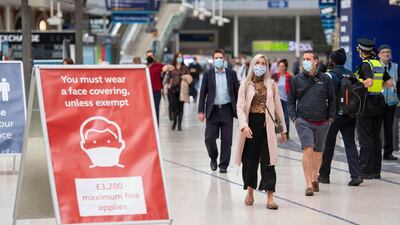
Commuters at Waterloo station in London. British Prime Minister Boris Johnson appealed for resolve and a “spirit of togetherness” through the winter as he unveiled new restrictions. AP Photo -
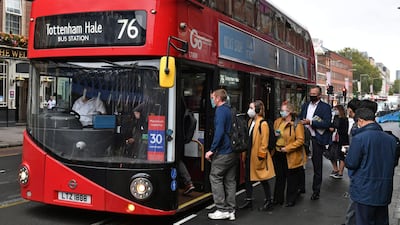
People board a bus outside Waterloo station in London. AP Photo -
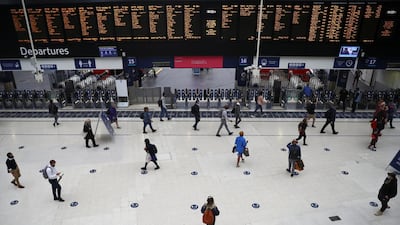
People wearing protective face masks make their way through Waterloo station during the morning rush hour on Wednesday morning. Reuters -
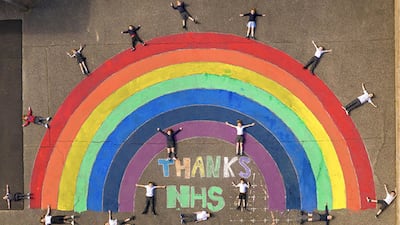
Children of keyworkers at Sheringham Primary School, Norfolk created this huge rainbow for the NHS on their playground. Some of the children's parents are nurses who have been working on the Covid ward at the Norfolk & Norwich University Hospital -
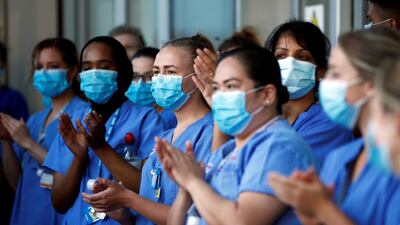
NHS workers react at the Royal London Hospital during the last day of the Clap for our Carers campaign in support of the NHS, following the outbreak of the coronavirus disease. Reuters -
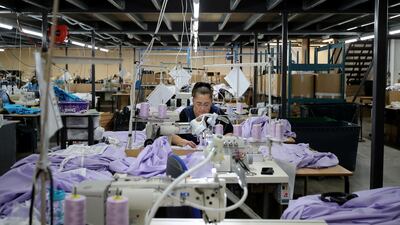
Employees make NHS uniforms at a factory in Dukinfield, Britain. The coronavirus pandemic has made the need to address the rapidly ageing workforce more urgent. Reuters -
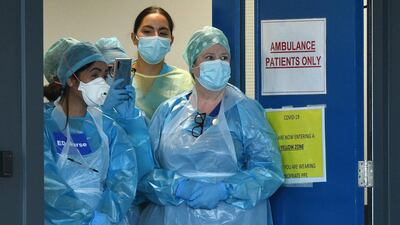
NHS workers wearing personal protective equipment as UK releases latest coronavirus data. Oli SCARFF / AFP -
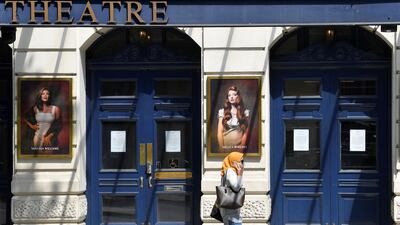
A woman wearing a protective face mask walks past a closed theatre, as the spread of the coronavirus disease (COVID-19) continues in London. Reuters -
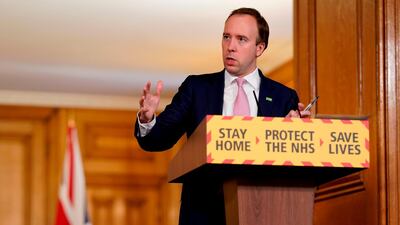
Britain's Health Secretary Matt Hancock launches review into how coronavirus affects ethnic minorities. AFP -
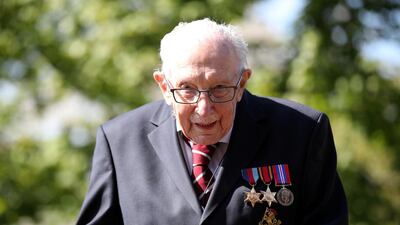
Captain Sir Tom Moore beat his original target of raising £1,000. Reuters -
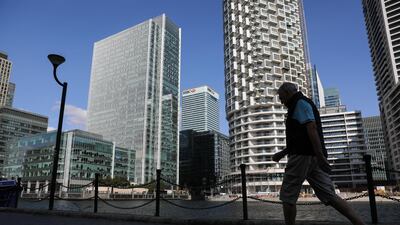
A pedestrian passes the HSBC Holdings Plc headquarters office building, centre, in the Canary Wharf business, financial and shopping district of London, UK Bloomberg -

British Airways will retire its Boeing 747 fleet immediately due to a drop in demand from the coronavirus pandemic. Courtesy British Airways -
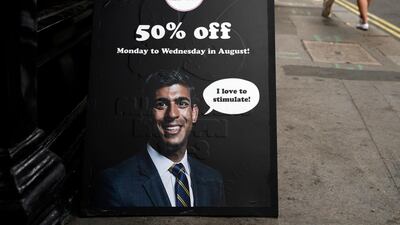
The UK Chancellor of the Exchequer Rishi Sunak's 'Eat Out to Help Out' scheme has been successful. EPA -
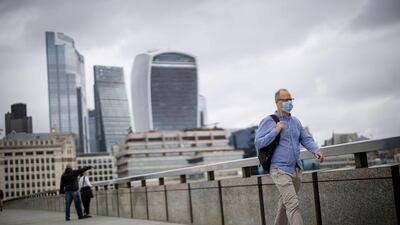
A man wearing a facemask walks across London Bridge. The OECD area economy contracted a record 9.8% in the second quarter of 2020. AFP -
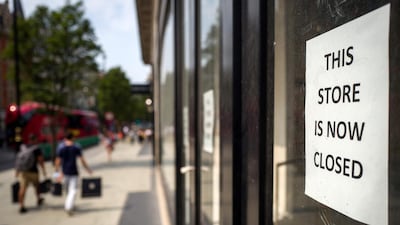
Stay-at-home orders wiped out 20 per cent of the British economy in the first half of 2020. AFP -
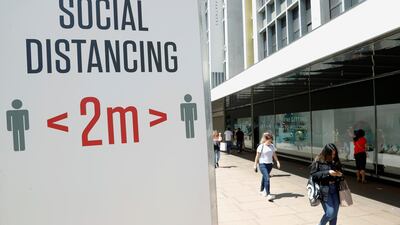
A social distancing sign in Oxford Street, London, usually one of the country's busiest shopping streets. Reuters -
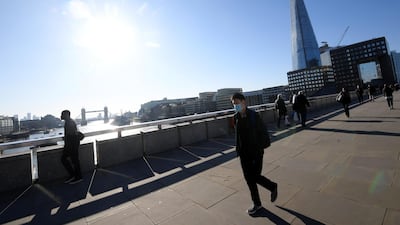
Commuters walk over London bridge during the morning rush hour, as the spread of the coronavirus disease (COVID-19) continues, in London. Reuters -
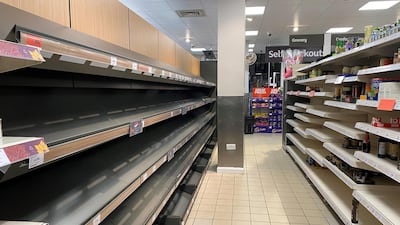
Empty shelves from a Sainsbury's supermarket in London, UK, as shoppers in the British capital stockpile goods in advance of strict lockdown measures to fight coronavirus. Emma Sky for The National -

The UK is still under a virtual lockdown. Reuters -
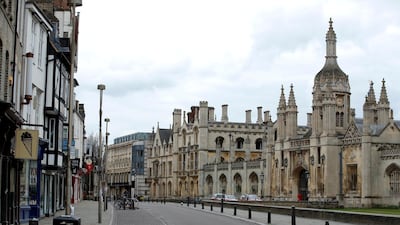
Deserted streets in Cambridge amid the UK's coronavirus lockdown. Reuters -
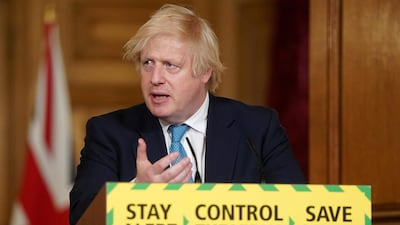
Minsters have condemned UK Prime Minister Boris Johnson's decision to abolish the Department for International Development on Tuesday. AFP -

People queue at a walk in Covid-19 testing centre in Bolton, England. Fears about rising infection rates among younger people across the UK has forced the government into tighter lockdown restrictions. Getty -
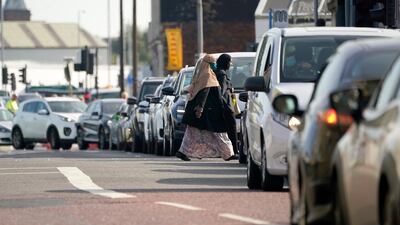
Cars queue for Covid-19 drive-in testing centre in Bolton, England. Fears about rising infection rates among younger people across the UK has forced the government into tighter lockdown restrictions. Getty -
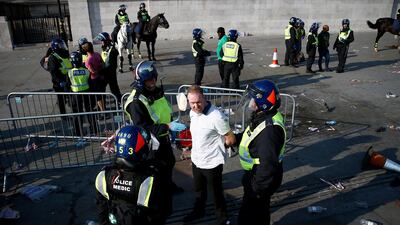
A person is detained during a demonstration in Trafalgar Square against the lockdown imposed by the government, following the outbreak of the coronavirus disease (COVID-19), in London,. Reuters



