Johnson & Johnson single-dose vaccine is effective against Covid-19


Paul Carey
  • English
  • Arabic

Johnson & Johnson’s long-awaited single-shot vaccine appears to protect against Covid-19 with only one shot, the company announced.

J&J said that in the US and seven other countries, the single-shot vaccine was 66 per cent effective overall at preventing moderate to severe illness, and much more protective – 85 per cent – against the most serious symptoms.

That means it is not as strong as some two-shot rivals but still potentially helpful for a world in dire need of more doses.

US infectious disease specialist Anthony Fauci said the variations in effectiveness around the world underlined the need to vaccinate as many people as quickly as possible to prevent new variants from emerging.

“It’s really a wake-up call for us to be nimble and to be able to adjust, as this virus will continue for certain to evolve,” Dr Fauci said.

A high bar has been set by two authorised vaccines from Pfizer-BioNTech and Moderna, each of which was about 95 per cent effective in preventing symptomatic illness in pivotal trials when given in two doses.

Those trials, however, were conducted mainly in the US and before new variants emerged.

A single-dose vaccine would offer governments a simpler route to proving protection for more people. It costs about $10 per dose, so would be beneficial for poorer countries, and can be stored at regular fridge temperatures so distribution and handling is easier.

“We’re proud to have reached this critical milestone and our commitment to address this global health crisis continues with urgency for everyone, everywhere,” the company’s chief executive, Alex Gorsky, said.

The company is quickly expected to apply for a US emergency authorisation, and could therefore soon be the third vaccine available in the world's hardest-hit country.

“These top-line results with a single-shot Covid-19 vaccine candidate represent a promising moment, said J&J’s chief scientific officer, Paul Stoffels.

“The potential to significantly reduce the burden of severe disease, by providing an effective and well-tolerated vaccine with just one immunisation, is a critical component of the global public health response.

“A one-shot vaccine is considered by the World Health Organisation to be the best option in pandemic settings, enhancing access, distribution and compliance.”

The vaccine is made by the US company’s subsidiary Janssen, based in the Netherlands, and was trialled in Britain. The UK government has bought 30 million doses, while the EU has ordered 400 million doses.

There was some geographic variation in the J&J findings. The vaccine worked better in the US – 72 per cent effective against moderate to severe Covid – compared with 57 per cent in South Africa, where it was up against a more contagious variant of the virus.

“Gambling on one dose was certainly worthwhile,” said Dr Mathai Mammen, global research chief for J&J’s Janssen Pharmaceutical unit.

With vaccinations off to a rocky start globally, experts had been counting on a one-dose vaccine that would stretch scarce supplies and avoid the logistical difficulties of getting people to return for boosters.

But with some other competing vaccines shown to be 95 per cent effective after two doses, at question is whether somewhat less protection is an acceptable trade-off to get more shots in arms quickly.

The company said within a week it would file an application for emergency use in the US, and then abroad. It expects to supply 100 million doses to the US by June, and expects to have some ready to ship as soon as authorities give the green light.

These are preliminary findings from a study of 44,000 volunteers that is not yet complete. Researchers tracked illnesses starting 28 days after vaccination – about the time when, if participants were getting a two-dose variety instead, they would have needed another shot.

After day 28, no one who was vaccinated needed to go to hospital or died, regardless of whether they were exposed to “regular Covid or these particularly nasty variants”, Mr Mammen said. When the immunised were infected, their illness was milder.

A vial and syringe are seen in front of a displayed Johnson&Johnson logo. Reuters

The announcement came shortly after success was announced for another vaccine.

The Novavax vaccine trials showed it offers 89 per cent protection against coronavirus.

The product is due to be manufactured in Britain and appears to be effective against the original strain of coronavirus and a mutant strain first identified in Kent, south-east England.

The Novavax drug showed about 60 per cent effectiveness against the strain of Covid-19 first identified in South Africa, which has been problematic for scientists owing to concerns it may evade vaccines.

The UK secured access to 60 million Novavax doses, which will be available in the second half of this year if the vaccine is approved by the medicines regulator.

More than 15,000 people in the UK took part in the clinical trial, of whom 27 per cent were aged 65 or older. The study assessed how effective the vaccine was when transmission of Covid-19 was high in the UK, and with the variant strain first identified in England circulating widely.

Prof Paul Heath, Novavax’s clinical trial chief investigator, said the data showed science was able to respond to mutations.

Kate Bingham, the former head of the UK’s vaccine task force and the person who placed the orders for Novavax doses, said she was delighted but the next goal was to find an easier way to administer vaccines.

“Frankly, two injections delivered by healthcare professionals is not a good way of delivering vaccines,” she said. “We need to get vaccine formats that are much more scalable and distributable. So whether they’re pills or patches or nose sprays, we need to find better ways of delivering vaccines.”

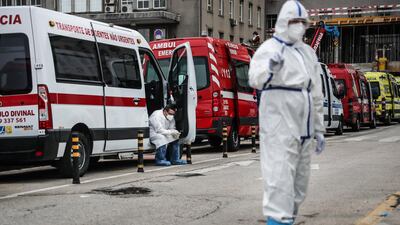
  • Dozens of ambulances with patients wait outside Santa Maria Hospital in Lisbon, Portugal. EPA
    Dozens of ambulances with patients wait outside Santa Maria Hospital in Lisbon, Portugal. EPA
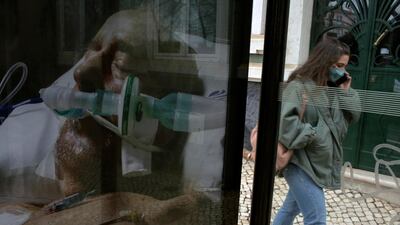
  • A woman wearing a face mask walks by a poster asking people to take precautions against the coronavirus, in Lisbon, Portugal. AP Photo
    A woman wearing a face mask walks by a poster asking people to take precautions against the coronavirus, in Lisbon, Portugal. AP Photo
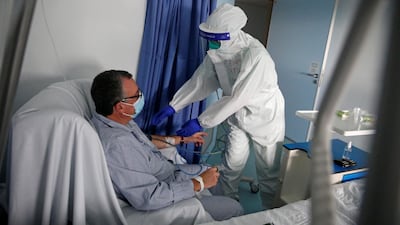
  • A nurse checks a patient in the Covid-19 ward of Cascais Hospital, Portugal. Reuters
    A nurse checks a patient in the Covid-19 ward of Cascais Hospital, Portugal. Reuters
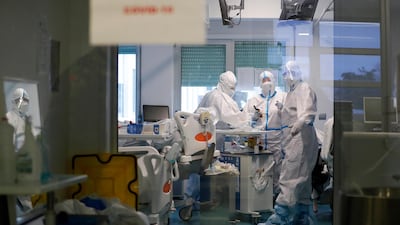
  • Medical personnel work inside a Covid-19 Intensive Care Unit at the Military Hospital in Lisbon, Portugal. At the hospital, hundreds of troops have spent frantic weeks this month rushing to turn every available space into makeshift Covid-19 wards. AP Photo
    Medical personnel work inside a Covid-19 Intensive Care Unit at the Military Hospital in Lisbon, Portugal. At the hospital, hundreds of troops have spent frantic weeks this month rushing to turn every available space into makeshift Covid-19 wards. AP Photo
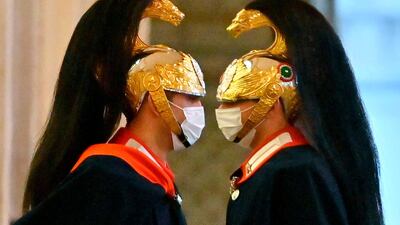
  • Corazzieri, of the Italian military Presidential honour guards, stand guard at the Quirinale Palace in Rome, Italy. AFP
    Corazzieri, of the Italian military Presidential honour guards, stand guard at the Quirinale Palace in Rome, Italy. AFP
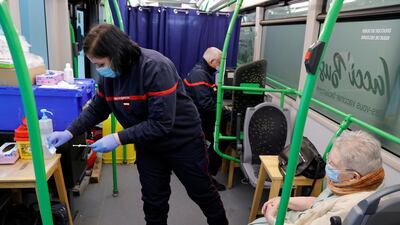
  • A firefighter prepares a dose of the Pfizer/BioNTech Covid-19 vaccine inside the Vacci'Bus, a bus converted into a vaccination center which travels through isolated villages near Reims, France. Reuters
    A firefighter prepares a dose of the Pfizer/BioNTech Covid-19 vaccine inside the Vacci'Bus, a bus converted into a vaccination center which travels through isolated villages near Reims, France. Reuters
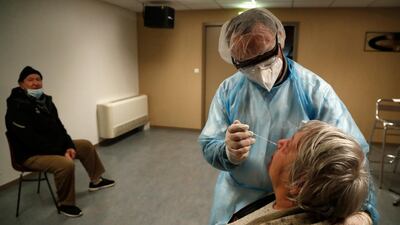
  • A medical worker takes nasal swab samples at a test station for Covid-19 in Beziers, France. EPA
    A medical worker takes nasal swab samples at a test station for Covid-19 in Beziers, France. EPA
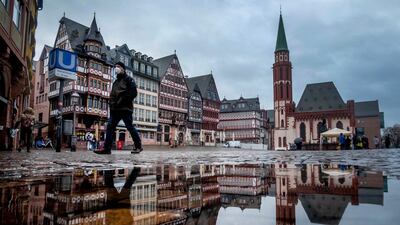
  • A man wears a face mask as he walks over the Roemerberg square in Frankfurt, Germany. AP Photo
    A man wears a face mask as he walks over the Roemerberg square in Frankfurt, Germany. AP Photo
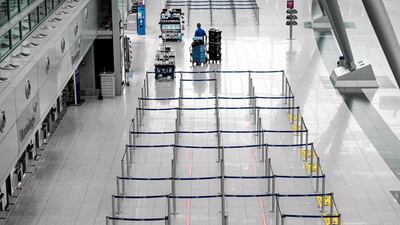
  • A view of the deserted check-in area of the International Airport in Duesseldorf, Germany. Concerned about a new and more contagious strain of the coronavirus, the German government plans to ban all passenger flights to Germany. EPA
    A view of the deserted check-in area of the International Airport in Duesseldorf, Germany. Concerned about a new and more contagious strain of the coronavirus, the German government plans to ban all passenger flights to Germany. EPA
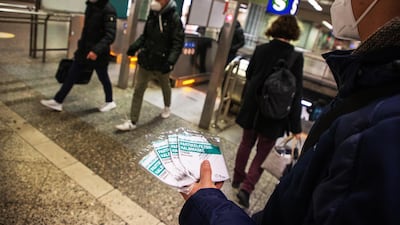
  • A public transport worker distributes free FFP2 protective face masks to commuters at Frankfurt's central railway station in Germany. Bloomberg
    A public transport worker distributes free FFP2 protective face masks to commuters at Frankfurt's central railway station in Germany. Bloomberg
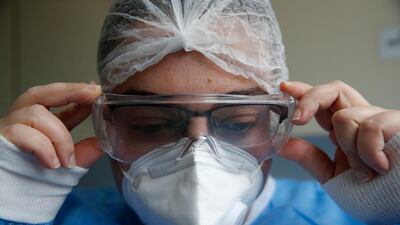
  • Cleaning worker Anthoula Dimitra Pagouni wears protective gear before entering an ICU at the Sotiria Thoracic Diseases Hospital in Athens, Greece. AP Photo
    Cleaning worker Anthoula Dimitra Pagouni wears protective gear before entering an ICU at the Sotiria Thoracic Diseases Hospital in Athens, Greece. AP Photo
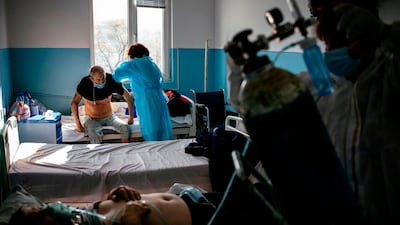
  • A doctor and a nurse examining patients in the Covid-19 unit of the hospital of Doupnitsa, Bulgaria, a municipality with 50,000 inhabitants which is desperately lacking in caregivers. AFP
    A doctor and a nurse examining patients in the Covid-19 unit of the hospital of Doupnitsa, Bulgaria, a municipality with 50,000 inhabitants which is desperately lacking in caregivers. AFP
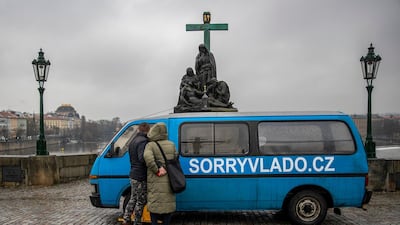
  • A couple looks inside a van parked on Charles Bridge in Prague, Czech Republic, in a protest against the government's new coronavirus measures. EPA
    A couple looks inside a van parked on Charles Bridge in Prague, Czech Republic, in a protest against the government's new coronavirus measures. EPA

Defeating the scourge, which has killed more than two million people worldwide, will require vaccinating billions, and the shots being rolled out in different countries so far all require two doses a few weeks apart for full protection. Early data is mixed on exactly how well all the different kinds work, but shots made by Pfizer-BioNTech and Moderna appear to be about 95 per cent protective after the second dose.

But amid shortages, some countries have advised delaying the second dose of certain vaccines with little data on how that would affect protection.

All Covid-19 vaccines train the body to recognise the new coronavirus, usually by spotting the spiky protein that coats it. But they are made in very different ways.

J&J’s shot uses a cold virus like a Trojan horse to carry the spike gene into the body, where cells make harmless copies of the protein to prime the immune system in case the real virus comes along.

Rival AstraZeneca makes a similar cold virus vaccine that requires two doses. Both the AstraZeneca and J&J vaccines can be stored in a refrigerator, making them easier to ship and to use in developing countries than the frozen kind made by Pfizer-BioNTech and Moderna.

It is not clear exactly how well the AstraZeneca version, being used in Britain and several other countries, works. Tests in Britain, South Africa and Brazil suggested two doses are about 70 per cent effective, although there are questions about how much protection older adults receive. An ongoing US study may provide more information.

J&J said its vaccine works consistently in a broad range of people. A third of participants were aged over 60, and more than 40 per cent had other conditions that put them at risk of severe Covid-19, such as obesity, diabetes and Aids.

J&J said the vaccine is safe, with reactions similar to other Covid-19 shots such as fever that occur when the immune system is revved up.

While it released few details, the company said there were no serious allergic reactions. But occasionally other Covid-19 vaccines trigger such reactions, which can be reversed if promptly treated – and authorities have warned people to be on the lookout, regardless of which type of vaccine is used.

J&J had hedged its bets with a study of a two-dose version of its vaccine, which is still under way.

Ten tax points to be aware of in 2026

1. Domestic VAT refund amendments: request your refund within five years

If a business does not apply for the refund on time, they lose their credit.

2. E-invoicing in the UAE

Businesses should continue preparing for the implementation of e-invoicing in the UAE, with 2026 a preparation and transition period ahead of phased mandatory adoption. 

3. More tax audits

Tax authorities are increasingly using data already available across multiple filings to identify audit risks. 

4. More beneficial VAT and excise tax penalty regime

Tax disputes are expected to become more frequent and more structured, with clearer administrative objection and appeal processes. The UAE has adopted a new penalty regime for VAT and excise disputes, which now mirrors the penalty regime for corporate tax.

5. Greater emphasis on statutory audit

There is a greater need for the accuracy of financial statements. The International Financial Reporting Standards standards need to be strictly adhered to and, as a result, the quality of the audits will need to increase.

6. Further transfer pricing enforcement

Transfer pricing enforcement, which refers to the practice of establishing prices for internal transactions between related entities, is expected to broaden in scope. The UAE will shortly open the possibility to negotiate advance pricing agreements, or essentially rulings for transfer pricing purposes. 

7. Limited time periods for audits

Recent amendments also introduce a default five-year limitation period for tax audits and assessments, subject to specific statutory exceptions. While the standard audit and assessment period is five years, this may be extended to up to 15 years in cases involving fraud or tax evasion. 

8. Pillar 2 implementation 

Many multinational groups will begin to feel the practical effect of the Domestic Minimum Top-Up Tax (DMTT), the UAE's implementation of the OECD’s global minimum tax under Pillar 2. While the rules apply for financial years starting on or after January 1, 2025, it is 2026 that marks the transition to an operational phase.

9. Reduced compliance obligations for imported goods and services

Businesses that apply the reverse-charge mechanism for VAT purposes in the UAE may benefit from reduced compliance obligations. 

10. Substance and CbC reporting focus

Tax authorities are expected to continue strengthening the enforcement of economic substance and Country-by-Country (CbC) reporting frameworks. In the UAE, these regimes are increasingly being used as risk-assessment tools, providing tax authorities with a comprehensive view of multinational groups’ global footprints and enabling them to assess whether profits are aligned with real economic activity. 

Contributed by Thomas Vanhee and Hend Rashwan, Aurifer

Mercer, the investment consulting arm of US services company Marsh & McLennan, expects its wealth division to at least double its assets under management (AUM) in the Middle East as wealth in the region continues to grow despite economic headwinds, a company official said.

Mercer Wealth, which globally has $160 billion in AUM, plans to boost its AUM in the region to $2-$3bn in the next 2-3 years from the present $1bn, said Yasir AbuShaban, a Dubai-based principal with Mercer Wealth.

Within the next two to three years, we are looking at reaching $2 to $3 billion as a conservative estimate and we do see an opportunity to do so,” said Mr AbuShaban.

Mercer does not directly make investments, but allocates clients’ money they have discretion to, to professional asset managers. They also provide advice to clients.

“We have buying power. We can negotiate on their (client’s) behalf with asset managers to provide them lower fees than they otherwise would have to get on their own,” he added.

Mercer Wealth’s clients include sovereign wealth funds, family offices, and insurance companies among others.

From its office in Dubai, Mercer also looks after Africa, India and Turkey, where they also see opportunity for growth.

Wealth creation in Middle East and Africa (MEA) grew 8.5 per cent to $8.1 trillion last year from $7.5tn in 2015, higher than last year’s global average of 6 per cent and the second-highest growth in a region after Asia-Pacific which grew 9.9 per cent, according to consultancy Boston Consulting Group (BCG). In the region, where wealth grew just 1.9 per cent in 2015 compared with 2014, a pickup in oil prices has helped in wealth generation.

BCG is forecasting MEA wealth will rise to $12tn by 2021, growing at an annual average of 8 per cent.

Drivers of wealth generation in the region will be split evenly between new wealth creation and growth of performance of existing assets, according to BCG.

Another general trend in the region is clients’ looking for a comprehensive approach to investing, according to Mr AbuShaban.

“Institutional investors or some of the families are seeing a slowdown in the available capital they have to invest and in that sense they are looking at optimizing the way they manage their portfolios and making sure they are not investing haphazardly and different parts of their investment are working together,” said Mr AbuShaban.

Some clients also have a higher appetite for risk, given the low interest-rate environment that does not provide enough yield for some institutional investors. These clients are keen to invest in illiquid assets, such as private equity and infrastructure.

“What we have seen is a desire for higher returns in what has been a low-return environment specifically in various fixed income or bonds,” he said.

“In this environment, we have seen a de facto increase in the risk that clients are taking in things like illiquid investments, private equity investments, infrastructure and private debt, those kind of investments were higher illiquidity results in incrementally higher returns.”

The Abu Dhabi Investment Authority, one of the largest sovereign wealth funds, said in its 2016 report that has gradually increased its exposure in direct private equity and private credit transactions, mainly in Asian markets and especially in China and India. The authority’s private equity department focused on structured equities owing to “their defensive characteristics.”

What can victims do?

Always use only regulated platforms

Stop all transactions and communication on suspicion

Save all evidence (screenshots, chat logs, transaction IDs)

Report to local authorities

Warn others to prevent further harm

Courtesy: Crystal Intelligence

THE BIO

Favourite place to go to in the UAE: The desert sand dunes, just after some rain

Who inspires you: Anybody with new and smart ideas, challenging questions, an open mind and a positive attitude

Where would you like to retire: Most probably in my home country, Hungary, but with frequent returns to the UAE

Favorite book: A book by Transilvanian author, Albert Wass, entitled ‘Sword and Reap’ (Kard es Kasza) - not really known internationally

Favourite subjects in school: Mathematics and science

Company profile

Company name: Suraasa

Started: 2018

Founders: Rishabh Khanna, Ankit Khanna and Sahil Makker

Based: India, UAE and the UK

Industry: EdTech

Initial investment: More than $200,000 in seed funding

The biog

Profession: Senior sports presenter and producer

Marital status: Single

Favourite book: Al Nabi by Jibran Khalil Jibran

Favourite food: Italian and Lebanese food

Favourite football player: Cristiano Ronaldo

Languages: Arabic, French, English, Portuguese and some Spanish

Website: www.liliane-tannoury.com

Points Classification after Stage 1

1. Geraint Thomas (Britain / Team Sky) 20

2. Stefan Kueng (Switzerland / BMC Racing) 17

3. Vasil Kiryienka (Belarus / Team Sky) 15

4. Tony Martin (Germany / Katusha) 13

5. Matteo Trentin (Italy / Quick-Step) 11

6. Chris Froome (Britain / Team Sky) 10

7. Jos van Emden (Netherlands / LottoNL) 9

8. Michal Kwiatkowski (Poland / Team Sky) 8

9. Marcel Kittel (Germany / Quick-Step) 7

10. Edvald Boasson Hagen (Norway / Dimension Data) 6

The biog

Age: 32

Qualifications: Diploma in engineering from TSI Technical Institute, bachelor’s degree in accounting from Dubai’s Al Ghurair University, master’s degree in human resources from Abu Dhabi University, currently third years PHD in strategy of human resources.

Favourite mountain range: The Himalayas

Favourite experience: Two months trekking in Alaska

GAC GS8 Specs

Engine: 2.0-litre 4cyl turbo

Power: 248hp at 5,200rpm

Torque: 400Nm at 1,750-4,000rpm

Transmission: 8-speed auto

Fuel consumption: 9.1L/100km

On sale: Now

Price: From Dh149,900