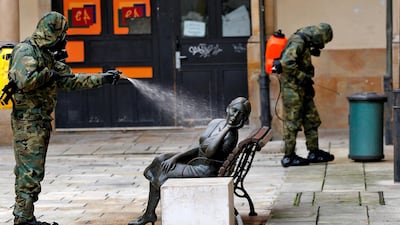
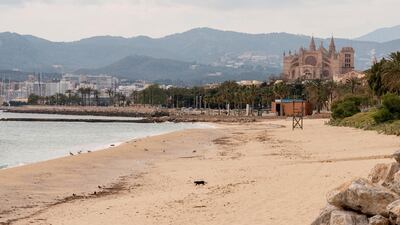
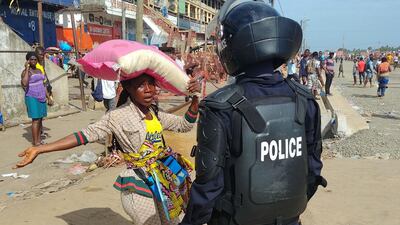
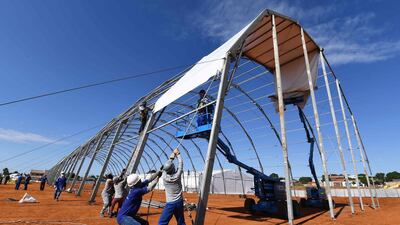
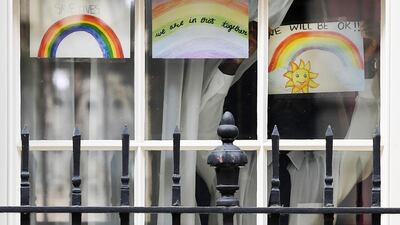
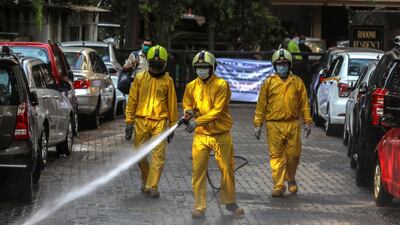
Russian President Vladimir Putin on Monday warned officials to prepare for the next stage in the coronavirus pandemic as the country tightened its lockdown and reported its highest daily infection figure.
In a video conference with officials on Monday, Mr Putin said the next weeks would be decisive for Russia's fight against the virus as the situation "is changing practically every day and unfortunately not for the better".
He said officials would need to "consider all scenarios for how the situation will develop, even the most complex and extraordinary".
Mr Putin called for measures to end shortages of protective equipment for medics, adding that infections had not reached their peak anywhere in Russia.
"I know there's not always enough of that and of course here we need additional measures to get rid of all these shortages," he said.
Mr Putin said Russia would bring in the Defence Ministry to help if necessary.
The country has sent military planes with specialists and equipment to countries including Italy, China and the US, in gestures that have prompted criticism from some Russians.
Moscow authorities on Monday began issuing digital permits to reduce breaches of the coronavirus lockdown.
Russia reported more than 2,500 new infections, its highest daily rise yet, bringing the tally to 18,328 cases and 148 deaths. Almost 1,500 have recovered.
The numbers are believed to be much higher because many with mild symptoms are not being tested.
Officials said more than 800,000 passes were issued to people planning to travel by car or public transport before the system's formal launch on Wednesday.
But they said hackers attacked the mayor's office website and applicants complained on social media that they were not able to get a pass despite several attempts.
People will be assigned a special code consisting of a sequence of figures and letters, which can be printed out or received by email, when they report where they are planning to go.
Work passes will be valid until April 30, while passes to go to a doctor or elsewhere can be used only once.
Police patrols will be able to check the passes on the streets and could fine people for breaches.
Exempt are armed forces personnel, municipal officials and journalists, among others.
Under strict confinement rules in the Russian capital, Muscovites are only allowed to leave their homes to walk their dogs, take out rubbish and visit their nearest shop, although private car journeys were not restricted until now.
Moscow has been under lockdown since March 30, but is now struggling to cope with the influx of new patients and officials have said hospitals are approaching their limits.
The densely populated capital of more than 12 million residents has reported 11,513 cases and 82 deaths.
More from Rashmee Roshan Lall
How to avoid crypto fraud
- Use unique usernames and passwords while enabling multi-factor authentication.
- Use an offline private key, a physical device that requires manual activation, whenever you access your wallet.
- Avoid suspicious social media ads promoting fraudulent schemes.
- Only invest in crypto projects that you fully understand.
- Critically assess whether a project’s promises or returns seem too good to be true.
- Only use reputable platforms that have a track record of strong regulatory compliance.
- Store funds in hardware wallets as opposed to online exchanges.
Milestones on the road to union
1970
October 26: Bahrain withdraws from a proposal to create a federation of nine with the seven Trucial States and Qatar.
December: Ahmed Al Suwaidi visits New York to discuss potential UN membership.
1971
March 1: Alex Douglas Hume, Conservative foreign secretary confirms that Britain will leave the Gulf and “strongly supports” the creation of a Union of Arab Emirates.
July 12: Historic meeting at which Sheikh Zayed and Sheikh Rashid make a binding agreement to create what will become the UAE.
July 18: It is announced that the UAE will be formed from six emirates, with a proposed constitution signed. RAK is not yet part of the agreement.
August 6: The fifth anniversary of Sheikh Zayed becoming Ruler of Abu Dhabi, with official celebrations deferred until later in the year.
August 15: Bahrain becomes independent.
September 3: Qatar becomes independent.
November 23-25: Meeting with Sheikh Zayed and Sheikh Rashid and senior British officials to fix December 2 as date of creation of the UAE.
November 29: At 5.30pm Iranian forces seize the Greater and Lesser Tunbs by force.
November 30: Despite a power sharing agreement, Tehran takes full control of Abu Musa.
November 31: UK officials visit all six participating Emirates to formally end the Trucial States treaties
December 2: 11am, Dubai. New Supreme Council formally elects Sheikh Zayed as President. Treaty of Friendship signed with the UK. 11.30am. Flag raising ceremony at Union House and Al Manhal Palace in Abu Dhabi witnessed by Sheikh Khalifa, then Crown Prince of Abu Dhabi.
December 6: Arab League formally admits the UAE. The first British Ambassador presents his credentials to Sheikh Zayed.
December 9: UAE joins the United Nations.
Ten tax points to be aware of in 2026
1. Domestic VAT refund amendments: request your refund within five years
If a business does not apply for the refund on time, they lose their credit.
2. E-invoicing in the UAE
Businesses should continue preparing for the implementation of e-invoicing in the UAE, with 2026 a preparation and transition period ahead of phased mandatory adoption.
3. More tax audits
Tax authorities are increasingly using data already available across multiple filings to identify audit risks.
4. More beneficial VAT and excise tax penalty regime
Tax disputes are expected to become more frequent and more structured, with clearer administrative objection and appeal processes. The UAE has adopted a new penalty regime for VAT and excise disputes, which now mirrors the penalty regime for corporate tax.
5. Greater emphasis on statutory audit
There is a greater need for the accuracy of financial statements. The International Financial Reporting Standards standards need to be strictly adhered to and, as a result, the quality of the audits will need to increase.
6. Further transfer pricing enforcement
Transfer pricing enforcement, which refers to the practice of establishing prices for internal transactions between related entities, is expected to broaden in scope. The UAE will shortly open the possibility to negotiate advance pricing agreements, or essentially rulings for transfer pricing purposes.
7. Limited time periods for audits
Recent amendments also introduce a default five-year limitation period for tax audits and assessments, subject to specific statutory exceptions. While the standard audit and assessment period is five years, this may be extended to up to 15 years in cases involving fraud or tax evasion.
8. Pillar 2 implementation
Many multinational groups will begin to feel the practical effect of the Domestic Minimum Top-Up Tax (DMTT), the UAE's implementation of the OECD’s global minimum tax under Pillar 2. While the rules apply for financial years starting on or after January 1, 2025, it is 2026 that marks the transition to an operational phase.
9. Reduced compliance obligations for imported goods and services
Businesses that apply the reverse-charge mechanism for VAT purposes in the UAE may benefit from reduced compliance obligations.
10. Substance and CbC reporting focus
Tax authorities are expected to continue strengthening the enforcement of economic substance and Country-by-Country (CbC) reporting frameworks. In the UAE, these regimes are increasingly being used as risk-assessment tools, providing tax authorities with a comprehensive view of multinational groups’ global footprints and enabling them to assess whether profits are aligned with real economic activity.
Contributed by Thomas Vanhee and Hend Rashwan, Aurifer
Avatar: Fire and Ash
Director: James Cameron
Starring: Sam Worthington, Sigourney Weaver, Zoe Saldana
Rating: 4.5/5
TRAP
Starring: Josh Hartnett, Saleka Shyamalan, Ariel Donaghue
Director: M Night Shyamalan
Rating: 3/5
The biog
Name: Shamsa Hassan Safar
Nationality: Emirati
Education: Degree in emergency medical services at Higher Colleges of Technology
Favourite book: Between two hearts- Arabic novels
Favourite music: Mohammed Abdu and modern Arabic songs
Favourite way to spend time off: Family visits and spending time with friends
Company Profile:
Name: The Protein Bakeshop
Date of start: 2013
Founders: Rashi Chowdhary and Saad Umerani
Based: Dubai
Size, number of employees: 12
Funding/investors: $400,000 (2018)
Four%20scenarios%20for%20Ukraine%20war
%3Cp%3E1.%20Protracted%20but%20less%20intense%20war%20(60%25%20likelihood)%3C%2Fp%3E%0A%3Cp%3E2.%20Negotiated%20end%20to%20the%20conflict%20(30%25)%3C%2Fp%3E%0A%3Cp%3E3.%20Russia%20seizes%20more%20territory%20(20%25)%3C%2Fp%3E%0A%3Cp%3E4.%20Ukraine%20pushes%20Russia%20back%20(10%25)%3C%2Fp%3E%0A%3Cp%3E%3Cem%3EForecast%20by%20Economist%20Intelligence%20Unit%3C%2Fem%3E%3C%2Fp%3E%0A
The chef's advice
Troy Payne, head chef at Abu Dhabi’s newest healthy eatery Sanderson’s in Al Seef Resort & Spa, says singles need to change their mindset about how they approach the supermarket.
“They feel like they can’t buy one cucumber,” he says. “But I can walk into a shop – I feed two people at home – and I’ll walk into a shop and I buy one cucumber, I’ll buy one onion.”
Mr Payne asks for the sticker to be placed directly on each item, rather than face the temptation of filling one of the two-kilogram capacity plastic bags on offer.
The chef also advises singletons not get too hung up on “organic”, particularly high-priced varieties that have been flown in from far-flung locales. Local produce is often grown sustainably, and far cheaper, he says.
European arms
Known EU weapons transfers to Ukraine since the war began: Germany 1,000 anti-tank weapons and 500 Stinger surface-to-air missiles. Luxembourg 100 NLAW anti-tank weapons, jeeps and 15 military tents as well as air transport capacity. Belgium 2,000 machine guns, 3,800 tons of fuel. Netherlands 200 Stinger missiles. Poland 100 mortars, 8 drones, Javelin anti-tank weapons, Grot assault rifles, munitions. Slovakia 12,000 pieces of artillery ammunition, 10 million litres of fuel, 2.4 million litres of aviation fuel and 2 Bozena de-mining systems. Estonia Javelin anti-tank weapons. Latvia Stinger surface to air missiles. Czech Republic machine guns, assault rifles, other light weapons and ammunition worth $8.57 million.