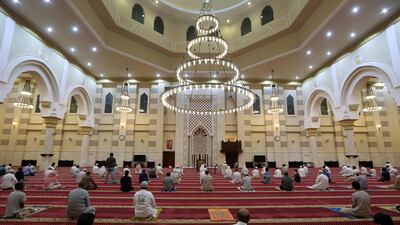
Arab countries and health experts have expressed support for Saudi Arabia’s decision to bar people from travelling to the kingdom for the Hajj pilgrimage this year.
On Monday, Saudi authorities said the pilgrimage, which usually draws about 2.5 million people to Makkah, would only be open to pilgrims who are already in the kingdom.
Yesterday, Saudi Minister of Hajj and Umrah Muhammad Saleh Benten said the decision could mean there are only about 1,000 pilgrims taking part this year.
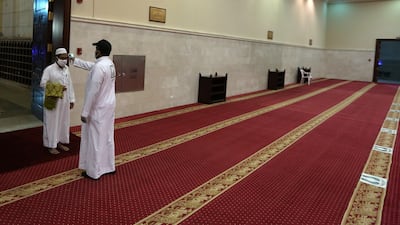
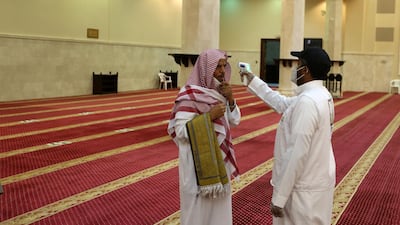
It is the latest measure to stop the spread of coronavirus in Saudi Arabia.
Nezar Bahabri, a Saudi infectious diseases consultant, said if Hajj were to be performed as usual this year, it would be difficult to control the spread of coronavirus.
"In such crowded gatherings, social distancing between pilgrims is very difficult to control while performing rituals," he told The National.
"We respect Saudi Arabia's decision to hold this year’s Hajj for only a limited number within the country. The kingdom made the prompt decision as precautionary measures to prevent the coronavirus or Covid-19 from spreading among pilgrims.”
Dr Bahabri said it was not unusual for pilgrims to contract illnesses such as respiratory infections from bacteria or viruses, which increased the risk that Covid-19 could spread easily if the number of people attending the Hajj pilgrimage was not limited.
Sami Angawi, an expert on Islamic architecture in Makkah and Madinah, praised the decision.
“The world is going through difficult times because of coronavirus. We want to protect the people. And in Islam, God is forgiving and merciful, so, if we're not able to go for Hajj, then it's not going to be a burden on anybody. We firmly believe that God does not place a burden on us more than what we can bear,” he said.
We want to protect the people. And in Islam, God is forgiving and merciful, so, if we're not able to go for Hajj, then it's not going to be a burden on anybody
Ammani Saad, head of government relations at International Hajj and Umrah establishment in Jeddah, said keeping pilgrims to those living in Saudi Arabia was a good decision under the circumstances.
“It is a wise decision, keeping in mind the safety of pilgrims and public health as a priority.”
This month, Malaysia, Singapore, Brunei and Indonesia barred their citizens from travelling to Saudi Arabia for the pilgrimage, citing fears of the coronavirus. In France, faith leaders have urged Muslims to reschedule their pilgrimage plans for next year.
“We worked with the Ministry of Health in Saudi Arabia to develop preventive and precautionary measures and protocols that are needed to ensure a safe Hajj season,” Dr Benten said.
As part of those precautions, pilgrims will be tested for infection before reaching the holy sites and people older than 65 will also be barred from taking part.
The UAE Egypt were among the countries that came out in support of the decision.
Egyptian Religious Affairs Minister Mukhtar Juma described the downsizing as practical and “conforming with jurisprudence regarding the pandemic”.
The Emirates' Hajj Affairs Office said Saudi Arabia's move “preserves the health of the people and their lives, which is one of the main purposes of our honoured religion”.
Bahraini Justice and Islamic Affairs and Endowments Minister Sheikh Khalid bin Khalifa said the decision “conforms with the core values of Islam” and that Bahrain appreciates what he described as Saudi Arabia’s quest to save lives.
The Saudi health ministry on Tuesday confirmed an additional 39 coronavirus deaths and 3,139 infections.
The death toll now stands at 1,346, with 164,144 infections.
Results
5pm: Wadi Nagab – Maiden (PA) Dh80,000 (Turf) 1,200m; Winner: Al Falaq, Antonio Fresu (jockey), Ahmed Al Shemaili (trainer)
5.30pm: Wadi Sidr – Handicap (PA) Dh80,000 (T) 1,200m; Winner: AF Majalis, Tadhg O’Shea, Ernst Oertel
6pm: Wathba Stallions Cup – Handicap (PA) Dh70,000 (T) 2,200m; Winner: AF Fakhama, Fernando Jara, Mohamed Daggash
6.30pm: Wadi Shees – Handicap (PA) Dh80,000 (T) 2,200m; Winner: Mutaqadim, Antonio Fresu, Ibrahim Al Hadhrami
7pm: Arabian Triple Crown Round-1 – Listed (PA) Dh230,000 (T) 1,600m; Winner: Bahar Muscat, Antonio Fresu, Ibrahim Al Hadhrami
7.30pm: Wadi Tayyibah – Maiden (TB) Dh80,000 (T) 1,600m; Winner: Poster Paint, Patrick Cosgrave, Bhupat Seemar
Ten tax points to be aware of in 2026
1. Domestic VAT refund amendments: request your refund within five years
If a business does not apply for the refund on time, they lose their credit.
2. E-invoicing in the UAE
Businesses should continue preparing for the implementation of e-invoicing in the UAE, with 2026 a preparation and transition period ahead of phased mandatory adoption.
3. More tax audits
Tax authorities are increasingly using data already available across multiple filings to identify audit risks.
4. More beneficial VAT and excise tax penalty regime
Tax disputes are expected to become more frequent and more structured, with clearer administrative objection and appeal processes. The UAE has adopted a new penalty regime for VAT and excise disputes, which now mirrors the penalty regime for corporate tax.
5. Greater emphasis on statutory audit
There is a greater need for the accuracy of financial statements. The International Financial Reporting Standards standards need to be strictly adhered to and, as a result, the quality of the audits will need to increase.
6. Further transfer pricing enforcement
Transfer pricing enforcement, which refers to the practice of establishing prices for internal transactions between related entities, is expected to broaden in scope. The UAE will shortly open the possibility to negotiate advance pricing agreements, or essentially rulings for transfer pricing purposes.
7. Limited time periods for audits
Recent amendments also introduce a default five-year limitation period for tax audits and assessments, subject to specific statutory exceptions. While the standard audit and assessment period is five years, this may be extended to up to 15 years in cases involving fraud or tax evasion.
8. Pillar 2 implementation
Many multinational groups will begin to feel the practical effect of the Domestic Minimum Top-Up Tax (DMTT), the UAE's implementation of the OECD’s global minimum tax under Pillar 2. While the rules apply for financial years starting on or after January 1, 2025, it is 2026 that marks the transition to an operational phase.
9. Reduced compliance obligations for imported goods and services
Businesses that apply the reverse-charge mechanism for VAT purposes in the UAE may benefit from reduced compliance obligations.
10. Substance and CbC reporting focus
Tax authorities are expected to continue strengthening the enforcement of economic substance and Country-by-Country (CbC) reporting frameworks. In the UAE, these regimes are increasingly being used as risk-assessment tools, providing tax authorities with a comprehensive view of multinational groups’ global footprints and enabling them to assess whether profits are aligned with real economic activity.
Contributed by Thomas Vanhee and Hend Rashwan, Aurifer
10 tips for entry-level job seekers
- Have an up-to-date, professional LinkedIn profile. If you don’t have a LinkedIn account, set one up today. Avoid poor-quality profile pictures with distracting backgrounds. Include a professional summary and begin to grow your network.
- Keep track of the job trends in your sector through the news. Apply for job alerts at your dream organisations and the types of jobs you want – LinkedIn uses AI to share similar relevant jobs based on your selections.
- Double check that you’ve highlighted relevant skills on your resume and LinkedIn profile.
- For most entry-level jobs, your resume will first be filtered by an applicant tracking system for keywords. Look closely at the description of the job you are applying for and mirror the language as much as possible (while being honest and accurate about your skills and experience).
- Keep your CV professional and in a simple format – make sure you tailor your cover letter and application to the company and role.
- Go online and look for details on job specifications for your target position. Make a list of skills required and set yourself some learning goals to tick off all the necessary skills one by one.
- Don’t be afraid to reach outside your immediate friends and family to other acquaintances and let them know you are looking for new opportunities.
- Make sure you’ve set your LinkedIn profile to signal that you are “open to opportunities”. Also be sure to use LinkedIn to search for people who are still actively hiring by searching for those that have the headline “I’m hiring” or “We’re hiring” in their profile.
- Prepare for online interviews using mock interview tools. Even before landing interviews, it can be useful to start practising.
- Be professional and patient. Always be professional with whoever you are interacting with throughout your search process, this will be remembered. You need to be patient, dedicated and not give up on your search. Candidates need to make sure they are following up appropriately for roles they have applied.
Arda Atalay, head of Mena private sector at LinkedIn Talent Solutions, Rudy Bier, managing partner of Kinetic Business Solutions and Ben Kinerman Daltrey, co-founder of KinFitz
Profile
Company: Justmop.com
Date started: December 2015
Founders: Kerem Kuyucu and Cagatay Ozcan
Sector: Technology and home services
Based: Jumeirah Lake Towers, Dubai
Size: 55 employees and 100,000 cleaning requests a month
Funding: The company’s investors include Collective Spark, Faith Capital Holding, Oak Capital, VentureFriends, and 500 Startups.
UAE squad
Ali Kashief, Salem Rashid, Khalifa Al Hammadi, Khalfan Mubarak, Ali Mabkhout, Omar Abdelrahman, Mohammed Al Attas (Al Jazira), Mohmmed Al Shamsi, Hamdan Al Kamali, Mohammad Barghash, Khalil Al Hammadi (Al Wahda), Khalid Eisa, Mohammed Shakir, Ahmed Barman, Bandar Al Ahbabi (Al Ain), Adel Al Hosani, Al Hassan Saleh, Majid Suroor (Sharjah), Waleed Abbas, Ismail Al Hammadi, Ahmed Khalil (Shabab Al Ahli Dubai) Habib Fardan, Tariq Ahmed, Mohammed Al Akbari (Al Nasr), Ali Saleh, Ali Salmeen (Al Wasl), Hassan Al Mahrami (Baniyas)
The%20specs
%3Cp%3E%3Cstrong%3EEngine%3A%3C%2Fstrong%3E%20Dual%20synchronous%20electric%20motors%0D%3Cbr%3E%3Cstrong%3EPower%3A%20%3C%2Fstrong%3E660hp%0D%3Cbr%3E%3Cstrong%3ETorque%3A%20%3C%2Fstrong%3E1%2C100Nm%0D%3Cbr%3E%3Cstrong%3ETransmission%3A%20%3C%2Fstrong%3ESingle-speed%20automatic%0D%3Cbr%3E%3Cstrong%3ETouring%20range%3A%20%3C%2Fstrong%3E488km-560km%0D%3Cbr%3E%3Cstrong%3EPrice%3A%20%3C%2Fstrong%3EFrom%20Dh850%2C000%20(estimate)%0D%3Cbr%3E%3Cstrong%3EOn%20sale%3A%20%3C%2Fstrong%3EOctober%3C%2Fp%3E%0A
Meydan racecard:
6.30pm: Handicap | US$135,000 (Dirt) | 1,400 metres
7.05pm: Handicap | $135,000 (Turf) | 1,200m
7.40pm: Dubai Millennium Stakes | Group 3 | $200,000 (T) | 2,000m
8.15pm: UAE Oaks | Group 3 | $250,000 (D) | 1,900m
8.50pm: Zabeel Mile | Group 2 | $250,000 (T) | 1,600m
9.20pm: Handicap | $135,000 (T) | 1,600m
The specs
Engine: 6.2-litre supercharged V8
Power: 712hp at 6,100rpm
Torque: 881Nm at 4,800rpm
Transmission: 8-speed auto
Fuel consumption: 19.6 l/100km
Price: Dh380,000
On sale: now
Groom and Two Brides
Director: Elie Semaan
Starring: Abdullah Boushehri, Laila Abdallah, Lulwa Almulla
Rating: 3/5
Teams in the EHL
White Bears, Al Ain Theebs, Dubai Mighty Camels, Abu Dhabi Storms, Abu Dhabi Scorpions and Vipers
As it stands in Pool A
1. Japan - Played 3, Won 3, Points 14
2. Ireland - Played 3, Won 2, Lost 1, Points 11
3. Scotland - Played 2, Won 1, Lost 1, Points 5
Remaining fixtures
Scotland v Russia – Wednesday, 11.15am
Ireland v Samoa – Saturday, 2.45pm
Japan v Scotland – Sunday, 2.45pm
How to avoid crypto fraud
- Use unique usernames and passwords while enabling multi-factor authentication.
- Use an offline private key, a physical device that requires manual activation, whenever you access your wallet.
- Avoid suspicious social media ads promoting fraudulent schemes.
- Only invest in crypto projects that you fully understand.
- Critically assess whether a project’s promises or returns seem too good to be true.
- Only use reputable platforms that have a track record of strong regulatory compliance.
- Store funds in hardware wallets as opposed to online exchanges.