• The first images arrive moments after Nasa's Perseverance Mars rover spacecraft successfully touched down on Mars on February 18, 2021. Nasa TV via Reuters
    The first images arrive moments after Nasa's Perseverance Mars rover spacecraft successfully touched down on Mars on February 18, 2021. Nasa TV via Reuters
  • Members of Nasa's Perseverance Mars rover team watch in mission control as the first images arrive moments after the spacecraft successfully touched down on Mars. Nasa via AP
    Members of Nasa's Perseverance Mars rover team watch in mission control as the first images arrive moments after the spacecraft successfully touched down on Mars. Nasa via AP
  • The second image sent by the Perseverance rover showing the surface of Mars, just after landing in the Jezero crater. Nasa via AP
    The second image sent by the Perseverance rover showing the surface of Mars, just after landing in the Jezero crater. Nasa via AP
  • Members of Nasa's Perseverance rover team react in mission control after receiving confirmation the spacecraft successfully touched down on Mars, at Nasa's Jet Propulsion Laboratory in Pasadena, California on February 18, 2021. Nasa via Reuters
    Members of Nasa's Perseverance rover team react in mission control after receiving confirmation the spacecraft successfully touched down on Mars, at Nasa's Jet Propulsion Laboratory in Pasadena, California on February 18, 2021. Nasa via Reuters
  • This artist's concept depicts Nasa's Mars 2020 rover on the surface of Mars. Nasa/JPL-Caltech
    This artist's concept depicts Nasa's Mars 2020 rover on the surface of Mars. Nasa/JPL-Caltech
  • This image shows the remains of an ancient delta in Mars' Jezero Crater, which Nasa's Perseverance Mars rover will explore for signs of fossilized microbial life. ESA
    This image shows the remains of an ancient delta in Mars' Jezero Crater, which Nasa's Perseverance Mars rover will explore for signs of fossilized microbial life. ESA
  • The successful landing of the Perseverance could answer the age-old question of whether life ever existed on the red planet. AFP
    The successful landing of the Perseverance could answer the age-old question of whether life ever existed on the red planet. AFP
  • This artist's concept depicts astronauts and human habitats on Mars. Scientists in Germany have found a way to grow bacteria under Mars-like conditions. Nasa / JPL-Caltech
    This artist's concept depicts astronauts and human habitats on Mars. Scientists in Germany have found a way to grow bacteria under Mars-like conditions. Nasa / JPL-Caltech
  • NASA's Mars 2020 rover will store rock and soil samples in sealed tubes on the planet's surface for future missions to retrieve, as seen in this illustration. Image credit: NASA/JPL-Caltech
    NASA's Mars 2020 rover will store rock and soil samples in sealed tubes on the planet's surface for future missions to retrieve, as seen in this illustration. Image credit: NASA/JPL-Caltech

How to watch Nasa’s Perseverance rover touch down on Mars


Arthur Scott-Geddes
  • English
  • Arabic

Nasa’s Perseverance rover will attempt a perilous landing on Mars on Thursday, becoming the latest mission to explore the surface of the Red Planet.

After a journey of 480 million kilometres, the robotic explorer will arrive at Mars – hot on the heels of the UAE's Hope probe – and execute a tricky landing in the planet's Jezero Crater at 12.55am UAE time on Friday.

Nasa will be live-streaming the event on its YouTube channel, with coverage to start at 11.15pm in the UAE on Thursday.

The space agency’s Jet Propulsion Laboratory, which built the rover, will broadcast an immersive 360-degree-view of their control room for the mission.

Mission timeline: Seven minutes of terror

Cruise stage separation

The spacecraft that has flown Perseverance to the Red Planet will separate from the entry capsule at about 12.38am.

Atmospheric entry

About 10 minutes later, the landing module is expected to hit the top of the Martian atmosphere travelling at about 19,500kph.

Peak heating: In a matter of seconds, atmospheric friction will heat the bottom of the spacecraft to about 1,300°C.

Parachute deployment

Still travelling at supersonic speed, the spacecraft will release its parachute at about 12.52am, helping to slow its descent.

Heat shield separation

The capsule’s protective heat shield will detach about 20 seconds later, allowing the rover to use radar to determine how far it is from the ground and find a safe landing site.

Back shell separation

The back half of the entry capsule that holds the parachute will separate, leaving the rover and its rocket-powered descent stage to slow down and fly to the landing site.

Touchdown

The rover will be lowered gently down to the surface using a sky crane descent stage. Travelling at human walking speed, the rover is expected to touch down at about 12.55am.

Scientists prepared for ‘most challenging’ landing

With its steep cliffs, sand dunes and boulder fields, the Jezero Crater, which scientists believe may once have been a lake, poses a particular threat to the mission’s success.

"Perseverance is Nasa's most ambitious Mars rover mission yet," said Thomas Zurbuchen, associate administrator for the Science Mission Directorate at Nasa headquarters in Washington. "The landing team will have its hands full getting us to Jezero Crater – the most challenging Martian terrain ever targeted for a landing."

Only half the previous attempts to land on Mars were successful, with the high temperatures of re-entry, lower gravity and rough terrain testing spacecraft engineering to its limits.

But despite the scale of the challenge, engineers and scientists at the JPL are hopeful.

Deputy project manager for the mission at JPL, Jennifer Trosper, said: “No Mars landing is guaranteed, but we have been preparing for a decade to put this rover’s wheels down on the surface of Mars and get to work.”

Why persevere? 

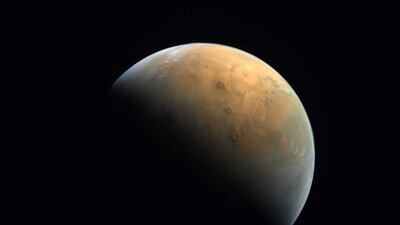
  • This February 10, 2021 image of Mars taken by the UAE's Hope probe shows Mars. The spacecraft now circles the Red Planet. Courtesy: Mohammed bin Rashid Space Centre
    This February 10, 2021 image of Mars taken by the UAE's Hope probe shows Mars. The spacecraft now circles the Red Planet. Courtesy: Mohammed bin Rashid Space Centre
  • An image of Mars taken from the Hubble Space Telescope in 2014. NASA / AP
    An image of Mars taken from the Hubble Space Telescope in 2014. NASA / AP
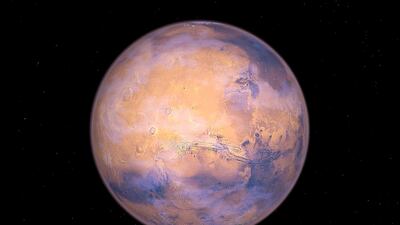
  • A full Mars. In this image the massive volcano Olympus Mons is clearly visible upper left of centre, while at centre are the three Tharsis Montes volcanoes. All these volcanoes are believed to be extinct. Mars is often host to white clouds of water ice crystals and experiences seasonal dust storms that can cover the entire planet.
    A full Mars. In this image the massive volcano Olympus Mons is clearly visible upper left of centre, while at centre are the three Tharsis Montes volcanoes. All these volcanoes are believed to be extinct. Mars is often host to white clouds of water ice crystals and experiences seasonal dust storms that can cover the entire planet.
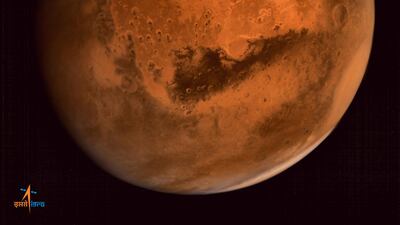
  • In this handout photograph received from the Indian Space Research Organisation on September 30, 2014, the planet Mars is seen in an image taken by the ISRO Mars Orbiter Mission spacecraft. AFP / ISRO
    In this handout photograph received from the Indian Space Research Organisation on September 30, 2014, the planet Mars is seen in an image taken by the ISRO Mars Orbiter Mission spacecraft. AFP / ISRO

Perseverance will search a particularly ancient area of Mars for evidence of past life, helping to pave the way for future human exploration and even colonisation.

Alongside a suite of advanced sensors and instruments, the rover is also carrying the Ingenuity Mars Helicopter, a small craft similar to a drone, that will attempt to carry out the first powered flight on the planet to survey more of its surface.

Perseverance will also collect samples from the Martian surface and eventually return them to Earth for the first time, with the help of a later mission.

Tomb%20Raider%20I%E2%80%93III%20Remastered
%3Cp%3EDeveloper%3A%20Aspyr%0D%3Cbr%3EPublisher%3A%20Aspyr%0D%3Cbr%3EConsole%3A%20Nintendo%20Switch%2C%20PlayStation%204%26amp%3B5%2C%20PC%20and%20Xbox%20series%20X%2FS%0D%3Cbr%3ERating%3A%203%2F5%3C%2Fp%3E%0A
Cricket World Cup League Two

Teams

Oman, UAE, Namibia

Al Amerat, Muscat


Results

Oman beat UAE by five wickets

UAE beat Namibia by eight runs

Namibia beat Oman by 52 runs

UAE beat Namibia by eight wickets


Fixtures

Saturday January 11 - UAE v Oman

Sunday January 12 – Oman v Namibia

History's medical milestones

1799 - First small pox vaccine administered

1846 - First public demonstration of anaesthesia in surgery

1861 - Louis Pasteur published his germ theory which proved that bacteria caused diseases

1895 - Discovery of x-rays

1923 - Heart valve surgery performed successfully for first time

1928 - Alexander Fleming discovers penicillin

1953 - Structure of DNA discovered

1952 - First organ transplant - a kidney - takes place 

1954 - Clinical trials of birth control pill

1979 - MRI, or magnetic resonance imaging, scanned used to diagnose illness and injury.

1998 - The first adult live-donor liver transplant is carried out

In numbers: PKK’s money network in Europe

Germany: PKK collectors typically bring in $18 million in cash a year – amount has trebled since 2010

Revolutionary tax: Investigators say about $2 million a year raised from ‘tax collection’ around Marseille

Extortion: Gunman convicted in 2023 of demanding $10,000 from Kurdish businessman in Stockholm

Drug trade: PKK income claimed by Turkish anti-drugs force in 2024 to be as high as $500 million a year

Denmark: PKK one of two terrorist groups along with Iranian separatists ASMLA to raise “two-digit million amounts”

Contributions: Hundreds of euros expected from typical Kurdish families and thousands from business owners

TV channel: Kurdish Roj TV accounts frozen and went bankrupt after Denmark fined it more than $1 million over PKK links in 2013 


Rock in a Hard Place: Music and Mayhem in the Middle East
Orlando Crowcroft
Zed Books

UAE currency: the story behind the money in your pockets
The specs: 2018 Nissan 370Z Nismo

The specs: 2018 Nissan 370Z Nismo
Price, base / as tested: Dh182,178
Engine: 3.7-litre V6
Power: 350hp @ 7,400rpm
Torque: 374Nm @ 5,200rpm
Transmission: Seven-speed automatic
​​​​​​​Fuel consumption, combined: 10.5L / 100km

The specs: 2019 Mini Cooper

Price, base: Dh141,740 (three-door) / Dh165,900 (five-door)
Engine: 1.5-litre four-cylinder (Cooper) / 2.0-litre four-cylinder (Cooper S)
Power: 136hp @ 4,500rpm (Cooper) / 192hp @ 5,000rpm (Cooper S)
Torque: 220Nm @ 1,480rpm (Cooper) / 280Nm @ 1,350rpm (Cooper S)
Transmission: Seven-speed automatic
Fuel consumption, combined: 4.8L to 5.4L / 100km

What are NFTs?

Are non-fungible tokens a currency, asset, or a licensing instrument? Arnab Das, global market strategist EMEA at Invesco, says they are mix of all of three.

You can buy, hold and use NFTs just like US dollars and Bitcoins. “They can appreciate in value and even produce cash flows.”

However, while money is fungible, NFTs are not. “One Bitcoin, dollar, euro or dirham is largely indistinguishable from the next. Nothing ties a dollar bill to a particular owner, for example. Nor does it tie you to to any goods, services or assets you bought with that currency. In contrast, NFTs confer specific ownership,” Mr Das says.

This makes NFTs closer to a piece of intellectual property such as a work of art or licence, as you can claim royalties or profit by exchanging it at a higher value later, Mr Das says. “They could provide a sustainable income stream.”

This income will depend on future demand and use, which makes NFTs difficult to value. “However, there is a credible use case for many forms of intellectual property, notably art, songs, videos,” Mr Das says.

MATCH INFO

Southampton 0
Manchester City 1
(Sterling 16')

Man of the match: Kevin de Bruyne (Manchester City)

The 10 Questions
  • Is there a God?
  • How did it all begin?
  • What is inside a black hole?
  • Can we predict the future?
  • Is time travel possible?
  • Will we survive on Earth?
  • Is there other intelligent life in the universe?
  • Should we colonise space?
  • Will artificial intelligence outsmart us?
  • How do we shape the future?