
Iran's judiciary has issued a second international "red notice" calling for the arrest of outgoing US President Donald Trump.
Red notices are alerts made by governments or tribunals to the International Criminal Police Organisation, or Interpol, when a fugitive has crossed foreign borders.
The most recent announcement was made two days after the anniversary of the assassination of the head of Iran's elite Quds Force, Gen Qassem Suleimani, who was killed in a US drone strike near Baghdad airport on January 3, 2020.
-
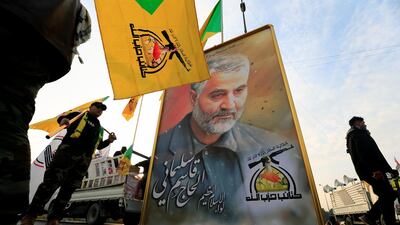
Members of Iraq's Kataib Hezbollah militia hold a picture of Iranian general Qassem Suleimani before his funeral procession in Baghdad on January 4, 2020. Reuters -

People attend a funeral procession for Iranian Major General Qassem Suleimani, head of the elite Quds Force, and Iraqi militia commander Abu Mahdi Al Muhandis, who were killed in an air strike at Baghdad airport. WANA via Reuters -
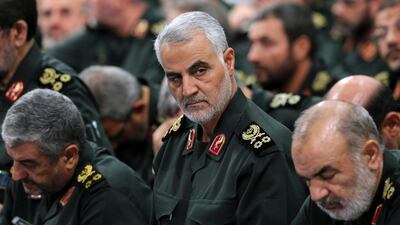
Qassem Suleimani former commander of the Quds Force, one of five branches of Iran's Islamic Revolutionary Guard Corps (IRGC). AP -

A picture published by the media office of the Iraqi military's joint operations forces on their official Facebook page shows a destroyed vehicle on fire following a US strike on January 3, 2020 on Baghdad international airport road in which top Iranian commander Qasem Soleimani was killed along with eight others, including the deputy head of Iraq's powerful Hashed al-Shaabi paramilitary force. Early Friday, a volley of US missiles hit Baghdad's international airport, striking a convoy belonging to the Hashed al-Shaabi, an Iraqi paramilitary force with close ties to Iran. Soleimani was killed in the US strike on the Iraqi capital's airport, according to Hashed, in a dramatic escalation of tensions between Washington and Tehran. AFP -

A file handout picture released by the office of Iran's Supreme Leader Ayatollah Ali Khamenei on October 1, 2019, shows Qasem Soleimani, Iranian Revolutionary Guards Corps (IRGC) Major General and commander of the Quds Force, speaking during an interview with members of the Iranian leader's bureau in Tehran. A US strike killed top Iranian commander Qasem Soleimani and the deputy head of Iraq's Hashed al-Shaabi military force at Baghdad's airport early on January 3, 2019, the Hashed announced. AFP -

Iran's supreme leader Ayatollah Ali Khamenei and president Hassan Rouhani pray near the coffin of Qassem Suleimani in Tehran. Reuters -

Iraqi cleric and Iranian-backed militia leader Moqtada Al Sadr with Qassem Suleimani in Tehran in September 2019. Mr Sadr said Iraqi militias must refrain from military action after Iran attacked US targets in Iraq with missiles on Wednesday in retaliation for Suleimani's killing. EPA -
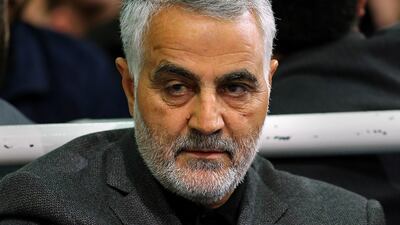
(FILES) This file handout photo released on March 27, 2015 by the official website of the Centre for Preserving and Publishing the Works of Iran's supreme leader, shows the commander of the Iranian Revolutionary Guard's Quds Force, Gen. Qassem Soleimani, attending a religious ceremony in Tehran to commemorate the anniversary of the death of the daughter of Prophet Mohammed. Top Iranian commander Qasem Soleimani was killed in a US strike on Baghdad's international airport on January 3, 2019, Iraq's powerful Hashed al-Shaabi paramilitary force has said, in a dramatic escalation of tensions between Washington and Tehran. AFP -

A funeral procession for General Suleimani in Iran. The general who also fought in the Iran-Iraq War received a multi-city commemoration. Office of the Iranian Supreme Leader via AP -
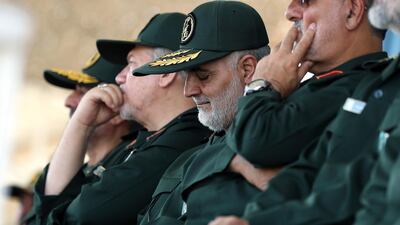
Iranian commander Qassem Suleimani, centre, was killed in an air strike near Baghdad airport raising tensions in the Middle East. AP -
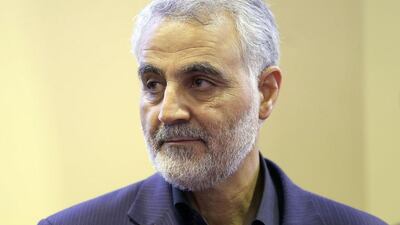
A file photo of the commander of Iranian Revolutionary Guard's Quds Force, Major General Qassem Suleimani. AFP


Head of the Iranian judiciary, Ebrahim Raisi, who said a red notice must be issued, is known as a hardline supporter of Iran's supreme leader Ayatollah Khamenei. At an event in Tehran on January 1 to commemorate Suleimani's death, Mr Raisi said his killers "will witness a severe revenge".
"What has come so far has only been glimpses," he said.
Analysts fear Iran may be planning a retaliatory terrorist attack after the head of the Revolutionary Guard Corps said a "hard revenge" was still being planned.
Iran asserts that the air strike that killed Suleimani last year was illegal under international law, but those defending the assassination argue that he had directed Iran-backed militias to kill US troops – an American had been killed by pro-Iran groups in Iraq the previous week.
This means he could be regarded as an enemy combatant under the laws of armed conflict.
Iran made a similar request to Interpol in June, which was denied on the grounds that the organisation would not undertake "any intervention or activities of a political, military, religious or racial character".
At the time, the Trump administration dismissed Iran's call to arrest Mr Trump as a "propaganda stunt".
An Interpol red notice is a request circulated to police around the world to locate and arrest a person wanted either by a country or an international tribunal, pending extradition or similar legal action.
While red notices are non-binding, they are common practice when wanted fugitives or people suspected of crimes flee across borders.

