
Iran said it would restart production of fuel for its Tehran Research Reactor, a facility that runs on uranium enriched to higher levels to produce medical isotopes.
International Atomic Energy Agency inspectors in Iran were told of the country's plans, according to a statement on Twitter by the country's envoy, which was confirmed by semi-official Tasnim news agency. The Vienna-based IAEA confirmed that it had received the information.
Iran's move is part of a broad suite of measures recently passed by the country's parliament to accelerate nuclear activities in response to US sanctions.
The country said it is prepared to roll back those moves once trade restrictions are lifted.
President-elect Joe Biden is expected to reassess the US relationship with Iran after taking office later this month.
A decision to turn its stockpile of 20 per cent-enriched uranium into metal plates for its research reactor would make it more difficult for Iran to further purify the material into weapons-grade materiel. The accumulation of enriched uranium is a long-standing concern among Iran's neighbours in the Arabian Gulf. The country's stockpile has swelled more than 10-fold after President Donald Trump's 2018 decision to jettison an international accord exchanging sanctions relief for nuclear restrictions.
This month, the Iranian government confirmed it was implementing an "anti-sanctions" law, ratified in December, reviving and promoting certain atomic activities to build pressure on the incoming Biden administration to lift key sanctions.
A January 4 statement on the government's official website, dolat.ir, said that the Atomic Energy Organisation of Iran would also take steps to establish a uranium metal production facility in Esfahan and "aim to have it operational" within months, as part of that law.
-
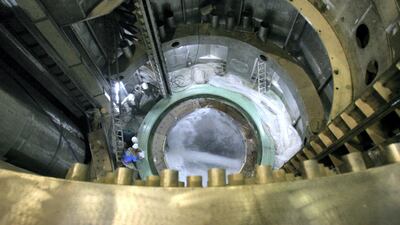
Russian contractors work at the Bushehr nuclear reactor site in 2007. The plant opened four years later. Bloomberg -
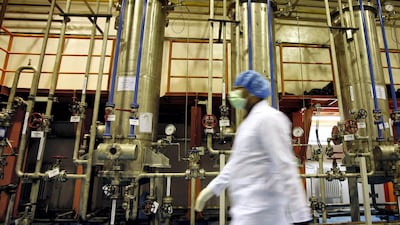
An Iranian technician at the International Atomic Energy Agency inspects the country's Isfahan plant in 2007. Tehran is no longer co-operating with the agency at nuclear sites across the country. EPA -

Workers wait to begin constructing a second reactor at the Bushehr nuclear power plant in 2019. AFP -
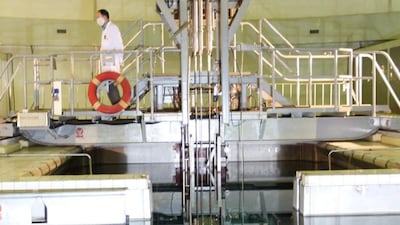
A metal-encased rod with 20 per cent enriched nuclear fuel is inserted into a reactor in Tehran in 2012. AFP -
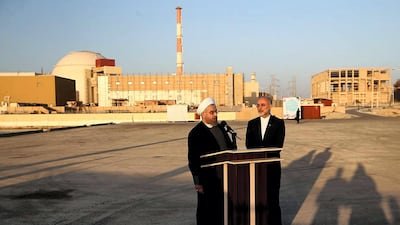
Fomer Iranian President Hassan Rouhani and the country's Atomic Energy Organisation chief Ali Akbar Salehi speak at the Bushehr nuclear site in 2015. AFP -
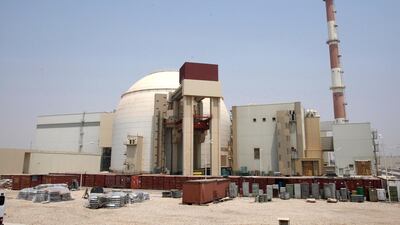
Iran's Bushehr nuclear plant has been restarted. EPA -
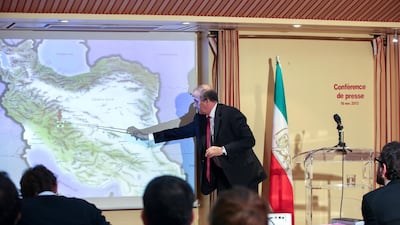
Mehdi Abrichamtchi, chairman of the Peace and Security Committee at the National Council of Resistance of Iran, shows journalists the location of a secret nuclear site in Iran in 2013. AFP -
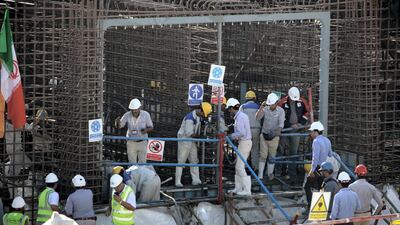
Workers prepare to begin the construction of a second reactor at the Bushehr site. AFP



