


Lebanon's first major anti-government protest in Beirut since the country imposed a coronavirus lockdown in mid-March was dispersed with tear gas on Saturday afternoon.
In front of Parliament, protesters threw rocks and fireworks at riot police who responded with several rounds of tear gas. By mid-afternoon, police cleared the area and nearby Martyrs’ Square. Several protesters fainted.
Forty-eight people were wounded, 11 of whom were taken to hospital, while the rest were treated at the scene, the Lebanese Red Cross said.
Thousands of protesters gathered peacefully in Martyrs’ Square in the early afternoon for the first time since Lebanon imposed confinement measures and closed its borders in mid-March to contain the spread of the coronavirus, which has killed 28 of the 1,312 people infected so far.
The demonstration became tense after a brawl started in the square for reasons that remain unclear. Dozens of young men then ran towards the entrance of a nearby neighbourhood dominated by the Shiite Amal and Hezbollah parties, who both oppose the anti-government protests.
Party supporters gathered and chanted sectarian slogans while protesters chanted insults about Hezbollah leader Hassan Nasrallah. Soldiers and riot police stood in between as the two groups threw rocks and bottles at each other.
-
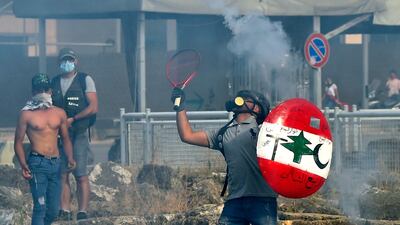
An anti-government protester uses a tennis racket to return a tear gas canister at riot policemen during a demonstration against the Lebanese government and worsening economic conditions in downtown Beirut, Lebanon. EPA -
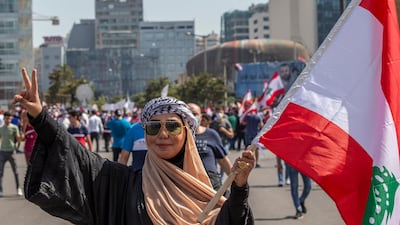
Anti-government protestors during a mass protest against the economic and financial crisis, and to demand early parliamentary elections, in Beirut, Lebanon. EPA -
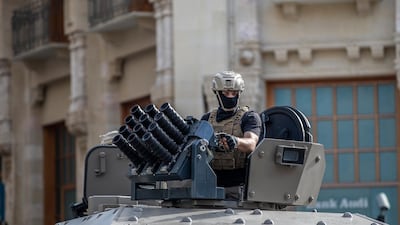
Lebanese Riot police officers sits on his armored vehicle during clashes with anti-government protesters during a mass protest against the economic and financial crisis, and to demand early parliamentary elections, in Beirut, Lebanon. EPA -
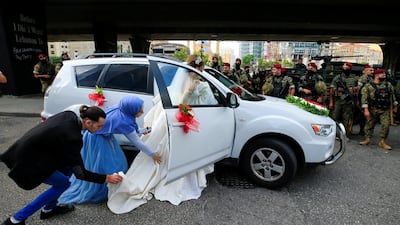
A bride gets into a car during a protest against the government performance and worsening economic conditions, in Beirut, Lebanon. EPA -
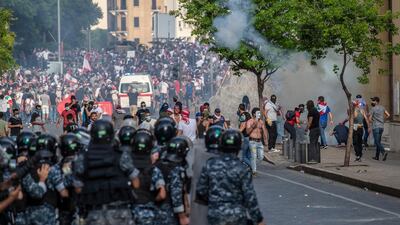
Lebanese security forces watch protesters trying to enter the parliament building during clashes with Lebanese riot police at a mass protest against the economic and financial crisis, and to demand early parliamentary elections, in Beirut, Lebanon. EPA -
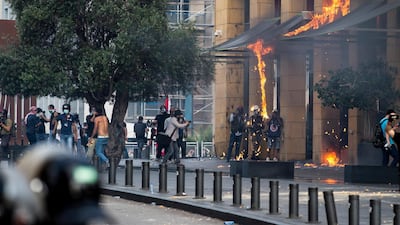
Lebanese security forces watch members of the media taking pictures of flames after a molotov cocktail was thrown by protesters trying to reach the parliament building during clashes with Lebanese riot police at a mass protest against the economic and financial crisis, and to demand early parliamentary elections, in Beirut, Lebanon. EPA -
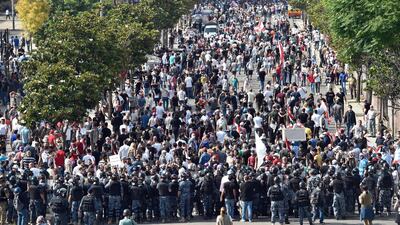
Security forces including Lebanese Army units block a protesters' march during a mass demonstration against the Lebanese government and worsening economic conditions, a road near the Mohammad Al-Amin Mosque, in Beirut, Lebanon. EPA -
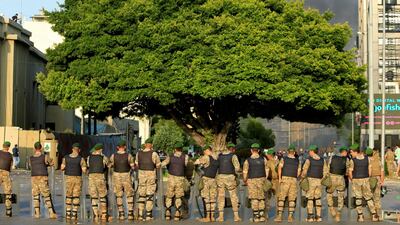
Smoke rises as Lebanese Army soldiers stand guard during a protest against the government performance and worsening economic conditions, in Beirut, Lebanon June. REUTERS


The protesters moved towards Parliament but riot police pushed them back. Demonstrators were quickly dispersed with tear gas after throwing fireworks at police.
“We will protect peaceful protests but attacks against public and private property are not allowed,” Interior Minister Mohamed Fahmi was quoted as saying in local media.
One woman standing in Martyrs’ Square cheered on a group of protesters hurling insults about the leaders of Hezbollah, Amal and their ally, President Michel Aoun’s Free Patriotic Movement. “They should all get the same. We shouldn’t be afraid,” she said.
Some protesters called for Hezbollah, the only party in the country that kept its weapons after the civil war ended in 1990, to disarm. Leaflets that read “Make it happen 1559 1701” could be seen lying on the ground. The numbers refer to UN Security Council resolutions passed in 2004 and 2006 that called for all of Lebanon’s militias to hand in their weapons, Hezbollah included.
However, protesters who spoke to The National said the issue of Hezbollah's weapons was not the main reason they were protesting.
“We are here to express that we are not happy with the government. Everything they promised when they were hired was not achieved,” said one woman who asked to remain anonymous.
Lebanon’s current government was sworn in in late January after protests toppled Saad Hariri’s government in late October. The new prime minister, Hassan Diab, promised to address Lebanon’s worst economic crisis as the country sinks deeper into poverty.
“We need fresh elections. We need an independent judiciary,” added the woman. Protesters and activists accuse the Lebanese judiciary of being manipulated by political parties.
Protester Jamal Halawani also called for strengthening the judiciary, but did not agree on new elections. “If they organise elections now, they will produce the same results because they will use the same old electoral law,” he said.
Echoing an oft-repeated slogan since protests began last October, he said the protesters “want the stolen money to be returned to the people”.
The massive anti-government protests were spurred by the record-high inflation and unemployment caused by economic crisis.
Under the slogan “all of them means all of them”, protesters rejected years of political corruption and inefficiency, but did not target Hezbollah specifically. Mr Nasrallah accused them of being manipulated by western powers.
Since confinement measures were introduced, living conditions worsened in the country. Almost half of Lebanon's people live below the poverty line.
“If the government falls now, the dollar will be worth 10,000 Lebanese pounds and increase poverty,” Mr Halawani said. While still officially pegged to the dollar, the local currency has crashed from 1,507.5 Lebanese pounds to the dollar to about 4,000 in the past nine months after banks severely restricted access to the US currency.
Mr Halawani – a left-wing activist – was cautious about criticising Hezbollah. “It’s not strategic to talk about Hezbollah’s weapons now. We are against them but talking about this now will cause a civil war,” he said. “We fought each other for 15 years. 150 000 were martyred … We do not want to return to that again.”

