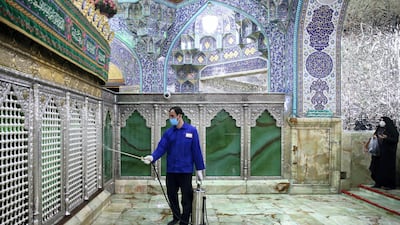
An Iranian official walks around the tomb of the Abdol Azim inside the shrine in the city of Shahre Ray, south of the capital city Tehran. EPA

Coronavirus: Iran reopens major shrines as deaths fall


  • English
  • Arabic

Iran on Monday reopened major shrines across the country, more than two months after they were closed.

At Tehran’s Shah Abdol Azim shrine, worshippers had to wear a mask, walk through a disinfection tunnel and have their temperature checked as they began returning from the early morning, according to AFP reporters.

The Imam Reza shrine in Mashhad in northeast Iran and the Fatima Masumeh shrine and Jamkaran mosque in Qom also reopened.

They are allowed to open starting from an hour after dawn until an hour before dusk.

Shrines were closed alongside schools, universities and all non-vital businesses in March after Iran reported its first two coronavirus deaths in Qom in late February.

On Monday, Health Ministry spokesman Kianoush Jahanpour said the coronavirus cases in Iran had reached 137,724, while the overall deaths had risen to 7,451.

In the past 24 hours, Iran recorded 2,032 new cases while the fatalities stood at 34 – the lowest daily count recorded since March 7 – he told a news conference.

Experts inside and outside Iran have cast doubt on the country’s official figures, and say the actual toll could be much higher.

Iran has allowed a phased reopening of its economy and gradual relaxation of restrictions since early April, with a further easing expected in the coming days despite a recent surge in new cases.

“High-risk” businesses such as restaurants, cafes and wedding halls in Tehran, which were left shuttered, will reopen from Tuesday, the capital’s deputy police chief Nader Moradi told Isna news agency.

Authorities are yet to say when similar measures will be allowed in other provinces.

  • An Iranian sanitary worker disinfects Qom's Masumeh shrine on February 25, 2020 to prevent the spread of the coronavirus. AFP
    An Iranian sanitary worker disinfects Qom's Masumeh shrine on February 25, 2020 to prevent the spread of the coronavirus. AFP
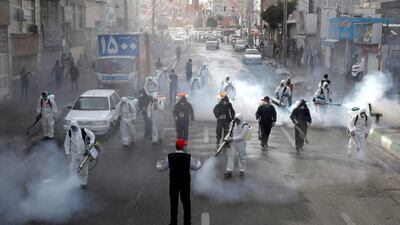
  • Iranian Firefighters disinfect streets in the capital Tehran in a bid to halt the wild spread of coronavirus on March 13, 2020. AFP
    Iranian Firefighters disinfect streets in the capital Tehran in a bid to halt the wild spread of coronavirus on March 13, 2020. AFP
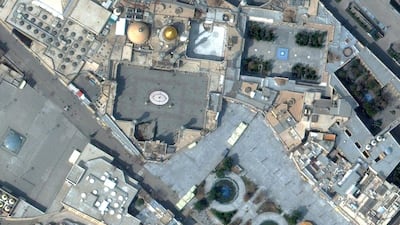
  • A nearly empty Hazrat Masumeh Shrine in Qom, Iran on March 1, 2020. AFP
    A nearly empty Hazrat Masumeh Shrine in Qom, Iran on March 1, 2020. AFP
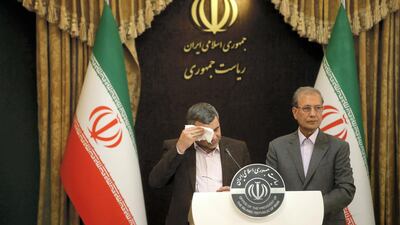
  • Iranian Deputy Health Minister Iraj Harirchi (left) wipes the sweat off his face, during a press conference with the Islamic republic's government spokesman Ali Rabiei in the capital Tehran on February 24, 2020. AFP
    Iranian Deputy Health Minister Iraj Harirchi (left) wipes the sweat off his face, during a press conference with the Islamic republic's government spokesman Ali Rabiei in the capital Tehran on February 24, 2020. AFP
  • An image grab of footage obtained from Iranian State TV IRINN on February 25, 2020, shows Iran's deputy health minister Iraj Harirchi speaking in a video apparently shot by himself, regarding being infected with coronavirus. AFP
    An image grab of footage obtained from Iranian State TV IRINN on February 25, 2020, shows Iran's deputy health minister Iraj Harirchi speaking in a video apparently shot by himself, regarding being infected with coronavirus. AFP
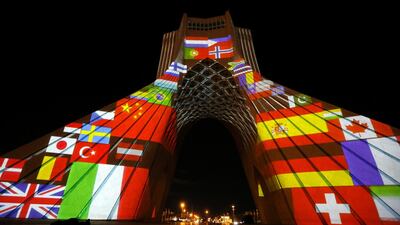
  • Iran's Azadi (Freedom) Tower is lit up with flags and messages of hope in solidarity with all the countries affected by the coronavirus pandemic, in Tehran on March 31, 2020. AFP
    Iran's Azadi (Freedom) Tower is lit up with flags and messages of hope in solidarity with all the countries affected by the coronavirus pandemic, in Tehran on March 31, 2020. AFP
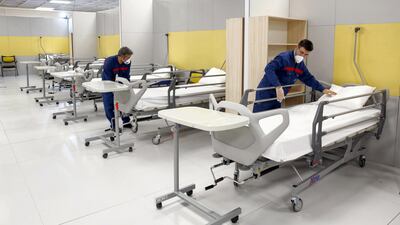
  • Iranian workers set up a makeshift hospital inside the Iran Mall, northwest of Tehran, on March 21, 2020 amid the coronavirus outbreak. - Iran said that 123 more people had died from coronavirus, raising the official death toll to 1,556 in the Islamic republic, one of the world's worst affected countries. AFP
    Iranian workers set up a makeshift hospital inside the Iran Mall, northwest of Tehran, on March 21, 2020 amid the coronavirus outbreak. - Iran said that 123 more people had died from coronavirus, raising the official death toll to 1,556 in the Islamic republic, one of the world's worst affected countries. AFP
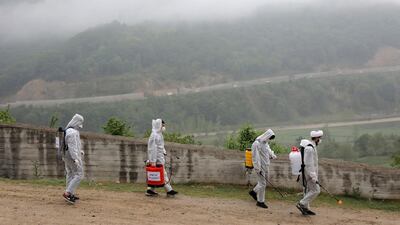
  • Volunteers wearing protective clothing, take part in disinfecting a village during the coronavirus outbreak, in the outskirts of the city of Ghaemshahr, in north of Iran, on Wednesday, April 29, 2020. AP Photo
    Volunteers wearing protective clothing, take part in disinfecting a village during the coronavirus outbreak, in the outskirts of the city of Ghaemshahr, in north of Iran, on Wednesday, April 29, 2020. AP Photo
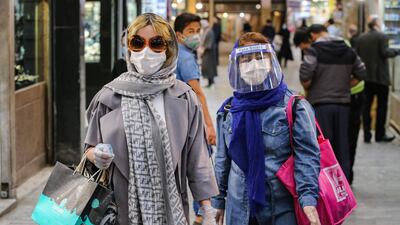
  • Shoppers clad in protective gear, including face masks and shields and latex gloves, due to the coronavirus pandemic, walk through the Tajrish Bazaar in Iran's capital Tehran on April 25, 2020. AFP
    Shoppers clad in protective gear, including face masks and shields and latex gloves, due to the coronavirus pandemic, walk through the Tajrish Bazaar in Iran's capital Tehran on April 25, 2020. AFP
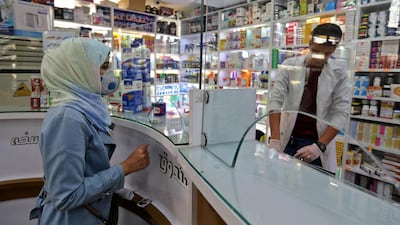
  • A customer wears a protective masks at a pharmacy in the Iranian capital Tehran on February 24, 2020. AFP
    A customer wears a protective masks at a pharmacy in the Iranian capital Tehran on February 24, 2020. AFP
  • A Tehran Municipality worker cleans a bus to avoid the spread of Covid-19 on February 26, 2020. AFP
    A Tehran Municipality worker cleans a bus to avoid the spread of Covid-19 on February 26, 2020. AFP
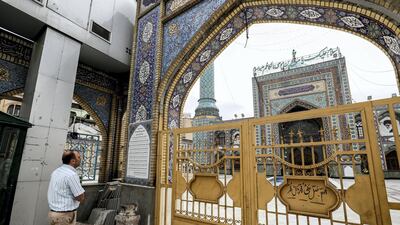
  • A man stands by the closed gate outside the Imamzadeh Saleh in the Iranian capital Tehran's Shemiran district on April 25, 2020 . AFP
    A man stands by the closed gate outside the Imamzadeh Saleh in the Iranian capital Tehran's Shemiran district on April 25, 2020 . AFP
  • Labourers unloading medical equipment and coronavirus testing kits provided by the World Health Organisation, from a UAE military transport plane upon their arrival at Mehrabad International Airport in Iran's capital Tehran. AFP
    Labourers unloading medical equipment and coronavirus testing kits provided by the World Health Organisation, from a UAE military transport plane upon their arrival at Mehrabad International Airport in Iran's capital Tehran. AFP
UK’s AI plan
  • AI ambassadors such as MIT economist Simon Johnson, Monzo cofounder Tom Blomfield and Google DeepMind’s Raia Hadsell
  • £10bn AI growth zone in South Wales to create 5,000 jobs
  • £100m of government support for startups building AI hardware products
  • £250m to train new AI models
AI traffic lights to ease congestion at seven points to Sheikh Zayed bin Sultan Street

The seven points are:

Shakhbout bin Sultan Street

Dhafeer Street

Hadbat Al Ghubainah Street (outbound)

Salama bint Butti Street

Al Dhafra Street

Rabdan Street

Umm Yifina Street exit (inbound)

The National in Davos

We are bringing you the inside story from the World Economic Forum's Annual Meeting in Davos, a gathering of hundreds of world leaders, top executives and billionaires.

Citizenship-by-investment programmes

United Kingdom

The UK offers three programmes for residency. The UK Overseas Business Representative Visa lets you open an overseas branch office of your existing company in the country at no extra investment. For the UK Tier 1 Innovator Visa, you are required to invest £50,000 (Dh238,000) into a business. You can also get a UK Tier 1 Investor Visa if you invest £2 million, £5m or £10m (the higher the investment, the sooner you obtain your permanent residency).

All UK residency visas get approved in 90 to 120 days and are valid for 3 years. After 3 years, the applicant can apply for extension of another 2 years. Once they have lived in the UK for a minimum of 6 months every year, they are eligible to apply for permanent residency (called Indefinite Leave to Remain). After one year of ILR, the applicant can apply for UK passport.

The Caribbean

Depending on the country, the investment amount starts from $100,000 (Dh367,250) and can go up to $400,000 in real estate. From the date of purchase, it will take between four to five months to receive a passport. 

Portugal

The investment amount ranges from €350,000 to €500,000 (Dh1.5m to Dh2.16m) in real estate. From the date of purchase, it will take a maximum of six months to receive a Golden Visa. Applicants can apply for permanent residency after five years and Portuguese citizenship after six years.

“Among European countries with residency programmes, Portugal has been the most popular because it offers the most cost-effective programme to eventually acquire citizenship of the European Union without ever residing in Portugal,” states Veronica Cotdemiey of Citizenship Invest.

Greece

The real estate investment threshold to acquire residency for Greece is €250,000, making it the cheapest real estate residency visa scheme in Europe. You can apply for residency in four months and citizenship after seven years.

Spain

The real estate investment threshold to acquire residency for Spain is €500,000. You can apply for permanent residency after five years and citizenship after 10 years. It is not necessary to live in Spain to retain and renew the residency visa permit.

Cyprus

Cyprus offers the quickest route to citizenship of a European country in only six months. An investment of €2m in real estate is required, making it the highest priced programme in Europe.

Malta

The Malta citizenship by investment programme is lengthy and investors are required to contribute sums as donations to the Maltese government. The applicant must either contribute at least €650,000 to the National Development & Social Fund. Spouses and children are required to contribute €25,000; unmarried children between 18 and 25 and dependent parents must contribute €50,000 each.

The second step is to make an investment in property of at least €350,000 or enter a property rental contract for at least €16,000 per annum for five years. The third step is to invest at least €150,000 in bonds or shares approved by the Maltese government to be kept for at least five years.

Candidates must commit to a minimum physical presence in Malta before citizenship is granted. While you get residency in two months, you can apply for citizenship after a year.

Egypt 

A one-year residency permit can be bought if you purchase property in Egypt worth $100,000. A three-year residency is available for those who invest $200,000 in property, and five years for those who purchase property worth $400,000.

Source: Citizenship Invest and Aqua Properties

Company%20profile
%3Cp%3EName%3A%20Tabby%3Cbr%3EFounded%3A%20August%202019%3B%20platform%20went%20live%20in%20February%202020%3Cbr%3EFounder%2FCEO%3A%20Hosam%20Arab%2C%20co-founder%3A%20Daniil%20Barkalov%3Cbr%3EBased%3A%20Dubai%2C%20UAE%3Cbr%3ESector%3A%20Payments%3Cbr%3ESize%3A%2040-50%20employees%3Cbr%3EStage%3A%20Series%20A%3Cbr%3EInvestors%3A%20Arbor%20Ventures%2C%20Mubadala%20Capital%2C%20Wamda%20Capital%2C%20STV%2C%20Raed%20Ventures%2C%20Global%20Founders%20Capital%2C%20JIMCO%2C%20Global%20Ventures%2C%20Venture%20Souq%2C%20Outliers%20VC%2C%20MSA%20Capital%2C%20HOF%20and%20AB%20Accelerator.%3Cbr%3E%3C%2Fp%3E%0A

Origin
Dan Brown
Doubleday