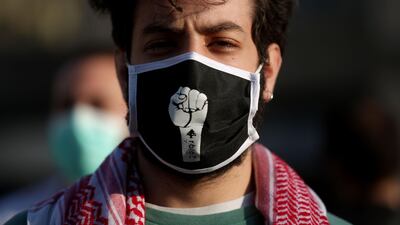
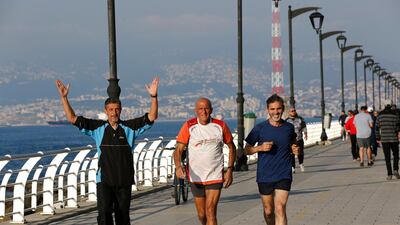
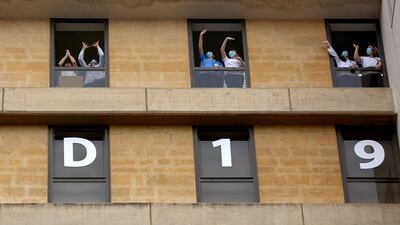
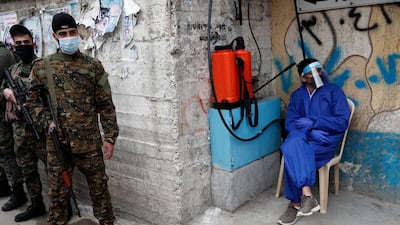
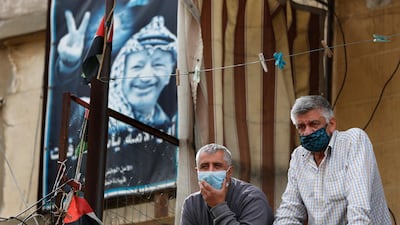
Lebanon will close down again on Wednesday as the government announced a further four-day lockdown to stem the rising number of coronavirus cases in the country just over a week after reopening the country.
The cabinet on Tuesday ordered the shutdown from "May 13 in the evening until Monday, May 18 in the morning," the state-run National News Agency reported.
The Interior Ministry is expected to issue a statement to specify what sectors and which people will be exempt from the measures.
At the beginning of the Cabinet's meeting, President Michel Aoun highlighted the need to "tighten preventative measures to cope with the coronavirus pandemic, especially that the number of infections, unfortunately, increased in the past days."
On Tuesday, Lebanon's Health Ministry said that there were 11 new cases of the novel coronavirus, including 1 infected person returning from abroad on a special repatriation flight that has allowed thousands of Lebanese home in the past weeks.
The latest figures represent a sharp increase for Lebanon, where the pandemic has been relatively contained up to now. In total, the virus has infected 870 people and killed 26.
Last week, Lebanon slowly started lifting confinement measures, with restaurants, hairdressers, churches and mosques allowed to operate at reduced capacity. The move came after several days of either a very low number of new cases or none at all.
But then on Saturday, with numbers picking up again, Health Minister Hamad Hassan announced that he would seek approval for a two-day lockdown if the rise continued.
The next day, the ministry issued a stern warning, calling the Lebanese to adhere to strict home quarantine if they had received instructions from local authorities to do so, particularly those who took part in the repatriation programme.
There were new cases of infection in the past days "as a result of the non-application of required quarantine measures," said the health ministry's press release.
On Sunday, the Interior Ministry reintroduced a stricter night-time curfew, accusing the Lebanese of "selfishness, blatant disregard, and indifference towards their health and the health of society."
The army also announced that 13 soldiers from the Military Court had tested positive for the coronavirus.
What can victims do?
Always use only regulated platforms
Stop all transactions and communication on suspicion
Save all evidence (screenshots, chat logs, transaction IDs)
Report to local authorities
Warn others to prevent further harm
Courtesy: Crystal Intelligence
SERIE A FIXTURES
Saturday (All UAE kick-off times)
Lecce v SPAL (6pm)
Bologna v Genoa (9pm)
Atlanta v Roma (11.45pm)
Sunday
Udinese v Hellas Verona (3.30pm)
Juventus v Brescia (6pm)
Sampdoria v Fiorentina (6pm)
Sassuolo v Parma (6pm)
Cagliari v Napoli (9pm)
Lazio v Inter Milan (11.45pm)
Monday
AC Milan v Torino (11.45pm)
Fund-raising tips for start-ups
Develop an innovative business concept
Have the ability to differentiate yourself from competitors
Put in place a business continuity plan after Covid-19
Prepare for the worst-case scenario (further lockdowns, long wait for a vaccine, etc.)
Have enough cash to stay afloat for the next 12 to 18 months
Be creative and innovative to reduce expenses
Be prepared to use Covid-19 as an opportunity for your business
* Tips from Jassim Al Marzooqi and Walid Hanna
Financial considerations before buying a property
Buyers should try to pay as much in cash as possible for a property, limiting the mortgage value to as little as they can afford. This means they not only pay less in interest but their monthly costs are also reduced. Ideally, the monthly mortgage payment should not exceed 20 per cent of the purchaser’s total household income, says Carol Glynn, founder of Conscious Finance Coaching.
“If it’s a rental property, plan for the property to have periods when it does not have a tenant. Ensure you have enough cash set aside to pay the mortgage and other costs during these periods, ideally at least six months,” she says.
Also, shop around for the best mortgage interest rate. Understand the terms and conditions, especially what happens after any introductory periods, Ms Glynn adds.
Using a good mortgage broker is worth the investment to obtain the best rate available for a buyer’s needs and circumstances. A good mortgage broker will help the buyer understand the terms and conditions of the mortgage and make the purchasing process efficient and easier.
VEZEETA PROFILE
Date started: 2012
Founder: Amir Barsoum
Based: Dubai, UAE
Sector: HealthTech / MedTech
Size: 300 employees
Funding: $22.6 million (as of September 2018)
Investors: Technology Development Fund, Silicon Badia, Beco Capital, Vostok New Ventures, Endeavour Catalyst, Crescent Enterprises’ CE-Ventures, Saudi Technology Ventures and IFC
COMPANY PROFILE
Initial investment: Undisclosed
Investment stage: Series A
Investors: Core42
Current number of staff: 47
WHAT FANS WILL LOVE ABOUT RUSSIA
FANS WILL LOVE
Uber is ridiculously cheap and, as Diego Saez discovered, mush safer. A 45-minute taxi from Pulova airport to Saint Petersburg’s Nevsky Prospect can cost as little as 500 roubles (Dh30).
FANS WILL LOATHE
Uber policy in Russia is that they can start the fare as soon as they arrive at the pick-up point — and oftentimes they start it even before arriving, or worse never arrive yet charge you anyway.
FANS WILL LOVE
It’s amazing how active Russians are on social media and your accounts will surge should you post while in the country. Throw in a few Cyrillic hashtags and watch your account numbers rocket.
FANS WILL LOATHE
With cold soups, bland dumplings and dried fish, Russian cuisine is not to everybody’s tastebuds. Fortunately, there are plenty Georgian restaurants to choose from, which are both excellent and economical.
FANS WILL LOVE
The World Cup will take place during St Petersburg's White Nights Festival, which means perpetual daylight in a city that genuinely never sleeps. (Think toddlers walking the streets with their grandmothers at 4am.)
FANS WILL LOATHE
The walk from Krestovsky Ostrov metro station to Saint Petersburg Arena on a rainy day makes you wonder why some of the $1.7 billion was not spent on a weather-protected walkway.
Paatal Lok season two
Directors: Avinash Arun, Prosit Roy
Stars: Jaideep Ahlawat, Ishwak Singh, Lc Sekhose, Merenla Imsong
Rating: 4.5/5
Brief scores:
Toss: India, opted to field
Australia 158-4 (17 ov)
Maxwell 46, Lynn 37; Kuldeep 2-24
India 169-7 (17 ov)
Dhawan 76, Karthik 30; Zampa 2-22
Result: Australia won by 4 runs by D/L method
The Old Slave and the Mastiff
Patrick Chamoiseau
Translated from the French and Creole by Linda Coverdale
J%20Street%20Polling%20Results
%3Cp%3E97%25%20of%20Jewish-Americans%20are%20concerned%20about%20the%20rise%20in%20anti-Semitism%3Cbr%3E%3Cbr%3E76%25%20of%20US%20Jewish%20voters%20believe%20Donald%20Trump%20and%20his%20allies%20in%20the%20Republican%20Party%20are%20responsible%20for%20a%20rise%20in%20anti-Semitism%3Cbr%3E%3Cbr%3E74%25%20of%20American%20Jews%20agreed%20that%20%E2%80%9CTrump%20and%20the%20Maga%20movement%20are%20a%20threat%20to%20Jews%20in%20America%22%3Cbr%3E%3C%2Fp%3E%0A
Ten tax points to be aware of in 2026
1. Domestic VAT refund amendments: request your refund within five years
If a business does not apply for the refund on time, they lose their credit.
2. E-invoicing in the UAE
Businesses should continue preparing for the implementation of e-invoicing in the UAE, with 2026 a preparation and transition period ahead of phased mandatory adoption.
3. More tax audits
Tax authorities are increasingly using data already available across multiple filings to identify audit risks.
4. More beneficial VAT and excise tax penalty regime
Tax disputes are expected to become more frequent and more structured, with clearer administrative objection and appeal processes. The UAE has adopted a new penalty regime for VAT and excise disputes, which now mirrors the penalty regime for corporate tax.
5. Greater emphasis on statutory audit
There is a greater need for the accuracy of financial statements. The International Financial Reporting Standards standards need to be strictly adhered to and, as a result, the quality of the audits will need to increase.
6. Further transfer pricing enforcement
Transfer pricing enforcement, which refers to the practice of establishing prices for internal transactions between related entities, is expected to broaden in scope. The UAE will shortly open the possibility to negotiate advance pricing agreements, or essentially rulings for transfer pricing purposes.
7. Limited time periods for audits
Recent amendments also introduce a default five-year limitation period for tax audits and assessments, subject to specific statutory exceptions. While the standard audit and assessment period is five years, this may be extended to up to 15 years in cases involving fraud or tax evasion.
8. Pillar 2 implementation
Many multinational groups will begin to feel the practical effect of the Domestic Minimum Top-Up Tax (DMTT), the UAE's implementation of the OECD’s global minimum tax under Pillar 2. While the rules apply for financial years starting on or after January 1, 2025, it is 2026 that marks the transition to an operational phase.
9. Reduced compliance obligations for imported goods and services
Businesses that apply the reverse-charge mechanism for VAT purposes in the UAE may benefit from reduced compliance obligations.
10. Substance and CbC reporting focus
Tax authorities are expected to continue strengthening the enforcement of economic substance and Country-by-Country (CbC) reporting frameworks. In the UAE, these regimes are increasingly being used as risk-assessment tools, providing tax authorities with a comprehensive view of multinational groups’ global footprints and enabling them to assess whether profits are aligned with real economic activity.
Contributed by Thomas Vanhee and Hend Rashwan, Aurifer
Scotland v Ireland:
Scotland (15-1): Stuart Hogg; Tommy Seymour, Huw Jones, Sam Johnson, Sean Maitland; Finn Russell, Greig Laidlaw (capt); Josh Strauss, James Ritchie, Ryan Wilson; Jonny Gray, Grant Gilchrist; Simon Berghan, Stuart McInally, Allan Dell
Replacements: Fraser Brown, Jamie Bhatti, D'arcy Rae, Ben Toolis, Rob Harley, Ali Price, Pete Horne, Blair Kinghorn
Coach: Gregor Townsend (SCO)
Ireland (15-1): Rob Kearney; Keith Earls, Chris Farrell, Bundee Aki, Jacob Stockdale; Jonathan Sexton, Conor Murray; Jack Conan, Sean O'Brien, Peter O'Mahony; James Ryan, Quinn Roux; Tadhg Furlong, Rory Best (capt), Cian Healy
Replacements: Sean Cronin, Dave Kilcoyne, Andrew Porter, Ultan Dillane, Josh van der Flier, John Cooney, Joey Carbery, Jordan Larmour
Coach: Joe Schmidt (NZL)
Frankenstein in Baghdad
Ahmed Saadawi
Penguin Press
Rock in a Hard Place: Music and Mayhem in the Middle East
Orlando Crowcroft
Zed Books
The five pillars of Islam
UAE%20v%20West%20Indies
%3Cp%3EFirst%20ODI%20-%20Sunday%2C%20June%204%20%0D%3Cbr%3ESecond%20ODI%20-%20Tuesday%2C%20June%206%20%0D%3Cbr%3EThird%20ODI%20-%20Friday%2C%20June%209%26nbsp%3B%3C%2Fp%3E%0A%3Cp%3EMatches%20at%20Sharjah%20Cricket%20Stadium.%20All%20games%20start%20at%204.30pm%0D%3Cbr%3E%0D%3Cbr%3E%3Cstrong%3EUAE%20squad%3C%2Fstrong%3E%0D%3Cbr%3EMuhammad%20Waseem%20(captain)%2C%20Aayan%20Khan%2C%20Adithya%20Shetty%2C%20Ali%20Naseer%2C%20Ansh%20Tandon%2C%20Aryansh%20Sharma%2C%20Asif%20Khan%2C%20Basil%20Hameed%2C%20Ethan%20D%E2%80%99Souza%2C%20Fahad%20Nawaz%2C%20Jonathan%20Figy%2C%20Junaid%20Siddique%2C%20Karthik%20Meiyappan%2C%20Lovepreet%20Singh%2C%20Matiullah%2C%20Mohammed%20Faraazuddin%2C%20Muhammad%20Jawadullah%2C%20Rameez%20Shahzad%2C%20Rohan%20Mustafa%2C%20Sanchit%20Sharma%2C%20Vriitya%20Aravind%2C%20Zahoor%20Khan%0D%3C%2Fp%3E%0A
MOUNTAINHEAD REVIEW
Starring: Ramy Youssef, Steve Carell, Jason Schwartzman
Director: Jesse Armstrong
Rating: 3.5/5
The five pillars of Islam
1. Fasting
2. Prayer
3. Hajj
4. Shahada
5. Zakat