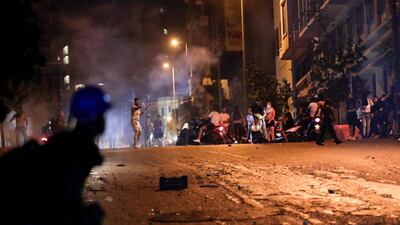
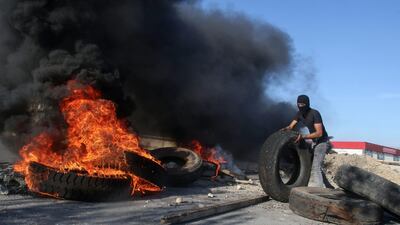
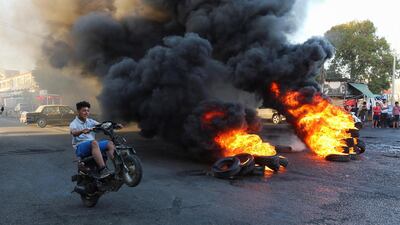
The economic crisis in Lebanon causes numerous power cuts across the country. Even in Beirut, in the capital, the inhabitants spend several hours a day without electricity. Hans Lucas

Power cuts increase in Lebanon as private generator owners strike


Sunniva Rose
  • English
  • Arabic

“Have you seen this?” asked Walid, a generator owner in Beirut, as he held up a plastic bottle in disbelief.

It was filled with two different liquids: yellow at the top, and transparent at the bottom.

“This is diesel mixed with water that I bought on the black market last week," Walid said. "It broke four of my filters."

Compounding Lebanon’s electricity problems, its local “mafia” of private generators owners went on strike for an hour on Tuesday.

They threatened to turn off all of the country’s generators next week for an entire day.

They are unhappy because the country’s economic crisis forces them to buy diesel, which is sometimes tainted, at inflated prices.

“I have spent as much money last month as I usually do in six months," Walid said. "I don’t know if I’ll be able to continue to operate."

He stood in the dark in his small basement office, regularly wiping his brow with a handkerchief because of the heat.

Walid said he had spent 2.4 million Lebanese pounds, or $315 at the black market rate, to repair the filters that were damaged by tainted diesel.

Lebanon’s state utility Electricite du Liban’s (EDL) output provides two hours of electricity a day on average in Beirut.

It has been unable to produce enough electricity to satisfy demand since the end of Lebanon’s 1975-1990 civil war.

EDL scheduled power cuts averaging three hours a day that became the norm in the capital before the financial crisis. They were as long as 12 hours in the countryside.

As the crisis worsened and in recent weeks as EDL cuts increased, private generator owners have stepped in to close the gap. They are technically illegal but operate freely.

“They are called a mafia because they divide neighbourhoods up like drug dealers,” said Nizar Hassan, a Lebanese political analyst.

"People don’t have the option to choose who they will subscribe with.

“Generator owners also impose much higher fees on people than they should and do not respect prices imposed by the energy ministry."

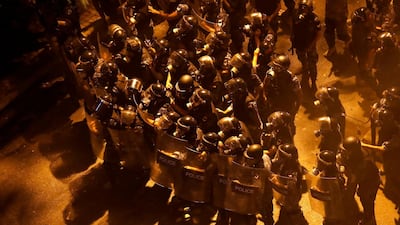
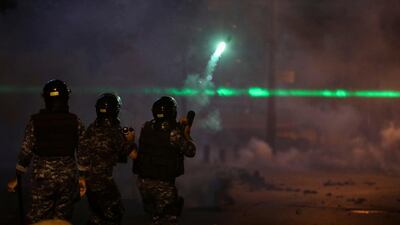
  • Riot police advance to push back demonstrators from a square near the government house in downtown Beirut, Lebanon. AP Photo
    Riot police advance to push back demonstrators from a square near the government house in downtown Beirut, Lebanon. AP Photo
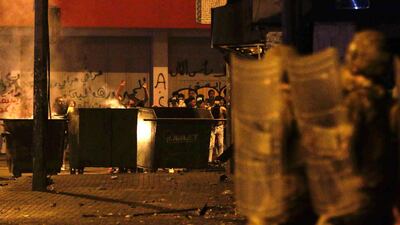
  • Lebanese security forces advance as anti-government protesters gather behind rubbish containers during a demonstration against dire economic conditions in the northern city of Tripoli. AFP
    Lebanese security forces advance as anti-government protesters gather behind rubbish containers during a demonstration against dire economic conditions in the northern city of Tripoli. AFP
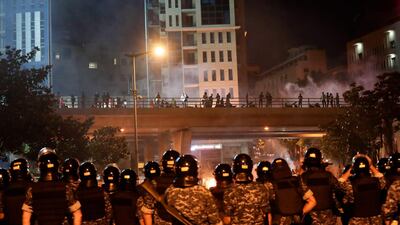
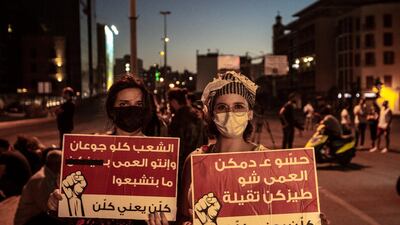
  • Anti-government protesters gather on the Fuad Shehab bridge, known as the Ring, as Lebanese security forces stand guard below, during a demonstration against dire economic conditions in the capital Beirut. AFP
    Anti-government protesters gather on the Fuad Shehab bridge, known as the Ring, as Lebanese security forces stand guard below, during a demonstration against dire economic conditions in the capital Beirut. AFP
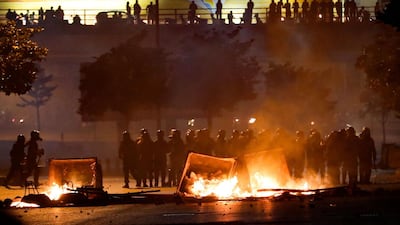
  • People watch from a bridge as Lebanese security forces gather behind rubbish containers set ablaze by anti-government protesters, during a demonstration against dire economic conditions in the downtown district of the capital Beirut. AFP
    People watch from a bridge as Lebanese security forces gather behind rubbish containers set ablaze by anti-government protesters, during a demonstration against dire economic conditions in the downtown district of the capital Beirut. AFP
  • Lebanese anti-government protesters clash with security forces during a demonstration against dire economic conditions in the capital Beirut. AFP
    Lebanese anti-government protesters clash with security forces during a demonstration against dire economic conditions in the capital Beirut. AFP
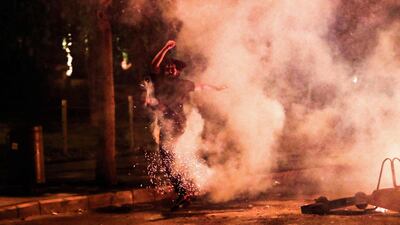
  • A Lebanese anti-government protester reacts as he runs in a cloud of smoke and sparks, during a demonstration against dire economic conditions in the downtown districtof the capital Beirut. AFP
    A Lebanese anti-government protester reacts as he runs in a cloud of smoke and sparks, during a demonstration against dire economic conditions in the downtown districtof the capital Beirut. AFP
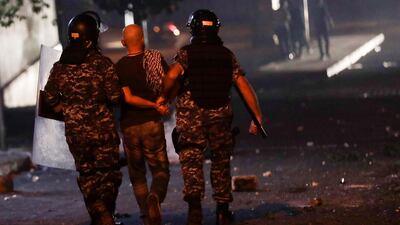
  • Lebanese security forces arrest a man during an anti-government demonstration against dire economic conditions in the downtown district of the capital Beirut. AFP
    Lebanese security forces arrest a man during an anti-government demonstration against dire economic conditions in the downtown district of the capital Beirut. AFP
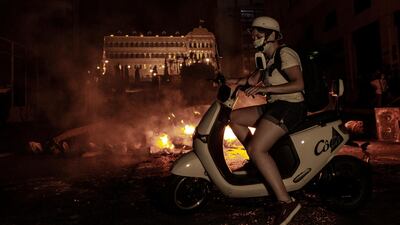
  • An Anti-government protester on her motorcycle returns where burn tires block the road near the government palace, during a protest against the economic condition, the collapsing Lebanese pound currency and and increasing prices in Beirut. EPA
    An Anti-government protester on her motorcycle returns where burn tires block the road near the government palace, during a protest against the economic condition, the collapsing Lebanese pound currency and and increasing prices in Beirut. EPA
  • A member of the Lebanese riot police fires tear gas towards demonstrators during a protest against the fall in pound currency and mounting economic hardship, in Beirut. Reuters
    A member of the Lebanese riot police fires tear gas towards demonstrators during a protest against the fall in pound currency and mounting economic hardship, in Beirut. Reuters
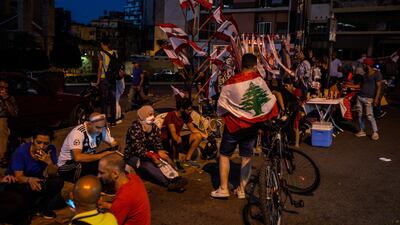
  • A man sells Lebanese flags, cold water and shisha, as anti-government protesters wait to reach the Rang area to start demonstrations in Beirut. EPA
    A man sells Lebanese flags, cold water and shisha, as anti-government protesters wait to reach the Rang area to start demonstrations in Beirut. EPA
  • Anti-government protesters gather as they try to block tabarize highway during a protest against the economic condition, the collapsing Lebanese pound currency and increasing prices in Beirut. EPA
    Anti-government protesters gather as they try to block tabarize highway during a protest against the economic condition, the collapsing Lebanese pound currency and increasing prices in Beirut. EPA
  • Anti-government protesters gather as they try to block tabarize highway during a protest against the economic condition, the collapsing Lebanese pound currency and increasing prices in Beirut. EPA
    Anti-government protesters gather as they try to block tabarize highway during a protest against the economic condition, the collapsing Lebanese pound currency and increasing prices in Beirut. EPA
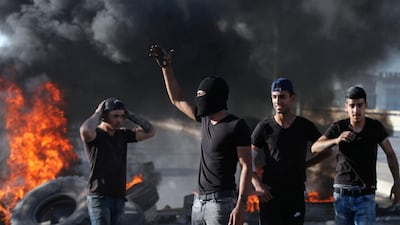
  • Lebanese protesters block a bridge with flaming tyres on the Sidon-Ghazieh highway amid demonstrations which erupted after the sharp drop of the Lebanese pound on the black market, in the southern coastal town of Ghazieh. AFP
    Lebanese protesters block a bridge with flaming tyres on the Sidon-Ghazieh highway amid demonstrations which erupted after the sharp drop of the Lebanese pound on the black market, in the southern coastal town of Ghazieh. AFP
  • A Lebanese protester takes part in blocking a bridge with flaming tyres on the Sidon-Ghazieh highway amid demonstrations which erupted after the sharp drop of the Lebanese pound on the black market, in Ghazieh. AFP
    A Lebanese protester takes part in blocking a bridge with flaming tyres on the Sidon-Ghazieh highway amid demonstrations which erupted after the sharp drop of the Lebanese pound on the black market, in Ghazieh. AFP
  • A young man boy rides his motorbike near burning tires during a sit-in protest against the fall in pound currency and mounting economic hardship, in Ghazieh. Reuters
    A young man boy rides his motorbike near burning tires during a sit-in protest against the fall in pound currency and mounting economic hardship, in Ghazieh. Reuters

A campaign led by former Energy Minister Raed Khoury in 2018 forced a significant number of generator owners to stop imposing flat fees and to install meters, bringing prices down.

But in these past weeks, Lebanon has struggled to import enough fuel for EDL’s power plants to function or to satisfy private generators’ demand.

As the small country is suffering a severe economic crisis, all imports are delayed and a corruption scandal in the fuel sector temporarily halted imports from Algeria last March.

As a result, electricity cuts have increased across Lebanon to more than 20 hours a day, and generator owners are running out of diesel.

In some neighbourhoods of Beirut, they turn generators off for several hours a day, most often at night.

Electricity output has become so unsteady that it is reportedly damaging electrical appliances, from fridges to laptops.

Fuel and diesel imports are partly subsidised by the central bank, which guarantees importers 85 per cent of their needs in US dollars at the official exchange rate of 1507.5 Lebanese pounds.

They buy the rest on the black market, where the local currency has lost 80 per cent of its value since banks restricted access to dollars in November.

On Monday, generator owners protested outside the energy ministry in Beirut with two demands: fair pricing and access to diesel imported by Lebanon’s official importers.

Generator owners accuse them of selling to third parties who raise the prices.

“We came here to ask for mazout [fuel] to be able to provide light to you, to citizens” a generator owner told local television network MTV.

“Tomorrow, there might be no more light in Lebanon,” another said.

Generator owners said they would continue to strike and warned that they would turn all generators off on August 5 if their demands were not met.

On Tuesday afternoon, local media reported that they dropped the threat after the intervention of Abbas Ibrahim, the head of one of Lebanon’s most powerful security services, General Security.

Walid said that General Security fined one of his colleagues five million Lebanese pounds last year for joining a strike at the time.

"They want to make us afraid to strike," he said.

Neither Energy Minister Raymond Ghajar nor the head of the union of generator owners were available for comment.

One fuel importer said most generator owners used to work with oil installations and some importing companies, or through middle men.

Oil installations and most importing companies have reduced their imports because of the economic crisis, and middlemen are raising their prices.

"They sell 20 litres of diesel for up to 34,000 Lebanese pounds instead of the usual 16,000," he told The National. "They are profiting from the situation."

The only way importers could sell diesel directly to private generator owners would be to cut down on their sales to other customers.

These include malls, hospitals, supermarkets, restaurants, factories and banks that run their own generators separately, the source said.

“We must increase the imports to satisfy the high demand,” he said.

But there is little chance that this will happen soon.

On Tuesday, Prime Minister Hassan Diab criticised French Foreign Minister Jean-Yves Le Drian, who last week repeated that the international community would not help financially unless the country introduced reforms to fight corruption and increase transparency.

Mr Le Drian, who visited Lebanon for two days last week, did not know enough about “the government’s reform journey", Mr Diab said.

He also claimed that Lebanon had enough fuel for six months.

NATIONAL%20SELECTIONS
%3Cp%3E6.00pm%3A%20Heros%20de%20Lagarde%3Cbr%3E6.35pm%3A%20City%20Walk%3Cbr%3E7.10pm%3A%20Mimi%20Kakushi%3Cbr%3E7.45pm%3A%20New%20Kingdom%3Cbr%3E8.20pm%3A%20Siskany%3Cbr%3E8.55pm%3A%20Nations%20Pride%3Cbr%3E9.30pm%3A%20Ever%20Given%3C%2Fp%3E%0A
The Brutalist

Director: Brady Corbet

Stars: Adrien Brody, Felicity Jones, Guy Pearce, Joe Alwyn

Rating: 3.5/5

David Haye record

Total fights: 32
Wins: 28
Wins by KO: 26
Losses: 4

Three ways to get a gratitude glow

By committing to at least one of these daily, you can bring more gratitude into your life, says Ong.

  • During your morning skincare routine, name five things you are thankful for about yourself.
  • As you finish your skincare routine, look yourself in the eye and speak an affirmation, such as: “I am grateful for every part of me, including my ability to take care of my skin.”
  • In the evening, take some deep breaths, notice how your skin feels, and listen for what your skin is grateful for.

Mercer, the investment consulting arm of US services company Marsh & McLennan, expects its wealth division to at least double its assets under management (AUM) in the Middle East as wealth in the region continues to grow despite economic headwinds, a company official said.

Mercer Wealth, which globally has $160 billion in AUM, plans to boost its AUM in the region to $2-$3bn in the next 2-3 years from the present $1bn, said Yasir AbuShaban, a Dubai-based principal with Mercer Wealth.

Within the next two to three years, we are looking at reaching $2 to $3 billion as a conservative estimate and we do see an opportunity to do so,” said Mr AbuShaban.

Mercer does not directly make investments, but allocates clients’ money they have discretion to, to professional asset managers. They also provide advice to clients.

“We have buying power. We can negotiate on their (client’s) behalf with asset managers to provide them lower fees than they otherwise would have to get on their own,” he added.

Mercer Wealth’s clients include sovereign wealth funds, family offices, and insurance companies among others.

From its office in Dubai, Mercer also looks after Africa, India and Turkey, where they also see opportunity for growth.

Wealth creation in Middle East and Africa (MEA) grew 8.5 per cent to $8.1 trillion last year from $7.5tn in 2015, higher than last year’s global average of 6 per cent and the second-highest growth in a region after Asia-Pacific which grew 9.9 per cent, according to consultancy Boston Consulting Group (BCG). In the region, where wealth grew just 1.9 per cent in 2015 compared with 2014, a pickup in oil prices has helped in wealth generation.

BCG is forecasting MEA wealth will rise to $12tn by 2021, growing at an annual average of 8 per cent.

Drivers of wealth generation in the region will be split evenly between new wealth creation and growth of performance of existing assets, according to BCG.

Another general trend in the region is clients’ looking for a comprehensive approach to investing, according to Mr AbuShaban.

“Institutional investors or some of the families are seeing a slowdown in the available capital they have to invest and in that sense they are looking at optimizing the way they manage their portfolios and making sure they are not investing haphazardly and different parts of their investment are working together,” said Mr AbuShaban.

Some clients also have a higher appetite for risk, given the low interest-rate environment that does not provide enough yield for some institutional investors. These clients are keen to invest in illiquid assets, such as private equity and infrastructure.

“What we have seen is a desire for higher returns in what has been a low-return environment specifically in various fixed income or bonds,” he said.

“In this environment, we have seen a de facto increase in the risk that clients are taking in things like illiquid investments, private equity investments, infrastructure and private debt, those kind of investments were higher illiquidity results in incrementally higher returns.”

The Abu Dhabi Investment Authority, one of the largest sovereign wealth funds, said in its 2016 report that has gradually increased its exposure in direct private equity and private credit transactions, mainly in Asian markets and especially in China and India. The authority’s private equity department focused on structured equities owing to “their defensive characteristics.”

The Sheikh Zayed Future Energy Prize

This year’s winners of the US$4 million Sheikh Zayed Future Energy Prize will be recognised and rewarded in Abu Dhabi on January 15 as part of Abu Dhabi Sustainable Week, which runs in the capital from January 13 to 20.

From solutions to life-changing technologies, the aim is to discover innovative breakthroughs to create a new and sustainable energy future.

WITHIN%20SAND
%3Cp%3EDirector%3A%20Moe%20Alatawi%3C%2Fp%3E%0A%3Cp%3EStarring%3A%20Ra%E2%80%99ed%20Alshammari%2C%20Adwa%20Fahd%2C%20Muhand%20Alsaleh%3C%2Fp%3E%0A%3Cp%3ERating%3A%203%2F5%3C%2Fp%3E%0A
The schedule

December 5 - 23: Shooting competition, Al Dhafra Shooting Club

December 9 - 24: Handicrafts competition, from 4pm until 10pm, Heritage Souq

December 11 - 20: Dates competition, from 4pm

December 12 - 20: Sour milk competition

December 13: Falcon beauty competition

December 14 and 20: Saluki races

December 15: Arabian horse races, from 4pm

December 16 - 19: Falconry competition

December 18: Camel milk competition, from 7.30 - 9.30 am

December 20 and 21: Sheep beauty competition, from 10am

December 22: The best herd of 30 camels

Indoor cricket in a nutshell

Indoor Cricket World Cup - Sep 16-20, Insportz, Dubai

16 Indoor cricket matches are 16 overs per side

8 There are eight players per team

There have been nine Indoor Cricket World Cups for men. Australia have won every one.

5 Five runs are deducted from the score when a wickets falls

Batsmen bat in pairs, facing four overs per partnership

Scoring In indoor cricket, runs are scored by way of both physical and bonus runs. Physical runs are scored by both batsmen completing a run from one crease to the other. Bonus runs are scored when the ball hits a net in different zones, but only when at least one physical run is score.

Zones

A Front net, behind the striker and wicketkeeper: 0 runs

B Side nets, between the striker and halfway down the pitch: 1 run

Side nets between halfway and the bowlers end: 2 runs

Back net: 4 runs on the bounce, 6 runs on the full

Indoor cricket in a nutshell

Indoor Cricket World Cup - Sep 16-20, Insportz, Dubai

16 Indoor cricket matches are 16 overs per side

8 There are eight players per team

There have been nine Indoor Cricket World Cups for men. Australia have won every one.

5 Five runs are deducted from the score when a wickets falls

Batsmen bat in pairs, facing four overs per partnership

Scoring In indoor cricket, runs are scored by way of both physical and bonus runs. Physical runs are scored by both batsmen completing a run from one crease to the other. Bonus runs are scored when the ball hits a net in different zones, but only when at least one physical run is score.

Zones

A Front net, behind the striker and wicketkeeper: 0 runs

B Side nets, between the striker and halfway down the pitch: 1 run

Side nets between halfway and the bowlers end: 2 runs

Back net: 4 runs on the bounce, 6 runs on the full

Company%20Profile
%3Cp%3E%3Cstrong%3EName%3A%20%3C%2Fstrong%3ENadeera%3Cbr%3E%3Cstrong%3EBased%3A%3C%2Fstrong%3E%20Abu%20Dhabi%2C%20UAE%3Cbr%3E%3Cstrong%3EFounders%3A%20%3C%2Fstrong%3ERabih%20El%20Chaar%20and%20Reem%20Khattar%3Cbr%3E%3Cstrong%3ESector%3A%20%3C%2Fstrong%3ECleanTech%3Cbr%3E%3Cstrong%3ETotal%20funding%3A%3C%2Fstrong%3E%20About%20%241%20million%3Cbr%3E%3Cstrong%3EInvestors%3A%20%3C%2Fstrong%3EHope%20Ventures%2C%20Rasameel%20Investments%20and%20support%20from%20accelerator%20programmes%20%3Cbr%3E%3Cstrong%3ENumber%20of%20employees%3A%3C%2Fstrong%3E%2012%3C%2Fp%3E%0A
RESULTS

Bantamweight: Victor Nunes (BRA) beat Azizbek Satibaldiev (KYG). Round 1 KO

Featherweight: Izzeddin Farhan (JOR) beat Ozodbek Azimov (UZB). Round 1 rear naked choke

Middleweight: Zaakir Badat (RSA) beat Ercin Sirin (TUR). Round 1 triangle choke

Featherweight: Ali Alqaisi (JOR) beat Furkatbek Yokubov (UZB). Round 1 TKO

Featherweight: Abu Muslim Alikhanov (RUS) beat Atabek Abdimitalipov (KYG). Unanimous decision

Catchweight 74kg: Mirafzal Akhtamov (UZB) beat Marcos Costa (BRA). Split decision

Welterweight: Andre Fialho (POR) beat Sang Hoon-yu (KOR). Round 1 TKO

Lightweight: John Mitchell (IRE) beat Arbi Emiev (RUS). Round 2 RSC (deep cuts)

Middleweight: Gianni Melillo (ITA) beat Mohammed Karaki (LEB)

Welterweight: Handesson Ferreira (BRA) beat Amiran Gogoladze (GEO). Unanimous decision

Flyweight (Female): Carolina Jimenez (VEN) beat Lucrezia Ria (ITA), Round 1 rear naked choke

Welterweight: Daniel Skibinski (POL) beat Acoidan Duque (ESP). Round 3 TKO

Lightweight: Martun Mezhlumyan (ARM) beat Attila Korkmaz (TUR). Unanimous decision

Bantamweight: Ray Borg (USA) beat Jesse Arnett (CAN). Unanimous decision

Our legal consultants

Name: Hassan Mohsen Elhais

Position: legal consultant with Al Rowaad Advocates and Legal Consultants.

MOUNTAINHEAD REVIEW

Starring: Ramy Youssef, Steve Carell, Jason Schwartzman

Director: Jesse Armstrong

Rating: 3.5/5

The specs

Engine: 2.0-litre 4-cylinder turbo

Power: 240hp at 5,500rpm

Torque: 390Nm at 3,000rpm

Transmission: eight-speed auto

Price: from Dh122,745

On sale: now

Race 3

Produced: Salman Khan Films and Tips Films
Director: Remo D’Souza
Cast: Salman Khan, Anil Kapoor, Jacqueline Fernandez, Bobby Deol, Daisy Shah, Saqib Salem
Rating: 2.5 stars