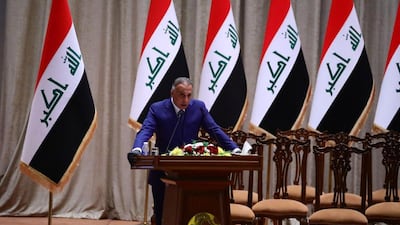
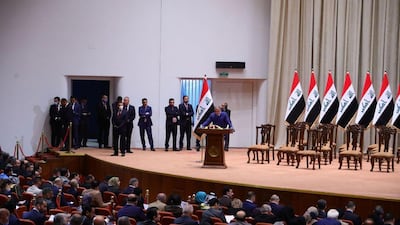
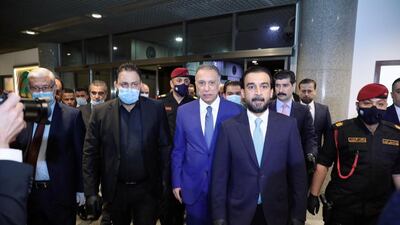
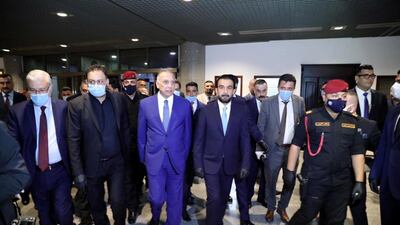
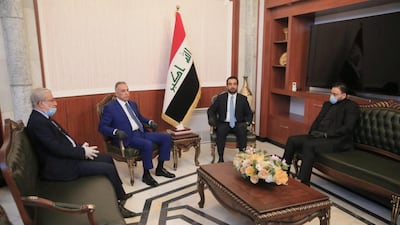
It was a bold opening gambit from new Iraqi Prime Minister Mustafa Al Kadhimi. On the night of May 10, protesters gathered outside the offices of a little known militia organisation in Basra, Thar Allah.
When they were met with live fire, it seemed a typically brutal response from Iraq’s numerous Iran-backed militias, whom many hold responsible for killing hundreds of protesters.
What happened next surprised observers: Thar Allah’s offices were raided by security forces, although their leader, Youssef Al Musawi, was not present at the scene of the raid. Mr Al Kadhimi later tweeted that the raid had been executed on his personal orders and that “those who spill Iraqi blood will not rest.”
The new PM has promised to re-establish rule of law. This means reining in powerful elements of Iraq’s Popular Mobilisation Forces (PMF), some of which are linked to Iran.
For now, the new policy could have some momentum following developments in recent weeks. PMF groups linked to Iraq’s religious authorities (sometimes called the Shrine PMF) have voluntarily moved towards stronger government control.
Meanwhile, Iran-backed groups such as the notorious Kataib Hezbollah continue to violate Article 9 of Iraq’s Constitution, which outlaws political activity in the armed forces and mandates strong civilian control of the military.
So does the Thar Allah raid mark a new era? The most important point to consider is that Thar Allah is not within the PMF and nowhere near as strong as Kataib Hezbollah. They have no direct connection to the Iraqi government but share the outlook of the late Abu Mahdi Al Muhandis, the Iran-backed militia leader killed in a US drone strike on January 3.
According to PMF expert Inna Rudolf, the new Iraqi premier’s order for the raid could be, “a signal meant to discourage outsourcing of resistance activities, which would allow to keep the PMF statist and neat while others play spearhead and convey certain messages.”
The raid could therefore represent a warning to other, smaller militias, giving the PM some leverage by creating uncertainty surrounding the fate of those who do not follow government orders.
A fringe movement
Once a typical Iran-proxy, Thar Allah emerged from an array of exiled anti-Saddam Hussein opposition groups in Iran, such as the Badr Organisation, Iran’s oldest proxy in the country, and the Islamic Supreme Council of Iraq (ISCI). Thar Allah ran with ISCI an election coalition in 2005, when ISCI was known as the Supreme Council for Islamic Revolution in Iraq.
After the US invasion in 2003, the group benefited from Iran’s early policy in Iraq of “betting on all the horses”. A 2005 leaked US army report mentions the group as being involved in the assassination of Sunnis in Basra, part of Iran’s ruthless strategy at the time to cement hegemonic control in Iraq’s south and wipe out any trace of their former foes, the Iraqi Baath party.
British soldiers reported in December 2003 finding a Thar Allah “torture chamber” in Basra.
Unsurprisingly, the group’s brutal tactics fanned the flames of civil war. This situation wasn’t helped by the fact that the British army initially thought the group was merely a local extremist organisation amid a much larger insurgency.
As late as 2007, Thar Allah received Iranian financial support, according to leaked State Department cables, alongside groups such as the now defunct Jaish Al Mahdi, followers of populist cleric Moqtada Al Sadr. By then, Basra was crumbling amid an array of rival militias, running mafioso style operations.
As the occupying British army lost control of southern Iraq, Thar Allah became embroiled in a vicious feud with the rival Shia Fadhila Party. Much was at stake, from controlling extortion rackets to oil smuggling.
In a desperate attempt to bring rival factions together, the Iraqi government and the British army agreed to have Al Musawi on a newly formed Basra Security Committee, despite his involvement in death squads.
Unsurprisingly, the effort quickly fell apart, but it is strangely absent from the official British inquiry into the Iraq war, the 6,000 page Chilcot Report. The report does however mention the failed Security Committee, described at the time by British Major General Sir Richard Shirreff as "no longer fit for purpose."
It is around this time that the group appears to have over-reached, probably because Iran had become wary of seeing its proxies clash, undoing Tehran’s project of political hegemony in Iraq.
As former PM Nouri Al Maliki, himself a Shiite, sent Iraqi forces to retake Basra from the Jaish Al Mahdi in 2008, Youssef Al Musawi fled to Iran where he reportedly remained until 2014, when the PMF formed to fight ISIS. Little is known about his time there.
As pro-Iran militias mobilised for war, Iranian support was not forthcoming for Thar Allah, which was absent from the major battles with ISIS.
This led Al Musawi to remould himself as a modern, clean cut politician, cultivating an image more like an accountant than a warlord. His Facebook page shows glossy campaign material but the posts are very much on message with Iranian propaganda, blaming the US for protests across Iraq.
Al Musawi also appears to have tried to rebuild political connections, praising former Islamic Supreme Council of Iraq leader Ammar Al Hakim on the founding of his breakaway Al Hikma party. But these efforts were to no avail.
Cut off from political support, Thar Allah had become an easy target for the new government. The question now remains, is this a new era for rule of law in Iraq, as Mr Al Kadhimi promised, or a symbolic move that may not deter groups such as Kataib Hezbollah? Only time will tell.

Mercer, the investment consulting arm of US services company Marsh & McLennan, expects its wealth division to at least double its assets under management (AUM) in the Middle East as wealth in the region continues to grow despite economic headwinds, a company official said.
Mercer Wealth, which globally has $160 billion in AUM, plans to boost its AUM in the region to $2-$3bn in the next 2-3 years from the present $1bn, said Yasir AbuShaban, a Dubai-based principal with Mercer Wealth.
“Within the next two to three years, we are looking at reaching $2 to $3 billion as a conservative estimate and we do see an opportunity to do so,” said Mr AbuShaban.
Mercer does not directly make investments, but allocates clients’ money they have discretion to, to professional asset managers. They also provide advice to clients.
“We have buying power. We can negotiate on their (client’s) behalf with asset managers to provide them lower fees than they otherwise would have to get on their own,” he added.
Mercer Wealth’s clients include sovereign wealth funds, family offices, and insurance companies among others.
From its office in Dubai, Mercer also looks after Africa, India and Turkey, where they also see opportunity for growth.
Wealth creation in Middle East and Africa (MEA) grew 8.5 per cent to $8.1 trillion last year from $7.5tn in 2015, higher than last year’s global average of 6 per cent and the second-highest growth in a region after Asia-Pacific which grew 9.9 per cent, according to consultancy Boston Consulting Group (BCG). In the region, where wealth grew just 1.9 per cent in 2015 compared with 2014, a pickup in oil prices has helped in wealth generation.
BCG is forecasting MEA wealth will rise to $12tn by 2021, growing at an annual average of 8 per cent.
Drivers of wealth generation in the region will be split evenly between new wealth creation and growth of performance of existing assets, according to BCG.
Another general trend in the region is clients’ looking for a comprehensive approach to investing, according to Mr AbuShaban.
“Institutional investors or some of the families are seeing a slowdown in the available capital they have to invest and in that sense they are looking at optimizing the way they manage their portfolios and making sure they are not investing haphazardly and different parts of their investment are working together,” said Mr AbuShaban.
Some clients also have a higher appetite for risk, given the low interest-rate environment that does not provide enough yield for some institutional investors. These clients are keen to invest in illiquid assets, such as private equity and infrastructure.
“What we have seen is a desire for higher returns in what has been a low-return environment specifically in various fixed income or bonds,” he said.
“In this environment, we have seen a de facto increase in the risk that clients are taking in things like illiquid investments, private equity investments, infrastructure and private debt, those kind of investments were higher illiquidity results in incrementally higher returns.”
The Abu Dhabi Investment Authority, one of the largest sovereign wealth funds, said in its 2016 report that has gradually increased its exposure in direct private equity and private credit transactions, mainly in Asian markets and especially in China and India. The authority’s private equity department focused on structured equities owing to “their defensive characteristics.”
Museum of the Future in numbers
- 78 metres is the height of the museum
- 30,000 square metres is its total area
- 17,000 square metres is the length of the stainless steel facade
- 14 kilometres is the length of LED lights used on the facade
- 1,024 individual pieces make up the exterior
- 7 floors in all, with one for administrative offices
- 2,400 diagonally intersecting steel members frame the torus shape
- 100 species of trees and plants dot the gardens
- Dh145 is the price of a ticket
PRIMERA LIGA FIXTURES
All times UAE ( 4 GMT)
Saturday
Atletico Madrid v Sevilla (3pm)
Alaves v Real Madrid (6.15pm)
Malaga v Athletic Bilbao (8.30pm)
Girona v Barcelona (10.45pm)
Sunday
Espanyol v Deportivo la Coruna (2pm)
Getafe v Villarreal (6.15pm)
Eibar v Celta Vigo (8.30pm)
Las Palmas v Leganes (8.30pm)
Real Sociedad v Valencia (10.45pm)
Monday
Real Betis v Levante (11.pm)
UAE currency: the story behind the money in your pockets
MATCH INFO
Uefa Champions League semi-final, first leg
Tottenham 0-1 Ajax, Tuesday
Second leg
Ajax v Tottenham, Wednesday, May 8, 11pm
Game is on BeIN Sports
The more serious side of specialty coffee
While the taste of beans and freshness of roast is paramount to the specialty coffee scene, so is sustainability and workers’ rights.
The bulk of genuine specialty coffee companies aim to improve on these elements in every stage of production via direct relationships with farmers. For instance, Mokha 1450 on Al Wasl Road strives to work predominantly with women-owned and -operated coffee organisations, including female farmers in the Sabree mountains of Yemen.
Because, as the boutique’s owner, Garfield Kerr, points out: “women represent over 90 per cent of the coffee value chain, but are woefully underrepresented in less than 10 per cent of ownership and management throughout the global coffee industry.”
One of the UAE’s largest suppliers of green (meaning not-yet-roasted) beans, Raw Coffee, is a founding member of the Partnership of Gender Equity, which aims to empower female coffee farmers and harvesters.
Also, globally, many companies have found the perfect way to recycle old coffee grounds: they create the perfect fertile soil in which to grow mushrooms.
Generational responses to the pandemic
Devesh Mamtani from Century Financial believes the cash-hoarding tendency of each generation is influenced by what stage of the employment cycle they are in. He offers the following insights:
Baby boomers (those born before 1964): Owing to market uncertainty and the need to survive amid competition, many in this generation are looking for options to hoard more cash and increase their overall savings/investments towards risk-free assets.
Generation X (born between 1965 and 1980): Gen X is currently in its prime working years. With their personal and family finances taking a hit, Generation X is looking at multiple options, including taking out short-term loan facilities with competitive interest rates instead of dipping into their savings account.
Millennials (born between 1981 and 1996): This market situation is giving them a valuable lesson about investing early. Many millennials who had previously not saved or invested are looking to start doing so now.
SPECS
%3Cp%3E%3Cstrong%3EEngine%3A%20%3C%2Fstrong%3E2.4-litre%204-cylinder%20turbo%20hybrid%0D%3Cbr%3E%3Cstrong%3EPower%3A%3C%2Fstrong%3E%20366hp%0D%3Cbr%3E%3Cstrong%3ETorque%3A%20%3C%2Fstrong%3E550Nm%0D%3Cbr%3E%3Cstrong%3ETransmission%3A%20%3C%2Fstrong%3ESix-speed%20auto%0D%3Cbr%3E%3Cstrong%3EPrice%3A%3C%2Fstrong%3E%20From%20Dh360%2C000%0D%3Cbr%3E%3Cstrong%3EAvailable%3A%20%3C%2Fstrong%3ENow%0D%3C%2Fp%3E%0A
Key facilities
- Olympic-size swimming pool with a split bulkhead for multi-use configurations, including water polo and 50m/25m training lanes
- Premier League-standard football pitch
- 400m Olympic running track
- NBA-spec basketball court with auditorium
- 600-seat auditorium
- Spaces for historical and cultural exploration
- An elevated football field that doubles as a helipad
- Specialist robotics and science laboratories
- AR and VR-enabled learning centres
- Disruption Lab and Research Centre for developing entrepreneurial skills
Teaching your child to save
Pre-school (three - five years)
You can’t yet talk about investing or borrowing, but introduce a “classic” money bank and start putting gifts and allowances away. When the child wants a specific toy, have them save for it and help them track their progress.
Early childhood (six - eight years)
Replace the money bank with three jars labelled ‘saving’, ‘spending’ and ‘sharing’. Have the child divide their allowance into the three jars each week and explain their choices in splitting their pocket money. A guide could be 25 per cent saving, 50 per cent spending, 25 per cent for charity and gift-giving.
Middle childhood (nine - 11 years)
Open a bank savings account and help your child establish a budget and set a savings goal. Introduce the notion of ‘paying yourself first’ by putting away savings as soon as your allowance is paid.
Young teens (12 - 14 years)
Change your child’s allowance from weekly to monthly and help them pinpoint long-range goals such as a trip, so they can start longer-term saving and find new ways to increase their saving.
Teenage (15 - 18 years)
Discuss mutual expectations about university costs and identify what they can help fund and set goals. Don’t pay for everything, so they can experience the pride of contributing.
Young adulthood (19 - 22 years)
Discuss post-graduation plans and future life goals, quantify expenses such as first apartment, work wardrobe, holidays and help them continue to save towards these goals.
* JP Morgan Private Bank
Desert Warrior
Starring: Anthony Mackie, Aiysha Hart, Ben Kingsley
Director: Rupert Wyatt
Rating: 3/5
Going grey? A stylist's advice
If you’re going to go grey, a great style, well-cared for hair (in a sleek, classy style, like a bob), and a young spirit and attitude go a long way, says Maria Dowling, founder of the Maria Dowling Salon in Dubai.
It’s easier to go grey from a lighter colour, so you may want to do that first. And this is the time to try a shorter style, she advises. Then a stylist can introduce highlights, start lightening up the roots, and let it fade out. Once it’s entirely grey, a purple shampoo will prevent yellowing.
“Get professional help – there’s no other way to go around it,” she says. “And don’t just let it grow out because that looks really bad. Put effort into it: properly condition, straighten, get regular trims, make sure it’s glossy.”
DC%20League%20of%20Super-Pets
%3Cp%3EDirector%3A%20Jared%20Stern%3C%2Fp%3E%0A%3Cp%3EStarring%3A%20Dwayne%20Johnson%2C%20Kevin%20Hart%2C%20John%20Krasinski%2C%20Keanu%20Reeves%2C%20Olivia%20Wilde%2C%20Kate%20McKinnon%2C%20Jameela%20Jamil%3C%2Fp%3E%0A%3Cp%3ERating%3A%203%2F5%3C%2Fp%3E%0A
In-demand jobs and monthly salaries
- Technology expert in robotics and automation: Dh20,000 to Dh40,000
- Energy engineer: Dh25,000 to Dh30,000
- Production engineer: Dh30,000 to Dh40,000
- Data-driven supply chain management professional: Dh30,000 to Dh50,000
- HR leader: Dh40,000 to Dh60,000
- Engineering leader: Dh30,000 to Dh55,000
- Project manager: Dh55,000 to Dh65,000
- Senior reservoir engineer: Dh40,000 to Dh55,000
- Senior drilling engineer: Dh38,000 to Dh46,000
- Senior process engineer: Dh28,000 to Dh38,000
- Senior maintenance engineer: Dh22,000 to Dh34,000
- Field engineer: Dh6,500 to Dh7,500
- Field supervisor: Dh9,000 to Dh12,000
- Field operator: Dh5,000 to Dh7,000
The distance learning plan
Spring break will be from March 8 - 19
Public school pupils will undergo distance learning from March 22 - April 2. School hours will be 8.30am to 1.30pm
Staff will be trained in distance learning programmes from March 15 - 19
Teaching hours will be 8am to 2pm during distance learning
Pupils will return to school for normal lessons from April 5
ZIMBABWE V UAE, ODI SERIES
All matches at the Harare Sports Club:
1st ODI, Wednesday - Zimbabwe won by 7 wickets
2nd ODI, Friday, April 12
3rd ODI, Sunday, April 14
4th ODI, Tuesday, April 16
UAE squad: Mohammed Naveed (captain), Rohan Mustafa, Ashfaq Ahmed, Shaiman Anwar, Mohammed Usman, CP Rizwan, Chirag Suri, Mohammed Boota, Ghulam Shabber, Sultan Ahmed, Imran Haider, Amir Hayat, Zahoor Khan, Qadeer Ahmed
How to wear a kandura
Dos
- Wear the right fabric for the right season and occasion
- Always ask for the dress code if you don’t know
- Wear a white kandura, white ghutra / shemagh (headwear) and black shoes for work
- Wear 100 per cent cotton under the kandura as most fabrics are polyester
Don’ts
- Wear hamdania for work, always wear a ghutra and agal
- Buy a kandura only based on how it feels; ask questions about the fabric and understand what you are buying