Turkey fuels new eastern Mediterranean tensions after research vessel redeployed


Jamie Prentis
  • English
  • Arabic

Turkey’s redeployment of a research vessel to the eastern Mediterranean will cause new tensions in the region, the European Union warned on Monday, after Greece accused Ankara of lacking credibility in talks over disputed maritime boundaries.

EU foreign affairs chief Josep Borrell said the return of the Oruc Reiss to conduct seismic studies was "regrettable".

“This will lead to new tensions instead of contributing to the de-escalation efforts that we were calling for at the last European Union Council,” he said, after meeting with EU foreign ministers in Luxembourg.

While there was no suggestion of sanctions being discussed on Monday, Brussels has previously said it would punish Turkey if it continued its operations in the region, which have angered Greece and Cyprus in particular.

European Commission President Ursula von der Leyen warned Turkey earlier this month against taking provocative measures and said the EU would "use all its instruments and options available" if Turkish unilateral actions did not cease.

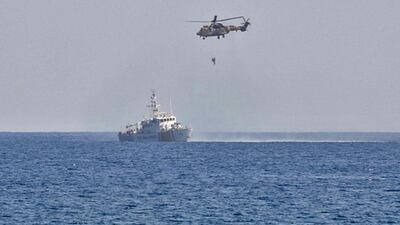
  • A soldier hangs from a helicopter during a military exercise in the self-proclaimed Turkish Republic of Northern Cyprus. AFP
    A soldier hangs from a helicopter during a military exercise in the self-proclaimed Turkish Republic of Northern Cyprus. AFP
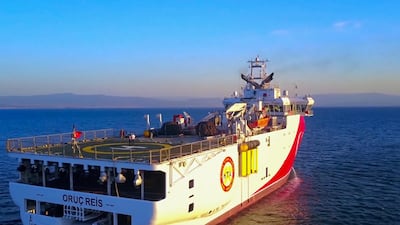
  • Turkey's research vessel, Oruc Reis, center, is surrounded by Turkish navy vessels as it was heading in the west of Antalya on the Mediterranean, Turkey. AP
    Turkey's research vessel, Oruc Reis, center, is surrounded by Turkish navy vessels as it was heading in the west of Antalya on the Mediterranean, Turkey. AP
  • Turkish seismic research vessel 'Oruc Reis' heads in the west of Antalya on the Mediterranean Sea.AFP
    Turkish seismic research vessel 'Oruc Reis' heads in the west of Antalya on the Mediterranean Sea.AFP
  • A Turkish Navy warship patroling next to Turkey's drilling ship "Fatih" dispatched towards the eastern Mediterranean near Cyprus. AFP
    A Turkish Navy warship patroling next to Turkey's drilling ship "Fatih" dispatched towards the eastern Mediterranean near Cyprus. AFP
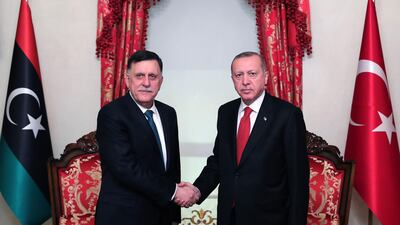
  • Turkish President Recep Tayyip Erdogan shakes hands with Fayez al-Sarraj, the head of the Tripoli-based Government of National Accord , during their meeting in Istanbul. Turkey signed a military deal late on November 27, 2019, with Libya's UN-recognised government following a meeting with Turkish President in Istanbul, his office said. AFP
    Turkish President Recep Tayyip Erdogan shakes hands with Fayez al-Sarraj, the head of the Tripoli-based Government of National Accord , during their meeting in Istanbul. Turkey signed a military deal late on November 27, 2019, with Libya's UN-recognised government following a meeting with Turkish President in Istanbul, his office said. AFP

Ankara withdrew the vessel last month to allow for talks to resume with Athens over the contested boundaries before an EU summit at which Cyprus had pushed for sanctions on Turkey.

But on Monday, Turkey issued a maritime advisory that the Oruc Reis would be dispatched back to the region, leading to a stinging rebuke from Greece only days after the two countries' foreign ministers met in Slovakia in a sign that tensions could have been easing.

Turkey insists it is operating within its continental shelf and has rejected Greece’s objections. France, which has been particularly critical of Ankara, said Turkey must abstain from new provocations “and show concrete evidence of good faith”.

Greek Prime Minister Kyriakos Mitsotakis said the “new unilateral act is a severe escalation on Turkey’s part”.

Greece’s foreign ministry also accused Turkey of lacking credibility and said it had proven itself to be unreliable in prospective talks over the dispute.

It said the planned return of the Oruc Reis constituted "a major escalation and direct threat to peace and security in the region".

It accused Turkey of undermining dialogue, ignoring international law and stoking tensions in the region by initiating surveys only 6.5 nautical miles from Greece’s continental shelf, south of the island of Kastelorizo.

“Just a few days after the meeting between the Ministers of Foreign Affairs of Greece and Turkey, during which the Turkish side committed to proposing a date for the exploratory talks, Turkey’s unreliability and the fact that it does not sincerely desire dialogue have once again become evident,” the Greek foreign ministry said.

“Turkey is persisting with the use of aggressive and illegal tactics of past centuries, thus confirming its role as the prime factor for instability and violation of international legality in the region.”

Greek government spokesman Stelios Petsas said the move showed that Turkey “lacks credibility”.

Turkish Energy Minister Fatih Donmez wrote on Twitter that the Oruc Reis had weighed anchor after undergoing maintenance.

"We will continue to explore, dig and protect our rights," he wrote.

Turkish Defence Minister Hulusi Akar said Turkey's navy would provide protection and support if necessary.

The standoff comes at a particularly tense time as Turkish-backed northern Cyprus goes to the polls for its presidential election.

It pits incumbent Mustafa Akinci, who supports the reunification of the Northern Territory with Greece-backed southern Cyprus, against Prime Minister Ersin Tatar, a favourite of Turkish president Recep Tayyip Erdogan.

The Buckingham Murders

Starring: Kareena Kapoor Khan, Ash Tandon, Prabhleen Sandhu

Director: Hansal Mehta

Rating: 4 / 5

Sun jukebox

Rufus Thomas, Bear Cat (The Answer to Hound Dog) (1953)

This rip-off of Leiber/Stoller’s early rock stomper brought a lawsuit against Phillips and necessitated Presley’s premature sale to RCA.

Elvis Presley, Mystery Train (1955)

The B-side of Presley’s final single for Sun bops with a drummer-less groove.

Johnny Cash and the Tennessee Two, Folsom Prison Blues (1955)

Originally recorded for Sun, Cash’s signature tune was performed for inmates of the titular prison 13 years later.

Carl Perkins, Blue Suede Shoes (1956)

Within a month of Sun’s February release Elvis had his version out on RCA.

Roy Orbison, Ooby Dooby (1956)

An essential piece of irreverent juvenilia from Orbison.

Jerry Lee Lewis, Great Balls of Fire (1957)

Lee’s trademark anthem is one of the era’s best-remembered – and best-selling – songs.

UAE currency: the story behind the money in your pockets
LAST-16 EUROPA LEAGUE FIXTURES

Wednesday (Kick-offs UAE)

FC Copenhagen (0) v Istanbul Basaksehir (1) 8.55pm

Shakhtar Donetsk (2) v Wolfsburg (1) 8.55pm

Inter Milan v Getafe (one leg only) 11pm

Manchester United (5) v LASK (0) 11pm 

Thursday

Bayer Leverkusen (3) v Rangers (1) 8.55pm

Sevilla v Roma  (one leg only)  8.55pm

FC Basel (3) v Eintracht Frankfurt (0) 11pm 

Wolves (1) Olympiakos (1) 11pm 

The specs

Engine: 6.2-litre supercharged V8

Power: 712hp at 6,100rpm

Torque: 881Nm at 4,800rpm

Transmission: 8-speed auto

Fuel consumption: 19.6 l/100km

Price: Dh380,000

On sale: now 

Asia%20Cup%202022
%3Cp%3E%3Cstrong%3EWhat%3C%2Fstrong%3E%3Cbr%3EAsia%20Cup%20final%3A%20Sri%20Lanka%20v%20Pakistan%3Cbr%3E%3Cbr%3E%3Cstrong%3EWhen%20%3C%2Fstrong%3E%3Cbr%3ESunday%2C%20September%2011%2C%20from%206pm%3Cbr%3E%3Cbr%3E%3Cstrong%3EWhere%3C%2Fstrong%3E%3Cbr%3EDubai%20International%20Stadium%3Cbr%3E%3Cbr%3E%3Cstrong%3EHow%20to%20watch%3C%2Fstrong%3E%3Cbr%3ECatch%20the%20live%20action%20on%20Starzplay%20across%20Mena%20region.%26nbsp%3B%3C%2Fp%3E%0A
Ten tax points to be aware of in 2026

1. Domestic VAT refund amendments: request your refund within five years

If a business does not apply for the refund on time, they lose their credit.

2. E-invoicing in the UAE

Businesses should continue preparing for the implementation of e-invoicing in the UAE, with 2026 a preparation and transition period ahead of phased mandatory adoption. 

3. More tax audits

Tax authorities are increasingly using data already available across multiple filings to identify audit risks. 

4. More beneficial VAT and excise tax penalty regime

Tax disputes are expected to become more frequent and more structured, with clearer administrative objection and appeal processes. The UAE has adopted a new penalty regime for VAT and excise disputes, which now mirrors the penalty regime for corporate tax.

5. Greater emphasis on statutory audit

There is a greater need for the accuracy of financial statements. The International Financial Reporting Standards standards need to be strictly adhered to and, as a result, the quality of the audits will need to increase.

6. Further transfer pricing enforcement

Transfer pricing enforcement, which refers to the practice of establishing prices for internal transactions between related entities, is expected to broaden in scope. The UAE will shortly open the possibility to negotiate advance pricing agreements, or essentially rulings for transfer pricing purposes. 

7. Limited time periods for audits

Recent amendments also introduce a default five-year limitation period for tax audits and assessments, subject to specific statutory exceptions. While the standard audit and assessment period is five years, this may be extended to up to 15 years in cases involving fraud or tax evasion. 

8. Pillar 2 implementation 

Many multinational groups will begin to feel the practical effect of the Domestic Minimum Top-Up Tax (DMTT), the UAE's implementation of the OECD’s global minimum tax under Pillar 2. While the rules apply for financial years starting on or after January 1, 2025, it is 2026 that marks the transition to an operational phase.

9. Reduced compliance obligations for imported goods and services

Businesses that apply the reverse-charge mechanism for VAT purposes in the UAE may benefit from reduced compliance obligations. 

10. Substance and CbC reporting focus

Tax authorities are expected to continue strengthening the enforcement of economic substance and Country-by-Country (CbC) reporting frameworks. In the UAE, these regimes are increasingly being used as risk-assessment tools, providing tax authorities with a comprehensive view of multinational groups’ global footprints and enabling them to assess whether profits are aligned with real economic activity. 

Contributed by Thomas Vanhee and Hend Rashwan, Aurifer