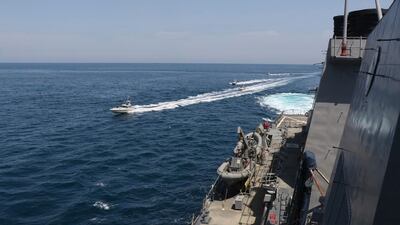
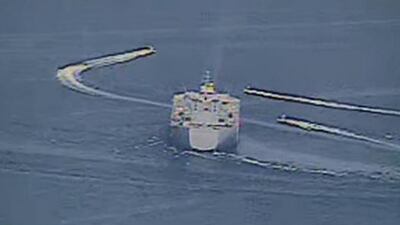
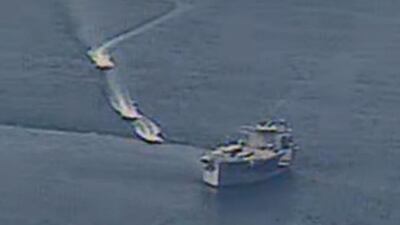
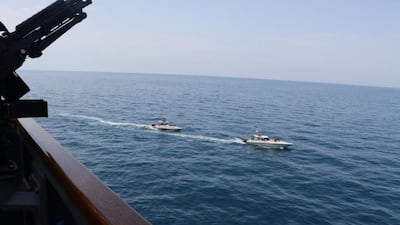
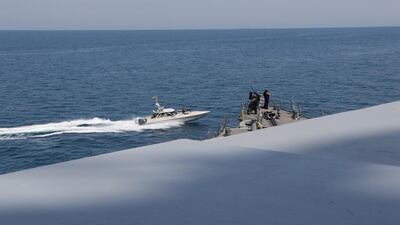
A new US president should use diplomacy as a key tool to bring peace to Gulf region and Iran into line, leading American commentators have said.
They have also called for a mutual non-aggression pact to be agreed between Iran and Saudi Arabia to end hostilities.
America should also consider reversing its policy of applying maximum pressure on Iran, which uses sanctions to force Tehran to the negotiating table, the webinar hosted by the International Institute for Strategic Studies heard.
The debate on the large US military presence in the Gulf region is intensifying with pressure mounting on Washington to put more resources in the Pacific to face the growing Chinese threat.
A regional non-aggression pact would be a "win win win" in that the threat perception would be lowered with Iran and the burden on the US would be lightened, too, said Daniel Benaim, a fellow at The Century Foundation think tank.
“That would be difficult to do but I think for a lot of reasons it may be less impossible than in the past and worth trying,” he added.
Influential American thinkers were also suggesting a non-aggression pact similar to one made in the 1990s, Kirsten Fontenrose of the Atlantic Council said. A pact could lead to a "tit-for-tat de-escalation that pulls us back from where we are towards negotiated peace in the region", she said.
America has a large military presence in the region to deter Iran, reassure Gulf allies and help US counter-terrorism operations as well as secure shipping lanes. But in recent years politicians have raised concerns about the financial cost and political exposure of the deployment.
Mr Benaim believed that a US government under Joe Biden, the expected Democrat challeneger to Donald Trump, would “likely see a reassessment of the maximum pressure policy on Iran in favour of an approach for an opening for diplomacy”.
He added that a new government would look for key Middle East states to lower tensions and de-escalate the situation using diplomacy.
“I think we are headed towards a reassertion of diplomatic and civilian engagement and towards a measure of commitment in terms of more than the number of carrier groups,” he said. “I think you will see the State Department put forward diplomacy as a tool of foreign policy.”
He added that the US military posture was “not set in stone” and numbers had risen by tens of thousands amid tensions with Iran. “If we are able to address those tensions with more diplomacy we may not need quite so many troops,” he added.
The greater use of American diplomacy was also suggested by Becca Wasser, a fellow at the Centre for a New American Security. “I think there is a tool in the US toolkit that has gone underutilised and that is diplomacy.” She added that diplomacy would give America “more space to look at what our military options are and what our footprint should be”.
With Joe Biden widely eight points ahead in the US presidential polling, it appears that President Donald Trump’s chaotic policy in the Middle East might come to an end.
“I do think the diplomatic terrain looks a little bit different and that gives me cause for optimism that there might be a whole different US approach to Iran and new Democrat administration might pursue such an approach,” Mr Benaim said.
He added how the Gulf region engaged with the possible new government would be important to “shape the debate” and “build confidence”.
More from Neighbourhood Watch:
The specs: 2018 Mercedes-Benz S 450
Price, base / as tested Dh525,000 / Dh559,000
Engine: 3.0L V6 biturbo
Transmission: Nine-speed automatic
Power: 369hp at 5,500rpm
Torque: 500Nm at 1,800rpm
Fuel economy, combined: 8.0L / 100km
bundesliga results
Mainz 0 Augsburg 1 (Niederlechner 1')
Schalke 1 (Caligiuri pen 51') Bayer Leverkusen 1 (Miranda og 81')
UAE players with central contracts
Rohan Mustafa, Ashfaq Ahmed, Chirag Suri, Rameez Shahzad, Shaiman Anwar, Adnan Mufti, Mohammed Usman, Ghulam Shabbir, Ahmed Raza, Qadeer Ahmed, Amir Hayat, Mohammed Naveed and Imran Haider.
Disturbing%20facts%20and%20figures
%3Cp%3E%3Cstrong%3E51%25%3C%2Fstrong%3E%20of%20parents%20in%20the%20UAE%20feel%20like%20they%20are%20failing%20within%20the%20first%20year%20of%20parenthood%3C%2Fp%3E%0A%3Cp%3E%3Cstrong%3E57%25%20vs%2043%25%3C%2Fstrong%3E%20is%20the%20number%20of%20mothers%20versus%20the%20number%20of%20fathers%20who%20feel%20they%E2%80%99re%20failing%3C%2Fp%3E%0A%3Cp%3E%3Cstrong%3E28%25%3C%2Fstrong%3E%20of%20parents%20believe%20social%20media%20adds%20to%20the%20pressure%20they%20feel%20to%20be%20perfect%3C%2Fp%3E%0A%3Cp%3E%3Cstrong%3E55%25%3C%2Fstrong%3E%20of%20parents%20cannot%20relate%20to%20parenting%20images%20on%20social%20media%3C%2Fp%3E%0A%3Cp%3E%3Cstrong%3E67%25%3C%2Fstrong%3E%20of%20parents%20wish%20there%20were%20more%20honest%20representations%20of%20parenting%20on%20social%20media%3C%2Fp%3E%0A%3Cp%3E%3Cstrong%3E53%25%3C%2Fstrong%3E%20of%20parents%20admit%20they%20put%20on%20a%20brave%20face%20rather%20than%20being%20honest%20due%20to%20fear%20of%20judgment%3C%2Fp%3E%0A%3Cp%3E%3Cspan%20style%3D%22font-size%3A%2014px%3B%22%3ESource%3A%20YouGov%3C%2Fspan%3E%3C%2Fp%3E%0A
Disability on screen
Empire — neuromuscular disease myasthenia gravis; bipolar disorder; post-traumatic stress disorder (PTSD)
Rosewood and Transparent — heart issues
24: Legacy — PTSD;
Superstore and NCIS: New Orleans — wheelchair-bound
Taken and This Is Us — cancer
Trial & Error — cognitive disorder prosopagnosia (facial blindness and dyslexia)
Grey’s Anatomy — prosthetic leg
Scorpion — obsessive compulsive disorder and anxiety
Switched at Birth — deafness
One Mississippi, Wentworth and Transparent — double mastectomy
Dragons — double amputee
BIG SPENDERS
Premier League clubs spent £230 million (Dh1.15 billion) on January transfers, the second-highest total for the mid-season window, the Sports Business Group at Deloitte said in a report.
Mercer, the investment consulting arm of US services company Marsh & McLennan, expects its wealth division to at least double its assets under management (AUM) in the Middle East as wealth in the region continues to grow despite economic headwinds, a company official said.
Mercer Wealth, which globally has $160 billion in AUM, plans to boost its AUM in the region to $2-$3bn in the next 2-3 years from the present $1bn, said Yasir AbuShaban, a Dubai-based principal with Mercer Wealth.
“Within the next two to three years, we are looking at reaching $2 to $3 billion as a conservative estimate and we do see an opportunity to do so,” said Mr AbuShaban.
Mercer does not directly make investments, but allocates clients’ money they have discretion to, to professional asset managers. They also provide advice to clients.
“We have buying power. We can negotiate on their (client’s) behalf with asset managers to provide them lower fees than they otherwise would have to get on their own,” he added.
Mercer Wealth’s clients include sovereign wealth funds, family offices, and insurance companies among others.
From its office in Dubai, Mercer also looks after Africa, India and Turkey, where they also see opportunity for growth.
Wealth creation in Middle East and Africa (MEA) grew 8.5 per cent to $8.1 trillion last year from $7.5tn in 2015, higher than last year’s global average of 6 per cent and the second-highest growth in a region after Asia-Pacific which grew 9.9 per cent, according to consultancy Boston Consulting Group (BCG). In the region, where wealth grew just 1.9 per cent in 2015 compared with 2014, a pickup in oil prices has helped in wealth generation.
BCG is forecasting MEA wealth will rise to $12tn by 2021, growing at an annual average of 8 per cent.
Drivers of wealth generation in the region will be split evenly between new wealth creation and growth of performance of existing assets, according to BCG.
Another general trend in the region is clients’ looking for a comprehensive approach to investing, according to Mr AbuShaban.
“Institutional investors or some of the families are seeing a slowdown in the available capital they have to invest and in that sense they are looking at optimizing the way they manage their portfolios and making sure they are not investing haphazardly and different parts of their investment are working together,” said Mr AbuShaban.
Some clients also have a higher appetite for risk, given the low interest-rate environment that does not provide enough yield for some institutional investors. These clients are keen to invest in illiquid assets, such as private equity and infrastructure.
“What we have seen is a desire for higher returns in what has been a low-return environment specifically in various fixed income or bonds,” he said.
“In this environment, we have seen a de facto increase in the risk that clients are taking in things like illiquid investments, private equity investments, infrastructure and private debt, those kind of investments were higher illiquidity results in incrementally higher returns.”
The Abu Dhabi Investment Authority, one of the largest sovereign wealth funds, said in its 2016 report that has gradually increased its exposure in direct private equity and private credit transactions, mainly in Asian markets and especially in China and India. The authority’s private equity department focused on structured equities owing to “their defensive characteristics.”