Researchers are exploring if wearable tech devices such as Fitbits or Apple Watches could be used to detect a coronavirus infection before the onset of symptoms.
Last month, scientists at the West Virginia University Rockefeller Neuroscience Institute in the US said they had created a digital platform that can detect Covid-19 symptoms up to three days before they show up using the Oura ring, a wearable fitness and activity tracker.
An app developed by the researchers uses artificial intelligence to forecast the onset of Covid-19 related symptoms such as fever, coughing, breathing difficulties and fatigue, with more than 90 per cent accuracy, according to the university.
The researchers said the system could offer clues of infection in people not yet showing symptoms, helping to address one of the problems in detection and containment of the deadly outbreak.
Separately, Scripps Research Institute has enrolled more than 30,000 people, and aims for much more, in a similar study aiming to use wearables to find "presymptomatic" and asymptomatic people with Covid-19.
Scripps researchers already previously demonstrated the value of wearables in predicting influenza in a study published in January in the British medical journal The Lancet.
Early indications suggest the devices "have the potential to identify people who are presymptomatic but still infectious," said Jennifer Radin, a Scripps epidemiologist leading the research.
Dr Radin told an online conference that wearables are detecting "subtle changes that indicate you are coming down with a viral illness" before the onset of symptoms.
Scripps researchers say they hope to show that wearables data may be more reliable than temperature checks.
-
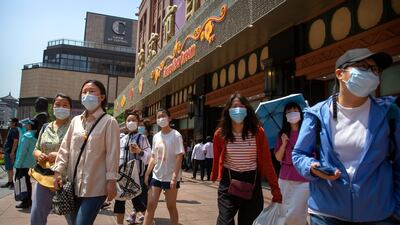
People wearing face masks to protect against the new coronavirus walk outside of a shopping mall at a pedestran shopping street in Beijing. China's capital is lowering its emergency response level to the second-lowest starting Saturday for the coronavirus pandemic. That will lift most restrictions on people traveling to Beijing from Wuhan and surrounding Hubei province, where the virus first appeared late last year. AP Photo -
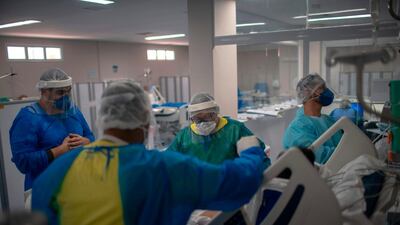
Health professionals take care of a patient at the Intensive Care Unit (ICU) ward where patients infected with the novel coronavirus, COVID-19, are being treated at the Doctor Ernesto Che Guevara Public Hospital in Marica city, state of Rio de Janeiro, Brazil. AFP -
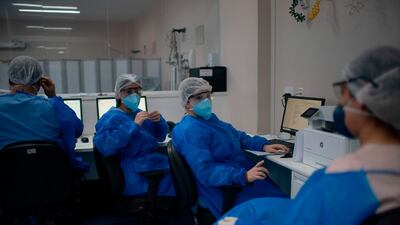
Health professionals work at the Intensive Care Unit (ICU) ward where patients infected with the novel coronavirus, COVID-19, are being treated at the Doctor Ernesto Che Guevara Public Hospital in Marica city, state of Rio de Janeiro, Brazil. AFP -
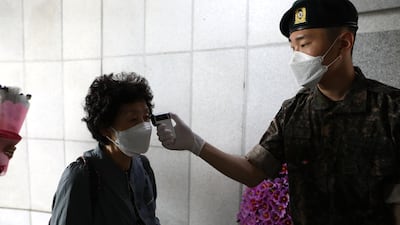
A South Korean woman receives body temperature check from soldier as she arrive visits at the Seoul National Cemetery during a 65th anniversary of the Memorial Day amid coronavirus pandemic in Seoul, South Korea. South Korea marks the 65th anniversary of the Memorial Day for people who died during the military service in the 1950-53 Korean War. Getty -
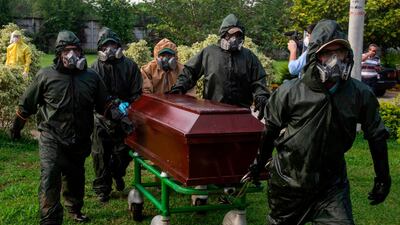
Gravediggers carry a coffin during a funeral at the Jardines del Recuerdo Cemetery in Managua, amid the new coronavirus pandemic. AFP -
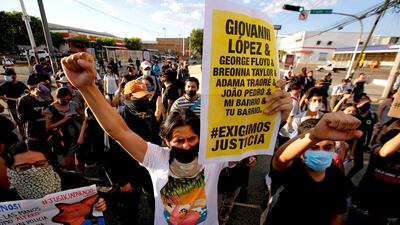
People protest following the death of a young man while in police custody, after he had been arrested allegedly for failing to comply with measures to prevent the spread of COVID-19 coronavirus in Guadalajara, Jalisco state, Mexico. AFP -
Passengers wearing protective face masks are seen at the concourse amid the coronavirus disease (COVID-19) outbreak, at Tokyo Metro's newly-opened Toranomon Hills Station in Tokyo, Japan. REUTERS -
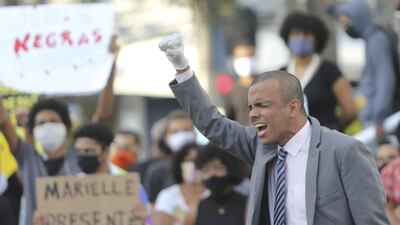
A protester raises his fist in the streets of Sao Goncalo during a protest amidst the coronavirus (COVID-19) pandemic in Sao Goncalo, Brazil. About 300 people walked and shouted slogans against the government of Jair Bolsonaro and protested against the death of the American George Floyd and the boy Joao Pedro (murdered by police in the Salgueiro community). The protesters were sympathizers of the "All Against Racism Movement" and "Black Lives Matter." Getty -
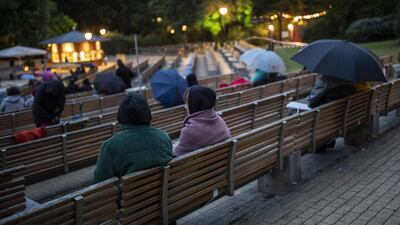
Visitors at the sold out open air cinema watch a movie in Berlin, Germany. As part of the easing measures concerts, kino and other open air events are allowed from June 2nd in the German capital, with a maximum of 200 people. The lock down measures have largely eased nationwide, with stores, restaurants and cafes open again, though under certain restrictions to avoid people crowding together. The economic outlook as a whole remains uncertain, prompting the German government to approve a EUR 130 billion stimulus package earlier this week. Getty -

Disguised as characters of "Alice in Wonderland" and wearing face masks against the spread of the novel coronavirus, Venezuelan migrants perfom in Bogota. AFP -

People stand in a line waiting food outside a community center during the coronavirus crisis in Padre Rodolfo Ricciardelli neigborhood, before knowed as Villa 1-11-14, in Buenos Aires, Argentina one of the neighborhood most affected by COVID-19. EPA -
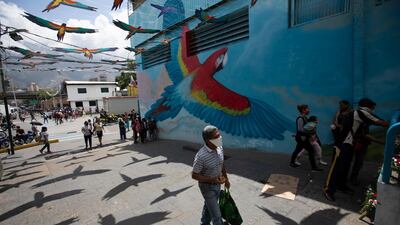
The shadows of synthetic macaws are cast on the pavement backdropped by a mural of a macaw as pedestrians wearing protective face masks walk past, in the Petare neighborhood of Caracas, Venezuela. President Nicolas Maduro and Venezuela's opposition, led by Juan Guaido, have agreed to measures for battling the new coronavirus to be overseen by international health workers, a first step in years toward cooperation between bitter political rivals for the benefit of the country. AP Photo -
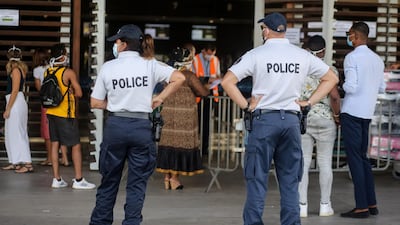
Police offciers stand guard as travellers wearing protective face masks queue for check-in on an Air Austral flight to Paris, from Dzaoudzi Airport in Petite Terre on the French Indian Ocean island of Mayotte, as measures to curb the spread of the COVID-19 (novel coronavirus) are maintained on Mayotte over concerns about the continued spread of the virus there and a fragile health system. AFP -

People walk along a street outside the Jama Masjid after the government eased a nationwide lockdown imposed as a preventive measure against the COVID-19 coronavirus in the old quarters of New Delhi. AFP -
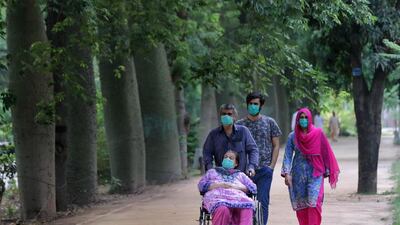
People walk in a park after it was reopened with the easing of the lockdown against the spread of the COVID-19 coronavirus in Lahore, Pakistan. Countries around the world are taking increased measures to stem the widespread of the SARS-CoV-2 coronavirus which causes the Covid-19 disease. EPA -
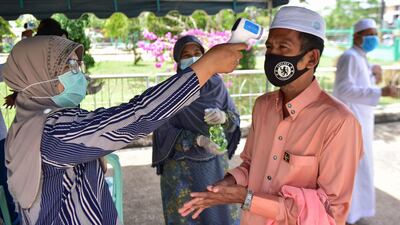
A public health officer checks the temperature of a Muslim man as he arrives to attend Friday prayers at a mosque in the southern Thai province of Narathiwat as restrictions aimed at curbing the spread of the COVID-19 novel coronavirus are slowly eased. AFP


"Forty per cent of people who come down with Covid don't have a fever," Dr Radin said. "This is something that can be used to screen people that's better than a temperature check."
Resting heart rate, for example, is a good indicator because it is normally consistent before an infection, and can be accurately measured by most wearables.
"We see these changes (in heart rate) four days before someone starts to develop a fever," Dr Radin said.
Eric Topol, director of the Scripps Institute, said the idea of using wearables is promising because "over 100 million Americans have a smart watch or fitness band" which can provide key data for researchers, but that getting good results "is contingent on getting large numbers" to opt into the studies.
California health tech startup Evidation meanwhile has begun a project to produce an early warning algorithm from wearables worn by 300 people at high risk of contracting coronavirus, with funding from the US government and the Bill & Melinda Gates Foundation.
Luca Foschini, Evidation's co-founder and chief data scientist, said the research aims "to more effectively identify when and where people may contract Covid-19, and can potentially enable real-time interventions to limit spread and monitor outcomes".
A similar research effort is underway in Germany.
The latest research highlights how some wearable devices, developed initially for fitness and recreation uses, may be adapted for important medical research.
Apple has begun studies on how its smartwatch can detect heart problems. And Fitbit has been working with some 500 different projects for research on cancer, diabetes, respiratory and other health issues.
Scientists say wearables can provide data on body temperature, heart and respiratory rates, sleep and activity patterns and other indicators which can be used as diagnostic tools.
Researchers from Stanford University in the US announced plans in April to participate in research on wearables, in collaboration with Scripps, for Covid-19 and other diseases.
"Smartwatches and other wearables make many, many measurements per day, at least 250,000, which is what makes them such powerful monitoring devices," said Prof Michael Snyder, chair of genetics at Stanford School of Medicine.
Mr Snyder said these devices may alert users when their heart rate, skin temperature or some other part of their physiology signals of infection or another ailment.
"You might wonder, 'Are these sniffles allergies, or am I getting sick?' These algorithms could help people determine if they should stay home in case their body is fighting off an infection," Prof Snyder said.