

From knowing the original name of Manchester City to identifying the world’s smallest species of penguin, elite intellectuals were once able to stand out from the crowd for being able to answer the seemingly unanswerable.
But with the dawn of the internet two men, Larry Page and Sergey Brin, changed quizzing forever when they unleashed Google on the world.
Now, as the search engine celebrates 25 years, gone are the days of swatting in libraries and memorising encyclopaedias. Google has changed the dynamics and given the rest of the room a fighting chance to compete with the best.
A quick search on Google can now reveal the most taxing answers within moments and has revolutionised how the world gathers its knowledge.
The amazing feat may seem second nature to many now, but for quizzers it has become a growing headache as advances in technology allow unscrupulous competitors to use their phones to find the answers on Google – closing the once wide knowledge gap.
Google is a real sore point for Jon Stitcher – more so than most.
He runs the UK’s largest quiz organisation, the Online Quiz League, which has 3,000 players every week.
When Mr Stitcher appeared on British quiz show Who Wants to Be a Millionaire? it was a question on the colour of the ‘G’ in Google that lost him £15,000 – Mr Stitcher answered ‘green’ instead of ‘blue’.
Despite his loss, the search engine still continues to be a thorn in his side as he and his team try to create new ways of combating cheats.

“When we first launched in lockdown I was very trusting and let people do what they wanted to do then we realised some people were clearly Googling the answers,” he told The National.
“It led to us having to tell people to have their hands in clear sight at all times, have their volume on their computer turned on in case someone was on the other side giving the answers. For me quizzes are the fun of taking part not cheating.
“We have had to threaten sanctions and lifetime bans if someone flouts the rules. We give people 15 seconds to answer, it’s still enough time to Google but we try to make some questions too complicated to Google in that time. I’ve known of quiz masters setting up fake websites with false information on to catch people out.”
Quiz masters believe Google has made competitions more professional
Maths teacher Bobby Seagull shot to fame when he made it to the final of University Challenge. He and his rival Eric Monkman went on the present the BBC’s Monkman and Seagull’s Genius Guide to Britain.
Mr Seagull has since won Celebrity Mastermind and writes questions for quiz shows including Radio4’s Brain of Britain and Channel 4 game show The Answer Trap.
Unlike some of his competitors, he has embraced Google and believes it has made quizzing harder and more of a challenge. He enjoys creating unGoogleable questions.
“Before Google people who tended to do well at quizzes had sticky memories or they would remember the dates of battles, read lots of books in libraries and encyclopedias,” Mr Seagull told The National.
“Google has had two effects; firstly, it has made it easier for the average person to find out things. Previously you might be told a really interesting anecdote and you would have to rely on the clever person being correct.
Search engines have also made quizzing a lot more professional and ensure people are at the very top of their game, Mr Seagull said.
“Before Google, normal people did well because they had a bank of knowledge they had accumulated over a period of time," he said.
“Now, with Google, people can prepare more extensively. I was looking up etymology linked to the periodic table and the countries elements have been named after. Historically, I would have needed to go to the library to do it.
“For the people in the top 1 per cent it is a fantastic aid. The best quizzers can go even further by using it as a tool to refine their profession and study process. I write questions for quizzes for example countries with elements named after them and I rely on Google extensively. Before I would have had to use an encyclopaedia to help me find quirky questions.”
My Seagull and his team used Google to prepare for University Challenge.
“At school and university you are given a curriculum, but for preparing for quizzes you cover the basics such as kings and queens. Now, with Google, you can get the answers quicker and double your chances of winning because you have swift access to more information,” he said.
Google makes quizmasters raise their game
“Pre-Google you used encyclopaedias and it was a slow process. Questions as a result are now getting harder.
In the quiz world, there are questions known as chestnuts.
"These are questions that sound difficult to the average person, for example identifying the flags of Romania and Chad which look identical or knowing that Salvador Dali created the Chupa Chups logo and it’s a way of getting an edge over each other," Mr Seagull said.
“We try to beat Google by writing questions which are not Googleable, such as trying to find the connection between three or four things, which if you Googled you might struggle.
“Quizmasters now need to raise their game especially when there is prize money at stake because we can’t ask people to handover their phones.”
Some venues now use speed quizzes which involve answering questions within seconds using your phone, thus preventing people from having the time to use them to cheat.
Google has 8.5 billion searches worldwide everyday
Since its launch, Google has expanded and developed new tools and now deals with more than 93 per cent of worldwide online search requests.
From being started in a dorm by two Harvard students, Google was the brainchild of Mr Page and Mr Brin.
Originally called Backrub, the pair moved the business to their friend’s garage in California and incorporated it as Google – a play on the mathematical expression Googol [sic] for the number 1 followed by 100 zeros – on September 4, 1998.
Its mission was to “organise the world's information and make it universally accessible and useful” – a feat it has undoubtedly achieved.
Initially starting with 26 million web pages, Google has come a long way in the last 25 years and now holds an index of over 40 billion web pages – which it searches in less than half a second.
The search engine now deals has 8.5 billion searches per day worldwide – 15 per cent of which are brand new searches, which have not been seen before.
Its advances have included image searches, maps, street views, news and videos.
For quiz contestant Terry Ridgway Google’s advances make life for his elite team a constant challenge.
He has appeared on BBC show Eggheads and been the phone a friend on Who Wants to be a Millionaire twice – once for Don Fear who won £1m and the second time for his brother Davyth Fear who came away with £500,000.

Together they form a formidable team but have found that some quiz masters turn a blind eye to other teams Googling as they desperately try to triumph over the group.
“We are well known quizzers and win quite a lot, we rarely lose, but more often than not we see people googling the answers. It is so frustrating, they are not relying on knowledge but on speed of Googling and the ability to type quickly,” he told The National.
“Teams turn up and want the challenge of beating us and we do see the quiz masters turning a blind eye and it does feel unfair. They can google quicker than we can recall the answers. Due to our notoriety people want to beat us and when they can’t some resort to Google.”
Quiz hosts try to throw in trickier questions such as picture rounds, but now you can do Google image searches, he said.
“Google is the bane of our lives. It’s hard to compete with it. People are asked to turn their phones off but often say they need them as they are on call but we see them using them.
“We didn’t start off as good quizzers, we had to earn our colours. We got better and better and developed a team with individuals having specialist knowledge of things. We never resort to Google. We don’t cheat. It is frustrating because we have worked hard to become a good quiz team.”
However, there are occasions where Google saves the day even for the most competent quizzers.
“But I’ll admit it does come in handy sometimes,” Mr Ridgway conceded.
“Google can sometimes help us when we know the correct answer and the quizmaster has got it wrong. It does happen, recently a question was who sang Polly and the quiz host claimed it was The Jam but we knew it was Nirvana.”
For Mr Stitcher, Google still remains a bone of contention.
“I’m still not over losing the quiz show over a question about Google,” he said chuckling.
“I’ll never live it down.
“For our quizzes though, we know that people will continue to find new ways to try to beat them using Google but we just have to hope that people have integrity. It’s the fun of taking part at the end of the day.”
25 years of Google - in pictures
-
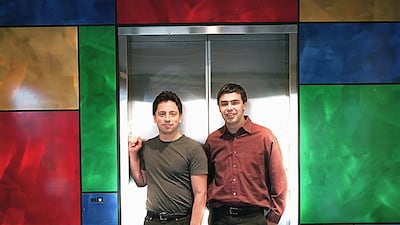
Google founders Sergey Brin, left, and Larry Page at the company's HQ in Mountain View, California, in 2003. Getty Images -
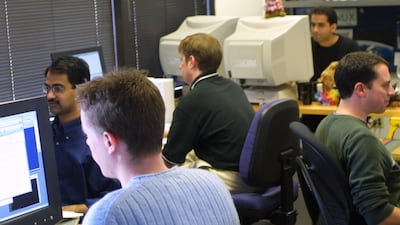
Employees working in the office, dubbed the 'Googleplex', in 2003. Getty Images -
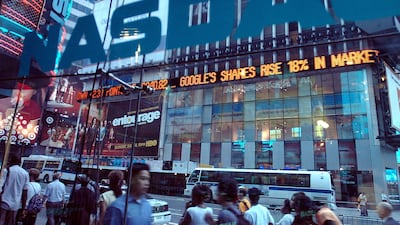
Google's closing share price is displayed in Times Square, New York City, on the company's first day of public trading in August 2004. Getty Images -
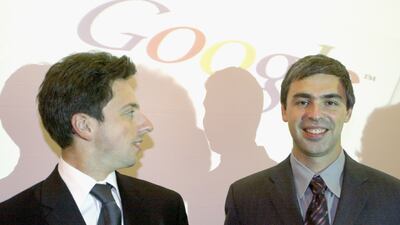
Sergey Brin and Larry Page at the opening of the Frankfurt book fair in 2004. Getty Images -
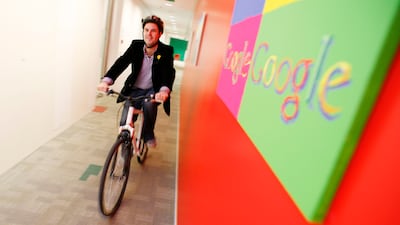
An employee rides his new Google-branded bike in 2007 in London. Google improved its green credentials by offering all staff a free bike to ride to work. Getty Images -

A Google Street View camera car makes its way through London in 2008, creating innovative mapping. Getty Images -
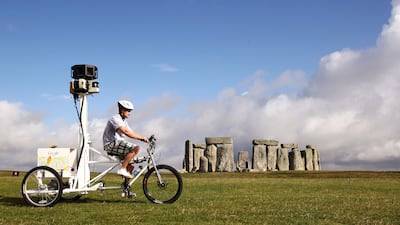
Google launches the Street View Trike at Stonehenge in Wiltshire in 2009. The British public voted for the top 6 tourist attractions they wished to be photographed by the tricycle. Getty Images -
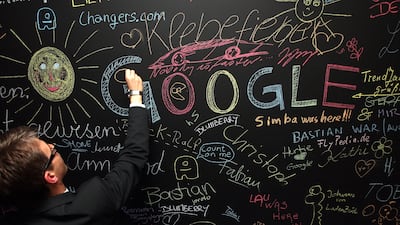
The official opening party of Berlin's Google offices in 2012. Getty Images -
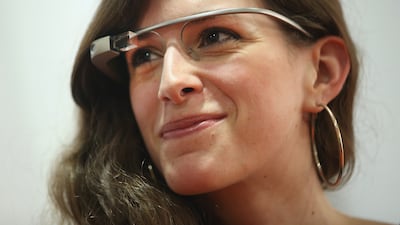
Trying out the wearable tech 'Google Glass' in Berlin, 2014. Getty Images -
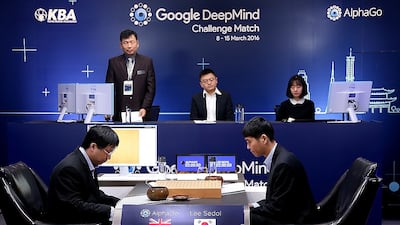
South Korean professional Go player Lee Se-dol, right, prepares for his match against Google's AI programme, AlphaGo, during the Google DeepMind challenge match in Seoul, 2016. Getty Images -
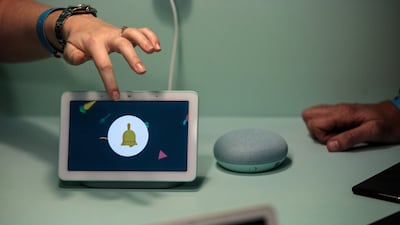
The new Google Home Hub displayed at a Google hardware launch event in London in 2018. Getty Images -
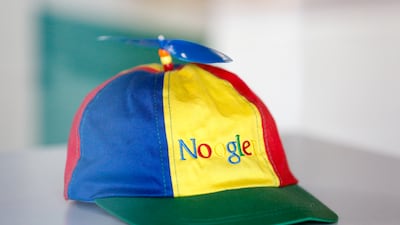
A Noogler hat, given to each new employee, displayed at the Google Search 20th Anniversary Event in San Francisco in 2018. AFP -
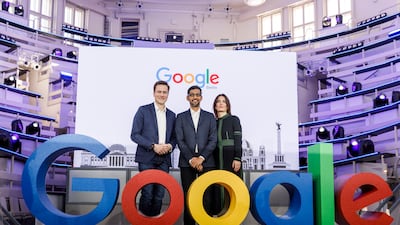
From left, bosses Philipp Justus, Sundar Pichai and Annette Kroeber-Riel at the opening of the Berlin representation of Google Germany in 2019. Getty Images -

Ivy Goodall, 11, meets with her teacher and her classmates in Google Classroom for the first lessons of term while in Covid-19 lockdown from her home in Auckland, New Zealand, in 2020. Getty Images -
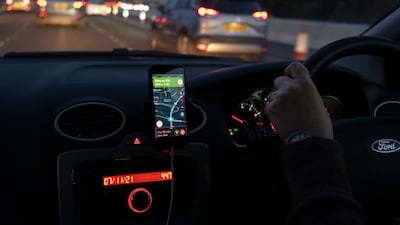
A driver using Google Maps to navigate towards London in 2021. Getty Images -
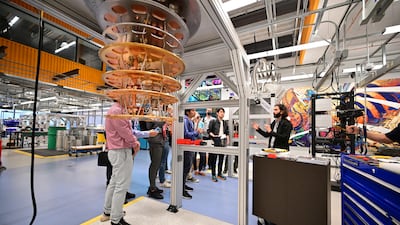
Dr Erik Lucero, lead engineer of Google Quantum AI, leads a media tour of campus in Goleta, California in 2022. AFP -

Workers leave Google’s Bay View campus in Mountain View in 2022. AFP -
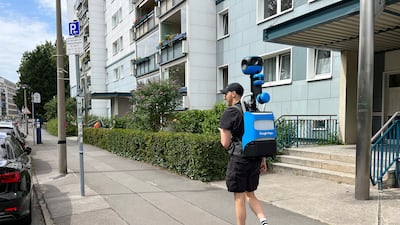
A man carries a Google Street View Trekker backpack in Berlin in 2023. Getty Images -
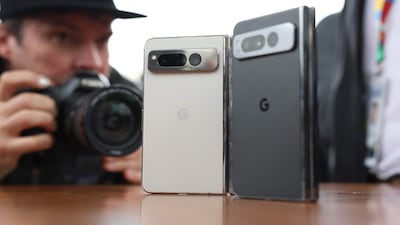
The new Google Pixel Fold phone on display at an I/O developers' conference in Mountain View, 2023. AFP



