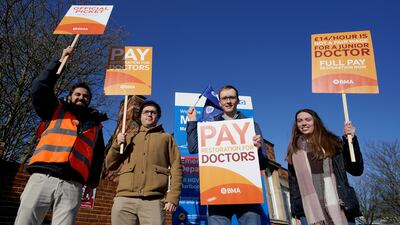
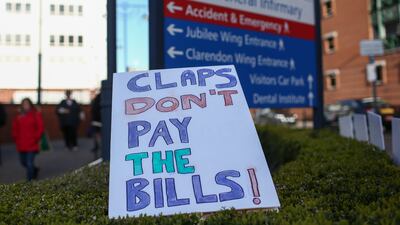
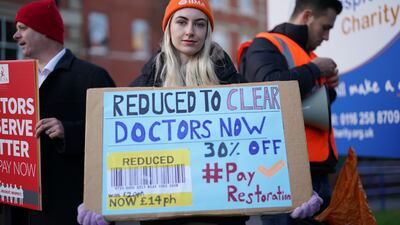
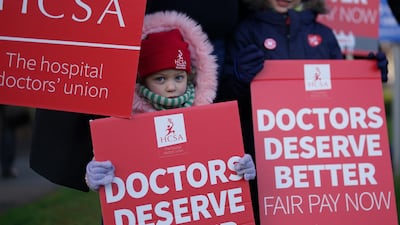
British healthcare faces weeks of disruption as hospitals battle with rising winter rates of illness and a six-day strike by junior doctors that starts on Wednesday.
The walkout will be the longest strike in the National Health Service’s (NHS) history and is expected to have a significant impact not only on daily operations but long-planned operations and other appointments..
“This January could be one of the most difficult starts to the year the NHS has ever faced,” Sir Stephen Powis, national medical director of NHS England, said as he warned the impact of the strike will be felt for weeks.
“Six consecutive days of industrial action comes at one of our busiest periods – the action will not only have an enormous impact on planned care, but comes on top of a host of seasonal pressures such as Covid, flu, and staff absences due to sickness – all of which is impacting on how patients flow through hospitals,” he said.
On the back foot
“Our colleagues across the health service are doing their very best for patients every day with extensive preparations in place, but there's no doubt they are starting 2024 on the back foot – not only will action impact next week, it will continue to have a serious impact in the weeks after as we recover services and deal with additional demand.”
Junior doctors are set to walk out from 7am on January 3 until 7am on January 9 – amounting to 144 consecutive hours of industrial action.
The British Medical Association (BMA) union wants junior doctors to get a 35 per cent pay rise, which it says would restore their real earnings to 2008 levels, but the government says this is unaffordable.
Hopes the walkout could be called off are fading as a “stand-off” between the government and the BMA is holding firm, according to NHS Confederation chief executive Matthew Taylor.
He told BBC News on Monday that “even at this late stage, an intervention could make a difference”, and the industrial action will leave hospitals, GP surgeries and other services “skating on very thin ice”.
Mr Taylor said: “Unfortunately it feels like there is a stand-off, which is the government refusing to enter negotiations unless the junior doctors call off the strike action, and the junior doctors are refusing to call off strike action unless the government commits to investing more money – and that is a pity.
“These days are going to be very damaging to us.”
An agreement allows striking junior doctors to be recalled for major incidents and in extreme circumstances.
The confederation is urging the BMA to respond quickly to requests for junior doctors to be recalled and for the judgment of senior medics to be “trusted” when they say they need cover from those on strike.
Mr Taylor said: “Many NHS trusts will have thin rotas and will be in a highly vulnerable position as they enter what is widely regarded as the busiest week of the year for local NHS services.
Junior doctors across England begin 96 hour strike – in pictures
“Parts of the NHS will be skating on very thin ice, and they will need the BMA to back any recall requests for junior doctors when services find themselves under extreme pressure.”
He said under these circumstances, the focus must now be for every NHS leader and their staff to try to mitigate “as many of the considerable risks that they face as possible”.
He added: “To face almost 150 hours of continuous stoppages is a serious and unprecedented risk – and one that NHS leaders and their staff have never experienced before.
“That means more delays for patients who have faced lengthy waits for routine treatment.”
Figures released last month showed more than 1.2 million appointments have had to be postponed because of industrial action in the NHS since it began in December 2022. Strikes by junior doctors last month alone caused around 86,000 appointments to be postponed.
RIVER%20SPIRIT
%3Cp%3E%3Cstrong%3EAuthor%3A%20%3C%2Fstrong%3ELeila%20Aboulela%C2%A0%3C%2Fp%3E%0A%3Cp%3E%3Cstrong%3EPublisher%3A%3C%2Fstrong%3E%20Saqi%20Books%3C%2Fp%3E%0A%3Cp%3E%3Cstrong%3EPages%3A%3C%2Fstrong%3E%20320%3C%2Fp%3E%0A%3Cp%3E%3Cstrong%3EAvailable%3A%3C%2Fstrong%3E%20Now%3C%2Fp%3E%0A
Ten tax points to be aware of in 2026
1. Domestic VAT refund amendments: request your refund within five years
If a business does not apply for the refund on time, they lose their credit.
2. E-invoicing in the UAE
Businesses should continue preparing for the implementation of e-invoicing in the UAE, with 2026 a preparation and transition period ahead of phased mandatory adoption.
3. More tax audits
Tax authorities are increasingly using data already available across multiple filings to identify audit risks.
4. More beneficial VAT and excise tax penalty regime
Tax disputes are expected to become more frequent and more structured, with clearer administrative objection and appeal processes. The UAE has adopted a new penalty regime for VAT and excise disputes, which now mirrors the penalty regime for corporate tax.
5. Greater emphasis on statutory audit
There is a greater need for the accuracy of financial statements. The International Financial Reporting Standards standards need to be strictly adhered to and, as a result, the quality of the audits will need to increase.
6. Further transfer pricing enforcement
Transfer pricing enforcement, which refers to the practice of establishing prices for internal transactions between related entities, is expected to broaden in scope. The UAE will shortly open the possibility to negotiate advance pricing agreements, or essentially rulings for transfer pricing purposes.
7. Limited time periods for audits
Recent amendments also introduce a default five-year limitation period for tax audits and assessments, subject to specific statutory exceptions. While the standard audit and assessment period is five years, this may be extended to up to 15 years in cases involving fraud or tax evasion.
8. Pillar 2 implementation
Many multinational groups will begin to feel the practical effect of the Domestic Minimum Top-Up Tax (DMTT), the UAE's implementation of the OECD’s global minimum tax under Pillar 2. While the rules apply for financial years starting on or after January 1, 2025, it is 2026 that marks the transition to an operational phase.
9. Reduced compliance obligations for imported goods and services
Businesses that apply the reverse-charge mechanism for VAT purposes in the UAE may benefit from reduced compliance obligations.
10. Substance and CbC reporting focus
Tax authorities are expected to continue strengthening the enforcement of economic substance and Country-by-Country (CbC) reporting frameworks. In the UAE, these regimes are increasingly being used as risk-assessment tools, providing tax authorities with a comprehensive view of multinational groups’ global footprints and enabling them to assess whether profits are aligned with real economic activity.
Contributed by Thomas Vanhee and Hend Rashwan, Aurifer
Spare
Profile
Company name: Spare
Started: March 2018
Co-founders: Dalal Alrayes and Saurabh Shah
Based: UAE
Sector: FinTech
Investment: Own savings. Going for first round of fund-raising in March 2019
What the law says
Micro-retirement is not a recognised concept or employment status under Federal Decree Law No. 33 of 2021 on the Regulation of Labour Relations (as amended) (UAE Labour Law). As such, it reflects a voluntary work-life balance practice, rather than a recognised legal employment category, according to Dilini Loku, senior associate for law firm Gateley Middle East.
“Some companies may offer formal sabbatical policies or career break programmes; however, beyond such arrangements, there is no automatic right or statutory entitlement to extended breaks,” she explains.
“Any leave taken beyond statutory entitlements, such as annual leave, is typically regarded as unpaid leave in accordance with Article 33 of the UAE Labour Law. While employees may legally take unpaid leave, such requests are subject to the employer’s discretion and require approval.”
If an employee resigns to pursue micro-retirement, the employment contract is terminated, and the employer is under no legal obligation to rehire the employee in the future unless specific contractual agreements are in place (such as return-to-work arrangements), which are generally uncommon, Ms Loku adds.
Ultra processed foods
- Carbonated drinks, sweet or savoury packaged snacks, confectionery, mass-produced packaged breads and buns
- margarines and spreads; cookies, biscuits, pastries, cakes, and cake mixes, breakfast cereals, cereal and energy bars;
- energy drinks, milk drinks, fruit yoghurts and fruit drinks, cocoa drinks, meat and chicken extracts and instant sauces
- infant formulas and follow-on milks, health and slimming products such as powdered or fortified meal and dish substitutes,
- many ready-to-heat products including pre-prepared pies and pasta and pizza dishes, poultry and fish nuggets and sticks, sausages, burgers, hot dogs, and other reconstituted meat products, powdered and packaged instant soups, noodles and desserts.
The Dark Blue Winter Overcoat & Other Stories From the North
Edited and Introduced by Sjón and Ted Hodgkinson
Pushkin Press
Key facilities
- Olympic-size swimming pool with a split bulkhead for multi-use configurations, including water polo and 50m/25m training lanes
- Premier League-standard football pitch
- 400m Olympic running track
- NBA-spec basketball court with auditorium
- 600-seat auditorium
- Spaces for historical and cultural exploration
- An elevated football field that doubles as a helipad
- Specialist robotics and science laboratories
- AR and VR-enabled learning centres
- Disruption Lab and Research Centre for developing entrepreneurial skills