Lebanese Prime Minister Hassan Diab is sprayed with disinfectant as he arrives to attend a legislative session in Beirut. Reuters

UN Security Council calls for international support for Lebanon after IMF bail-out request


Sunniva Rose
  • English
  • Arabic

The UN Security Council has called on the international community to help Lebanon tackle its worst-ever social and economic crisis, days after the government announced it would request an aid package from the IMF.

A statement published on Monday followed a Security Council briefing on Lebanon by UN Special Co-ordinator Jan Kubis and Under-Secretary General for Peace Operations Jean-Pierre Lacroix.

“The Members of the Security Council expressed support to Lebanon to help it exit the current crisis … and called the international community, including international organisations, to do so,” the statement read.

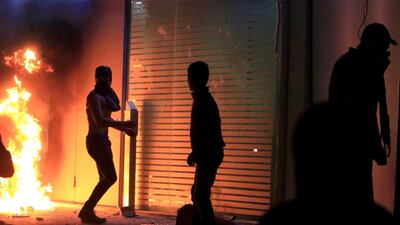
  • A demonstrator is seen next to a burning fire in front of a bank during a protest against growing economic hardship in Sidon, Lebanon. Reuters
    A demonstrator is seen next to a burning fire in front of a bank during a protest against growing economic hardship in Sidon, Lebanon. Reuters
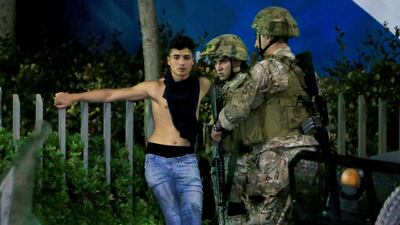
  • A detained demonstrator stands near Lebanese army soldiers during a protest against growing economic hardship in Sidon, Lebanon. Reuters
    A detained demonstrator stands near Lebanese army soldiers during a protest against growing economic hardship in Sidon, Lebanon. Reuters
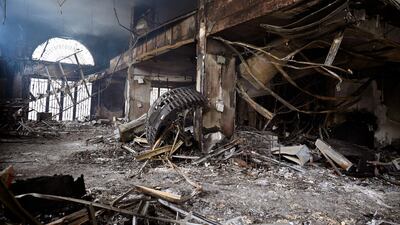
  • Interior view of a damaged bank that was set ablaze by protesters in Tripoli, northern Lebanon. EPA
    Interior view of a damaged bank that was set ablaze by protesters in Tripoli, northern Lebanon. EPA
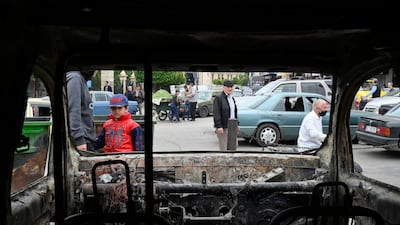
  • Lebanese people inspect a burnt out car of the Lebanese Internal Security Forces which was set ablaze by protesters in Tripoli, northern Lebanon. EPA
    Lebanese people inspect a burnt out car of the Lebanese Internal Security Forces which was set ablaze by protesters in Tripoli, northern Lebanon. EPA
  • Anti-government protesters shout slogans during a protest against the collapsing Lebanese currency and the price hikes of goods, in front the central bank in Beirut, Lebanon. EPA
    Anti-government protesters shout slogans during a protest against the collapsing Lebanese currency and the price hikes of goods, in front the central bank in Beirut, Lebanon. EPA
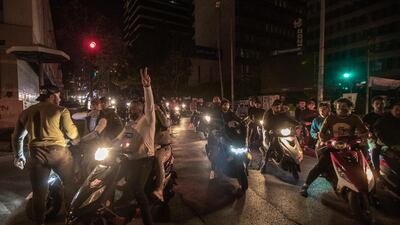
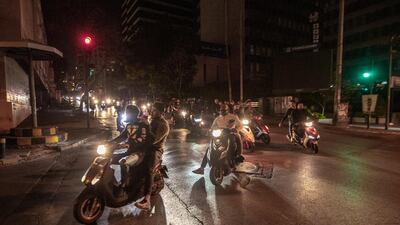
  • Anti-government protesters ride their motorcycles during a protest against the collapsing Lebanese currency and the price hikes of goods, in front the central bank in Beirut, Lebanon. EPA
    Anti-government protesters ride their motorcycles during a protest against the collapsing Lebanese currency and the price hikes of goods, in front the central bank in Beirut, Lebanon. EPA
  • Lebanese men inspect a burnt out car of the Lebanese Internal Security Forces which was set ablaze by protesters in Tripoli, northern Lebanon. EPA
    Lebanese men inspect a burnt out car of the Lebanese Internal Security Forces which was set ablaze by protesters in Tripoli, northern Lebanon. EPA
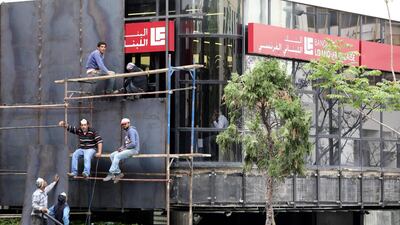
  • Workers install metallic barriers on the facade of a bank as a protective measure against vandalism in Tripoli, northern Lebanon. EPA
    Workers install metallic barriers on the facade of a bank as a protective measure against vandalism in Tripoli, northern Lebanon. EPA
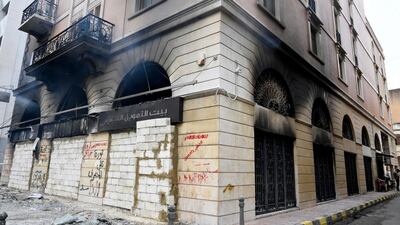
  • Exterior view of a damaged bank that was set ablaze by protesters in Tripoli, northern Lebanon. EPA
    Exterior view of a damaged bank that was set ablaze by protesters in Tripoli, northern Lebanon. EPA
  • Workers install metallic barriers along the facade of a bank as a protective measure against vandalism in the Lebanese capital Beirut. AFP
    Workers install metallic barriers along the facade of a bank as a protective measure against vandalism in the Lebanese capital Beirut. AFP
  • Anti-government protesters shout slogans during a protest against the collapsing Lebanese currency and the price hikes of goods, in front the central bank in Beirut, Lebanon. EPA
    Anti-government protesters shout slogans during a protest against the collapsing Lebanese currency and the price hikes of goods, in front the central bank in Beirut, Lebanon. EPA
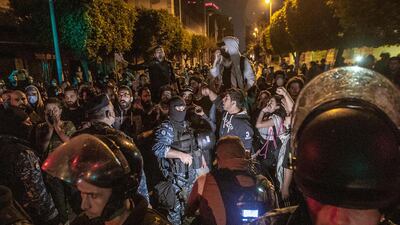
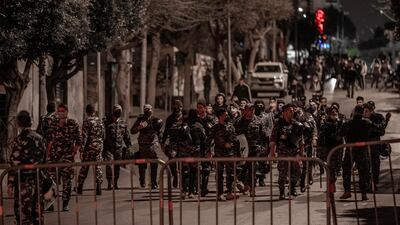
  • Lebanese riot control police watch as annti-government protesters gather during a demonstration against the collapsing Lebanese currency and the price hikes of goods, in Beirut, Lebanon. EPA
    Lebanese riot control police watch as annti-government protesters gather during a demonstration against the collapsing Lebanese currency and the price hikes of goods, in Beirut, Lebanon. EPA
  • Anti-government protesters ride their motorcycles during a protest against the collapsing Lebanese currency and the price hikes of goods, in front the central bank in Beirut, Lebanon. EPA
    Anti-government protesters ride their motorcycles during a protest against the collapsing Lebanese currency and the price hikes of goods, in front the central bank in Beirut, Lebanon. EPA
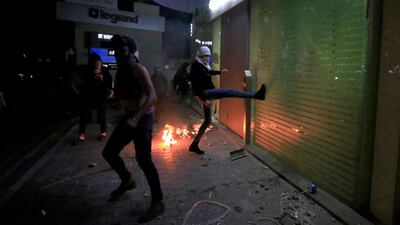
  • A demonstrator smashes a window of a bank during a protest against growing economic hardship in Sidon, Lebanon. Reuters
    A demonstrator smashes a window of a bank during a protest against growing economic hardship in Sidon, Lebanon. Reuters

Lebanon officially requested IMF help on Friday, one day after Prime Minister Hassan Diab said his country needed $10 billion (Dh36.7bn) in international support. He said he hoped to find that cash in the $11 billion in soft loans and grants promised two years ago by the international community, including the World Bank, Saudi Arabia, the US and France, at a conference in Paris in April 2018.The funds were never disbursed as the previous government failed to implement the necessary reforms.

In its recovery plan, the government wrote that IMF support would provide “strong backing to the difficult decisions” that it would have to take, which include recovering $10 billion worth of public assets embezzled by officials over 5 years and restructuring the banking sector which has estimated losses of 154 trillion Lebanese pounds, or $44 billion at parallel market exchange rates.

Lebanon’s debt-to-GDP ratio is among the highest in the world, at 176 per cent, while inflation is expected to spike at 53 per cent this year, according to the government’s plan. The crisis has pushed nearly half of the Lebanese people into poverty and caused violent protests across the country since October.

Hassan Nasrallah, the leader of Lebanon’s influential Hezbollah party, said in a speech on Monday evening that he was not against Lebanon’s request for IMF assistance as long as the government controlled its implementation.

“We are not in principle against seeking assistance from any party in the world … but we refuse to surrender completely to conditions of the IMF,” he said.

In previous speeches, Mr Nasrallah has warned against the influence the US, which considers Hezbollah a terrorist organisation, has over the IMF. He fears the Trump administration through the IMF could try to impose conditions that would go against the party’s interests.

The government’s rescue plan, which has caused public friction between the banking sector and Mr Diab, will be discussed by MPs on Wednesday. They will not meet in Parliament as usual but at the presidential palace outside Beirut.

Former Prime Minister Saad Hariri's Future Movement said it would boycott the meeting after weeks of hostility between his party and the government, which has criticised him and his father, late Prime Minister Rafiq Hariri, for their bad management of the country's finances since the end of the civil war in 1990.

Sweet%20Tooth
%3Cp%3E%3Cstrong%3ECreator%3A%20%3C%2Fstrong%3EJim%20Mickle%3Cbr%3E%3Cstrong%3EStarring%3A%20%3C%2Fstrong%3EChristian%20Convery%2C%20Nonso%20Anozie%2C%20Adeel%20Akhtar%2C%20Stefania%20LaVie%20Owen%3Cbr%3E%3Cstrong%3ERating%3A%20%3C%2Fstrong%3E2.5%2F5%3C%2Fp%3E%0A

Black Panther
Dir: Ryan Coogler
Starring: Chadwick Boseman, Michael B Jordan, Lupita Nyong'o
Five stars

MATCH STATS

Wolves 0

Aston Villa 1 (El Ghazi 90 4' pen)

Red cards: Joao Moutinho (Wolves); Douglas Luiz (Aston Villa)

Man of the match: Emi Martinez (Aston Villa)

Why are you, you?

Why are you, you?
From this question, a new beginning.
From this question, a new destiny.
For you are a world, and a meeting of worlds.
Our dream is to unite that which has been
separated by history.
To return the many to the one.
A great story unites us all,
beyond colour and creed and gender.
The lightning flash of art
And the music of the heart.
We reflect all cultures, all ways.
We are a twenty first century wonder.
Universal ideals, visions of art and truth.
Now is the turning point of cultures and hopes.
Come with questions, leave with visions.
We are the link between the past and the future.
Here, through art, new possibilities are born. And
new answers are given wings.

Why are you, you?
Because we are mirrors of each other.
Because together we create new worlds.
Together we are more powerful than we know.
We connect, we inspire, we multiply illuminations
with the unique light of art.

 Ben Okri,

Company Profile

Name: Thndr
Started: 2019
Co-founders: Ahmad Hammouda and Seif Amr
Sector: FinTech
Headquarters: Egypt
UAE base: Hub71, Abu Dhabi
Current number of staff: More than 150
Funds raised: $22 million

The specs

Engine: 2.9-litre twin-turbo V6

Power: 540hp at 6,500rpm

Torque: 600Nm at 2,500rpm

Transmission: Eight-speed auto

Kerb weight: 1580kg

Price: From Dh750k

On sale: via special order

Mercer, the investment consulting arm of US services company Marsh & McLennan, expects its wealth division to at least double its assets under management (AUM) in the Middle East as wealth in the region continues to grow despite economic headwinds, a company official said.

Mercer Wealth, which globally has $160 billion in AUM, plans to boost its AUM in the region to $2-$3bn in the next 2-3 years from the present $1bn, said Yasir AbuShaban, a Dubai-based principal with Mercer Wealth.

Within the next two to three years, we are looking at reaching $2 to $3 billion as a conservative estimate and we do see an opportunity to do so,” said Mr AbuShaban.

Mercer does not directly make investments, but allocates clients’ money they have discretion to, to professional asset managers. They also provide advice to clients.

“We have buying power. We can negotiate on their (client’s) behalf with asset managers to provide them lower fees than they otherwise would have to get on their own,” he added.

Mercer Wealth’s clients include sovereign wealth funds, family offices, and insurance companies among others.

From its office in Dubai, Mercer also looks after Africa, India and Turkey, where they also see opportunity for growth.

Wealth creation in Middle East and Africa (MEA) grew 8.5 per cent to $8.1 trillion last year from $7.5tn in 2015, higher than last year’s global average of 6 per cent and the second-highest growth in a region after Asia-Pacific which grew 9.9 per cent, according to consultancy Boston Consulting Group (BCG). In the region, where wealth grew just 1.9 per cent in 2015 compared with 2014, a pickup in oil prices has helped in wealth generation.

BCG is forecasting MEA wealth will rise to $12tn by 2021, growing at an annual average of 8 per cent.

Drivers of wealth generation in the region will be split evenly between new wealth creation and growth of performance of existing assets, according to BCG.

Another general trend in the region is clients’ looking for a comprehensive approach to investing, according to Mr AbuShaban.

“Institutional investors or some of the families are seeing a slowdown in the available capital they have to invest and in that sense they are looking at optimizing the way they manage their portfolios and making sure they are not investing haphazardly and different parts of their investment are working together,” said Mr AbuShaban.

Some clients also have a higher appetite for risk, given the low interest-rate environment that does not provide enough yield for some institutional investors. These clients are keen to invest in illiquid assets, such as private equity and infrastructure.

“What we have seen is a desire for higher returns in what has been a low-return environment specifically in various fixed income or bonds,” he said.

“In this environment, we have seen a de facto increase in the risk that clients are taking in things like illiquid investments, private equity investments, infrastructure and private debt, those kind of investments were higher illiquidity results in incrementally higher returns.”

The Abu Dhabi Investment Authority, one of the largest sovereign wealth funds, said in its 2016 report that has gradually increased its exposure in direct private equity and private credit transactions, mainly in Asian markets and especially in China and India. The authority’s private equity department focused on structured equities owing to “their defensive characteristics.”