
Condolences have poured in from across the country following the death of former US first lady Rosalynn Carter, wife of former president Jimmy Carter.
Ms Carter died on Sunday after being placed in hospice care alongside her husband. She was 96.
“First lady Rosalynn Carter walked her own path, inspiring a nation and the world along the way,” said US President Joe Biden.
“On behalf a grateful nation, we send our love to the entire Carter family and the countless people whose lives are better, fuller and brighter because of Rosalynn Carter.”
The current first lady, Jill Biden, expressed her condolences to the Carter family on X, formerly Twitter: “My love is with the entire Carter family, as they, and we, grieve our dearest Rosalynn.”
Another former first lady Michelle Obama spoke of Ms Carter as an inspiration: “Guided by her abiding faith and her commitment to service, Mrs Carter used her platform in profoundly meaningful ways. Her groundbreaking work to combat the stigma faced by those struggling with their mental health brought light to so many suffering in silence.
“She advocated for better care for the elderly. She advanced women’s rights. And she remained a champion for those causes – and many others like building affordable housing for those in need and caring for our nation’s caregivers – in the more than four decades that followed.”
Donald Trump and his wife Melania expressed their sorrow over the loss of the former first lady.
“Melania and I join all Americans in mourning the loss of Rosalynn Carter,” Mr Trump posted on his Truth Social media platform. “She was a devoted first lady, a great humanitarian, a champion for mental health and a beloved wife to her husband for 77 years, President Carter.
“Over a life spanning nearly a century, Rosalynn Carter earned the admiration and gratitude of our entire nation."
Outside Washington, organisations that benefited from the Carters' work also sent their condolences.
The Alzheimer's Association praised the former first lady for creating the Rosalynn Carter Institute for Caregivers and working “to improve the lives of family caregivers”, the association wrote on X.
“She leaves behind a legacy of inspiring action and change.”
Equal Means Equal, a national non-profit that advocates the Equal Rights Amendment, said it was heart-broken by the death of the former first lady, whom it called a warrior for equality and who “fought hard” for a level playing field for women.
Martin Luther King III, son of civil rights leader Martin Luther King Jr, also issued a statement, saying: “I hold the Carter family in our thoughts and prayers as they mourn the loss of a mother, grandmother and former first lady Rosalynn Carter. Truly a life well lived and a beautiful legacy. May her life continue to inspire us. Rest easy on the wings of eternity.”
Dr Tedros Adhanom Ghebreyesus, director general of the World Health Organisation, said in a post on X he was saddened by the former first lady’s passing.
“My deepest condolences to the Carter family and the American people,” he said. “The first lady was an outstanding champion for health and equity. Her legacy must not be forgotten.”
And philanthropist Melinda French Gates, also in a tribute on X, called the former first lady “an extraordinary woman” who left the world a better place and addressed mental health at a time when few public figures did.
“Rosalynn refused to let stigma be an excuse for silence. She took up the cause with courage and compassion,” she said. “I am grateful that I got to know her and for the legacy she leaves behind.”
The first lady's mark was felt even in Hollywood, with famous singer and actress Barbra Streisand calling the Carters an “amazing couple”.
“How many marriages last 77 years?”
The former first lady is survived by her husband, Mr Carter, their four children and 22 grandchildren and great-grandchildren.
-
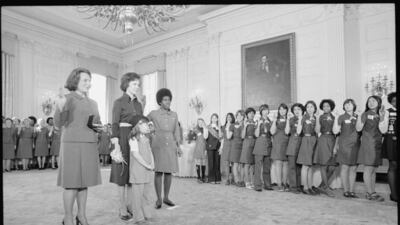
Rosalynn Carter with members of the Girl Scouts of America in the White House in March 1977. Photo: US National Archives -
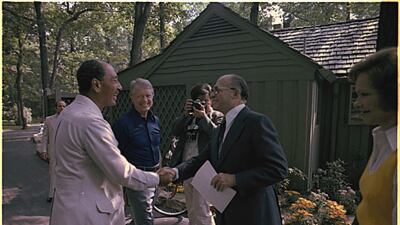
Ms Carter was one of her husband Jimmy's closest advisers while he was US president and governor of Georgia, seen here at Camp David with Anwar Sadat and Menachem Begin in September 1978. Photo: US National Archives -

Ms Carter stands to the right as her husband signs the Extension of Equal Rights Amendment ratification at the White House in October 1978. Photo: US National Archives -
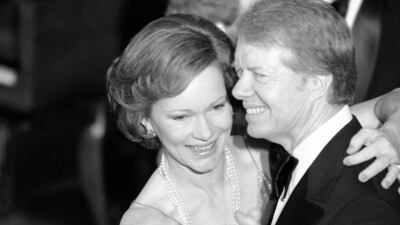
Mr and Ms Carter dance at the Congressional Christmas Ball at the White House in Washington in 1978. AP -
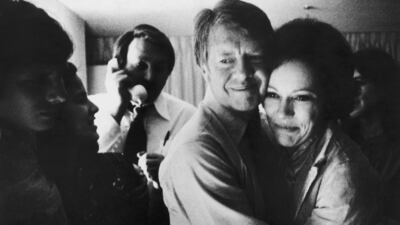
Democratic presidential candidate Jimmy Carter embraces his wife Rosalynn after receiving final news of his victory in the national general election on November 2, 1976. Getty -

Mr Carter is sworn in by chief justice Earl Burger as the 39th president of the US, with his wife by his side on the East Portico of the White House on January 20, 1977. Getty -
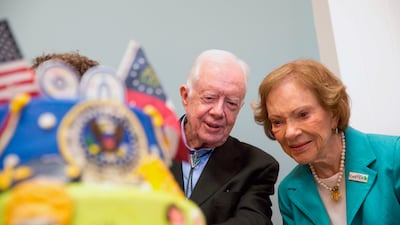
The Carters admire the cake for his 90th birthday in Americus, Georgia. AP -
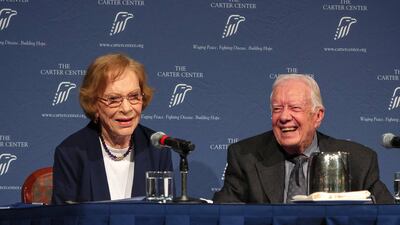
Ms Carter advocates for mental health at the Carter Centre in Atlanta. Michael A Schwarz -

The Carters leave a ribbon-cutting ceremony for a solar panel project on farmland he owns in their hometown of Plains. The Carters installed solar panels on the roof of the White House, which were removed by president Ronald Reagan. AP -

The Carters celebrate their 75th wedding anniversary with friends at Plains High School, in the Jimmy Carter National Historical Park in Georgia. The Carter Centre / Reuters -

Ms Carter was one of her husband's most important advisers while he was president and governor of Georgia. AFP -

The Carters at a welcoming ceremony during a visit to 32 houses built for poor families under the Habitat for Humanity project at Dong Xa, a village in the northern province of Hai Duong, Vietnam. AFP -
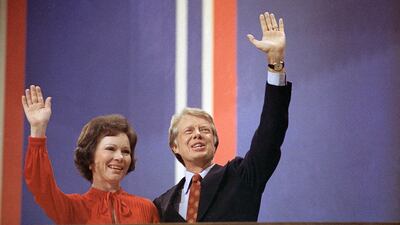
The Carters at the Democratic National Convention in Madison Square Gardens in New York. AP -

Ms Carter receives a kiss from her husband at the reopening ceremony for the newly redesigned Carter Presidential Library in Atlanta, in 2009. AP -
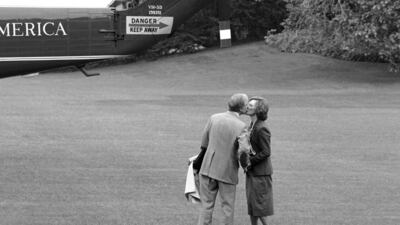
Ms Carter gives her husband a send-off as he boards a helicopter in Washington for the trip to Camp David. AP -

The Carters and daughter Amy respond to a huge crowd that welcomed them to New York. AP -
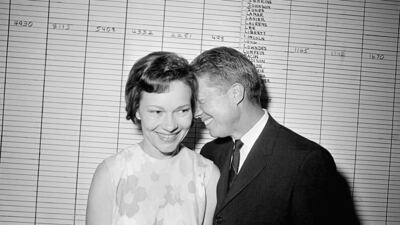
Then Georgia state senator Jimmy Carter with his wife at his Atlanta campaign headquarters in 1966. AP



