
Ramadan is observed by more than 1.8 billion Muslims and is believed to be the month when the Quran was revealed to the Prophet Mohammed.
Fasting during the holy month is one of the Five Pillars of Islam and is mandatory for all Muslims who are in good health. Those exempt include young children, anyone who is sick, travellers and women who are pregnant, nursing or menstruating.
Ramadan is also considered a nocturnal month for Muslims who end their daily fast at sunset, then begin longer-form Taraweeh prayers that are traditionally followed by social gatherings that last into the night.
Why is the crescent sighting date crucial?
The sighting of the moon signifies the start and the end of Ramadan, the ninth month of the Islamic calendar. Religious authorities in the Middle East and beyond will soon begin scanning the night sky for the first glimpse of a crescent moon, heralding the start of Ramadan.
In the Islamic lunar calendar, Ramadan is preceded by the month of Shabaan. The month of fasting and spirituality begins when moon-sighting committees convene after the sunset on Shabaan 29 to look for a crescent moon, in a tradition that has lasted for generations.
The crescent moon is an important symbol in Islam and is used in Ramadan decorations. It can often be seen hung outside homes, on Ramadan lanterns and even on gift-wrapped chocolates, dates and sweets often exchanged among family, friends and neighbours.
How is the first day of Ramadan determined?
Saudi Arabia's moon-sighting committee of the Supreme Court announces the official date of Ramadan. The court often calls on Saudi residents to join in on the efforts to sight the crescent.
A team of astronomy observers in Saudi Arabia's Hautat Sudair, a village located at an intersection between Riyadh, Sudair and Qassim, observe the sighting of the moon.
-
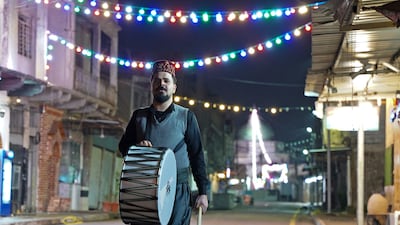
A traditional Iraqi 'musaharati' bangs his drum to wake Muslims for their suhoor meal during Ramadan, near Al Nuri mosque in Mosul's old city. AFP -

A drummer walks along a street in Enfidha, Tunisia, to wake Muslims for their predawn meals. Reuters -

A Ramadan drummer makes his way through the town of Cukurkoy, Turkey. Reuters -
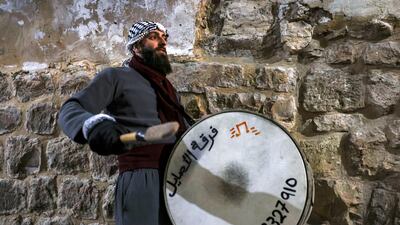
A member of a troupe of young Palestinian drummers walks through the streets in the old city of Hebron in the occupied West Bank. AFP -
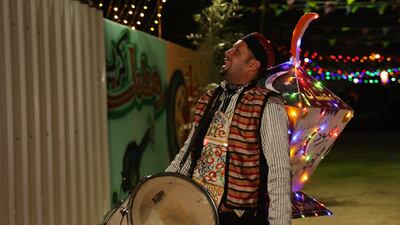
A Palestinian drummer walks through the streets of Rafah in the southern Gaza Strip on the first night of Ramadan. AFP -
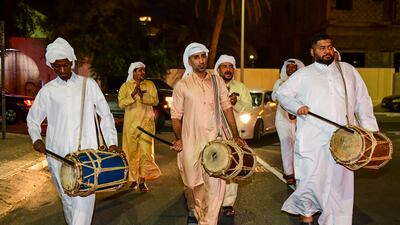
Qatari men play drums and sing traditional songs to awaken people for suhoor in Doha. Getty


The remote mountain area, located to the south-west of the city, is far from industrial pollution and is located between 780 and 930 metres above sea level, and was selected by a team of astronomers.
The holy month begins almost two weeks earlier each year and, for half the world, it will move away from the longer, hotter days of summer towards the shorter, cooler winter.
The Muslim world typically looks to Saudi Arabia to decide the days on which major religious events fall, including the start of Ramadan and Eid Al Fitr, which marks the end of the holy month.
However, each country is required to independently verify these dates, usually through a committee of astronomers, court officials and advisers from Islamic authorities.
The Ministry of Endowments and Islamic Affairs (Awqaf) in Qatar also called on its people last year to participate in the sighting of the Moon.
How has science changed Ramadan practices?
Modern science and astronomy changed the way the start of Ramadan is observed.
Telescopes and radio telescopes are used widely to aid moon-sighting and make more accurate predictions.
The Moon might appear in the sky for a short period of time, sometimes visible only for a matter of minutes. Observers are required to be in position during that window in a remote location that is open, free of visual pollution and preferably on high ground.
The International Astronomical Centre in Abu Dhabi set up the Islamic Crescents Observation Project, which is now used as an important reference in the Muslim world. The centre publishes a map illustrating the regions where a crescent moon would be seen with the naked eye, a telescope and places where a moon sighting would be impossible.

Saudi Arabia’s Supreme Court has called on the public on several occasions to report any sightings of the crescent moon with the naked eye.
The methodology for determining the start of Ramadan is updated regularly with religious rulings that take scientific advancements into account.
In 2015, Saudi Arabia announced it made an inaccurate calculation of the beginning of Eid Al Fitr after astronomers said observers were probably looking at Saturn rather than the new moon, causing some Muslims to break their fast a day early.
The Saudi government said it would pay kaffarah, donations to make up for a broken fast, on behalf of the country's residents and citizens.

